
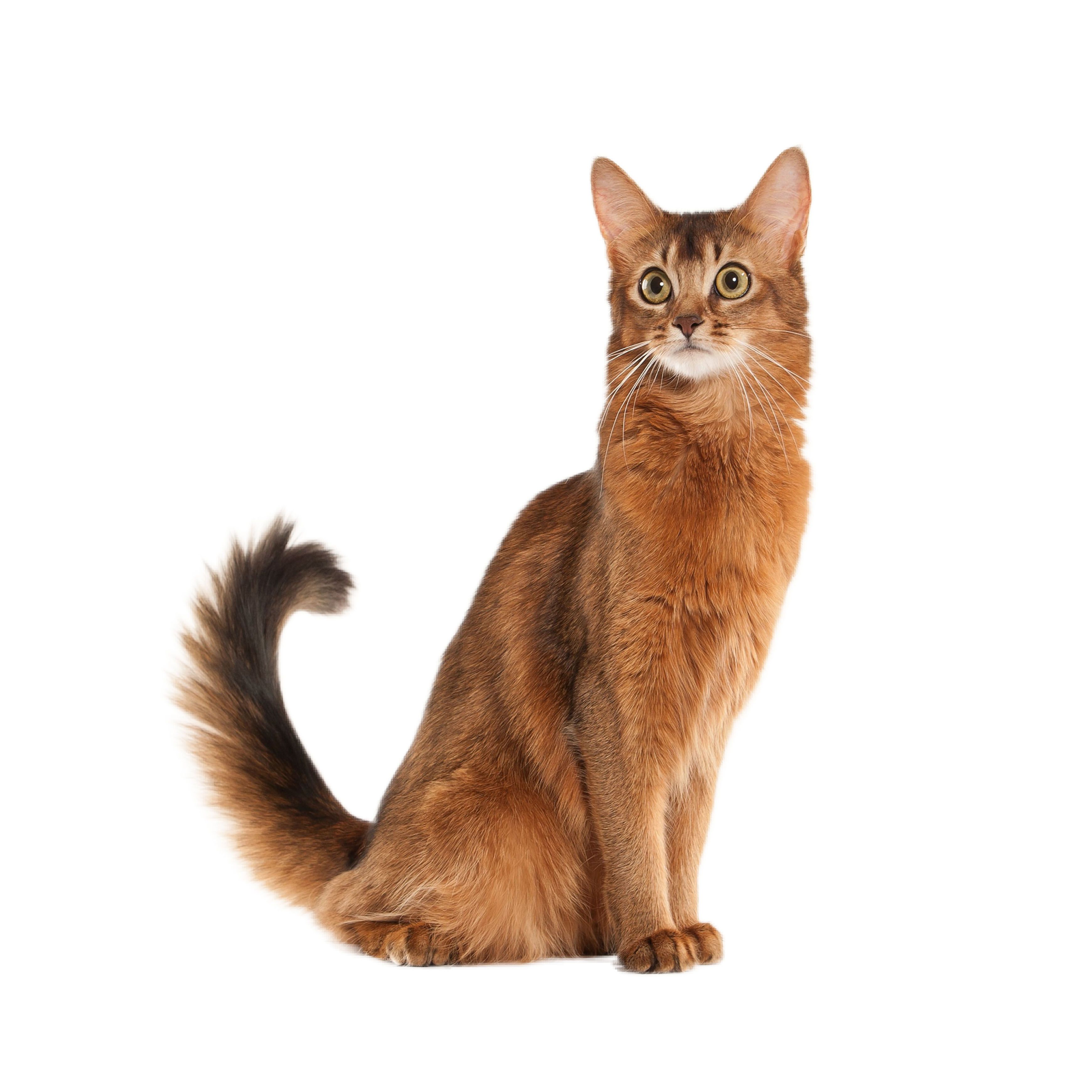
The Somali cat breed is the long-haired Abyssinian, a breed that arose within Abyssinian breeding programs when the recessive gene for long coat, present in the Abyssinian gene pool but typically unexpressed, occasionally produced long-haired kittens in otherwise short-haired litters. For years, these kittens were given away as pets and kept out of sight in breeding programs embarrassed by their appearance.
Eventually, breeders recognized that these long-haired variants were beautiful in their own right, and the Somali was developed as a separate recognized breed.
The Somali's coat transforms the Abyssinian's distinctive ticked agouti pattern, each hair banded with multiple colors, giving the coat a wild, luminous depth, into something dramatically different. Where the Abyssinian coat lies flat and appears as an even, vibrating color field, the Somali's longer coat fans out to reveal the full complexity of each ticked hair in flowing, fox-like waves.
The breed's distinctive appearance, combining a wild-cat ticked pattern with medium-long coat, ruff, breeches, and plumed tail, is one of the most immediately recognizable in the pedigree cat world.
Origin and Recognition
The Abyssinian breed carries a recessive gene for long coat (the l gene) that entered the gene pool at some point in the breed's history, possibly through crosses with Balinese or other semi-longhaired cats during the breed's development in the United Kingdom in the late nineteenth and early twentieth centuries.
The gene is recessive, meaning both parents must carry one copy for a long-haired kitten to appear. This occurs often enough in Abyssinian breeding that long-haired kittens were a recurring feature in many programs.
Canadian breeder Mary Mague and American breeder Evelyn Mague (no relation) were among the pioneers who recognized the potential of these long-haired Abyssinians as a distinct type. The breed was named "Somali" after Somalia, a country adjacent to Abyssinia (modern Ethiopia), reflecting both its African heritage and its Abyssinian origins while distinguishing it with a geographic reference of its own.
CFA began accepting Somalis for registration in 1976 and granted Championship status in 1979. TICA and other international registries also recognize the breed.
The Ticked Coat in Long Form
The Abyssinian's ticked agouti coat pattern, produced by the Ticked Tabby gene (Ta), gives each individual hair multiple bands of color from base to tip. In the short-coated Abyssinian, this creates a fine, shimmering surface texture. In the Somali's longer coat, each ticked hair is displayed in its full length, creating a coat with extraordinary visual depth and a flowing, layered quality.
The four standard Abyssinian/Somali colors appear in the Somali:
| Color | Description |
|---|---|
| Ruddy | Deep brown ticking on warm apricot ground; most common |
| Red (sorrel) | Chocolate brown ticking on red-orange ground |
| Blue | Blue-grey ticking on warm beige ground |
| Fawn | Pale pinkish-beige ticking on pale ground |
In each color, the spine is darker, a line of concentrated ticking runs along the back, while the belly, inner legs, and chest are lighter. The ticking must be clearly visible in show-quality individuals: a minimum of four alternating bands of color on the spine hairs is typically required.
The Somali's coat in this ticked pattern creates the "wild fox" appearance for which the breed is famous. The combination of the ticked coat, the dense tail plume, the full neck ruff, and the longer breeches on the hind legs makes the Somali's grooming profile quite different from the Abyssinian's despite sharing identical genetics except for coat length.
Physical Characteristics
The Somali shares the Abyssinian's medium-sized, athletic body type, a foreign body type that is neither extreme nor cobby, with a fine-boned structure and a lithe, graceful movement style.
| Characteristic | Details |
|---|---|
| Weight | 3.5-5.5 kg |
| Build | Medium, athletic, fine-boned |
| Head | Slightly rounded wedge |
| Eyes | Almond-shaped; amber, hazel, or green |
| Coat | Medium-long; ticked; no woolly undercoat |
| Coat features | Full tail plume, ruff, breeches |
| Lifespan | 11-16 years |
| CFA recognition | 1979 |
The coat is medium-long with a silky texture and minimal woolly undercoat; it does not mat as readily as Persian or Maine Coon coats. The tail is full and plume-like, the neck ruff frames the face attractively, and the breeches, longer hair on the thighs and hindquarters, give the hind legs a distinctive "pants" appearance. All of these features are absent or minimal in the short-coated Abyssinian.
Temperament
The Somali inherits the Abyssinian's famous personality: highly active, intensely curious, playful throughout life, athletic, and engaged with its environment in a way that is described as almost frenetically investigative. These are cats that cannot leave anything unexplored. They move through a room by climbing every accessible surface, investigating every container, and testing every obstacle.
"Abyssinian and Somali cats show some of the highest exploratory activity scores of any domestic cat breed in structured behavioral assessments. Their curiosity appears to be genuinely motivating rather than anxiety-driven, and they show very little habituation to novel objects over repeated exposure." Bradshaw, J., Cat Sense, 2013
The breed is social and affectionate with its own family but may be initially reserved with strangers, in this it resembles the Egyptian Mau more than the gregarious Ragdoll or Birman. Once comfortable, the Somali is interactive, communicative, and entertaining. It is not a lap cat in the traditional sense; it is too active for extended periods of sitting still, but it is affectionate on its own energetic terms.
For jumping capabilities see How High Can Cats Jump. For Abyssinian comparison see Abyssinian. For grooming guidance see How to Groom a Cat at Home. For Somali care guidance see Somali Cat Care Guide.
Health Profile
The Somali shares the Abyssinian's hereditary health concerns, and prospective owners should understand these thoroughly.
Progressive retinal atrophy (rdAc-PRA) is a hereditary form of retinal degeneration caused by an autosomal recessive mutation that causes gradual vision loss progressing to complete blindness. A DNA test is available and responsible breeders should test breeding animals.
Pyruvate kinase (PK) deficiency is a hereditary blood disorder in which defective pyruvate kinase in red blood cells causes hemolytic anemia, the premature destruction of red blood cells. Severity varies from subclinical to significantly life-limiting. A DNA test is available.
Renal amyloidosis, the deposition of amyloid protein in kidney tissue, causing progressive kidney failure, has been reported in Abyssinian and Somali lines, though prevalence estimates vary and the genetic mechanism is not fully characterized.
| Health Concern | Details | DNA Test |
|---|---|---|
| rdAc-PRA (retinal atrophy) | Autosomal recessive; progressive blindness | Available |
| PK deficiency | Hemolytic anemia | Available |
| Renal amyloidosis | Kidney failure; familial pattern | Not fully characterized |
| Dental disease | Progressive with age | Clinical care |
"The rdAc mutation causing progressive retinal atrophy in Abyssinian and Somali cats has been identified and a diagnostic test developed. Breeding from tested-clear animals eliminates the risk of producing affected offspring." Menotti-Raymond, M., et al., Genomics, 2010. https://doi.org/10.1016/j.ygeno.2010.02.003
For Norwegian Forest Cat comparison see Norwegian Forest Cat.
Grooming
The Somali's coat is easier to maintain than it looks. The absence of a woolly undercoat means the coat does not felt or mat readily, and weekly combing with a medium-toothed comb is sufficient for most of the year. The tail plume and the breeches benefit from more frequent attention during shedding season.
The coat responds well to regular grooming and develops a full, flowing appearance when kept in good condition. A damp hand run over the coat can remove fine loose hairs between brushing sessions.
References
- Menotti-Raymond, M., et al. "Widespread retinal degenerative disease mutation (rdAc) discovered among a large number of popular cat breeds." Veterinary Journal, 2010. https://doi.org/10.1016/j.tvjl.2009.01.028
- Bradshaw, J. Cat Sense. Basic Books, 2013. ISBN 978-0465031016.
- Lyons, L.A., et al. "Pyruvate kinase deficiency mutation identification in the domestic cat." Experimental Hematology, 2005. https://doi.org/10.1016/j.exphem.2005.07.005
- Cat Fanciers' Association. "Somali Breed Standard." CFA.org, 2023. https://cfa.org/somali/
- Reiter, A.M. and Gracis, M. "Breed-specific dental considerations in small animal practice." Journal of Veterinary Dentistry, 2018.
Frequently Asked Questions
Is the Somali the same as an Abyssinian?
The Somali is genetically an Abyssinian with two copies of the recessive long-coat gene, producing a medium-long ticked coat instead of the Abyssinian’s short coat. Everything else, the ticked agouti pattern, the body type, the personality, and the health risks, is the same as the Abyssinian. The two breeds share identical genetics except for the single gene locus that controls coat length.
The Somali is recognized as a separate breed by CFA, TICA, and other major registries.
What is rdAc-PRA and do Somali cats carry it?
rdAc-PRA (retinal degenerative change, autosomal recessive progressive retinal atrophy) is a hereditary form of retinal degeneration caused by a recessive mutation. Affected cats gradually lose vision, eventually becoming completely blind. It occurs in Abyssinians and Somalis. A DNA test identifies carriers and affected animals.
Responsible breeders test breeding animals and breed only tested-clear individuals, which eliminates the risk of producing affected kittens.
What does the Somali coat look like?
The Somali coat is medium-long, silky, and ticked, each hair is banded with alternating darker and lighter color bands, a pattern called the agouti ticking that gives the coat an extraordinary luminous depth. The longer coat fans this ticking out into flowing waves, creating the ‘wild fox’ appearance for which the breed is famous. The tail is a full plume, the neck has a decorative ruff, and the hind legs have longer ‘breeches’ of hair.
The coat lacks a dense woolly undercoat and does not mat readily.
How active are Somali cats?
Extremely active. Somalis share the Abyssinian’s legendary energy and curiosity; they are among the most active and investigative domestic cat breeds. They climb, jump, and explore relentlessly, and they need significant play, enrichment, and physical space. A bored Somali in an unstimulating environment will find its own entertainment, which often means knocking things off shelves, opening cabinet doors, and dismantling anything accessible.
Regular interactive play and environmental enrichment are genuine necessities.
What is PK deficiency in Somali cats?
Pyruvate kinase (PK) deficiency is a hereditary blood disorder in which a defective enzyme in red blood cells causes hemolytic anemia, the premature destruction of red blood cells. Severity ranges from mild and subclinical to seriously life-limiting. It is caused by an autosomal recessive mutation and a DNA test is available. Breeding from tested-clear animals prevents the production of affected offspring.
Is the Somali coat hard to groom?
No, despite its impressive appearance. The Somali’s semi-long ticked coat lacks the dense woolly undercoat that makes Persian grooming so labor-intensive. The coat resists matting and requires only weekly combing with a medium-toothed comb during normal periods. The tail plume and breeches need more attention during seasonal shedding. The overall grooming commitment is significantly less than for a Persian or Maine Coon of comparable coat length.