
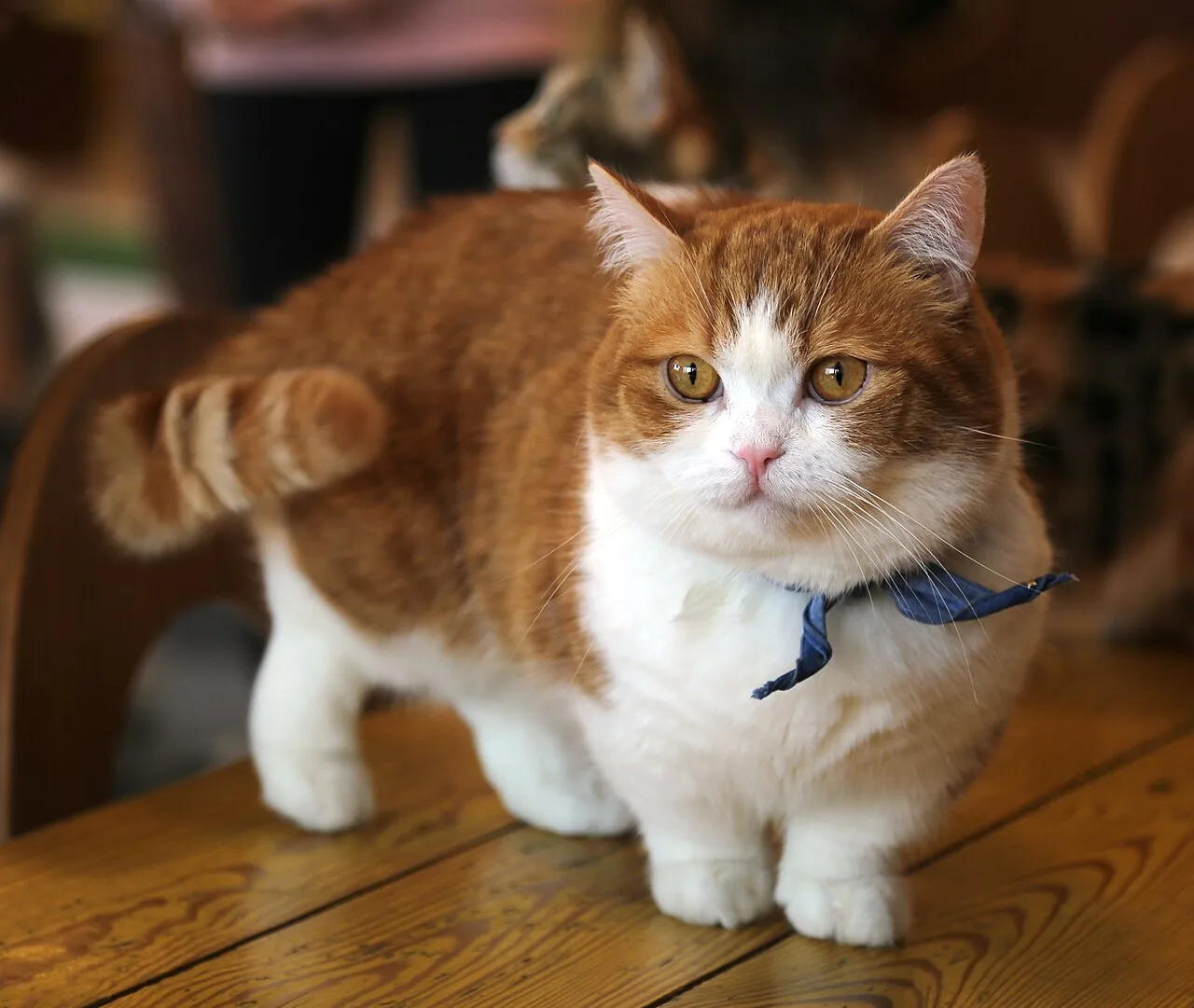
The Munchkin is the feline equivalent of the Dachshund, a cat with dramatically shortened legs caused by a spontaneous genetic mutation, recognized by TICA in 1994 but still not recognized by CFA and still the subject of ongoing ethical debate within the veterinary and cat-breeding communities. The breed's signature short legs result from an autosomal dominant mutation affecting a gene in the UGDH region that causes chondrodysplasia, abnormal cartilage development, in the long bones of the legs.
The controversy around the Munchkin is substantive and not merely aesthetic. The parallel with chondrodystrophic dog breeds, Dachshunds, Basset Hounds, Corgis, is immediately apparent, and these dog breeds are well-documented to suffer elevated rates of intervertebral disc disease (IVDD), spinal compression, and chronic pain associated with their disproportionate body structure.
Whether the same risks apply to the Munchkin is genuinely contested in the scientific literature, with some studies finding no significant spinal pathology and others identifying concerns that warrant monitoring.
Understanding the Munchkin requires engaging with this controversy rather than dismissing it.
Origin and History
The Munchkin mutation has arisen independently multiple times in cat populations throughout the twentieth century. Short-legged cats were documented in England in the 1940s and in various other countries before the deliberate breed development began.
The founding individual of the modern breed is generally identified as a short-legged female named Blackberry, discovered in Louisiana in 1983 by music teacher Sandra Hochenedel under a truck. Hochenedel kept Blackberry, who was pregnant, and when she gave birth, some of the kittens had the same short legs as their mother.
Hochenedel gave one of these kittens, a male named Toulouse, to her friend Kay LaFrance. Toulouse and Blackberry became the founding individuals of the Munchkin breed as it is now known. When Toulouse was allowed to breed freely in the local area, he passed the short-leg trait to some of his offspring, confirming the dominant nature of the mutation.
TICA accepted the Munchkin for registration in 1994, over the objections of several members including at least one judge who resigned from the registry in protest. The breed achieved Championship status in 2003. CFA has declined to recognize the Munchkin, citing concerns about breeding for intentionally disabling physical traits.
The Genetics of Short Legs
The Munchkin's short legs are caused by a dominant mutation, one copy of the gene is sufficient to produce the shortened limbs. However, the homozygous state (two copies of the mutation) is lethal. Embryos that inherit two copies of the Munchkin gene die early in development and are resorbed before birth.
This means that all living Munchkin cats are heterozygous for the mutation, and Munchkin x Munchkin matings produce, on average, two curly-coated kittens for every one expected stillbirth or early fetal death.
This lethal homozygous effect is one of the primary genetic concerns raised by critics of the breed. Breeding programs that knowingly produce some embryo deaths in every litter raise welfare questions that are distinct from the post-birth health of individual cats.
| Genetic State | Copies of Mutation | Outcome |
|---|---|---|
| Non-Munchkin | 0 | Normal leg length |
| Heterozygous Munchkin | 1 | Short legs (breed standard) |
| Homozygous Munchkin | 2 | Lethal in utero |
The specific gene affected is in a region associated with UGDH (UDP-Glucose 6-Dehydrogenase), which is involved in the production of proteoglycans, structural components of cartilage and bone. The mutation reduces the production of these components in long bones, causing them to remain shorter than normal while other bones develop typically.
Physical Characteristics
The Munchkin is a small to medium cat with a normal-sized body and dramatically shortened legs. The forelimbs are most visibly affected, the legs are visibly shorter and the cat sits with its body noticeably closer to the ground than a typical cat. The hindlegs are somewhat longer than the forelimbs, giving some Munchkins a slight "tipped forward" appearance when standing.
| Characteristic | Details |
|---|---|
| Weight | 2.7-4.1 kg |
| Build | Normal body, short legs |
| Coat | Both shorthair and longhair versions |
| Colors | All colors and patterns |
| Leg length | Approximately half the typical leg length |
| Lifespan | 12-15 years |
| TICA recognition | 1994 (championship 2003) |
Despite the shortened legs, the Munchkin's spine and pelvis are proportionally normal. The breed can run, jump, and climb with reasonable competence, though the shortened levers of the limbs naturally reduce absolute jumping height and speed relative to normal-legged cats.
The Spinal Controversy
The central health question for the Munchkin breed is whether the chondrodysplasia that shortens the legs also affects the spine. In chondrodystrophic dog breeds, the same genetic mechanism that shortens the limbs also produces abnormal, calcified intervertebral discs that rupture at elevated rates, causing severe spinal pain and paralysis. IVDD is a leading cause of disability and death in Dachshunds and other chondrodystrophic dog breeds.
The cat spine is structurally and biomechanically different from the dog spine, and early studies of the Munchkin found less evidence of the disc pathology seen in dogs. However, the evidence base is limited, the breed is relatively young, and long-term longitudinal studies with adequate controls are scarce.
"The available evidence does not definitively confirm that Munchkin cats develop intervertebral disc disease at elevated rates compared to non-chondrodystrophic cats, but the evidence base is insufficient to conclude that significant spinal risk is absent. Long-term studies with radiographic follow-up are needed." Biller, D.S., et al., Veterinary Radiology and Ultrasound, 2012
Pectus excavatum, a deformity of the sternum and ribcage, has been reported in some Munchkin lines and is a concern worth noting.
| Health Concern | Status | Management |
|---|---|---|
| Spinal complications | Debated; inconclusive evidence | Monitor; avoid selective jumping pressure |
| Pectus excavatum | Reported in some lines | Veterinary assessment in kittens |
| Obesity | Risk given reduced activity range | Measured meals; weight monitoring |
| HCM | No specific breed predisposition identified | Standard monitoring |
For health detail see Munchkin Cat Health Problems. For care guidance see Munchkin Cat Care Guide.
Temperament
Despite the controversy surrounding the breed, the Munchkin's personality is consistently described as playful, curious, confident, and social. The breed's ground-level perspective does not appear to create behavioral timidity, Munchkins navigate their environment actively and engage with interactive play, puzzle feeders, and human interaction with genuine enthusiasm.
The breed interacts well with children and with other cats and dogs. It is not demanding or particularly vocal. The playful, kitten-like quality persists into adult life, and many Munchkin owners describe their cats as maintaining a sense of fun and exploration beyond the age at which most cats become sedentary.
"Munchkin cats show no behavioral impairment relative to normal-legged cats in structured tests of exploratory behavior, play, and social interaction. Their confidence and activity levels are comparable to mixed-breed domestic cats." Winn Feline Foundation Munchkin Study Summary, 1995
For apartment considerations see Best Cats for Apartments. For health context see Common Cat Illnesses Explained. For a comparison with other unusual-limb breeds see Sphynx Cat.
The Ethical Debate
The Munchkin exists within a broader debate about whether breeding cats (and other animals) for traits that alter their normal body structure in potentially harmful ways is ethically justifiable. Critics argue that the lethal homozygous effect, the potential for spinal problems, and the deliberately engineered physical limitation are incompatible with good breeding practice.
Supporters argue that current evidence does not support significant welfare harm and that the Munchkin's active, happy personality indicates a satisfactory quality of life.
This debate has not been resolved and may not be until longer-term studies with larger populations provide clearer evidence. Prospective Munchkin owners should engage with it honestly rather than dismissing it.
Grooming
Munchkin shorthairs need only weekly brushing. Munchkin longhairs need more frequent combing, particularly in the areas behind the ears and on the hindquarters where tangles form most easily. Neither version has breed-specific grooming challenges beyond what their coat length would normally require.
References
- Biller, D.S., et al. "Spinal lesions in dwarf cats." Veterinary Radiology and Ultrasound, 2012. https://doi.org/10.1111/j.1740-8261.2011.01875.x
- Lyons, L.A. "Feline genetics: Clinical applications and genetic testing." Topics in Companion Animal Medicine, 2010. https://doi.org/10.1053/j.tcam.2010.09.002
- Winn Feline Foundation. "Munchkin Cat Health Study." 1995. https://www.winnfelinefoundation.org/
- The International Cat Association. "Munchkin Breed Standard." TICA.org, 2022.
- Hansen, H.J. "A pathologic-anatomical interpretation of disc degeneration in dogs." Acta Orthopaedica Scandinavica, 1952. https://doi.org/10.3109/17453675208991171
Frequently Asked Questions
Why do Munchkin cats have short legs?
The Munchkin’s short legs are caused by an autosomal dominant mutation in the UGDH gene region that affects the production of structural components in cartilage and bone during development. This causes the long bones of the legs to remain shorter than normal while the rest of the skeleton develops typically. One copy of the mutation is sufficient to produce short legs, but two copies are lethal in embryos, all living Munchkins are heterozygous.
Do Munchkin cats have back problems?
This is genuinely debated. In chondrodystrophic dog breeds like Dachshunds, the same type of mutation causes both shortened limbs and calcified intervertebral discs that rupture at high rates. Some early studies of Munchkin cats found less spinal pathology than in comparable dogs, but the evidence base is limited and long-term studies are scarce.
Current veterinary consensus is that significant spinal risk has not been conclusively confirmed but also cannot be ruled out. Ongoing monitoring of aging Munchkin populations is warranted.
Is the Munchkin cat recognized by all registries?
No. TICA recognized the Munchkin in 1994 and granted Championship status in 2003. The Cat Fanciers’ Association (CFA) does not recognize the Munchkin, citing concerns about breeding for intentionally disabling physical traits. Other registries have varying positions. The breed’s recognition status reflects the ongoing ethical debate about whether deliberately breeding for shortened limbs is consistent with good breeding practice.
Can Munchkin cats jump?
Munchkin cats can jump, but their shortened legs reduce the mechanical advantage available for jumping compared to normal-legged cats. They compensate through alternate routes, use ramps and steps, and navigate their environment actively. Most Munchkins appear untroubled by their limited jumping height in daily life, but they cannot match the vertical reach of normal-legged cats.
High-sided litter boxes and tall cat trees without intermediate steps may need to be adapted.
What is the lethal homozygous effect in Munchkins?
Two copies of the Munchkin mutation cause embryo death early in development. This means that kittens cannot be born with two copies of the gene, all living Munchkins carry exactly one copy. In Munchkin x Munchkin matings, approximately one in four embryos inherits two copies and dies before birth, which critics identify as an inherent ethical problem with the breed’s existence.
Are Munchkin cats good apartment cats?
Yes. The Munchkin’s moderate size, playful temperament, and somewhat reduced jumping ability compared to normal cats make it reasonably well-suited to apartment living. The breed does not require large spaces and is content with interactive play sessions and enrichment activities that do not demand high vertical space.
The main care considerations are appropriate food portions to prevent obesity, which has more negative consequences in cats with reduced leg function.