
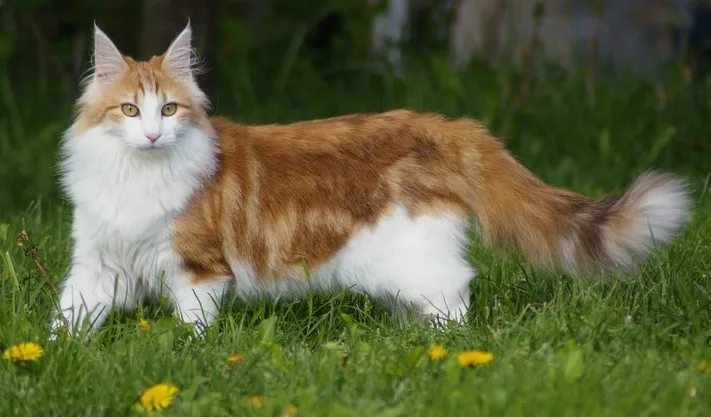
The Norwegian Forest Cat is a natural breed from Norway, shaped over centuries by the demands of Scandinavian winters into one of the most physically formidable domestic cats in the world.
Large, powerfully built, and dressed in a two-layered coat adapted to shed water and retain heat, the Norwegian Forest Cat, known in its homeland as the Norsk Skogkatt, or simply Skogkatt, is a cat with ancient history, genuine outdoor capability, and a temperament that combines friendliness with a striking degree of self-sufficiency.
This guide covers the breed's origins in Norse mythology and history, its physical structure and coat biology, how it compares to the Maine Coon, temperament and behaviour, known genetic health conditions, grooming requirements, and what ownership of this distinctive breed practically involves.
Origins: Mythology, Vikings, and the Forest Cat
The Norwegian Forest Cat's history intersects with Norse mythology in ways that distinguish it from virtually every other domestic cat breed. The Skogkatt appears in Norse mythology as the large, powerful cat associated with the goddess Freya, her chariot was pulled by two cats described as so big and strong that even the mighty god Thor could not lift them.
Mythological descriptions match the Norwegian Forest Cat's general type so closely that historians of Norse culture have long suggested the Skogkatt was the direct inspiration for these accounts.
The breed's documented history is less mythological but equally long. Norwegian farmers and seafarers kept large, hardy cats as working mousers for centuries. Viking longships almost certainly carried cats on voyages to control the rodents that threatened food stores.
The Norwegian Forest Cat's physical adaptation to cold, wet northern conditions, its water-resistant outer coat, muscular build, and exceptional climbing ability, is consistent with centuries of natural selection in a harsh northern environment.
The question of the Norwegian Forest Cat's genetic relationship to the Maine Coon is one of the more interesting puzzles in domestic cat genetics.
The two breeds are strikingly similar in appearance, both large, heavy-boned, with dense layered coats and tufted ears, and the Viking origin theory for the Maine Coon proposes that Norse seafarers brought Skogkatter to North America, where their descendants became the Maine Coon.
Genetic studies have found the Maine Coon and Norwegian Forest Cat to be related at the population level, but whether the relationship is direct descent or parallel evolution under similar climatic pressures is not definitively settled.
The Norwegian Forest Cat was formally standardised and registered in Norway in the 1930s. World War II severely disrupted the breeding program, and the breed was nearly lost to crossbreeding with domestic cats. A formal revival effort began in the 1970s, led by Norwegian cat fanciers who gathered remaining examples of the traditional type and established the standards still used today.
The breed was recognised by FIFe (the European cat registry federation) in 1977 and by TICA in 1994. It remains one of Norway's national symbols and is consistently among the most popular cat breeds in Scandinavia.
Physical Structure: Built for the Mountains
The Norwegian Forest Cat is a large, substantial breed, but its size is characterised by muscular power rather than the dramatic length of the Maine Coon. Males typically weigh between 4.5 and 9 kg; females range from 3.5 to 5.5 kg. The body is long and well-muscled, with a broad chest, a straight topline, and notably powerful hindquarters.
The hindquarters deserve specific attention because they are central to one of the breed's most distinctive capabilities: climbing. The Norwegian Forest Cat's rear legs are proportionally longer and more muscular than the forelegs, creating a slightly upward slope to the back that is visible in profile.
Combined with large, strong paws with well-developed interdigital tufts (providing grip on rough surfaces), this structure makes the Norwegian Forest Cat an exceptionally capable climber, able to descend trees head-first, a feat most cats cannot manage, and to navigate steep rocky surfaces with unusual confidence.
The breed matures slowly, like the Maine Coon. Full adult size is not reached until approximately five years of age. This means a Norwegian Forest Cat purchased at twelve months will continue adding mass and muscle for years.
The head is equilateral triangular in shape when viewed from the front, a key distinguishing feature from the Maine Coon, which has a longer, less symmetrically triangular head. The forehead is flat and the profile is straight from brow to nose tip, with no stop or concavity.
This flat forehead profile is the most reliable single feature for distinguishing Norwegian Forest Cats from Maine Coons in the absence of breed documentation. The eyes are large, almond-shaped, and set at a slight angle. Eye colour can be any colour and is not restricted by coat colour (except that white cats may have blue or odd eyes).
| Measurement | Norwegian Forest Cat (Male) | Norwegian Forest Cat (Female) | Maine Coon (Male) |
|---|---|---|---|
| Adult weight | 4.5-9 kg | 3.5-5.5 kg | 5.9-8.2 kg |
| Head shape | Equilateral triangle | Equilateral triangle | Longer, more rectangular |
| Forehead profile | Flat | Flat | Slightly concave |
| Full maturity | ~5 years | ~5 years | 3-5 years |
| Hind leg length | Longer than forelegs | Longer than forelegs | Roughly equal to forelegs |
| Climbing ability | Exceptional, descends head-first | Exceptional, descends head-first | Very good |
The Double Coat: Structure and Seasonal Change
The Norwegian Forest Cat's coat is its most striking physical feature and the product of centuries of adaptation to cold, wet northern conditions. The coat is structured in two distinct layers that perform different functions.
The inner layer is a thick, woolly undercoat that provides thermal insulation. This layer is substantially denser in winter than in summer, the seasonal change in the Norwegian Forest Cat's coat is more dramatic than in most other long-haired breeds, and a winter-coated Norwegian Forest Cat looks almost like a different animal compared with the same cat in its summer coat.
The ruff, the mane-like collar of longer fur around the chest and neck, is largely absent in summer and fully developed in winter.
The outer layer consists of long, coarse guard hairs that have a natural water-repellent quality due to their surface structure. Rain and snow bead on these hairs rather than penetrating to the undercoat. A Norwegian Forest Cat that has been out in moderate rain will typically shake off moisture and be nearly dry within minutes. This water resistance is a genuine functional adaptation, not merely an aesthetic trait.
The coat texture varies across the body. The flanks, belly, and lower legs carry the longest guard hairs; the back and shoulders have shorter, more protective coverage suited to rain. The tail is fully plumed in winter and somewhat less spectacular in summer. The ears have tufts both at the tips and within the ear canal (lynx tips and ear furnishings, respectively).
"The Norwegian Forest Cat's coat evolved under selection pressures that humans did not engineer. The water resistance, layering, and seasonal modulation represent genuine biological responses to northern climate, and this origin accounts for why the coat functions as well as it does." Clutton-Brock, J., A Natural History of Domesticated Mammals, Natural History Museum / Cambridge University Press, 1999
One practical consequence of the coat's structure is that it sheds significantly during the spring moult. The volume of undercoat released during a Norwegian Forest Cat's spring shed can be striking. Outside of moult periods, however, the coat requires less day-to-day maintenance than its appearance suggests, the guard hair texture resists matting more effectively than the silkier coats of Persians or Ragdolls.
Distinguishing the Norwegian Forest Cat from the Maine Coon
The two breeds are so visually similar that even experienced cat owners sometimes confuse them. A systematic approach using measurable anatomical features is the most reliable method.
Head profile is the single most diagnostic feature. The Norwegian Forest Cat has a flat forehead and a straight nose profile, viewed in profile, the line from the top of the skull to the tip of the nose is straight. The Maine Coon has a slightly concave forehead profile, producing a barely perceptible curve in the same profile view.
Head shape from the front confirms the distinction. The Norwegian Forest Cat's head forms a near-equilateral triangle. The Maine Coon's head is longer and less symmetrical, with a more prominent muzzle and higher cheekbones.
Eye shape differs: the Norwegian Forest Cat has almond-shaped eyes; the Maine Coon's eyes are slightly more oblique and often appear larger in proportion to the face.
Chin differences are subtle but consistent. The Norwegian Forest Cat has a firm, well-defined chin. The Maine Coon has a more square muzzle with a more pronounced chin definition.
Coat texture is genuinely different to the touch despite looking similar in photographs. The Norwegian Forest Cat's guard hairs are coarser and more clearly differentiated from the undercoat. The Maine Coon's coat is silkier overall and the layers blend more.
Both breeds share large size, long body, tufted ears, plumed tail, and tufted paws. Both produce their most dramatic appearance in winter coat. Both are friendly, family-oriented breeds with moderate to good activity levels. See Maine Coon for full detail on the other breed.
Temperament and Behaviour
The Norwegian Forest Cat's temperament reflects its origins as an independent working cat. It is friendly, adaptable, and family-oriented; it does not retreat from household life or require extensive convincing to participate in family activities, but it has a degree of self-directedness and independence that distinguishes it from more people-dependent breeds.
Norwegian Forest Cats typically enjoy human company without requiring constant attention.
They will join household activities, tolerate being held when they initiate contact, and form genuine attachments to their people, but they are also comfortable pursuing their own interests, climbing, exploring, watching outdoor activity from a window, for extended periods without needing interaction.
This independence makes the breed more resilient in households where owners are away for regular portions of the day.
The breed is described as quieter and less demanding than Maine Coons, which is broadly accurate. Norwegian Forest Cats are not silent, but they use their voices infrequently and without the persistence that characterises Siamese or vocal Oriental breeds. Their communication is more often expressed through positioning and physical contact.
Compatibility with other cats, dogs, and children is consistently rated as good. The breed's confidence; it tends to meet novel situations with curiosity rather than fear, and its physical robustness mean that it handles the social complexity of multi-pet or active family households without excessive stress. Early socialisation, as with all breeds, improves outcomes.
The breed's climbing ability and outdoor orientation mean that Norwegian Forest Cats given safe outdoor access (enclosed gardens, supervised access) typically use it enthusiastically. For households keeping the cat fully indoors, vertical enrichment, tall cat trees, wall-mounted shelving at multiple heights, is particularly important for this breed given its natural climbing behaviour.
The question of indoor versus outdoor management for active breeds involves real tradeoffs; Indoor vs Outdoor Cats Which Is Better examines these in detail.
Genetic Health Conditions
The Norwegian Forest Cat has two significant hereditary health conditions that should be part of any responsible breeding program: hypertrophic cardiomyopathy (HCM) and glycogen storage disease type IV (GSD IV).
Hypertrophic Cardiomyopathy (HCM) is the thickening of the heart's left ventricular wall, reducing cardiac function and increasing risk of blood clots and heart failure. HCM is the most common acquired heart disease in cats across all breeds, but the Norwegian Forest Cat, along with the Maine Coon and Ragdoll, is among the breeds with elevated genetic predisposition.
The same MYBPC3 gene mutation identified in Maine Coons (the HCM1 variant) has been found in Norwegian Forest Cats, though population prevalence data in the Norwegian Forest Cat is less well established than in the Maine Coon. Annual echocardiographic screening of breeding animals is the current standard of care in responsible Norwegian Forest Cat breeding programs.
Glycogen Storage Disease Type IV (GSD IV) is a fatal progressive neuromuscular disease specific to the Norwegian Forest Cat. GSD IV is caused by a deficiency in the enzyme glycogen-branching enzyme (GBE), which results in the abnormal accumulation of polyglucosan (an aberrant form of glycogen) in muscle and nerve tissue.
Affected kittens show progressive muscle weakness, neurological deterioration, and die or must be euthanised by five months of age. The disease is autosomal recessive: both parents must carry the mutation for affected offspring to be produced. A DNA test for the GSD IV mutation is commercially available, and responsible breeders test all breeding animals before mating.
Carriers (one copy of the mutation) are clinically normal and can be safely used in breeding programs provided they are not paired with another carrier.
"Glycogen storage disease type IV in Norwegian Forest Cats represents a well-characterised example of an autosomal recessive lethal mutation in a pedigree breed that is entirely preventable through DNA testing of breeding animals. The test is widely available, and its use should be considered a minimum requirement for responsible breeding." Fyfe, J.C., et al., "Glycogen storage disease type IV: inherited deficiency of branching enzyme activity in cats," Pediatric Research, 1992
Hip dysplasia occurs in Norwegian Forest Cats at low frequency and is rarely clinically significant. It can be screened radiographically in breeding animals through the OFA (Orthopedic Foundation for Animals) or equivalent national organisation.
| Health Condition | Type | Severity | DNA Test Available | Action Required |
|---|---|---|---|---|
| HCM (MYBPC3 variant) | Inherited cardiac | Serious; can be life-limiting | Yes | Annual echo; test breeding animals |
| GSD IV | Autosomal recessive lethal | Fatal before 5 months | Yes | Mandatory test of all breeding animals |
| Hip dysplasia | Polygenic | Usually mild; rarely symptomatic | No | Radiographic screen of breeding animals |
For a full discussion of all health conditions affecting the Norwegian Forest Cat and their management, see Norwegian Forest Cat Health Problems.
Lifespan and General Health
With responsible breeding (including mandatory GSD IV testing) and attentive care, Norwegian Forest Cats typically live 14-16 years. The breed's general constitution is robust, the combination of natural selection for cold-climate survival and the absence of extreme conformational traits means the Norwegian Forest Cat does not carry the structural health penalties of brachycephalic breeds or the severe genetic disease load of less carefully managed breeds.
Body weight management is relevant because the breed's large size can conceal gradual obesity. Norwegian Forest Cats maintained at healthy body weight show better cardiac outcomes and reduced joint stress. Measured feeding rather than free-choice access is advisable.
Dental disease follows standard feline patterns. Regular toothbrushing and annual professional dental cleaning under anaesthesia are the most effective preventive interventions.
For longevity comparisons across breeds, see How Long Do Cats Live.
Grooming the Norwegian Forest Cat
The coat's two-layer structure and water-repellent properties mean the Norwegian Forest Cat requires moderate grooming, less than Persians, more than shorthaired breeds.
During most of the year, combing twice per week with a wide-toothed metal comb is sufficient. The priority areas are the belly, the armpits (axillae), and the area behind the ears, where the undercoat is densest and most prone to forming mats when loose hairs are not removed. The coarse guard hairs resist tangling and rarely mat if the undercoat is kept clear.
During the spring moult, when the thick winter undercoat is shed, daily grooming is typically required for two to four weeks. The volume of loose undercoat can be remarkable; a deshedding tool used in the direction of hair growth helps remove bulk without damaging the outer coat.
Bathing is not required routinely but is well tolerated by most Norwegian Forest Cats, the water-repellent coat actually makes thorough wetting more challenging than with other long-haired breeds. Show cats are bathed before exhibitions; pet cats benefit from an occasional bath to remove accumulated oils from the coat.
For detailed grooming guidance, seasonal schedules, and tool recommendations, see Norwegian Forest Cat Grooming Guide.
Living with a Norwegian Forest Cat
The Norwegian Forest Cat is one of the most versatile large cat breeds for varied household types. Its combination of physical robustness, friendly but self-sufficient temperament, and adaptability to indoor life (with appropriate enrichment) or supervised outdoor access makes it genuinely suitable for families, single-person homes, and households with other animals.
The practical commitments are real but manageable. The coat requires consistent twice-weekly grooming that increases to daily during moult periods. The breed's size means veterinary costs are somewhat elevated. The HCM risk requires cardiac monitoring. The GSD IV test should be confirmed before purchase, responsible breeders provide documentation; the absence of documentation should be treated as a warning sign.
For households that want the experience of a large, visually impressive, genuinely interactive cat without the extreme health controversies of some other breeds, the Norwegian Forest Cat represents an excellent choice. It is a breed with genuine substance, physically, historically, and as a companion animal.
References
Fyfe, J.C., et al. (1992). "Glycogen storage disease type IV: inherited deficiency of branching enzyme activity in cats." Pediatric Research, 32(6), 719-725. https://doi.org/10.1203/00006450-199212000-00021
Meurs, K.M., et al. (2005). "A cardiac myosin binding protein C mutation in the Maine Coon cat with familial hypertrophic cardiomyopathy." Human Molecular Genetics, 14(23), 3587-3593. https://doi.org/10.1093/hmg/ddi386
Lipinski, M.J., et al. (2008). "The ascent of cat breeds: genetic evaluations of breeds and worldwide random-bred populations." Genomics, 91(1), 12-21. https://doi.org/10.1016/j.ygeno.2007.10.009
The International Cat Association (TICA). (2023). Norwegian Forest Cat Breed Standard. Retrieved from https://tica.org/breeds/browse-all-breeds
Federation Internationale Feline (FIFe). (2023). Norwegian Forest Cat Breed Standard. Retrieved from https://fifeweb.org
Wastlhuber, J. (1991). "History of domestic cats and cat breeds." In Pedersen, N.C. (Ed.), Feline Husbandry: Diseases and Management in the Multiple-Cat Environment. American Veterinary Publications.
Frequently Asked Questions
How do you tell a Norwegian Forest Cat from a Maine Coon?
The most reliable distinguishing feature is the head profile: the Norwegian Forest Cat has a completely flat forehead and a straight nose profile with no concavity, while the Maine Coon has a slightly concave forehead visible in profile. From the front, the Norwegian Forest Cat’s head forms a near-equilateral triangle, whereas the Maine Coon’s head is longer and more rectangular with higher cheekbones.
Eye shape also differs, almond-shaped in the Norwegian Forest Cat, slightly more oblique in the Maine Coon. Both breeds are large, heavily coated, and tufted, making the distinction subtle without handling.
What is GSD IV in Norwegian Forest Cats?
Glycogen storage disease type IV (GSD IV) is a fatal inherited neuromuscular disease specific to the Norwegian Forest Cat, caused by a deficiency in the glycogen-branching enzyme. Affected kittens develop progressive muscle weakness and neurological deterioration and do not survive past five months. The disease is autosomal recessive, both parents must carry the mutation for affected kittens to be produced.
A DNA test is available and commercially accessible. Responsible breeders test all breeding animals; buyers should request documentation confirming both parents have been tested before purchasing a kitten.
Do Norwegian Forest Cats need a lot of grooming?
Norwegian Forest Cats require moderate grooming, more than shorthaired breeds, less than Persians. Twice-weekly combing with a wide-toothed metal comb is sufficient during most of the year. During the spring moult, when the thick winter undercoat sheds heavily, daily grooming is typically necessary for two to four weeks.
The coarse guard hair texture resists tangling effectively, so the coat requires less intensive maintenance than its visual appearance suggests. The belly, armpits, and area behind the ears are the most mat-prone locations and should receive priority attention.
Are Norwegian Forest Cats good indoor cats?
Norwegian Forest Cats adapt well to indoor living, provided they have adequate vertical space and enrichment. Tall cat trees, wall-mounted shelving, and multi-level perches are particularly important for this breed because climbing is central to its natural behaviour. Without vertical enrichment, indoor Norwegian Forest Cats may show frustration by attempting to climb furniture.
Given safe outdoor access, an enclosed garden or supervised time outside, Norwegian Forest Cats use it enthusiastically. Indoor-only management is feasible and is the safest option in many environments.
How big do Norwegian Forest Cats get?
Adult males typically weigh 4.5-9 kg; females 3.5-5.5 kg. The breed reaches full adult size at approximately five years of age, which is similar to the Maine Coon and considerably slower than the typical domestic cat. A Norwegian Forest Cat at twelve months may appear large but will continue adding mass and muscle for years.
The breed’s large size is characterised by muscular power, particularly in the hindquarters, which support the breed’s exceptional climbing capability.
Do Norwegian Forest Cats appear in Norse mythology?
Yes, the Norsk Skogkatt (forest cat) is the cat associated with the Norse goddess Freya, whose chariot was pulled by two large, powerful cats described in the Prose Edda as too strong for even Thor to lift. The physical descriptions of these mythological cats match the Norwegian Forest Cat closely enough that historians have long proposed the Skogkatt was the direct inspiration.
The breed’s genuine large size, muscular build, and ancient presence in Scandinavian farm and forest environments support this identification, though the mythological connection cannot be verified with certainty.