
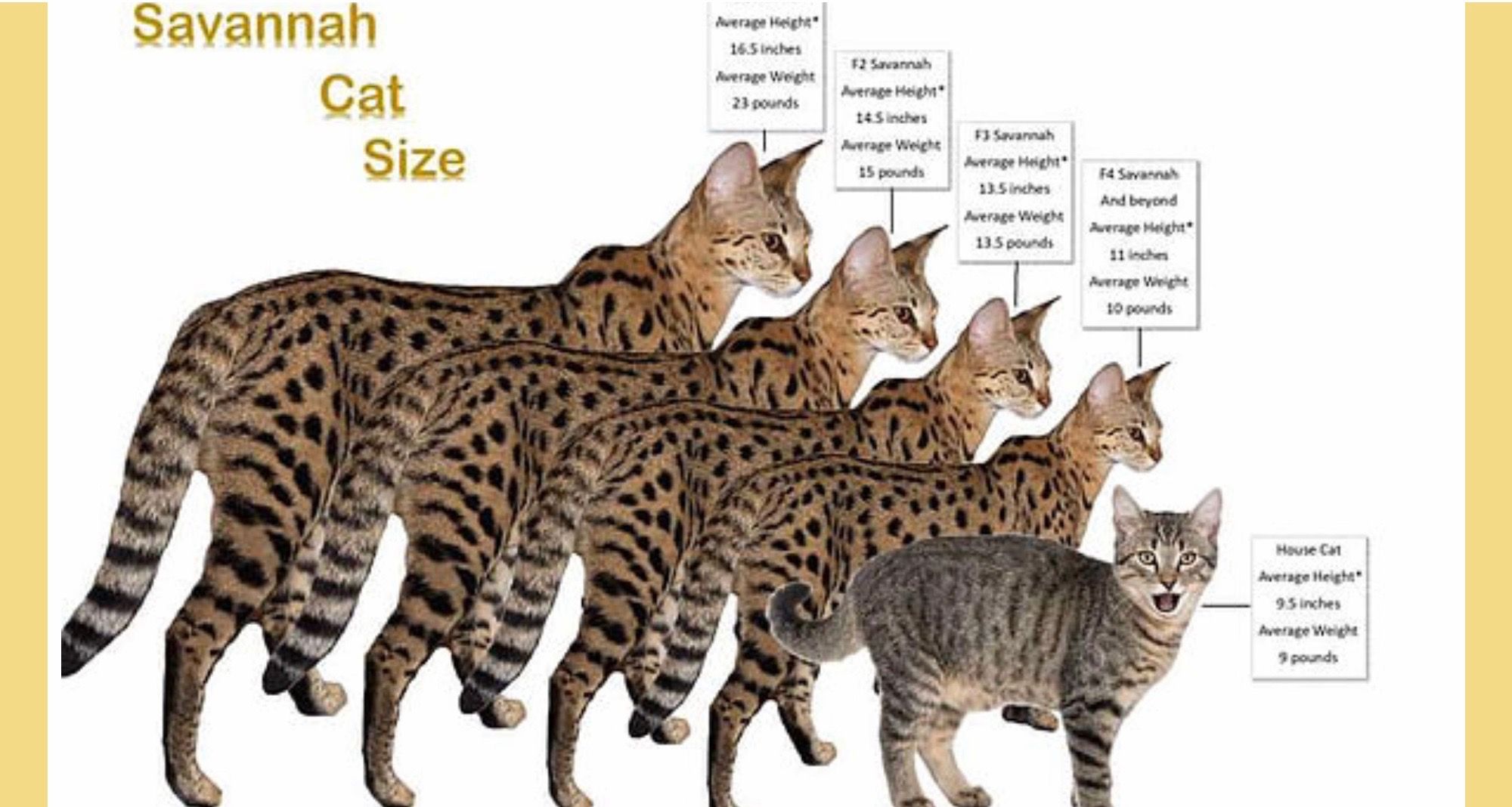
The Savannah cat is the largest domestic cat breed, not by selection for size among domestic breeds, but by direct hybridization with the serval (Leptailurus serval), a medium-sized wild African cat that stands 54 to 66 cm at the shoulder and weighs 9 to 18 kg.
The first Savannah was created in 1986 by Judee Frank, who crossed a male serval with a domestic Siamese female to produce a single female kitten named Savannah. That kitten became the founding individual of a breed that TICA accepted for registration in 2001 and granted championship status in 2012.
The Savannah is simultaneously one of the most impressive and one of the most controversial breeds in the domestic cat world. Impressive because first-generation individuals genuinely retain significant wild-cat characteristics, a size, athleticism, and intensity that differs profoundly from any fully domestic breed.
Controversial because those same wild-cat characteristics raise serious questions about whether F1 and F2 Savannah cats are appropriate as domestic pets, and because the breed's legal status is restricted or prohibited in numerous US states, Canadian provinces, and countries worldwide.
Understanding the Savannah requires understanding that "Savannah cat" describes a spectrum of animals rather than a uniform breed, because the degree of serval influence changes dramatically with each generation.
Origin and the Serval Connection
The serval is a wild felid native to sub-Saharan Africa, particularly common in the tall-grass savannahs of East and Southern Africa. It is a medium-sized cat with very long legs, enormous ears, a spotted coat, and a hunting style based on exceptional hearing and vertical pouncing leaps that can reach 3 meters in height. Servals are legal to own in some US states and are kept by some exotic animal enthusiasts, providing the population from which Savannah breeding draws its serval parents.
The serval is not closely related to the domestic cat, the two species diverged millions of years ago, and their hybridization requires careful management. The large size difference between serval males and domestic females creates obstetric risks in the domestic queen. Serval-domestic crosses frequently result in stillbirths and small litter sizes.
The fertility of male Savannahs is also affected by the wild-domestic hybridization: male F1 and F2 Savannahs are typically infertile, and fertile males do not reliably appear until the F3 or F4 generation.
Patrick Kelly, working with breeder Joyce Sroufe in 1992, began the systematic development of the Savannah as a breed, establishing the foundation program that TICA eventually recognized.
Generation Structure: F1 Through F5+
The filial generation system is crucial to understanding what a "Savannah cat" actually is:
| Generation | Serval Ancestry | Typical Weight | Serval Parent |
|---|---|---|---|
| F1 | 50% serval | 8-11+ kg | Direct serval parent |
| F2 | 25% serval | 7-10 kg | Serval grandparent |
| F3 | 12.5% serval | 6-8 kg | Serval great-grandparent |
| F4 | ~6% serval | 5-7 kg | Great-great-grandparent |
| F5+ | 3% and below | 4-7 kg | More distant |
F1 Savannahs, with a serval parent, are the largest and most wild in behavior and temperament. They retain strong hunting instincts, can be difficult to manage indoors, require specialized enrichment, and are not appropriate for most households. F1 Savannahs are illegal in many jurisdictions because they are classified as wild-domestic hybrids.
F3 and later generations become progressively more domesticated in behavior and legal status. From F5 onwards, the temperament is generally comparable to a very active, large domestic breed.
The size advantage also diminishes with each generation. The extraordinary size of F1 Savannahs (sometimes exceeding 11 kg and standing as tall as a medium-sized dog) is reduced in each subsequent generation. By F5, a Savannah cat may be larger than average domestic cats but is no longer in an entirely different category.
Physical Characteristics
The Savannah's physical appearance is immediately distinctive, tall, lean, long-legged, with a spotted coat, large ears, and a long neck that gives the cat a statuesque bearing unlike any other breed.
| Characteristic | Details |
|---|---|
| Weight | F1: 8-11+ kg; F5+: 4-7 kg |
| Build | Tall, lean, long-legged |
| Ears | Very large, wide-set, rounded at tip |
| Coat | Short, dense, spotted (like serval) |
| Tail | Medium length, black rings and tip |
| Eye color | Any; often golden, green, or brown |
| Lifespan | 12-20 years |
| TICA recognition | Championship 2012 |
The spotted coat is the breed's most visually distinctive feature. The spots are typically dark brown or black on a tan, gold, or silver background, echoing the serval's natural camouflage pattern. The spots are solid rather than rosette-shaped (as in Bengals), and their placement follows the random dispersal seen in wild servals rather than the more regular patterns selected for in Bengal breeding.
The large ears have a characteristic "ocelli" marking on the back, a dark spot with a pale outline resembling eyes, the same anti-predator signaling feature found on the serval's ears.
Temperament and Activity Requirements
The Savannah's temperament is highly variable depending on generation. F1 and F2 individuals retain significant wild-cat characteristics: they may be bonded to one person, aggressive with strangers, extremely active and destructive when under-stimulated, and difficult to manage in a standard domestic environment. These are not cats for typical households.
From F3 onwards, the temperament becomes progressively more domestic, though active, curious, and confident throughout all generations. F4 and F5 Savannahs can be excellent pets for active owners who can provide appropriate enrichment, large spaces, high climbing structures, interactive play sessions, and ideally an enclosed outdoor space.
"Savannah cats at earlier generations require owners with significant experience in exotic cat management. The combination of wild-cat ancestry, high activity requirements, and strong hunting drive creates a pet that genuinely cannot be accommodated in typical domestic settings." The International Cat Association, Savannah Breed Overview, 2021
The breed is known for being fascinated by water, a trait inherited from the serval, which wades readily into streams to hunt. Many Savannahs will play in water bowls, shower with their owners, or seek out any water source in the home. Securing water sources and expecting water-related play are practical preparation for Savannah ownership.
For enrichment guidance see Enrichment Activities for Indoor Cats. For legal and lifestyle considerations see Indoor vs Outdoor Cats Which Is Better.
Legal Status
The legal status of Savannah cats is a critical consideration. The following is a general summary, laws change and local regulations vary:
- F1 and F2 Savannahs are prohibited in Australia, many US states (including Georgia, Hawaii, Nebraska, and others), and some Canadian provinces
- Some jurisdictions require exotic animal permits for all Savannahs regardless of generation
- In the European Union, member state regulations vary; Germany, for example, requires permits for F1-F3
- The UK's Dangerous Wild Animals Act may cover early-generation Savannahs
Prospective Savannah owners must verify their jurisdiction's specific regulations before acquiring any generation of Savannah cat.
Health Profile
| Health Concern | Details | Management |
|---|---|---|
| Hypertrophic cardiomyopathy (HCM) | Reported in domestic-generation cats | Echocardiogram screening |
| Vaccination protocols | Some vets are cautious with modified live vaccines in early generations | Consult a exotic-experienced vet |
| Anesthesia protocols | Wild cat ancestry may affect drug response | Specialized veterinary knowledge needed |
| Intestinal issues | Sensitive digestion in early generations | Diet management |
Early-generation Savannahs require veterinary care from practitioners experienced with exotic felids. Standard domestic cat vaccination protocols may not be appropriate for F1 and F2 individuals, some veterinarians recommend killed-virus vaccines rather than modified live vaccines for early-generation hybrids, though evidence on this is limited.
For health detail see Savannah Cat Health Problems. For care guidance see Savannah Cat Care Guide. For a comparison with another spotted breed see Bengal Cat.
References
- The International Cat Association. "Savannah Breed Standard." TICA.org, 2022. https://tica.org/breeds/savannah
- Sunquist, M. and Sunquist, F. Wild Cats of the World. University of Chicago Press, 2002. ISBN 978-0226779997.
- Driscoll, C.A., et al. "The Near Eastern origin of cat domestication." Science, 2007. https://doi.org/10.1126/science.1139518
- Ottoni, C., et al. "The palaeogenetics of cat dispersal in the ancient world." Nature Ecology and Evolution, 2017. https://doi.org/10.1038/s41559-017-0139
- Little, S.E. (ed.) The Cat: Clinical Medicine and Management. Elsevier Saunders, 2012. ISBN 978-1437706208.
Frequently Asked Questions
What is an F1 Savannah cat?
An F1 Savannah cat has one serval parent and one domestic cat parent, giving it approximately 50% serval ancestry. F1 Savannahs are the largest generation, sometimes exceeding 11 kg, and retain the most wild-cat characteristics, strong hunting instinct, bonding primarily to one person, high activity requirements, and the most challenging temperament for domestic settings.
F1 Savannahs are illegal in many US states, Canadian provinces, and countries due to their wild animal classification.
Are Savannah cats legal to own?
It depends entirely on jurisdiction. F1 and F2 Savannahs are prohibited in Australia, Georgia, Hawaii, Nebraska, and many other US states and several countries. Some jurisdictions require exotic animal permits for any generation. Laws change, and local, state/provincial, and national regulations all apply. Anyone considering a Savannah must verify their specific jurisdiction’s rules before acquisition, violations can result in confiscation of the animal.
How big do Savannah cats get?
The size depends heavily on generation. F1 Savannahs can weigh 8 to 11 kilograms or more and stand tall enough to resemble small dogs in profile. Each subsequent generation is progressively smaller: F3s average 6 to 8 kg, and F5 or later generations typically range from 4 to 7 kg, larger than average domestic cats but not dramatically so. The breed is considered the largest domestic cat breed across its full generation range.
Are Savannah cats good pets?
Later generations (F4, F5, and beyond) can make excellent pets for active, experienced owners who can provide substantial enrichment, space, and engagement. Early generations (F1, F2) are not appropriate for most households; they require expert handling, cannot be left alone for long periods, have strong wild instincts, and may be aggressive or destructive in standard domestic settings. The answer depends strongly on which generation is being considered.
Why do Savannah cats like water?
The serval ancestor of the Savannah cat is a highly capable swimmer and often wades into water to hunt fish and frogs. This behavioral trait has been retained to varying degrees in Savannah cats across all generations. Many Savannahs are fascinated by water, will play in water bowls, follow their owners into the shower, and actively seek water features in the environment. This is a breed characteristic to expect and plan for.
What is the difference between a Savannah and a Bengal?
Both are hybrid cat breeds with wild cat ancestry and spotted coats, but they are distinct breeds with different wild ancestors. The Bengal is a hybrid of the Asian leopard cat (Prionailurus bengalensis) and the domestic cat, developed from the 1960s onward. The Savannah is a hybrid of the serval (Leptailurus serval) and the domestic cat.
Bengals are generally smaller, the hybrid program is more established, and their legal status is less restricted in most jurisdictions. Early-generation Savannahs have significantly more wild-cat influence than comparable-generation Bengals.