
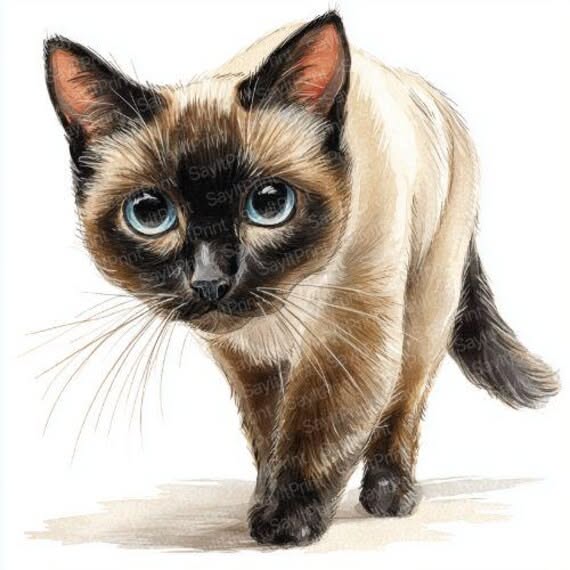
The Siamese is one of the oldest, most recognisable, and most influential cat breeds in the world.
Its pointed coat pattern, dark face, ears, paws, and tail contrasted against a pale body, appears in the earliest known illustrated manuscript about cats, and its striking appearance, combined with an unusually vocal, demanding, and intensely loyal temperament, has made it a defining reference point in the history of domestic cat breeding. Almost every other colourpoint cat breed in existence owes its coat genetics to Siamese ancestry.
This guide covers the Siamese cat's documented history stretching back to medieval Thailand, the genetics of the colourpoint pattern, the significant divergence between modern show-type Siamese and the traditional Thai type, the health conditions affecting the breed and their biological causes, the breed's exceptional lifespan relative to other pedigree cats, and the practical realities of living with a cat known as much for its voice as for its appearance.
Origins: The Cat-Book Poems and the Ayutthaya Kingdom
The Siamese's origins are better documented than those of almost any other domestic cat breed. The primary historical source is a Thai manuscript known as the Tamra Maew, which translates approximately as "The Cat-Book Poems." This illustrated text describes and depicts numerous cat varieties, some of which correspond clearly to cats recognisable as Siamese by their colouration and description.
Scholars estimate that the Tamra Maew was created during the Ayutthaya Kingdom, the Thai polity that existed from 1351 to 1767, though copies of the manuscript that survive today are from the early Rattanakosin period (post-1767). The exact age of the original text remains debated, but its depictions of pointed cats are consistent and detailed, showing cats with dark faces, dark extremities, and pale bodies in a manner that leaves little ambiguity about what breed is being described.
These cats were associated with royalty and temples in Siam (now Thailand), and were reportedly kept in the Grand Palace and given as gifts of considerable honour. Whether the association with royalty was as exclusive as Western accounts sometimes suggest is difficult to verify, but the breed's documented presence in Thailand centuries before its arrival in Europe is unambiguous.
The Siamese arrived in Britain in 1871, when a pair was exhibited at the Crystal Palace cat show in London. The response among Victorian observers was characterised by fascination and unease in roughly equal measure.
One journalist attending the show described the cats as "an unnatural, nightmare kind of cat." The unusual pointed appearance, striking blue eyes, and loud vocalisation set the Siamese immediately apart from anything the British cat fancy had previously encountered. Within two decades, the breed had attracted a dedicated following and was being bred in earnest in both Britain and the United States.
The first Siamese to arrive in the United States was reportedly gifted to Lucy Hayes, wife of President Rutherford B. Hayes, in 1878. By the early twentieth century, Siamese cats were established in North American breeding programs and show circuits.
The Genetics of Colourpoint: Temperature-Sensitive Albinism
The Siamese's distinctive pointed pattern is produced by one of the most elegantly explained mechanisms in feline genetics: temperature-sensitive partial albinism.
The cs allele (sometimes called the Siamese allele) is a variant of the gene encoding tyrosinase, the enzyme responsible for the first step in melanin synthesis. In cats carrying two copies of this allele (cs/cs), the enzyme is thermolabile; it functions normally at the relatively cool temperatures found at the extremities of the body (face, ears, paws, tail) but is denatured and inactive at the warmer core body temperature.
The result is that melanin production is restricted to the coolest body regions. The face, being the most exposed extremity, receives the most melanin and develops the darkest colouration, the characteristic dark mask. The ears, paws, and tail are similarly cool and similarly pigmented. The body, maintained at a higher internal temperature by metabolic heat, produces little or no melanin and remains pale.
This explains why Siamese kittens are born entirely white: inside the uterus, the mother's body heat maintains a uniform temperature across the kitten's entire surface, suppressing melanin production everywhere. As the kitten's body cools post-birth, and as the extremities cool more rapidly than the core, the points gradually develop their characteristic dark pigmentation over the first weeks and months of life.
It also explains an observation that any Siamese owner has likely noticed: a Siamese that lives in a cold environment or that is ill and running a low body temperature will develop darker body colouration, while a Siamese kept in warm conditions or that undergoes surgery with a shaved area (where the skin is cooled by the shaving and ambient air) may develop dark pigmentation in the shaved region as it grows back.
The same cs allele is present in all other colourpoint breeds, Ragdolls, Birmans, Himalayans, Balinese, and more, all of which derive their pointed colouration from Siamese breeding input at some point in their development.
Modern Siamese vs Traditional Siamese (Thai Cat)
The contemporary Siamese exists in two distinct forms that have diverged substantially from a shared ancestry.
The modern show Siamese, the form recognised and bred for championship competition by major registries including the CFA and TICA, is characterised by an extreme, highly elongated morphology. The head is a long, thin wedge shape tapering uniformly from the wide ears to a narrow muzzle, with a completely straight profile from the top of the skull to the tip of the nose.
The ears are very large, wide at the base, and set to continue the lines of the wedge. The body is long, lean, and tubular, with slender limbs and a long, whiplike tail. The eyes are almond-shaped and oriented at an angle that continues the wedge lines of the head.
The traditional Siamese, also known as the Applehead Siamese or the Thai Cat, more closely resembles the cats depicted in the original Thai manuscripts and imported to Europe in the nineteenth century. The head is rounder and more moderate, with fuller cheeks and a shorter muzzle. The body is medium-sized and more typically proportioned. TICA has granted the Thai Cat separate recognition as a breed (distinct from the contemporary Siamese show type), acknowledging the morphological divergence.
The split between these types developed gradually over the twentieth century as show breeders selected increasingly extreme features in response to judging preferences that rewarded elongated, angular forms. Many Siamese enthusiasts and some veterinary commentators have raised health concerns about the most extreme show morphology, including respiratory issues associated with the elongated skull structure and elevated rates of progressive retinal atrophy in show lines.
Temperament: Vocal, Social, and Intensely Loyal
No breed description of the Siamese is complete without acknowledging the voice. The Siamese is the most vocal of all established cat breeds, producing a range of calls that are louder, more varied, and, many owners report, more expressive than those of any other cat. The primary vocalisation is a loud, insistent call frequently described as resembling the cry of a human infant in timbre and volume.
This is not an exaggeration: the Siamese's call has the same fundamental frequency range as a baby's cry, which may partly explain why humans find it so difficult to ignore.
The breed vocalises constantly. It comments on its environment, demands attention, protests being left alone, announces hunger, and engages in extended conversations with its owners. Owners who find this quality endearing describe it as communicative and highly interactive. Owners who find it wearing report that a Siamese in full vocal expression is one of the more demanding presences a domestic cat can create.
Beyond vocalisation, the Siamese is intensely social and bonds deeply, often with a primary person in the household to whom it directs the majority of its attention and loyalty. This bond produces great warmth when the person is present and genuine distress when they are absent.
Separation anxiety at clinically meaningful levels is documented in the breed, and Siamese cats left alone for extended periods regularly develop stress-related behaviours including excessive grooming, reduced appetite, and increased vocalisation on the owner's return.
The Siamese thrives with companionship, another cat, a dog, or consistent human presence. For households where people are absent for extended workdays, a companion animal reduces the Siamese's isolation stress substantially.
Siamese cats are intelligent, curious, and easily bored. They require environmental enrichment, puzzle feeders, interactive toys, vertical space, and regular play sessions, to remain behaviorally healthy. A bored Siamese redirects its energy toward vocalisation, destructive behaviour, or persistent pestering of household members.
For breed comparisons relevant to choosing a social cat, see Do Cats Recognize Their Owners.
Coat Colours and Point Variations
In their original form and in the traditional registry standards, Siamese were recognised in four point colours: seal (very dark brown, nearly black), blue (cool slate grey), chocolate (lighter warm brown), and lilac (pale pinkish-grey, a dilute of chocolate). These four colours remain the accepted Siamese colours in the CFA standard.
TICA and some other registries recognise additional point colours in the Siamese or in closely related breeds (sometimes called Colourpoint Shorthairs in the CFA system, which treats them as a separate breed): red, cream, and various tortie and lynx (tabby-striped) variations.
The body colour in all Siamese is a pale version influenced by the point colour. Seal point Siamese have warm fawn bodies; blue points have cold off-white bodies; chocolate points have ivory bodies; lilac points have glacial white bodies with a slight pinkish tinge.
Health Conditions
The Siamese has a well-documented health profile shaped by its genetics and its long history as an inbred, closed registry breed. For a comprehensive review of all conditions and their management, see Siamese Cat Health Problems.
Progressive Retinal Atrophy (PRA) occurs in some Siamese lines and causes gradual degeneration of the retinal photoreceptors, leading to night blindness first and eventual total blindness. PRA in cats, as in dogs, is a hereditary condition with multiple genetic causes.
Siamese lines affected by PRA show the condition emerging in affected cats between one and five years of age, progressing over months to years. DNA tests exist for some PRA mutations in cats; affected lines can be identified and removed from breeding programs.
Convergent Strabismus and Nystagmus are neurological and ophthalmological conditions historically common in the Siamese and directly related to the same cs allele that produces the colourpoint coat.
The cs allele affects the routing of nerve fibres from the retina to the visual cortex: in normal cats, approximately half of the retinal nerve fibres from each eye cross to the opposite side of the brain, allowing binocular depth perception.
In Siamese cats, this routing is abnormal, a larger proportion of fibres cross, reducing binocular overlap and causing the convergent strabismus (crossed eyes) and nystagmus (involuntary rhythmic eye movement) that were once nearly universal in the breed.
Modern breeding selection has reduced the prevalence of visible strabismus and nystagmus in show lines, but the underlying neural routing abnormality persists in the genome of all colourpoint cats.
"The Siamese cat's visual pathway abnormality, in which retinogeniculate projections are more extensively crossed than in non-Siamese cats, is among the best-characterised neural development variations in any domestic animal species. It arises as a direct consequence of the tyrosinase mutation and cannot be eliminated without eliminating the colourpoint pattern itself." Guillery, R.W. & Kaas, J.H. (1971), Journal of Comparative Neurology, on Siamese visual pathways
Dilated Cardiomyopathy (DCM) has been documented in Siamese cats at elevated rates compared with the general cat population. DCM is the opposite of hypertrophic cardiomyopathy: rather than the ventricle wall thickening, in DCM the wall thins and the chamber dilates, reducing the heart's ability to contract effectively. Siamese DCM has been associated in some cases with taurine deficiency, and diet-responsive cases are documented. Other cases appear genetic in origin.
Hepatic Amyloidosis is a condition in which abnormal amyloid protein deposits accumulate in the liver, disrupting normal function and potentially leading to liver failure. It occurs at elevated rates in Siamese and Abyssinian cats compared with the general feline population. Clinical signs include weight loss, vomiting, and eventually jaundice and hepatic failure. There is no genetic test available; management is supportive.
| Health Condition | Mechanism | Genetic Test Available | Notes |
|---|---|---|---|
| Progressive Retinal Atrophy | Retinal photoreceptor degeneration | Partial (some mutations) | Breeding selection effective at reducing incidence |
| Convergent strabismus / nystagmus | Abnormal retinogeniculate routing from cs allele | No (linked to breed genetics) | Reduced in modern show lines but structurally persistent |
| Dilated cardiomyopathy | Thinning of ventricular wall | No | Screen for taurine status; cardiac monitoring recommended |
| Hepatic amyloidosis | Amyloid protein liver deposits | No | Supportive management only |
"Siamese cats are overrepresented in cases of hepatic amyloidosis at veterinary referral centres. The condition carries a guarded to poor prognosis once clinical signs are apparent, and early detection through routine chemistry panels in senior Siamese cats provides the best opportunity for supportive management." Godfrey, D.R., et al. (2002), Journal of Feline Medicine and Surgery, on amyloidosis in Siamese cats
Lifespan: One of the Longest-Lived Breeds
The Siamese is notable for an exceptionally long lifespan relative to most pedigree cat breeds. Well-cared-for Siamese regularly live 15 to 20 years, and individuals living beyond 20 years are documented. This longevity is particularly striking given the breed's known health issues, and likely reflects a combination of the breed's historically robust genetic constitution and its moderate body size and structure (in the traditional type at least).
Several large-scale studies of pedigree cat longevity have ranked the Siamese among the longest-lived breeds, in contrast to flat-faced breeds (Persians, Exotics) that tend to have shorter lifespans and brachycephalic health complications. The modern extreme show type may not share this longevity advantage to the same degree, as the selection for extreme morphology introduces potential health stressors not present in the traditional body form.
For a comprehensive lifespan comparison across breeds, see How Long Do Cats Live.
Grooming and Physical Care
The Siamese coat is short, fine, and lies close to the body with minimal undercoat. It is one of the lowest-maintenance coats of any cat breed. Weekly brushing with a fine-toothed comb or soft bristle brush is sufficient to remove dead hair and maintain coat condition. The Siamese does not shed heavily relative to longhaired breeds, and regular brushing prevents whatever shedding occurs from accumulating in upholstery and clothing.
Bathing is rarely necessary for coat maintenance, though Siamese generally tolerate it well when required. More important for this breed is ear monitoring: the large, wide-set ears accumulate debris more readily than smaller ear structures, and weekly inspection and cleaning with a veterinarian-approved ear cleaner prevents wax buildup and early ear infections.
Dental care is important in the Siamese, as it is in all cats. Dental disease is the most common chronic health condition in domestic cats, and the Siamese is not exempt. Regular toothbrushing with feline-formulated toothpaste, supplemented by annual veterinary dental examinations, provides the best protection.
For detailed care guidance, see Siamese Cat Care Guide.
The Siamese as a Foundation Breed
No other domestic cat breed has had a greater influence on the development of new breeds than the Siamese. The colourpoint gene, carried and transmitted by Siamese, has been introduced into virtually every breed that displays pointed colouration. Specific breeds created through deliberate Siamese crosses include:
The Balinese, which is a longhaired Siamese, the result of a spontaneous longhair mutation within Siamese breeding lines, selectively maintained as a separate breed.
The Himalayan (or Colourpoint Persian), created by introducing the Siamese colourpoint gene into Persian lines through deliberate outcrossing programs in the 1950s and 1960s.
The Birman, the Ragdoll, and the Snowshoe all carry colourpoint genetics attributable to Siamese ancestry in their breed development.
The Oriental Shorthair is a non-pointed Siamese variant in which the colourpoint gene has been removed by introducing the full-colour allele (C), producing cats with the same body type and temperament in solid, tabby, tortie, and bicolour patterns without the pointed restriction.
For comparison with a breed that shares similar intense social bonding, see Ragdoll. For the Maine Coon, which offers comparable interaction with less vocal demand, the contrast in daily experience is notable.
Living with a Siamese
The Siamese is not a passive companion. Owners who thrive with Siamese cats are those who appreciate, or at least tolerate, constant vocal and physical engagement, who find the one-person intensity of the bond rewarding rather than claustrophobic, and who can provide the social stimulation the breed requires.
The cat's long lifespan means a commitment of potentially two decades. That is a long time to share a home with an animal that will express its opinions loudly and at any hour. It is equally a long time to have a companion of unusual intelligence and attachment. The Siamese experience is one of the more polarising in the cat world: people who want one want nothing else; people who find the vocalisation and dependency excessive are unlikely to be converted.
For owners considering the breed's suitability for their specific lifestyle and household, Siamese Cat Care Guide provides a practical framework for assessment and preparation.
References
Guillery, R.W., & Kaas, J.H. (1971). "A study of normal and congenitally abnormal retinogeniculate projections in cats." Journal of Comparative Neurology, 143(1), 73-100. https://doi.org/10.1002/cne.901430106
Lyons, L.A. (2012). "Genetic testing in domestic cats." Molecular and Cellular Probes, 26(6), 224-230. https://doi.org/10.1016/j.mcp.2012.04.004
Godfrey, D.R., Day, M.J., & Barber, P.J. (2002). "Generalised amyloidosis and hyperthyroidism in a cat." Journal of Small Animal Practice, 39(10), 514-518. https://doi.org/10.1111/j.1748-5827.1998.tb03684.x
Lipinski, M.J., et al. (2008). "The ascent of cat breeds: Genetic evaluations of breeds and worldwide random-bred populations." Genomics, 91(1), 12-21. https://doi.org/10.1016/j.ygeno.2007.10.009
Cat Fanciers' Association (CFA). (2023). Siamese Breed Standard and Profile. Retrieved from https://cfa.org/siamese/
Robinson, R. (1959). "Genetics of the domestic cat." Bibliographia Genetica, 18, 273-362.
Pontier, D., et al. (1995). "Inbreeding depression in domestic cats." Journal of Heredity, 86(3), 183-188. https://doi.org/10.1093/oxfordjournals.jhered.a111556
Frequently Asked Questions
Why are Siamese cats so vocal?
The Siamese has been selectively bred for centuries for intense social engagement, and vocalisation is the breed’s primary communication tool. Their calls are unusually loud and insistent compared with most other cat breeds, with a timbre that overlaps with the frequency range of human infant cries. This may be why the sound is so difficult for humans to ignore.
The breed uses vocalisation to communicate hunger, loneliness, boredom, greeting, and general commentary. Owners describe it as conversational; the breed expects, and receives, responses.
Why do Siamese cats have blue eyes?
All Siamese cats have blue eyes as a direct consequence of the cs (colourpoint) allele that controls their coat pattern. The same tyrosinase enzyme mutation that restricts melanin to the cooler extremities also reduces melanin in the iris, leaving the eyes without the pigment that would produce green, gold, or copper colouration. The Siamese eye appears blue for the same reason the sky appears blue: light scattering in a structure with low melanin content.
Deeper, more vivid blue is preferred in show standards.
What is the difference between a modern Siamese and a traditional Siamese?
The modern show Siamese has an extremely long, triangular wedge-shaped head, very large ears, a lean tubular body, and an angular profile. This form was developed through twentieth-century show breeding selecting for increasingly extreme features.
The traditional Siamese (Applehead or Thai Cat) has a rounder head with fuller cheeks, a more moderate body, and more closely resembles the cats depicted in the original Thai manuscripts and imported to Europe in the 1870s. TICA now recognises the Thai Cat as a separate breed from the show Siamese. Most veterinarians consider the traditional type healthier in terms of structural conformation.
How long do Siamese cats live?
Siamese cats have one of the longest lifespans of any pedigree cat breed, regularly living 15 to 20 years with appropriate care. Individuals living beyond 20 years are documented. This longevity is associated with the breed’s moderate body size and structurally sound (traditional type) conformation.
Regular veterinary care including cardiac screening, dental care, and monitoring for breed-specific conditions such as progressive retinal atrophy and hepatic amyloidosis supports reaching the upper end of the lifespan range.
Do Siamese cats suffer from separation anxiety?
Yes, Siamese cats are among the breeds most prone to separation anxiety. The breed bonds intensely, often forming a primary attachment to one household member, and experiences genuine distress when left alone for extended periods. Behavioural signs include excessive vocalisation, reduced appetite, overgrooming, and altered behaviour on the owner’s return.
Providing a companion animal, another cat or a calm dog, significantly reduces isolation stress in Siamese cats left alone during working hours.