
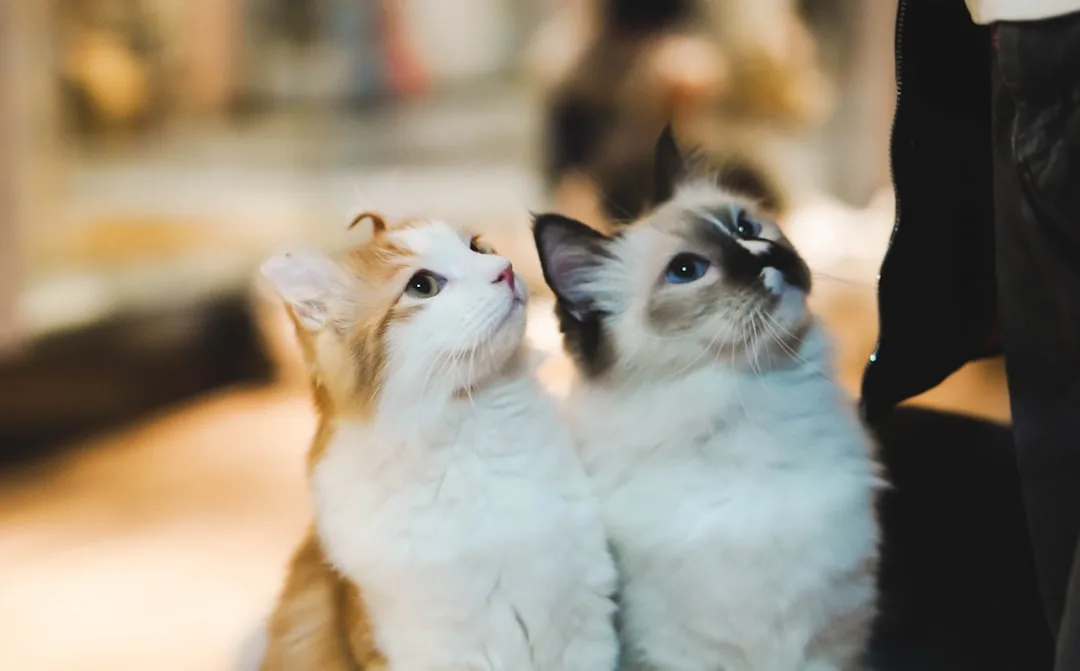
Cats communicate through an unusually rich and multi-channel system that includes vocalisation, body posture and movement, facial expression, scent marking, and tactile behaviour. Remarkably, most of this system is directed at other species, particularly humans, rather than at other cats.
Adult cats rarely meow at each other in nature; the majority of the vocalisations that domestic cats produce were developed and refined specifically for communication with humans. Understanding the full range of feline communication signals allows owners to read their cat's emotional state accurately and respond appropriately.
Vocal Communication: The Wide Range of Cat Sounds
Researchers studying cat vocalisation have catalogued between 16 and 21 distinct sound types produced by domestic cats, depending on how finely calls are categorised.
Nicholas Nicastro and Michael Owren, in their 2003 study published in the Journal of Comparative Psychology, analysed recordings of cat calls and found that humans with no cat ownership experience were able to judge the urgency and valence (positive vs. negative) of cat meows with above-chance accuracy, suggesting cats have evolved calls that exploit human perceptual sensitivity.
Meowing
Meowing is almost exclusively directed at humans in adult cats. Kittens meow to their mothers when distressed or hungry, and this maternal context appears to have been extended by domestication to include the human caregiver as a substitute attachment figure. Adult cats communicating with other adult cats do not meow.
The meow is not a single sound but a large family of vocalisations varying in pitch, duration, intensity, and harmonic structure. Karen McComb's research at the University of Sussex demonstrated that cats modulate their meows to embed different types of information, including the urgency of a request and the nature of the need (food vs. attention vs. distress), and that experienced cat owners are better than non-owners at distinguishing these types.
Chirping and Chattering
Chattering is the rapid jaw-clicking sound cats produce when watching birds or insects through a window. The mechanism involves rapid, tense jaw movements that some researchers have interpreted as suppressed frustration (the cat cannot reach the prey) and others as a rehearsal of the kill bite.
A 2010 study by Fabio Machado, a wildlife researcher in Brazil, described observations of domestic cats mimicking the calls of marmoset monkeys, suggesting that chattering in some contexts may function as a predatory lure, an interpretation that remains debated but has attracted serious scientific attention.
Trilling and Chirruping
The trill or chirrup is a short, rising, closed-mouth sound that cats produce as a greeting or attention-soliciting call. Mother cats use it to call kittens to follow them. Adult cats use it toward humans they are comfortable with. It is almost always associated with positive social interactions and is considered one of the clearest signals of a cat in a relaxed, friendly state.
Hissing, Spitting, and Growling
These are unambiguous distress and threat signals that cats produce when frightened, cornered, or actively defensive. Hissing involves forcing air through a partially open mouth with the tongue curved, producing the characteristic sharp sound. It is designed to startle and warn a perceived threat. Growling indicates escalating aggression and imminent defensive action.
Cats that hiss or growl at owners are communicating genuine fear or pain rather than aggression for its own sake. A cat that was previously relaxed and begins hissing or growling, particularly during handling of a specific body area, should be assessed by a veterinarian for possible pain or injury.
Purring
Purring spans communication and physiology. As a communicative signal, it indicates a range of states, contentment, self-soothing under stress, and solicitation. See Why Do Cats Purr? for a detailed examination of the mechanism and contexts of purring.
"The domestic cat has evolved a diverse and context-sensitive vocal repertoire in response to the social environment of humans. The ability of humans to correctly interpret cat vocalisations, even without experience, suggests co-evolutionary refinement of signals on both sides." Nicastro, N. & Owren, M. J., Journal of Comparative Psychology, 2003
Body Language: Reading the Whole Cat
Feline body language is expressed simultaneously through tail position, ear orientation, pupil dilation, whisker position, overall body posture, and the position of the back and fur. Reading individual signals in isolation is unreliable, the full picture provides the accurate read.
Tail Position and Movement
The tail is one of the most legible elements of cat body language.
| Tail Position or Movement | Likely Emotional State |
|---|---|
| Vertical (straight up) | Friendly greeting, confident approach |
| Vertical with curved tip | Friendly but slightly uncertain |
| Held horizontally or slightly lowered | Neutral, relaxed |
| Lowered or tucked between legs | Fear, submission, or pain |
| Puffed up (piloerection) | Extreme fear or aggression |
| Thrashing back and forth rapidly | Agitation, frustration, NOT playfulness |
| Slow, gentle swishing while resting | Mild stimulation, watching something |
| Quivering while upright against a surface | Scent spraying (marking behaviour) |
Ear Position
Forward-facing ears indicate alertness or positive engagement. Ears rotated outward ("satellite dish" position) indicate overstimulation or mild anxiety. Ears flattened sideways or backward ("airplane ears") signal fear, aggression, or severe discomfort. Ears held loosely upright with slight rotation toward sounds indicate relaxed vigilance.
Eye Contact and Pupil Dilation
Slow blinking, a slow, deliberate close-and-open of the eyes, is a well-documented affiliative signal in cats.
Research by Leanne Proops and colleagues at the University of Portsmouth, published in Scientific Reports (2020), demonstrated that cats are more likely to approach a human after the human performs a slow blink and that they increase their own slow blink rate in response to a human's slow blink.
This exchange of slow blinks has been described as a functional equivalent of a smile in feline communication.
Fully dilated pupils indicate either extreme excitement or extreme fear, depending on context. Constricted pupils in bright light are normal; constricted pupils in dim light or during an interaction may indicate pain or a neurological issue.
"Narrowed eyes and slow blinking are affiliative signals used by cats both toward humans and toward familiar conspecifics. The slow blink appears to function as a relaxation signal that communicates non-threatening intent and willingness for social proximity." Proops, L. et al., Scientific Reports, 2020
Whisker Position
Whiskers held forward indicate heightened engagement or threat assessment. Whiskers pulled back flat against the cheeks indicate fear or defensive posturing. Relaxed whiskers pointing slightly outward indicate a neutral or content state.
Scent Communication: The Invisible Language
Cats maintain an extensive chemical communication system that humans cannot directly perceive but that plays a central role in feline social life, territorial behaviour, and sexual signalling.
Facial Marking (Bunting)
When a cat rubs its face against a person, object, or another animal, it is depositing secretions from the sebaceous glands located on the forehead, cheeks, and chin. This facial marking, called bunting, deposits "friendly" pheromones that identify the marked object or individual as familiar, safe, and part of the cat's social environment. A cat that headbutts its owner is performing a bonding and possession signal simultaneously.
Feliway, the synthetic feline facial pheromone product, was developed based on the chemical analysis of these secretions and is used therapeutically to reduce anxiety in cats by replicating the familiar marking signals in stressful environments.
Urine Marking
Urine contains a complex mixture of pheromones conveying identity, sex, and reproductive status. Spraying, the backing-up-against-a-vertical-surface urination posture, deposits scent at nose-height for other cats and is distinct from normal elimination. Both male and female cats spray, but the behaviour is far more common in intact males, and neutering reduces it substantially.
Urine left on the floor or in a litter box does not function as territorial spray in the same way as vertical surface marking.
Paw Scent Glands
The interdigital glands of the paws deposit scent during kneading and scratching. This is why cats scratch at territory boundaries; they are leaving a combined visual and olfactory mark. For detail on the scratching-scent relationship, see Why Do Cats Scratch Things?.
Tactile Communication: Touch and Social Grooming
Allorubbing
Cats that share a social group, whether a multi-cat household or a feral colony, frequently rub their bodies along one another, a behaviour called allorubbing. This serves to create a shared colony scent that identifies group members and to reinforce social bonds. When a cat walks through a human's legs and rubs along their ankles and calves, it is performing allorubbing toward the human.
Allogrooming
Social grooming between familiar cats, grooming the head, ears, and neck of another cat, is a high-confidence affiliative behaviour seen primarily between cats with close social bonds. Some cats extend this behaviour to humans, licking the hair or eyebrows of owners they are bonded with.
Slow Kneading
Kneading, the rhythmic pressing of alternate forepaws against a soft surface, is rooted in the nursing behaviour of kittens stimulating milk letdown. In adult cats it is a comfort and bonding behaviour directed at surfaces and owners that the cat associates with warmth and security. For a full account of kneading, see Why Do Cats Knead?.
How Cats Communicate with Other Cats vs. with Humans
The division is striking and well-documented.
| Communication Channel | Primarily with Other Cats | Primarily with Humans |
|---|---|---|
| Meowing | Kittens to mothers | Adult cats to humans almost exclusively |
| Scent marking (facial) | Yes | Yes (bunting of humans) |
| Urine marking | Yes (territorial) | Rarely directed specifically at humans |
| Slow blinking | Yes (familiar conspecifics) | Yes (toward owners) |
| Allorubbing | Yes | Yes |
| Hissing and growling | Yes (threat) | Yes (fear/pain to owners) |
| Chattering | At prey | N/A |
| Purring | Occasionally | Very frequently toward humans |
| Tail-up greeting | Yes (friendly cats) | Yes (toward familiar humans) |
For further reading on related feline topics, see Why Do Cats Meow?, Why Do Cats Purr?, Why Do Cats Scratch Things?, and How Smart Are Cats?. For insights into the nocturnal dimension of cat behaviour, see Are Cats Nocturnal?.
References
Nicastro, N., & Owren, M. J. (2003). Classification of domestic cat (Felis catus) vocalizations by naive and experienced human listeners. Journal of Comparative Psychology, 117(1), 44-52. https://doi.org/10.1037/0735-7036.117.1.44
McComb, K., Taylor, A. M., Wilson, C., & Charlton, B. D. (2009). The cry embedded within the purr. Current Biology, 19(13), R507-R508. https://doi.org/10.1016/j.cub.2009.05.033
Proops, L., Grounds, K., Smith, A. V., & McComb, K. (2020). Animals remember previous facial expressions that specific humans have exhibited. Scientific Reports, 10, 9786. https://doi.org/10.1038/s41598-020-66426-6
Bradshaw, J. W. S. (2013). Cat Sense: How the New Feline Science Can Make You a Better Friend to Your Pet. Basic Books. ISBN 978-0465031016.
Bradshaw, J. W. S., & Hall, S. L. (1999). Affiliative behaviour of related and unrelated pairs of cats in catteries: A preliminary report. Applied Animal Behaviour Science, 63(3), 251-255. https://doi.org/10.1016/S0168-1591(99)00012-6
Vitale Shreve, K. R., & Udell, M. A. R. (2015). What's inside your cat's head? A review of cat (Felis silvestris catus) cognition research past, present and future. Animal Cognition, 18(6), 1195-1206. https://doi.org/10.1007/s10071-015-0897-6
Pageat, P., & Gaultier, E. (2003). Current research in canine and feline pheromones. Veterinary Clinics of North America: Small Animal Practice, 33(2), 187-211. https://doi.org/10.1016/S0195-5616(02)00128-6
Frequently Asked Questions
How do cats communicate with humans?
Cats communicate with humans primarily through meowing (a behaviour largely unique to the human-cat relationship in adults), body posture, tail position, ear orientation, slow blinking, facial bunting, allorubbing, and purring.
What does it mean when a cat slow blinks at you?
Slow blinking is an affiliative signal that communicates relaxed, non-threatening intent. Research by Proops et al. (2020) confirmed that cats respond to human slow blinks by increasing their own slow blink rate and approaching, suggesting it functions as a mutual social bonding signal.
Why do cats hold their tails straight up?
A vertical tail is a confident friendly greeting signal. Cats raise their tails when approaching humans or other cats they are comfortable with. A curved tip on a vertical tail indicates friendly uncertainty. A puffed-up tail signals extreme fear or aggression.
Why do cats rub their faces on people?
Facial rubbing (bunting) deposits secretions from the sebaceous glands on the forehead, cheeks, and chin. This marks the recipient as familiar and part of the cat’s social environment. It is a bonding and familiarity signal.
Do cats communicate differently with other cats than with people?
Yes. Adult cats rarely meow at other cats, meowing is a behaviour evolved specifically for communication with humans. Cats use scent marking, allorubbing, and body language with both cats and humans, but vocalisation patterns differ substantially.
What does it mean when a cat chatters at birds?
Chattering is a rapid jaw-clicking sound produced when a cat sees prey it cannot reach. It is interpreted as either frustrated predatory impulse or a rehearsal of the kill bite. Some researchers have proposed that in certain species it functions as a prey-luring vocalisation, though this remains debated.