
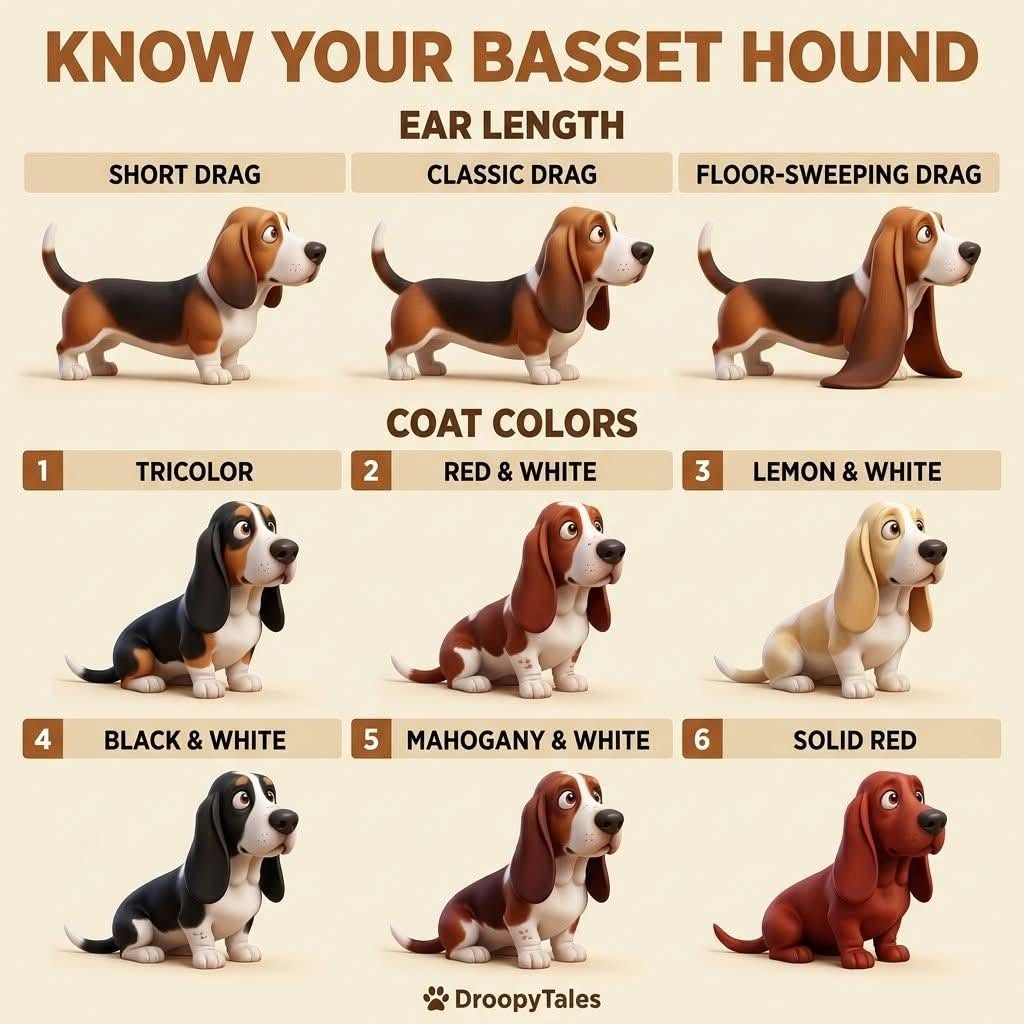
The Basset Hound is one of the most instantly recognisable dogs in the world: long body, impossibly short legs, ears that nearly brush the ground, and an expression of such settled melancholy that it has made the breed an enduring icon of gentle, philosophical canine dignity.
Behind the comic appearance lies a genuinely capable scent hound, ranked second only to the Bloodhound in olfactory ability among domestic dog breeds, with more than 220 million olfactory receptors directing every moment of its waking life toward the compelling world of scent.
The Basset Hound was developed in France and Belgium to trail game slowly and methodically, a pace deliberately suited to hunters on foot rather than on horseback. That original purpose has shaped every aspect of the breed's anatomy, temperament, and health profile, and understanding it is essential to understanding why a Basset Hound behaves the way it does and what it genuinely needs from an owner.
Origins and History
The name Basset comes directly from the French adjective bas, meaning low, a reference to the breed's distinctively low-slung profile. The breed descends from French hunting hounds, particularly those bred by French friars at the Abbaye de Saint-Hubert in the Ardennes region, the same religious community responsible for the ancestry of the Bloodhound.
The earliest written reference to a basset-type dog appears in a 16th-century French hunting text, La Venerie by Jacques du Fouilloux, published in 1561.
French and Belgian breeders developed the Basset specifically as a slow, methodical trailer. Where the taller, faster scent hounds were bred for mounted hunters who could keep pace, the Basset was configured for hunters working on foot, a dog slow enough for a man to walk behind comfortably while tracking hare through dense underbrush.
The breed's short legs, which result from the same chondrodystrophic dwarfism (FGF4 retrogene mutation) documented in the Dachshund, are not a limitation but a functional adaptation to this specific hunting style.
The Basset Hound was brought to England during the 19th century, where further development by English breeders produced the heavier, more wrinkled hound familiar today. The first Basset Hound is recorded in England in 1866. The American Kennel Club recognised the breed in 1885, and the Basset Hound Club of America was founded in 1935.
The breed's gentle, pack-oriented temperament made it an easy transition from working hunting hound to family companion, and it has occupied a consistent position in the AKC's top-40 most popular breeds for decades.
Physical Characteristics
The Basset Hound's body is heavy, dense, and deliberately built for ground-level scent work. Despite standing only 33 to 38 centimetres at the shoulder, adult Bassets weigh 18 to 30 kilograms, a weight distribution that places the breed among the heaviest dogs relative to height. The dense bone structure, massive head, and thick body all contribute to a dog that is genuinely difficult to pick up and carries substantially more physical presence than its short profile suggests.
| Characteristic | Measurement |
|---|---|
| Height (both sexes) | 33-38 cm (13-15 in) at the shoulder |
| Weight | 18-30 kg (40-65 lb) |
| Ear length | Ears extend well past the nose when drawn forward |
| Olfactory receptors | Approximately 220 million |
| Lifespan | 12-13 years |
| AKC Group | Hound |
The ears deserve specific anatomical attention. Basset Hound ears are not merely long for aesthetic effect; they serve a functional scent-trapping purpose. As the dog moves with its nose to the ground, the long ears sweep forward and disturb ground-level scent, funnelling it toward the nose.
The loose, wrinkled facial skin and pendulous dewlap (the fold of skin under the throat) additionally serve to catch and retain scent particles. This is the same functional anatomy found, in even more extreme form, in the Bloodhound, both breeds represent deliberate maximisation of the dog's natural scenting architecture.
The Basset's eyes carry a characteristic ectropion (outward rolling of the lower eyelid) that contributes to the breed's mournful expression. This anatomical feature, along with the prominent third eyelid often visible, is typical for the breed but requires monitoring for associated eye conditions.
Coat colours include any combination typical of hounds: tricolour (black, white, and tan), lemon and white, red and white, and various pied combinations. The coat is short, dense, and weather-resistant.
Temperament
The Basset Hound is a gentle, patient, and sociable dog with a notably even temperament. Bred for pack hunting, the breed is comfortable in multi-dog households and generally non-aggressive. The pack mentality that made Bassets functional hunting companions also makes them social dogs that do not thrive in isolation; they need company, either canine or human.
The defining temperament characteristic, however, is the scent drive. A Basset Hound that catches an interesting scent trail will follow it with the single-minded persistence of a dog whose entire neurological reward system has been calibrated over centuries for exactly this task. Recall, when the nose is engaged, is unreliable in all but the most thoroughly trained Bassets. The breed should be kept on lead or within a secure enclosure whenever off lead in unfenced areas, without exception.
The bay, the Basset's distinctive deep, resonant howl, is another product of its hunting heritage. Pack hounds communicated their progress through dense cover by voice. The Basset Hound's bay is large, melodious, and audible over considerable distances. It is not excessive barking in the conventional sense, but it is a significant sound that carries through walls and will affect neighbours in multi-unit housing.
"Among scent hound breeds, the Basset Hound represents one of the most refined balances between tracking persistence and manageable pace. The breed's olfactory anatomy, the ear structure, the loose skin, the pendulous lips, is a complete functional system engineered for maximising scent collection at ground level." Serpell, J. A. (Ed.). (2017). The Domestic Dog: Its Evolution, Behaviour and Interactions with People (2nd ed.). Cambridge University Press.
Health Conditions
The Basset Hound has a health profile that reflects both its chondrodystrophic anatomy and specific genetic predispositions, and prospective owners should be fully informed before acquiring a Basset.
| Health Condition | Prevalence / Notes |
|---|---|
| Ear infections (otitis externa) | Very common, long ears trap moisture and restrict air circulation; weekly ear cleaning is preventive maintenance |
| Intervertebral disc disease (IVDD) | Chondrodystrophic breed, same FGF4 mutation as Dachshund; significant lifetime risk |
| Hip dysplasia | Approximately 37% prevalence (OFA data), highest among scent hounds |
| Glaucoma | Elevated breed risk, regular eye examinations recommended |
| Obesity | Strong tendency, the breed's slow metabolism and food motivation combine dangerously |
| Patellar luxation | Present in the breed; more common in lighter-boned individuals |
| Thrombopathia | Bleeding disorder, Basset Hound hereditary thrombopathia; DNA test available |
The ear infection problem in Bassets is perhaps the most practically important daily management issue. The long, pendulous ears create an environment of warmth, reduced airflow, and retained moisture, ideal conditions for bacterial and yeast overgrowth. Weekly inspection and cleaning of the ear canals using a veterinarian-recommended ear cleaner is not optional maintenance; it is preventive medicine.
Untreated chronic ear infections cause pain, hearing loss, and ultimately structural damage to the middle and inner ear requiring expensive and invasive treatment.
"The Basset Hound's conformation creates specific predictable health challenges. Ear disease, intervertebral disc disease, and musculoskeletal strain from the disproportionate body-to-leg ratio are not incidental findings; they are the foreseeable consequences of the breed's physical structure and should be central to owner education at point of purchase." British Veterinary Association/Kennel Club Canine Health Schemes. (2022). Breed Health and Conservation Plans: Basset Hound. Retrieved from https://www.bva.co.uk
IVDD in Bassets presents the same risk as in other chondrodystrophic breeds. The mineralised intervertebral discs are vulnerable to herniation under load, and the breed's substantial body weight relative to leg length creates continuous mechanical pressure on the spine. Management strategies are the same as for other affected breeds: ramps instead of jumping, harness use, weight management, and supportive exercise.
Thrombopathia, a platelet function disorder unique to the Basset Hound, is an inherited bleeding disorder in which platelets fail to aggregate normally. Affected dogs bruise easily, bleed excessively from minor wounds, and may bleed seriously from surgical procedures. A DNA test is available, and all breeding Bassets should be tested. Owners should inform their veterinarian of the breed's susceptibility before any surgical procedure.
Coat Care and Grooming
The Basset Hound's short, dense coat requires minimal brushing, weekly grooming with a hound mitt or rubber grooming tool removes dead hair and maintains coat condition. However, the breed sheds moderately throughout the year, with heavier shedding periods in spring and autumn, and the dense hair has a tendency to embed in fabric upholstery and carpet.
The wrinkled facial skin and dewlap require specific attention: food and moisture collect in the folds and can cause skin fold dermatitis (intertrigo) if not cleaned regularly. Wiping the facial folds with a dry cloth after eating prevents accumulation.
Nail trimming is more important in Bassets than in many breeds. The breed's heavy body weight and close-to-ground conformation mean that long nails alter foot mechanics in ways that add stress to the joints and spine. Monthly nail trimming is a minimum standard. See also How to Groom a Dog at Home.
Training
Training a Basset Hound is an exercise in patience, consistency, and managing realistic expectations. The breed is not unintelligent, quite the opposite. But Basset intelligence is fundamentally oriented toward scent processing, environmental investigation, and the independent decision-making of a dog that was bred to follow a trail for hours without human guidance.
The result is a dog that understands what you are asking, considers the request on its own terms, and may decide that the interesting smell near the fence is more compelling than sitting on command.
Positive reinforcement with high-value food rewards is the only consistently effective approach. The Basset's powerful food drive (which contributes to obesity risk) is also its most reliable training lever. Short sessions of 5 to 10 minutes, repeated multiple times daily, produce better outcomes than long training sessions.
Housetraining is typically slower in Bassets than in more bidding breeds. Consistency, a strict schedule, and reinforcement of outdoor elimination without punishment for indoor accidents produces the best long-term result. Bassets that have been punished for indoor accidents do not learn faster; they learn to hide their accidents.
Recall is the most critical training priority for a Basset Hound. A Basset on a scent trail is genuinely difficult to interrupt, and the breed's bay will alert the entire neighbourhood to whatever it is tracking. Recall practice using extremely high-value food in safe, secure environments from puppyhood is essential for any Basset that will be exercised off lead.
Exercise and Activity
The Basset Hound needs regular moderate exercise, approximately 30 to 60 minutes of walking daily, but should not be over-exercised, particularly in the heat. The heavy body, low profile, and thick coat combine to make Bassets vulnerable to overheating. Exercise in hot weather should be kept short and conducted in the early morning or evening.
The combination of the Basset's build, its IVDD risk, and its natural exercise pace means that sustained high-impact activity (jogging on hard surfaces, repeated jumping, rough play with large dogs) is not appropriate. The breed is built for slow, persistent, methodical movement, walking, sniffing, exploring. Structured scent work, nose work competitions, tracking, scent trails laid in a garden, is the most naturally rewarding exercise for a Basset Hound.
"Exercise should serve the dog's physical and mental needs simultaneously. For scent-oriented breeds, the most valuable exercise is the kind that engages the nose as much as the legs, a long, leisurely walk in an environment with varied scents is more genuinely tiring and satisfying for a Basset Hound than the same distance covered at a faster pace in a featureless environment." Coppinger, R., & Coppinger, L. (2001). Dogs: A New Understanding of Canine Origin, Behavior and Evolution. Scribner.
See also How Far Can Dogs Smell for detailed information on canine olfactory capability, and Common Dog Illnesses Explained for recognising signs of ear and spinal problems early.
Feeding
Basset Hounds are strongly prone to obesity. The combination of a relatively slow metabolism, powerful food motivation, a characteristic willingness to eat beyond satiety, and the health consequences of excess weight on a compromised spine makes weight management in Bassets a genuine medical priority rather than a cosmetic preference.
A Basset Hound carrying excess weight is not merely aesthetically non-ideal; it is a dog bearing compounded risk for IVDD herniation, joint strain in the already-stressed hips and elbows, and reduced cardiovascular fitness. Every kilogram of excess body weight on a 25 kg Basset Hound represents proportionally greater spinal loading than the same excess on a normally-proportioned dog.
Daily caloric needs for an adult Basset of 25 kg at moderate activity are approximately 900 to 1100 kcal. This should be fed as two measured meals daily, free feeding (food available at all times) is strongly contraindicated in this breed. Body condition scoring monthly, combined with regular weigh-ins, is the most reliable ongoing weight management tool. See also Bloodhound and Beagle for related scent hound care information.
Basset Hound Suitability
The Basset Hound is an excellent companion for patient, consistent owners who enjoy a slow-paced, good-natured dog and who understand that the breed's independence and scent drive are fundamental characteristics, not behavioural problems to be trained out. The breed is excellent with children and typically tolerant of other dogs.
It is not a dog for highly active owners seeking a jogging or agility partner, nor for owners unwilling to manage the realities of ear cleaning, weight monitoring, and the occasional melodious bay at 11 pm.
For anyone interested in the science of canine scent detection, How Far Can Dogs Smell provides excellent context for appreciating what a Basset Hound experiences every time it steps outdoors. See also Basset Hound Health Problems for a complete condition-by-condition health reference.
References
Parker, H. G., VonHoldt, B. M., Quignon, P., et al. (2009). An expressed Fgf4 retrogene is associated with breed-defining chondrodysplasia in domestic dogs. Science, 325(5943), 995-998. https://doi.org/10.1126/science.1173275
Orthopedic Foundation for Animals. (2023). Breed Health Statistics: Basset Hound. Retrieved from https://ofa.org
British Veterinary Association/Kennel Club. (2022). Breed Health and Conservation Plan: Basset Hound. Retrieved from https://www.bva.co.uk/canine-health-schemes
Slater, M. R., et al. (1992). Risk factors for development of osteoarthritis and other joint diseases in dogs. Journal of the American Veterinary Medical Association, 200(12), 1819-1822.
Dodds, W. J. (1974). Hemorrhagic diathesis in Basset Hounds. Journal of the American Veterinary Medical Association, 165(11), 1021-1025.
Wilkes, M. K., & Palmer, A. C. (1987). Congenital deafness and dysmyelination in the Dalmatian dog. Journal of Small Animal Practice, 28(4), 321-330.
Frequently Asked Questions
Why do Basset Hounds have such long ears?
The Basset Hound’s long ears are not merely decorative; they serve a direct scent-trapping function. As the dog moves with its nose close to the ground, the ears sweep forward, disturbing scent particles and funnelling them toward the nose. The loose, wrinkled facial skin and pendulous dewlap also trap and retain scent.
This complete scent-collection anatomy is why the Basset Hound ranks second only to the Bloodhound in olfactory ability, with approximately 220 million olfactory receptors. The same ears that make the breed such an effective tracker, however, also trap moisture and restrict airflow, making ear infections the most common ongoing health issue in the breed.
How often should I clean my Basset Hound's ears?
Basset Hound ears should be inspected and cleaned at least once a week. The long, pendulous ears create warm, moist, low-airflow conditions that are ideal for bacterial and yeast growth. Weekly cleaning with a veterinarian-recommended ear cleaning solution, applying it to a cotton ball or gauze, never inserting objects into the ear canal, removes accumulated wax and debris before infection can establish.
Signs of an existing infection include head shaking, scratching at the ear, odour, discharge, or redness inside the ear canal. Any of these signs warrant a veterinary visit. Chronic untreated ear infections cause hearing loss and can require expensive surgical intervention.
Are Basset Hounds good family dogs?
Basset Hounds are excellent family dogs for patient, consistent households. The breed is notably gentle, tolerant of children, and comfortable around other dogs due to its pack-hunting heritage.
The key considerations for families are: managing the breed’s strong scent drive (which means secure fencing and on-lead exercise in unfenced areas); being prepared for the breed’s distinctive bay, which is loud and carries through walls; maintaining strict weight management to protect the spine; and committing to weekly ear cleaning as preventive care.
Families willing to manage these specific needs will find the Basset Hound a deeply affectionate, good-natured companion.
Do Basset Hounds have spinal problems like Dachshunds?
Yes. The Basset Hound carries the same FGF4 retrogene mutation that causes chondrodystrophic dwarfism in the Dachshund, and this mutation also predisposes Bassets to intervertebral disc disease (IVDD). The Basset’s heavy body weight relative to its short legs adds significant mechanical stress to the spine.
Prevention strategies include using ramps or steps instead of allowing jumping from furniture and vehicles, using a harness rather than a neck collar, maintaining a lean body weight, and providing core-building exercise such as swimming. Any sudden onset of back pain, reluctance to move, or hindlimb weakness in a Basset Hound should be treated as a veterinary emergency.
What is Basset Hound thrombopathia?
Basset Hound hereditary thrombopathia is an inherited platelet function disorder in which platelets fail to aggregate normally, causing defective blood clotting. Affected dogs bruise easily, bleed excessively from minor cuts or wounds, and are at serious risk of surgical haemorrhage. A DNA test is available and should be performed on all breeding animals.
Owners of Basset Hounds should inform their veterinarian of the breed’s susceptibility before any surgical procedure, even routine operations such as spaying or neutering, so that appropriate precautions can be taken. The condition is autosomal recessive, meaning a dog must inherit two copies of the defective gene to be affected.
How much exercise does a Basset Hound need?
Adult Basset Hounds need approximately 30 to 60 minutes of moderate exercise daily, ideally delivered as two walks. The breed is built for slow, methodical movement, long walks in scent-rich environments are more appropriate and more genuinely satisfying for a Basset than high-intensity exercise. Avoid exercise in hot weather, as the breed’s heavy body, dense coat, and low profile make them vulnerable to overheating.
Structured scent work, nose work games, garden scent trails, tracking, provides excellent mental stimulation that complements physical exercise. Off-lead exercise should only occur in securely fenced areas, as a Basset on an interesting scent trail will not respond reliably to recall.