
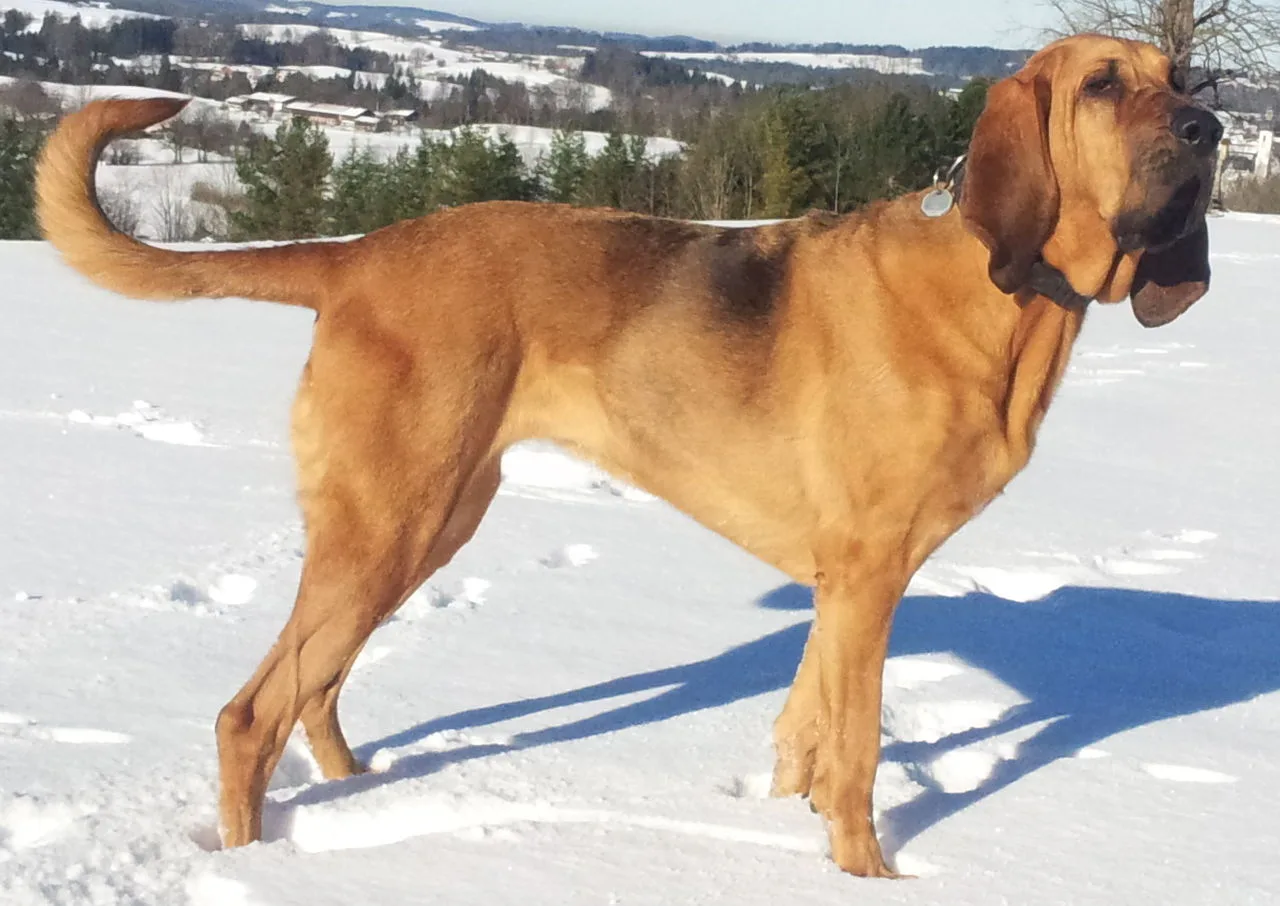
The Bloodhound holds a distinction shared by no other animal on earth: its ability to follow a scent trail is so precise and so well-documented that evidence based on Bloodhound tracking has been accepted in courts of law across the United States as legitimate forensic evidence.
A Bloodhound can track a scent trail that is more than 300 hours old, follow it for over 200 miles, and identify a specific individual's scent from among thousands of others. No technology developed by human engineering has yet replicated this capability with equivalent accuracy in field conditions.
This extraordinary ability is built into every aspect of the Bloodhound's anatomy, the 230 to 300 million olfactory receptors, the enormous pendant ears that sweep scent from the ground upward, the loose, wrinkled skin that traps scent particles, and the long neck and heavy head that keep the nose close to the ground during extended trailing.
The Bloodhound is not merely a dog with a good nose. It is the most specialised and capable scent-tracking organism that selective breeding has ever produced.
Origins and History
The Bloodhound descends from hounds maintained at the monastery of Saint-Hubert in the Ardennes region of Belgium, where the monks selectively bred trailing hounds beginning in the 7th century. These St. Hubert Hounds were regularly sent to the French royal court as gifts, and their descendants were eventually brought to England, where further development produced the dog known today as the Bloodhound.
The name Bloodhound does not refer to any particular ferocity or bloodlust. The term derives from "blooded hound" a hound of pure, documented blood (ancestry), distinguishing carefully bred aristocratic hunting hounds from the crossbred working dogs of the general population. The Bloodhound was historically a hound of nobility, kept and developed by the aristocracy of medieval France and England.
The breed was introduced to the United States in the 19th century, where its tracking ability was quickly recognised and put to practical use. American law enforcement agencies have used Bloodhounds in criminal tracking since the mid-19th century. The documented accuracy of Bloodhound trailing, studies have found accuracy rates exceeding 90 percent in controlled trials, led to its acceptance in American legal proceedings.
The American Kennel Club placed the Bloodhound in its Hound Group, where it has been registered since 1885.
Physical Characteristics
The Bloodhound is the largest of the scent hound breeds. Adult males stand 63 to 69 centimetres at the shoulder and weigh 41 to 50 kilograms. Females are somewhat smaller but remain impressive in scale. This is a powerful, substantial dog.
| Characteristic | Measurement |
|---|---|
| Height (males) | 63-69 cm (25-27 in) |
| Height (females) | 58-64 cm (23-25 in) |
| Weight (males) | 41-50 kg (90-110 lb) |
| Weight (females) | 36-45 kg (80-100 lb) |
| Olfactory receptors | 230-300 million |
| Lifespan | 7-10 years |
| AKC Group | Hound |
Every element of the Bloodhound's head serves the scent-tracking function. The ears are extraordinarily long, when drawn forward, they extend well past the tip of the nose, and they sweep the ground while the dog works a trail, disturbing scent particles and channelling them upward.
The deeply wrinkled skin on the head and face, combined with the pronounced dewlap (the large fold of loose skin under the throat), acts as a scent trap, catching and retaining odour molecules. The large, open nostrils maximise air intake. The long neck allows the heavy head to be carried low without fatigue.
The eyes show prominent ectropion (lower lids rolling outward), which gives the dog its characteristic sorrowful expression and also exposes the inner eyelid (haw) to environmental debris, creating a predisposition to eye irritation and infection.
Coat colours are limited: black and tan, liver and tan, and red (which ranges from tawny to deep mahogany). The coat is short, dense, and hard to the touch.
Temperament
The Bloodhound has a temperament that is simultaneously gentle and exasperatingly single-minded. With its family, the breed is affectionate, patient, and good-natured, particularly tolerant of children. It is not typically aggressive, a Bloodhound is more likely to attempt to lick a stranger to death than to bite one.
The temperament characteristic that defines every aspect of Bloodhound ownership is the inability to be reliably called off a scent. A Bloodhound that has committed to a trail is not ignoring its owner; it is physiologically incapable of prioritising human commands over the neurological imperative of the scent it is following.
Centuries of selection have produced a brain in which the scent-tracking drive is, in practical terms, dominant over all other competing motivations when the dog is actively trailing. This is not a training problem. It is the breed working as designed.
"The Bloodhound's trailing ability is not attributable solely to the number of olfactory receptors, though the 230 to 300 million receptor count is the highest recorded in any domestic dog breed. The precision of trailing also depends on the architecture of the olfactory bulb, the comparative size of which, relative to total brain mass, is many times larger in scent hound breeds than in humans or non-scenting breeds." Tyson, P. (2012). Dogs' Dazzling Sense of Smell. Nova Science Now, PBS. https://www.pbs.org/wgbh/nova/article/dogs-sense-of-smell/
The Bloodhound's voice is one of the most distinctive in the canine world, a deep, resonant bay that carries over considerable distances. The breed uses its voice to communicate the progress of a trail, and in domestic settings this vocal tendency requires management in close-quarter living situations.
Health Conditions
The Bloodhound's health profile presents some significant challenges. The combination of a large, deep-chested conformation, the breed's characteristic loose skin, and specific metabolic predispositions creates a set of health risks that potential owners must carefully consider.
| Health Condition | Prevalence / Notes |
|---|---|
| Gastric dilatation-volvulus (bloat) | High risk, deep-chested large breed; prophylactic gastropexy recommended at spay/neuter |
| Ear infections | Very common, same mechanism as Basset Hound; weekly cleaning essential |
| Hip dysplasia | Approximately 25% prevalence (OFA data) |
| Ectropion | Characteristic breed feature; severity varies; may require surgical correction |
| Skin fold infections | Facial folds require regular cleaning |
| Hypothyroidism | Elevated breed prevalence |
Gastric dilatation-volvulus (GDV or bloat) is the most immediately life-threatening health risk for Bloodhounds. GDV occurs when the stomach fills with gas and rotates on its axis, cutting off blood supply to the stomach wall and spleen. It is uniformly fatal without emergency surgical intervention.
Risk factors in the Bloodhound include: deep, narrow chest conformation; large body size; eating large meals rapidly; exercising immediately after eating; stress; and genetic predisposition.
Prophylactic gastropexy, surgically tacking the stomach to the abdominal wall during elective surgery such as spaying or neutering, virtually eliminates the volvulus component of GDV and is strongly recommended for all Bloodhounds. Owners should also: feed two smaller meals rather than one large meal; use a slow-feeder bowl; avoid exercise for at least an hour before and after feeding.
"Gastric dilatation and volvulus is a genuine emergency requiring surgical intervention within hours of onset. In at-risk breeds such as the Bloodhound, Great Dane, and German Shepherd Dog, prophylactic gastropexy at the time of spaying or castration reduces the lifetime risk of GDV-associated mortality by over 95 percent." Brourman, J. D., et al. (1996). Factors associated with perioperative mortality in dogs with surgically managed gastric dilatation-volvulus: 137 cases. Journal of the American Veterinary Medical Association, 208(11), 1855-1858.
The Bloodhound's relatively short lifespan of 7 to 10 years is partly attributable to its size (large dogs generally have shorter lifespans than small breeds) and partly to the breed-specific health challenges above. This is one of the shortest lifespans among purebred dogs and should be factored into the decision to acquire one.
See also Basset Hound for related scent hound health comparisons, and Exercise Needs by Dog Breed for large working breed exercise guidance.
Tracking Ability and Legal Recognition
The forensic use of Bloodhound trailing evidence deserves specific discussion, as it represents one of the most remarkable documented capabilities in the animal kingdom.
Multiple US state courts have ruled Bloodhound trailing evidence admissible as corroborating evidence in criminal trials. The leading case establishing this principle is State v. Coleman (South Carolina, 1886), and subsequent rulings have been consistent: Bloodhound trailing results, when properly conducted by a qualified handler, are legally meaningful evidence. This is not a legal technicality; it reflects decades of documented accuracy in controlled studies and field conditions.
Studies of Bloodhound tracking accuracy have found:
- Ability to discriminate between identical twins' scent trails in some documented cases
- Successful trailing of scent trails over 300 hours old under favourable conditions
- Documented trailing distances exceeding 200 miles on single tracks
- Accuracy rates exceeding 90 percent in controlled identification trials
The combination of scent receptor density, olfactory bulb architecture, and dedicated trailing behaviour produces an investigative capability that human forensic science cannot yet replicate electronically with equivalent reliability and sensitivity. See How Far Can Dogs Smell for comparative olfactory data across breeds.
Training and Exercise
Training a Bloodhound requires the recognition that the breed's response hierarchy is fundamentally different from that of biddable working breeds. A Bloodhound is not resistant to training; it is quite capable of learning obedience commands, and early socialisation and training produce a substantially more manageable adult dog. The challenge is in reliability once scent engagement occurs.
Basic obedience training from puppyhood is essential. A 50 kg dog that has not been taught to walk on lead without pulling, to sit, and to respond to basic commands is a significant physical management challenge. Bloodhounds pull hard on lead, the breed's physical strength and the intensity of scent-triggered forward motion means that a well-fitted harness and early loose-lead training are not optional.
Exercise needs for the Bloodhound are substantial: 1 to 2 hours of activity daily for a healthy adult. The breed was developed for extended trailing work and has the stamina and drive to sustain physical activity for hours. However, young dogs (under 18 months) should not be over-exercised, as the large skeleton is still developing and repetitive impact on immature joints increases the risk of orthopedic problems.
"For breeds originally selected for extended field work, exercise that engages the specific functional behaviours for which the breed was developed, trailing, searching, task-completion, produces qualitatively better behavioural outcomes than equivalent exercise that does not engage these drives." Lindsay, S. R. (2000). Handbook of Applied Dog Behavior and Training, Vol. 1: Adaptation and Learning. Iowa State University Press.
See also Bloodhound Care Guide for detailed daily management guidance.
Feeding
Bloodhounds require careful feeding management due to their GDV risk and propensity for rapid eating. Two measured meals daily (never one large meal) using a slow-feeder bowl or puzzle feeder are standard. The bowl should be placed at or near floor level, raised feeding bowls, once thought to reduce bloat risk, have not been consistently supported by evidence and some studies suggest elevated risk with raised bowls.
Adult males at 45 kg with moderate activity require approximately 1,600 to 2,000 kcal daily. This should be from a high-quality food appropriate for large breeds. Avoid feeding within an hour of exercise in either direction.
See also Beagle for related scent hound care, and Exercise Needs by Dog Breed.
References
Harvey, C. E., & Flanders, J. A. (1997). Olfactory capabilities of the Bloodhound: forensic implications. Journal of Forensic Sciences, 42(5), 897-902.
Brourman, J. D., Schertel, E. R., Allen, D. A., Birchard, S. J., & DeHoff, W. D. (1996). Factors associated with perioperative mortality in dogs with surgically managed gastric dilatation-volvulus. Journal of the American Veterinary Medical Association, 208(11), 1855-1858.
Orthopedic Foundation for Animals. (2023). Breed Health Statistics: Bloodhound. Retrieved from https://ofa.org
American Kennel Club. (2023). Bloodhound Breed Standard. Retrieved from https://www.akc.org/dog-breeds/bloodhound/
Settle, R. H., Sommerville, B. A., McCormick, J., & Broom, D. M. (1994). Human scent matching using specially trained dogs. Animal Behaviour, 48(6), 1443-1448. https://doi.org/10.1006/anbe.1994.1381
Lit, L., Schweitzer, J. B., & Oberbauer, A. M. (2011). Handler beliefs affect scent detection dog outcomes. Animal Cognition, 14(3), 387-394. https://doi.org/10.1007/s10071-010-0373-2
Frequently Asked Questions
Can Bloodhound tracking really be used as legal evidence?
Yes. Courts in the United States have accepted Bloodhound trailing as admissible corroborating evidence in criminal proceedings since the 19th century. The leading case is State v. Coleman (South Carolina, 1886), and subsequent courts have consistently upheld this principle when trailing was conducted by a qualified handler following proper procedure.
The basis for admissibility is the documented accuracy of Bloodhound trailing, controlled studies have found accuracy rates exceeding 90 percent, and Bloodhounds have successfully tracked specific individuals’ scent trails over distances exceeding 200 miles on trails more than 300 hours old. No electronic scent-detection technology has matched this performance in field conditions.
What is GDV and why are Bloodhounds at high risk?
Gastric dilatation-volvulus (GDV), commonly called bloat, is a life-threatening emergency in which the stomach fills with gas and twists on its axis. It is uniformly fatal without immediate surgical intervention. Bloodhounds are at high risk due to their deep, narrow chest conformation, large body size, and breed-specific predisposition.
Prevention includes: feeding two small meals rather than one large one; using a slow-feeder bowl; avoiding exercise for at least one hour before and after eating; and not allowing the dog to drink large volumes of water rapidly. Prophylactic gastropexy, surgically attaching the stomach to the abdominal wall during spaying or neutering, virtually eliminates the risk of the stomach rotating and is strongly recommended for all Bloodhounds.
Why do Bloodhounds have such a short lifespan?
The Bloodhound’s typical lifespan of 7 to 10 years is shorter than most breeds of comparable size and significantly shorter than smaller breeds.
Two primary factors contribute: the general correlation between larger body size and shorter lifespan, which is well-documented across dog breeds and attributable to accelerated cellular ageing processes in larger animals; and the specific health challenges of the breed, particularly GDV, which can cause sudden death in otherwise healthy dogs, and the elevated rates of hip dysplasia and cardiac disease.
Careful preventive management, prophylactic gastropexy, weight management, regular veterinary monitoring of cardiac function, can support longevity toward the upper end of the range.
Are Bloodhounds good family pets?
Bloodhounds make gentle, affectionate family companions in the right household. They are tolerant of children, non-aggressive by temperament, and deeply loyal to their families.
The practical challenges of Bloodhound ownership are: the breed’s size and strength (a motivated Bloodhound on a scent trail is very difficult to hold back physically); the inability to be reliably called off a scent (secure fencing is non-negotiable); the loud, resonant bay, which is frequent and audible at considerable distance; the weekly ear cleaning requirement; and the relatively short lifespan. Bloodhounds also need substantial daily exercise.
They are not suitable for apartment living or for inactive households.
How much exercise does a Bloodhound need?
Adult Bloodhounds need 1 to 2 hours of physical activity daily. The breed was developed for extended trailing work and has the stamina and drive to sustain activity for many hours. Exercise should be divided into multiple sessions and should always take place on lead or in a securely fenced area, a Bloodhound that detects an interesting scent will follow it regardless of traffic, fencing, or owner commands.
Mental exercise in the form of structured trailing, nose work, or search-and-find games is particularly valuable and genuinely tiring for this breed. Young dogs under 18 months should have their exercise moderated to protect developing joints.
Do Bloodhounds get along with other animals?
Bloodhounds generally get along well with other dogs, particularly if socialised from puppyhood. Their pack-hunting heritage makes them social rather than aggressive with other dogs. Interactions with small animals are more variable: the breed’s tracking instinct can be directed toward smaller animals, and Bloodhounds have a high prey drive for small fast-moving creatures. With cats raised alongside them from puppyhood, many Bloodhounds coexist peacefully.
Introductions to small animals should always be supervised, and any household with small pets should assess the specific dog’s prey drive before assuming safe cohabitation.