
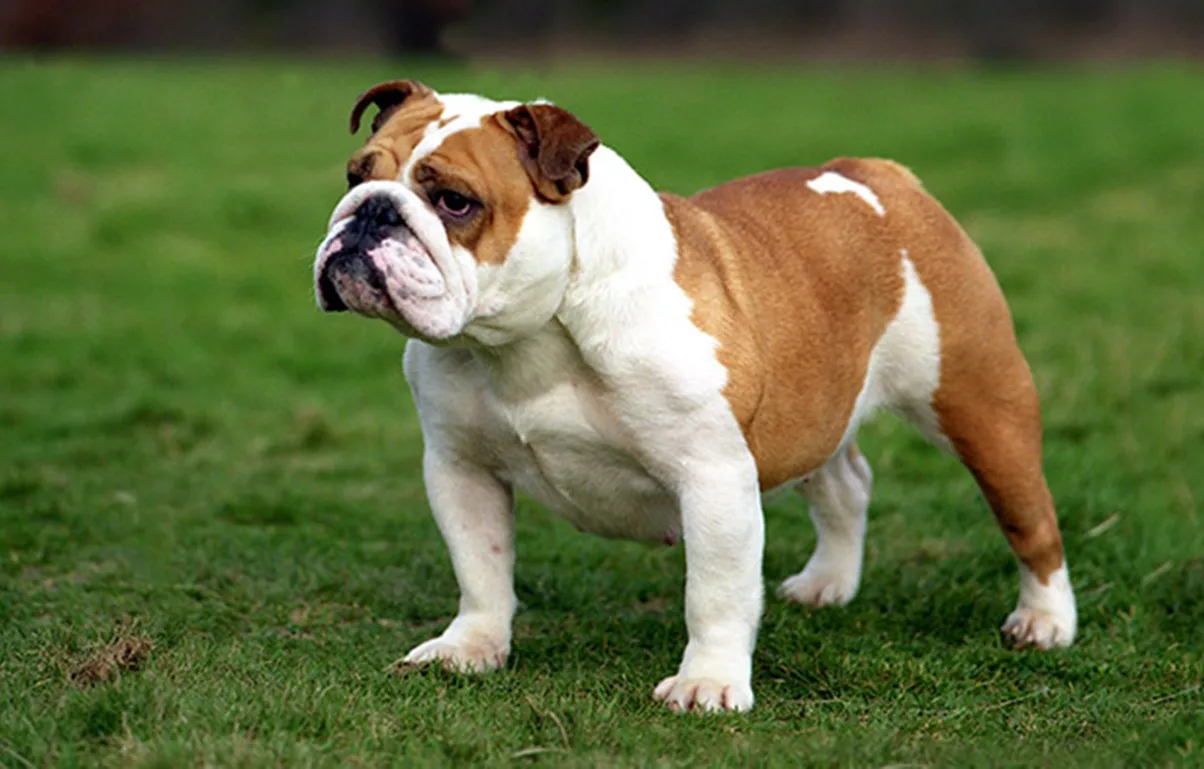
English Bulldog health problems are inseparable from its shape. The breed, often called simply the Bulldog, is one of the most recognisable in the world and simultaneously one of the most medically compromised.
The breed's extreme phenotype, characterised by a severely foreshortened skull, massive skin folds, wide low-slung body, and corkscrew tail, is the product of selective breeding that has diverged radically from the working dog that competed in bull-baiting centuries ago.
Modern research consistently documents that Bulldogs suffer disproportionate rates of respiratory, orthopaedic, dermatological, and reproductive disease compared to the canine average.
A 2022 study in Canine Medicine and Genetics compared 2,662 Bulldogs against 22,595 non-Bulldog controls and found that Bulldogs had significantly higher odds of 24 out of the 43 health conditions examined. This article covers the principal conditions affecting Bulldogs, the evidence behind each, and practical guidance for current and prospective owners.
Summary Health Table
| Condition | Estimated Prevalence | Category | Screening / Management |
|---|---|---|---|
| Brachycephalic obstructive airway syndrome (BOAS) | >70% have significant airway compromise | Conformational | BOAS grading; surgical correction |
| Skin fold dermatitis | Very high; exact figure varies by study | Conformational | Daily fold cleaning |
| Hip dysplasia | 74-76% (OFA data, highest of any breed) | Conformational/genetic | OFA radiograph |
| Elbow dysplasia | 35-45% (OFA data) | Conformational/genetic | OFA radiograph |
| Cherry eye (prolapsed nictitans gland) | ~10-15% | Conformational | Surgical replacement or excision |
| Shoulder OCD | Elevated breed risk | Developmental | Radiograph / arthroscopy |
| Spinal malformations (hemivertebrae) | Common; similar to French Bulldog | Conformational/genetic | Spinal radiograph or MRI |
| Hypothyroidism | Elevated breed risk | Endocrine | Thyroid panel |
| Difficult whelping (dystocia) | >80% require caesarean section | Conformational | Planned caesarean |
Hip Dysplasia: The Highest Rate of Any Breed
The English Bulldog holds the highest hip dysplasia rate in the OFA database of any breed for which sufficient data exists. Approximately 74-76% of submitted Bulldog radiographs are rated dysplastic. This figure is extraordinary; for context, the German Shepherd's rate of approximately 19-20% already raises significant welfare concerns, and the Bulldog's rate is nearly four times higher.
The Bulldog's characteristic wide, low-slung body and extreme hip width relative to body length create abnormal biomechanical loading of the hip joints from puppyhood. The femoral heads of Bulldogs are often poorly seated in shallow acetabula, and the angle of the femoral neck is atypical.
Despite this near-universal structural abnormality, many Bulldogs are not clinically lame until middle age because their low activity levels and slow movement reduce mechanical stress. Owners frequently interpret the Bulldog's slow, rolling gait as normal when it reflects significant joint compromise.
"The Bulldog's hip dysplasia prevalence approaching 75% in OFA submitted dogs likely represents a combination of true pathological prevalence and the confounding effect of extreme conformation that makes 'normal' hip anatomy nearly impossible to achieve within the breed standard." Orthopedic Foundation for Animals Breed Statistics Commentary, ofa.org
Management for Bulldog hip dysplasia follows established principles: weight control at lean body condition (critical given the breed's predisposition to obesity), low-impact exercise, physiotherapy, and NSAID pain management. Total hip replacement is available but carries additional anaesthetic risk due to the breed's respiratory compromise.
Brachycephalic Obstructive Airway Syndrome
Bulldogs have among the most severe BOAS presentations of any brachycephalic breed. Stenotic nares, elongated soft palate, everted laryngeal saccules, hypoplastic trachea, and aberrant nasopharyngeal turbinates are all common, and many Bulldogs have all five components simultaneously.
The Bulldog's characteristically narrow, undersized trachea (hypoplastic trachea) is particularly problematic: unlike stenotic nares or elongated soft palate, hypoplastic trachea cannot be surgically corrected, and it sets a permanent ceiling on the respiratory improvement achievable from other surgeries.
"The English Bulldog has a statistically narrower trachea relative to body size than all other brachycephalic breeds studied, and hypoplastic trachea is one of the most common findings on thoracic radiographs in the breed. Its presence is associated with a significantly worse prognosis for BOAS surgical outcomes." Stadler K et al., Veterinary Radiology and Ultrasound, 2014.
Anaesthesia is high-risk for Bulldogs due to the combination of airway compromise, short neck, and difficulty maintaining a patent airway after extubation. Any elective procedure requiring general anaesthesia should be performed only at a facility with intensive monitoring capabilities, a skilled anaesthetist familiar with brachycephalic protocols, and access to emergency tracheotomy equipment.
Signs of BOAS-related distress include loud snoring and snorting at rest, cyanotic (blue-tinged) gums during exercise, collapse after minimal exertion, and repeated regurgitation. Many Bulldog owners normalise these signs. The BOAS Functional Grading system allows objective assessment: Grade III BOAS requires surgical intervention before undertaking any stressful activity.
Skin Fold Dermatitis
The Bulldog's deep facial folds, tail fold (often a corkscrew formation that creates a deep, nearly inaccessible pocket over the tail base), nose roll (the fold above the nose), lip folds, and body folds all create warm, moist environments where bacteria and yeast proliferate. Pyoderma (bacterial skin infection), Malassezia dermatitis, and secondary ulceration are common.
The tail fold in Bulldogs presents a specific challenge. The corkscrew tail is partially embedded, with skin folded under and around the tail base, making thorough cleaning extremely difficult. Severe chronic infection of this area is painful, odorous, and can cause skin breakdown.
When medical management (daily cleaning with antiseptic solutions, systemic antibiotics during flares) fails to control the condition adequately, surgical tail amputation (caudectomy) combined with skin fold excision is the definitive treatment.
Daily maintenance of all skin folds, facial, nose roll, lip folds, tail fold, and any body folds, with commercially available fold-cleaning wipes or gentle antiseptic cloths is essential lifelong management. Bulldogs whose folds are not maintained daily are likely to develop chronic skin infections.
Eye Conditions
Cherry eye (prolapsed nictitans gland): Bulldogs have elevated breed risk for prolapse of the gland of the third eyelid, appearing as a pink or red swelling at the inner corner of the eye. Surgical replacement of the gland (pocket technique or imbrication technique) is strongly preferred over gland removal, as the third eyelid gland produces approximately 40% of aqueous tear film. Removal increases lifetime risk of keratoconjunctivitis sicca (dry eye syndrome).
Dry eye syndrome (KCS): Keratoconjunctivitis sicca causes inadequate tear production, leading to mucoid discharge, corneal ulceration, pigmentary keratitis, and eventual vision impairment. Bulldogs have elevated breed risk. Management is with topical cyclosporin ophthalmic ointment (0.2% cyclosporin or 0.03% tacrolimus) applied twice daily to stimulate tear production, supplemented by artificial tear application.
Entropion and distichiasis: As in other brachycephalic breeds, inward-rolling eyelids and aberrant eyelash growth are common and can cause chronic corneal irritation and ulceration. Surgical correction is curative.
Elbow Dysplasia
Approximately 35-45% of OFA-submitted Bulldog elbow radiographs are rated dysplastic, substantially higher than most other breeds. As with hip dysplasia, the Bulldog's unusual conformation (wide, out-turned front legs) contributes to abnormal elbow joint loading during development. Clinical signs include forelimb lameness and joint effusion, typically presenting between 4 and 12 months of age.
Spinal Malformations
Like the French Bulldog, the English Bulldog has a high prevalence of hemivertebrae (wedge-shaped vertebral bodies causing spinal curvature) and a genetic predisposition to IVDD. The Bulldog's corkscrew tail is the external manifestation of the same genetic pathway causing vertebral malformations along the thoracic spine. Compression of the spinal cord by hemivertebrae or herniated disc material can cause progressive hindlimb weakness, ataxia, or acute paralysis.
Spinal imaging (radiograph or MRI) is recommended in any Bulldog showing hindlimb weakness, changes in gait, incontinence, or pain on spinal palpation. Emergency surgery to decompress the spinal cord significantly improves outcomes compared to conservative management in dogs with moderate to severe neurological signs.
Heat Stroke and Exercise Intolerance
Bulldogs are among the most vulnerable breeds to heat stroke. Their severely compromised airways make efficient panting physiologically impossible; a Bulldog in a warm environment cannot remove heat from its body effectively. The breed's characteristic respiratory noises are often interpreted as acceptable by owners who have normalised what is in fact a chronic physiological emergency.
Exercise restrictions for Bulldogs should be taken seriously: short leash walks only, exclusively in the early morning or evening during summer months, with immediate access to cool water and shade. Bulldogs should never be left in vehicles or unshaded outdoor areas in warm weather. Commercial cooling vests and cooling mats offer meaningful relief in warm environments.
Reproductive Problems
English Bulldogs face severe reproductive challenges. The combination of the puppies' large heads (particularly the massive skull) and the dam's narrow pelvis makes natural birth hazardous. The vast majority of Bulldogs, estimated at over 80-90%, require planned caesarean section. This is one of the highest caesarean rates of any domestic animal.
Breeders must budget for routine caesarean surgery, and all breeding Bulldogs should have their pelvis assessed radiographically before being used for breeding.
"The English Bulldog has undergone such extreme morphological change from its working ancestors that it can no longer perform basic biological functions, including natural reproduction, without human medical intervention, raising fundamental questions about whether the breed can be sustained without health reform." Farstad W, Reproduction in Domestic Animals, 2018.
Hypothyroidism
Bulldogs have an elevated breed predisposition to acquired hypothyroidism. Clinical signs, weight gain, lethargy, bilateral symmetrical coat thinning, skin changes, cold intolerance, are frequently attributed to the breed's naturally low energy levels and tendency toward overweight, delaying diagnosis. Thyroid testing (total T4, free T4, cTSH) should be considered in any Bulldog presenting with unexplained weight gain or cutaneous changes.
Screening Recommendations for Breeding Stock
| Test | Method | Minimum Age | Governing Body |
|---|---|---|---|
| BOAS assessment | Respiratory grading (clinical exam) | 1-2 years | Breed club / BOAS scheme |
| Hip evaluation | OFA radiograph | 24 months | OFA |
| Elbow evaluation | OFA radiograph | 24 months | OFA |
| Spinal radiograph | Plain film at minimum | 2 years | Specialist |
| Eye examination | ACVO ophthalmoscopy | Annual | OFA Eye Registry |
| Thyroid panel | Blood T4, cTSH | Annual (recommended) | OFA Thyroid |
| Pelvic radiograph | Assessment before first breeding | Pre-breeding | Veterinary surgeon |
The Bulldog Club of America maintains a health committee that publishes breed-specific health recommendations and participates in the OFA CHIC program.
What to Ask a Breeder
- What is the BOAS grade for both parents?
- What are the OFA hip and elbow scores? (Note: many Bulldogs will not have Excellent or Good hip scores due to breed conformation, request the best available from breeding stock.)
- Has either parent required BOAS surgery?
- What is the tail fold status? Has surgical correction been needed?
- What is the caesarean history for the dam?
- Are there any OFA or health records available for previous litters?
Prospective Bulldog owners should budget for ongoing veterinary costs substantially higher than average-breed ownership, including potential BOAS surgery (often $1,500-4,000), dermatological management, orthopaedic care, and emergency services.
The Broader Welfare Debate
The English Bulldog is at the centre of an international veterinary welfare debate. In 2016, the British Veterinary Association and the Royal Veterinary College formally advised the public to consider not buying brachycephalic breeds until significant health reforms are achieved. The Norwegian government banned the breeding of English Bulldogs in 2022 on animal welfare grounds, following a court case brought by the Norwegian Society for the Protection of Animals.
The evidence base for welfare concerns is substantial and growing. Reform-oriented breeding programs exist in several countries, focusing on selection for measurably better respiratory function, less extreme skull compression, and straighter tail conformation. Prospective owners and breeders can support this direction by seeking out health-tested dogs from programs prioritising function over exaggerated form.
For comparison of brachycephalic and non-brachycephalic alternatives, see best dogs for first-time owners and best dogs for families with kids. For routine health care guidance, see the dog dental care guide.
Anaesthesia Risk
Anaesthesia in Bulldogs carries substantially elevated risk compared to non-brachycephalic dogs. The combination of a narrow trachea (often requiring a smaller endotracheal tube than expected for the dog's body weight), pharyngeal tissue collapse on extubation, and propensity for airway oedema after airway manipulation means that recovery from anaesthesia is the most dangerous phase of the procedure. Bulldogs may obstruct their airway within seconds of extubation.
Veterinarians experienced with brachycephalic protocols should be sought for any Bulldog anaesthesia. Key safety measures include pre-oxygenation before induction, use of a reverse-flow laryngoscope for intubation, keeping the dog intubated until it is fully awake and swallowing actively, maintaining sternal recumbency during recovery, and having reversal agents and emergency airway equipment immediately available.
Owners should inform any veterinarian, including emergency clinics, of the breed before any sedation or anaesthetic procedure.
Dental Crowding and Oral Health
Bulldogs have severely compressed jaws with dental overcrowding as a direct consequence of skull foreshortening. Crowded, rotated, and unerupted teeth accelerate periodontal disease and increase the risk of tooth root infections and jaw bone loss. Regular professional dental cleaning under anaesthesia and extraction of severely crowded or retained teeth are often necessary.
Home dental care with brushing and enzymatic dental products should begin in puppyhood to slow periodontal disease progression. See the dog dental care guide for practical home care guidance.
Juvenile Cellulitis (Puppy Strangles)
Bulldogs are among the breeds with elevated reported incidence of juvenile cellulitis (also called puppy strangles), an inflammatory and pustular condition of the skin of the face, muzzle, and submandibular lymph nodes in young dogs (3 weeks to 6 months). The condition is immune-mediated rather than infectious, though secondary bacterial infection is common.
Treatment with immunosuppressive doses of glucocorticoids combined with antibiotics is the standard approach; untreated cases can result in permanent scarring of facial skin. Breeders and owners should seek veterinary evaluation promptly for any puppy with facial swelling, pustular lesions, or swollen lymph nodes under the jaw.
Ongoing Veterinary Costs
English Bulldog ownership involves some of the highest average veterinary expenditure of any breed. UK-based practice data consistently places Bulldogs in the top three most expensive breeds to insure and to own. Representative costs for common Bulldog-specific interventions include:
- BOAS surgical correction: $1,500-4,500 USD depending on procedures performed
- Spinal surgery for IVDD or hemivertebrae compression: $3,000-8,000+ USD
- Planned caesarean section: $1,000-3,000 USD per litter
- Dermatological management (skin folds, atopy): ongoing, $200-2,000+ USD annually
- Hip or elbow surgical management in severely affected dogs: $2,000-6,000+ USD
Pet insurance purchased before health conditions develop is strongly recommended and should include generous annual limits. Many insurers apply breed-specific premium loading or exclusions to Bulldogs.
References
- O'Neill DG, Skipper AM, Kadhim J, et al. Disorders of Bulldogs under primary veterinary care in England. PLOS ONE. 2019;14(6):e0217928. DOI: 10.1371/journal.pone.0217928
- Packer RMA, Hendricks A, Tivers MS, Burn CC. Impact of facial conformation on canine health: brachycephalic obstructive airway syndrome. PLOS ONE. 2015;10(10):e0137496. DOI: 10.1371/journal.pone.0137496
- Stadler K, O'Brien RT. Quantitative computed tomography of the thorax of brachycephalic and nonbrachycephalic dogs. Veterinary Radiology and Ultrasound. 2014;55(1):1-9.
- Farstad W. Current trends in reproductive health management in dogs. Reproduction in Domestic Animals. 2018;53(Suppl 2):4-11. DOI: 10.1111/rda.13233
- Orthopedic Foundation for Animals. English Bulldog Breed Statistics. ofa.org. Accessed 2025.
- Liu NC, Adams VJ, Kalmar L, et al. Whole-body barometric plethysmography characterizes upper airway obstruction in 3 brachycephalic breeds. Journal of Veterinary Internal Medicine. 2016;30(3):853-865. DOI: 10.1111/jvim.13933
- Norwegian Supreme Court. Ruling on Bulldog and Cavalier King Charles Spaniel breeding ban. 2022.
- British Veterinary Association. BVA Policy Position on Brachycephalic Breeds. bva.co.uk. 2016, updated 2022.
- Bulldog Club of America Health Committee. BCA Health Testing Recommendations. bulldogclubofamerica.org. Accessed 2025.
- Roedler FS, Pohl S, Oechtering GU. How does severe brachycephaly affect dog's lives? Veterinary Journal. 2013;198(3):606-610. DOI: 10.1016/j.tvjl.2013.01.009
Frequently Asked Questions
Why do English Bulldogs have so many health problems?
English Bulldogs have been selectively bred for extreme physical features, severely foreshortened skull, deep skin folds, wide low-slung body, and corkscrew tail, that cause multiple simultaneous structural health problems. A 2019 study found Bulldogs had significantly higher odds of 24 health conditions compared to non-Bulldog controls.
The breed’s entire anatomy has been shaped by selective breeding for appearance over function, producing a dog that cannot breathe, reproduce, or thermoregulate normally without difficulty or medical intervention.
What is the Bulldog's hip dysplasia rate?
The English Bulldog has the highest hip dysplasia rate of any breed in the OFA database, with approximately 74-76% of submitted radiographs rated as dysplastic. This compares to approximately 19-20% in German Shepherd Dogs and 12-14% in Labrador Retrievers. The Bulldog’s characteristic wide, low-set body and abnormal pelvic conformation mean that structurally normal hips within the breed standard are essentially unachievable for most dogs.
Can English Bulldogs give birth naturally?
The vast majority of English Bulldogs, estimated at over 80-90%, require planned caesarean section to deliver puppies safely. The combination of the puppies’ large heads (particularly the broad skull) and the dam’s narrow pelvis makes natural birth highly likely to result in obstruction, fetal death, or death of the dam without surgical intervention. Breeders must budget for routine caesarean costs.
All Bulldogs intended for breeding should have pelvic radiographs taken before their first breeding.
How do I clean my Bulldog's skin folds?
All Bulldog skin folds, including the nose roll, facial folds, lip folds, tail fold, and any body folds, should be cleaned daily using commercially available fold-cleaning wipes or gentle antiseptic cloths. The tail fold is particularly challenging and prone to severe chronic infection; cleaning should extend into the fold pocket as thoroughly as possible.
Signs of infection include redness, odour, moisture, discharge, and the dog rubbing or scratching at the area. Regular veterinary check-ups should include fold assessment. Chronic uncontrolled tail fold infection may require surgical caudectomy and skin fold excision.
What is cherry eye in Bulldogs and how is it treated?
Cherry eye is the prolapse of the gland of the third eyelid, appearing as a pink or red swelling at the inner corner of the eye. Bulldogs have elevated breed risk. Treatment is surgical: the preferred technique is replacement of the gland rather than removal (pocket or imbrication technique).
Removal is discouraged because the gland produces approximately 40% of aqueous tear film; removing it significantly increases lifetime risk of dry eye syndrome (keratoconjunctivitis sicca), which requires lifelong management.
Is it ethical to buy an English Bulldog?
This is a question the veterinary profession is actively debating. The British Veterinary Association has formally advised the public to consider not buying brachycephalic breeds until significant breed health reforms occur. Norway banned Bulldog breeding in 2022.
If you choose to purchase a Bulldog, seek breeders participating in health testing and reform-oriented breeding programs that select for measurably better respiratory function and less extreme conformation. Budget for substantial veterinary costs throughout the dog’s life, including potential BOAS surgery, dermatological management, orthopaedic care, and caesarean section for breeding females.