
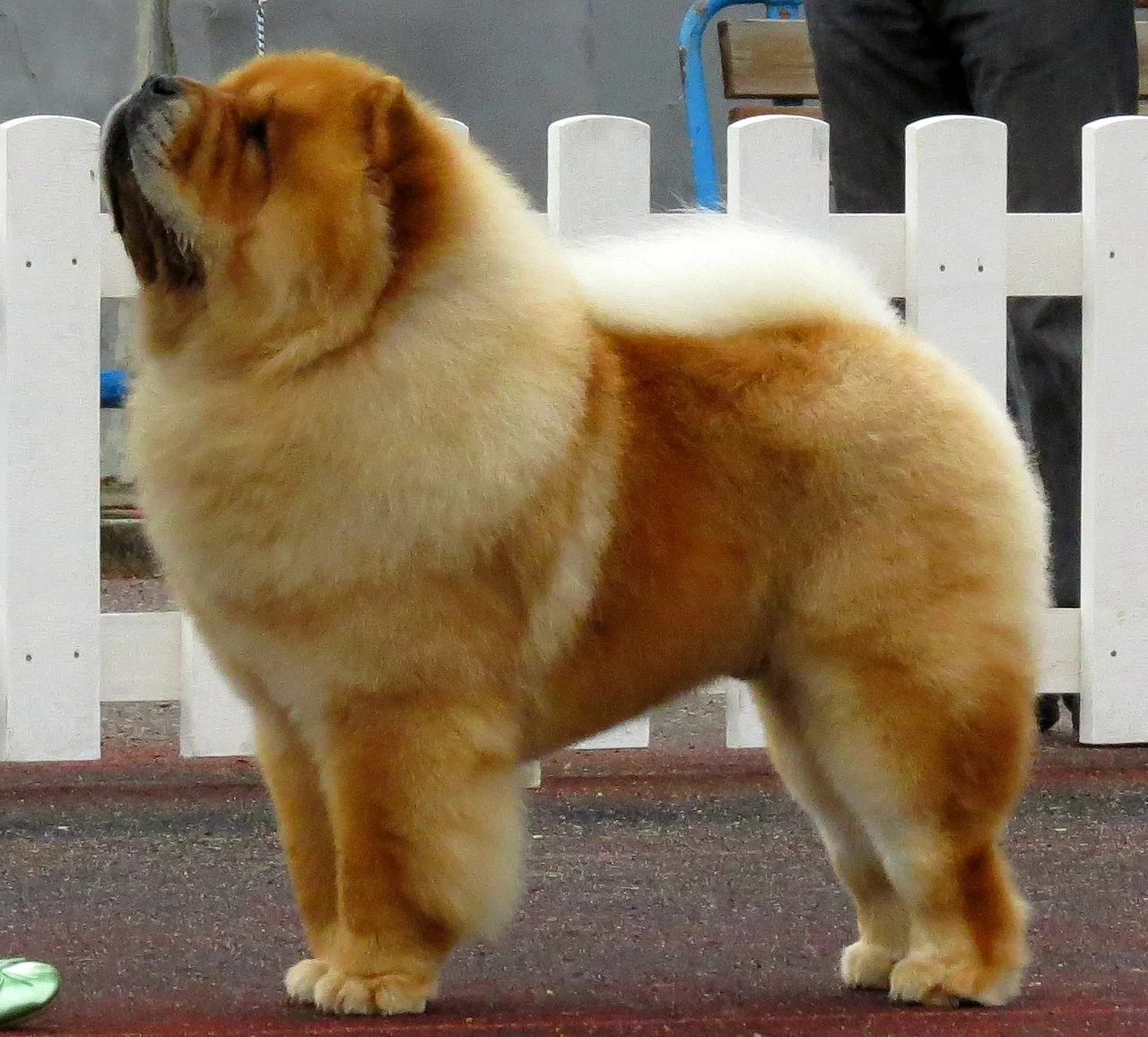
The Chow Chow is one of the most genetically primitive domestic dog breeds, and population genetics studies consistently place it among the small group of basal breeds most closely related to the ancestral wolf.
Behind the distinctive lion-like mane, the deep-set eyes, and the characteristic blue-black tongue is a dog shaped by thousands of years of Chinese history, used for hunting, herding, pulling sleds in northern China, and as a source of food and fur in some historical contexts.
The Chow Chow that sits on a sofa in a modern apartment is directly descended from one of the oldest dog populations on earth, and its temperament reflects that ancient lineage: cat-like independence, strong territorial instinct, and a social structure built around deep loyalty to a small inner circle and measured reserve toward everyone else.
The blue-black tongue is the Chow Chow's most immediately recognised anatomical signature. Of all domestic dog breeds, only two, the Chow Chow and the Shar-Pei, have a solid blue-black tongue as a breed standard requirement, and both originate from the same region of China. In all other dog breeds, the tongue is pink.
The colouration results from the high concentration of pigment-producing melanocytes in the tongue tissue, and puppies are born with pink tongues that darken as they age, typically becoming fully pigmented by 8 to 10 weeks.
Origins and History
The Chow Chow's origins are rooted in ancient China, where dogs of this general type are depicted in pottery and sculptures dating to the Han Dynasty (approximately 206 BCE to 220 CE) and possibly earlier. The breed name "Chow Chow" is not Chinese in origin; it is a pidgin English term used by British merchants in the 18th century to describe miscellaneous goods from China, and the breed name appears to have been applied to the dogs brought back on trading ships from China.
The breed was used historically in northern China for hunting (particularly for hunting bear and pheasant), herding, pulling sleds in cold climates, and as a guard dog. Historical accounts from China describe the breed in all of these working roles. The breed's fur was also used in clothing manufacture, and dogs were raised for meat in some regions, a historical reality that is culturally uncomfortable in the modern Western context but is well-documented.
The Chow Chow arrived in England in substantial numbers in the late 18th century via the East India Company's trading ships. Queen Victoria is known to have kept Chow Chows, which significantly elevated the breed's social cachet in Victorian England. The American Kennel Club recognised the Chow Chow in 1903.
The breed is one of those identified by Parker et al.'s landmark 2004 genetic study as basal, among the breeds most closely related to the wolf ancestor and most distantly separated from the modern breeds developed through intensive 19th and 20th-century selective breeding.
Physical Characteristics
The Chow Chow's physical profile is distinguished by the combination of the lion-like mane (particularly pronounced in the rough-coated variety), the distinctive blue-black tongue, the deep-set eyes that give the breed limited peripheral vision and a characteristic scowling expression, and the straight, stiff hind legs that produce the Chow's unique, stilted gait.
| Characteristic | Measurement |
|---|---|
| Height | 46-56 cm (18-22 in) |
| Weight | 20-32 kg (45-70 lb) |
| Lifespan | 8-12 years |
| AKC Group | Non-Sporting |
| Tongue colour | Blue-black (required; pink tongue is a disqualification) |
| Coat types | Rough (lion mane) and Smooth |
Two coat types are recognised: the Rough Chow, with the characteristic abundant mane and thick, profuse coat; and the Smooth Chow, with a harder, shorter, more plush coat without the mane. Both types have the same thick double coat with a dense, woolly undercoat.
The rough coat requires regular grooming, brushing 2 to 3 times weekly minimum to prevent matting in the mane and around the hindquarters, where mats form most readily. Bathing and thorough drying takes several hours for a rough Chow in full coat.
Coat colours include red (the most common, ranging from light golden to deep mahogany), black, blue, cinnamon (fawn), and cream.
The straight hind legs, a characteristic conformation resulting from the specific angulation of the Chow's stifle (knee) joint, produce the breed's characteristic stilted, bear-like gait. This conformation has orthopaedic implications and contributes to some of the breed's joint health challenges.
Temperament
The Chow Chow is perhaps the most accurately described as cat-like of all dog breeds, and the description captures something fundamental. The breed is independent to a degree that distinguishes it from virtually all working and sporting breeds. It bonds deeply with a small inner circle of family members but offers little automatic affection to anyone outside that circle. It grooms itself.
It chooses when to seek contact and when to be left alone. It is clean, quiet, and does not typically exhibit the attention-seeking behaviour of more people-oriented breeds.
This independence is not a personality defect; it is the authentic character of a dog whose evolutionary heritage predates the close human cooperation that shaped the herding and retrieving breeds. It is, however, important for prospective owners to understand before acquisition. An owner expecting an affectionate, effusive companion who seeks their approval will be profoundly mismatched with a Chow Chow.
The Chow Chow's territorial instinct is strong. The breed is a natural guardian, reserved and watchful with strangers, with a clear sense of household territory.
This territorial tendency, combined with the limited peripheral vision created by the deep-set eyes and heavy facial fold, means that Chow Chows can be startled by approaches from the side or from behind, and may react defensively. Training children to approach a Chow Chow from the front, calmly, and not to run toward the dog is important.
"The Chow Chow occupies an interesting position in the canine behavioural literature: it consistently scores high on measures of independence and territorial aggression, and low on measures of social motivation toward humans. These characteristics are consistent with its basal genetic status; it represents a dog type that has undergone less modification of wolf-type social behaviour through the domestication process than most modern breeds." Svartberg, K. (2006). Breed-typical behaviour in dogs: historical remnants or recent constructs? Applied Animal Behaviour Science, 96(3-4), 293-313. https://doi.org/10.1016/j.applanim.2005.06.014
Health Conditions
The Chow Chow has a moderate lifespan of 8 to 12 years and several specific health conditions that require attention.
| Health Condition | Prevalence / Notes |
|---|---|
| Hip dysplasia | ~22% prevalence (OFA data) |
| Elbow dysplasia | ~14% prevalence (OFA data) |
| Entropion | Very common, inward rolling of the eyelid(s) that causes chronic corneal irritation; frequently requires surgical correction |
| Glaucoma | Elevated breed prevalence |
| Patellar luxation | Present in the breed |
| Hypothyroidism | Present; thyroid testing recommended |
Entropion, the inward rolling of the eyelid, usually the lower eyelid, is a very common problem in the Chow Chow, resulting from the breed's prominent facial skin folds and deep-set eye conformation. When the eyelid rolls inward, the eyelashes and skin contact the corneal surface continuously, causing chronic irritation, tearing, corneal ulceration, and pain.
Many Chow Chows are born with entropion severe enough to require surgical correction (entropion repair, or blepharoplasty). Even mild entropion requires monitoring, as chronic low-grade corneal irritation causes cumulative damage. Any Chow Chow showing excessive tearing, squinting, or rubbing at the eyes should be evaluated by a veterinarian.
The combination of significant hip (22%) and elbow (14%) dysplasia rates reflects the breed's conformation and the mechanical stress of the straight-legged gait. OFA testing of breeding stock is recommended, and prospective buyers should ask for hip and elbow health test results for both parents.
See also Shiba Inu, Akita, and How Dogs Evolved from Wolves for context on ancient Asian breeds.
Training
Training a Chow Chow is a test of patience, consistency, and the willingness to find motivators that work for the individual dog. The breed is intelligent and learns efficiently, but the independent character means that compliance is contingent on the dog's own assessment of the situation and the perceived value of compliance.
The training relationship must be built on mutual respect established early. A Chow Chow that has been permitted to establish dominance over the household will be substantially more difficult to train in adulthood. From puppyhood, the dog should be handled regularly, examined, groomed, and asked to defer to the owner in small ways, so that handling and requests for compliance are established as normal and non-threatening experiences.
Socialisation is critical. The breed's natural reserve can develop into serious territorial aggression in under-socialised individuals. Exposure to varied people, dogs, children, and environments from 8 weeks of age shapes the social expectations of the adult dog.
See Best Dogs for First-Time Owners, the Chow Chow is not typically on this list.
Exercise and Grooming
Adult Chow Chows need moderate exercise, approximately 45 to 60 minutes of daily walking. The breed is not a high-energy dog and does not require extended vigorous activity, but regular exercise is essential for maintaining healthy weight and joint function. The breed is not suited to jogging or sustained high-impact exercise due to the joint health risks and the heavy coat's tendency to cause overheating in warm weather.
The rough coat requires brushing 2 to 3 times weekly and more frequently during seasonal shedding. The mane and the coat around the hindquarters (where the dense coat meets the tail) mat most readily and need most attention. Professional grooming every 8 to 12 weeks is practical for most rough Chow Chow owners. The smooth coat is substantially easier to maintain.
References
Parker, H. G., Kim, L. V., Sutter, N. B., et al. (2004). Genetic structure of the purebred domestic dog. Science, 304(5674), 1160-1164. https://doi.org/10.1126/science.1097788
Svartberg, K. (2006). Breed-typical behaviour in dogs. Applied Animal Behaviour Science, 96(3-4), 293-313. https://doi.org/10.1016/j.applanim.2005.06.014
Orthopedic Foundation for Animals. (2023). Breed Health Statistics: Chow Chow. Retrieved from https://ofa.org
Stades, F. C., & Gelatt, K. N. (2007). Diseases and surgery of the canine eyelid. In K. N. Gelatt (Ed.), Veterinary Ophthalmology (4th ed.). Blackwell Publishing.
American Kennel Club. (2023). Chow Chow Breed Standard. Retrieved from https://www.akc.org/dog-breeds/chow-chow/
Chow Chow Club Inc. (2023). Health Issues in the Chow Chow. Retrieved from https://chowclub.org/health
Frequently Asked Questions
Why do Chow Chows have a blue-black tongue?
The Chow Chow’s blue-black tongue results from the high concentration of melanocytes (pigment-producing cells) in the tongue tissue. Of all domestic dog breeds, only the Chow Chow and the Shar-Pei are required by their breed standards to have a solid blue-black tongue, all other dog breeds have pink tongues.
Chow Chow puppies are born with pink tongues that progressively darken as melanin accumulates in the tissue, typically becoming fully pigmented by 8 to 10 weeks of age. A partially pink tongue in an adult Chow Chow is considered a conformation fault. The exact genetic mechanism producing this characteristic is associated with the same pigmentation genes that produce the breed’s coat colours.
Are Chow Chows aggressive?
Chow Chows are not inherently aggressive, but they have a temperament and conformation that can lead to misunderstandings and incidents if not properly managed. The breed’s territorial instinct, limited peripheral vision (the deep-set eyes and heavy facial folds reduce side and rear vision), and reserve toward strangers combine to create a dog that may react defensively if startled or approached in ways it finds threatening.
A well-socialised, well-trained Chow Chow managed by an experienced owner is a composed, dignified companion. Under-socialised individuals, dogs that have been poorly handled, or dogs in situations their owners are not managing appropriately are where incidents occur. The breed requires experienced ownership and is not appropriate for households with young children who may approach the dog from behind or run toward it unpredictably.
What is entropion in Chow Chows?
Entropion is the inward rolling of one or both eyelids, causing the eyelashes and skin to rub against the surface of the eye. In Chow Chows, entropion commonly affects the lower eyelids and is a consequence of the breed’s deep-set eyes, heavy facial skin folds, and characteristic conformation. The continuous contact of the eyelashes with the cornea causes chronic irritation, tearing, pain, and progressive corneal ulceration.
Mild cases may be managed conservatively; more severe or persistent cases require surgical correction (blepharoplasty). Signs of entropion include excessive tearing, squinting, pawing at the eyes, and eye redness. Any Chow Chow showing these signs should be evaluated by a veterinarian, as chronic untreated entropion causes permanent corneal damage.
How often should I groom a Chow Chow?
Rough-coated Chow Chows require brushing 2 to 3 times weekly to prevent matting, with more frequent brushing during the twice-yearly coat blows when the thick undercoat sheds in large quantities. The areas that mat most readily are the mane around the neck and chest, and the coat around the hindquarters and under the tail. Each brushing session should work through the full coat to the skin rather than just the surface.
Bathing a rough Chow Chow requires 2 to 3 hours from wet to fully dry, as the dense undercoat retains moisture. Professional grooming every 8 to 12 weeks is practical for most rough Chow owners. Smooth-coated Chows are significantly easier to maintain, requiring weekly brushing and periodic bathing.
Are Chow Chows good family dogs?
Chow Chows can be good family dogs in the right household, but they are not universally suitable for family life with young children. The breed forms deep loyalty to its immediate family members but is reserved with others. The combination of territorial instinct, limited peripheral vision, and a tendency to react defensively when startled creates genuine risk in households with young children who approach dogs unpredictably or from behind.
In households with older children who are dog-experienced and interact calmly and respectfully, Chow Chows often integrate well. The breed is not known for the effusive affection of retrieving or herding breeds, so families seeking an actively loving, playful companion may find the Chow Chow temperamentally distant.
Why is the Chow Chow considered an ancient breed?
Genetic studies analysing microsatellite markers across 85 purebred breeds (Parker et al., 2004) identified the Chow Chow as one of a small group of basal breeds, dogs that diverged earliest from the ancestral wolf population and are most distantly related to the modern breeds developed through intensive 19th and 20th century selective breeding. Dogs of Chow Chow type are depicted in Chinese pottery and sculpture from the Han Dynasty (206 BCE to 220 CE).
The breed’s geographic isolation in China, combined with consistent selection for working function over many centuries without the genetic bottlenecks of modern kennel club breeding, contributed to the preservation of this ancient genetic character.