
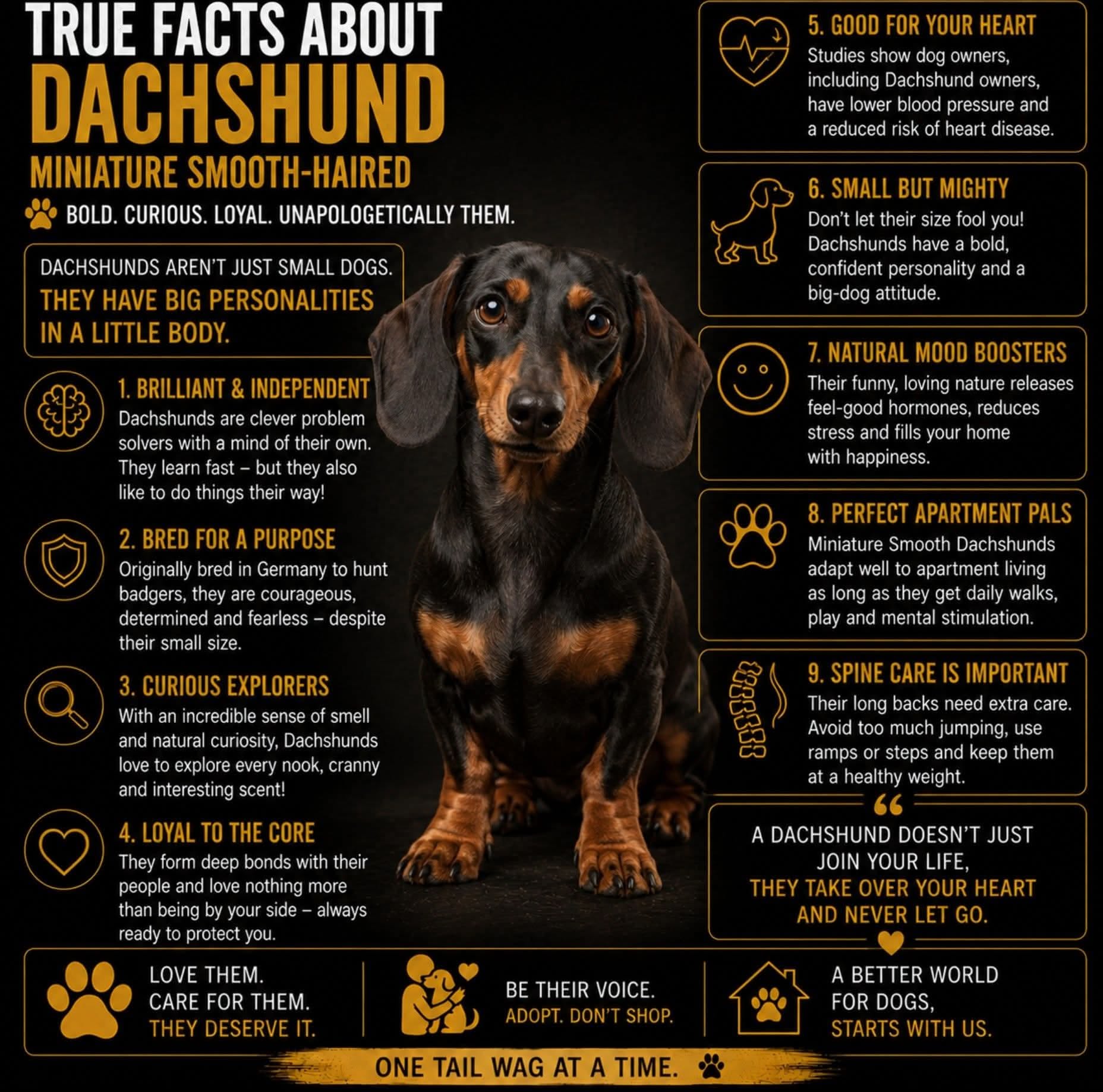
The Dachshund is one of the most recognisable dog breeds in the world, distinguished by a body plan found in no other dog: an elongated trunk, a deep chest, and dramatically shortened legs that place the dog close to the ground.
This body plan is not an accident of selective breeding for aesthetics; it is a functional hunting adaptation, refined over centuries to produce a dog that could pursue badgers into underground tunnels and emerge victorious.
The consequences of that anatomy are as significant medically as they are visually distinctive, and anyone considering a Dachshund must understand the breed's elevated risk for intervertebral disc disease (IVDD), which affects between 19 and 24 percent of all Dachshunds in their lifetime.
Despite this health consideration, the Dachshund offers a combination of intelligence, personality, and adaptability that makes it one of the most enduringly popular breeds across Europe and North America. This guide covers the breed in full: origins, anatomy, temperament, the critical health profile, coat varieties, training, exercise, feeding, and the frank question of whether a Dachshund is the right choice for a given owner.
Origins and History
The word Dachshund is German, composed of Dachs (badger) and Hund (dog). The breed was developed in Germany as a specialist hunting dog for badger hunting, Dackelarbeit (dachshund work) in German hunting terminology, and was shaped over several centuries to perform tasks requiring both above-ground scenting ability and the physical capacity to enter and navigate underground burrows.
The body form that defines the breed today, the condition known as chondrodystrophic dwarfism, was selectively preserved because it produced a dog that combined the scenting and tracking ability of a hound with the short-legged profile necessary to follow prey underground. Badgers are large, powerful animals capable of inflicting serious injury, and the Dachshund was bred for both courage and physical tenacity in close quarters.
The earliest records of Dachshund-type dogs appear in German hunting manuals and paintings from the early 18th century. The breed appears in the German stud book as early as 1840. The Deutsche Teckelklub (German Dachshund Club), founded in 1888, is one of the oldest breed clubs in the world and continues to maintain the German breed standard.
Dachshunds arrived in the United States in significant numbers during the late 19th century. The American Kennel Club recognised the breed in 1885, one of the earliest AKC registrations. The breed's popularity in the United States suffered during World War I due to anti-German sentiment; many owners renamed their Dachshunds "liberty hounds" to avoid public hostility. The breed recovered in popularity through the mid-20th century and has remained a consistent top-20 AKC breed since.
In Germany and many European countries, Dachshunds are still used for hunting today, both in traditional badger hunting contexts and, more frequently, for tracking wounded deer and boar. The working population is maintained separately from show and companion lines by the Teckelklub.
Physical Characteristics
The Dachshund's body plan is the result of a specific genetic mutation: the retrogene insertion of FGF4 (fibroblast growth factor 4) identified in a 2009 study published in Science by Parker et al. This insertion causes premature activation of growth factor signalling in developing limb bones, resulting in dramatically shortened legs and the characteristic chondrodystrophic body form.
The same mutation has been identified in at least 18 other short-legged dog breeds, including the Basset Hound, Corgi, and Shih Tzu, but the Dachshund's combination of body length and leg shortness is the most extreme.
| Variety | Weight | Height |
|---|---|---|
| Standard | 7-14.5 kg (15-32 lb) | 20-25 cm (8-10 in) |
| Miniature | under 5.4 kg (12 lb) | 13-18 cm (5-7 in) |
| Rabbit (Kaninchen, German registry only) | under 3.5 kg | under 13 cm |
Three coat types are recognised by all major kennel clubs. Each has distinct grooming requirements:
Smooth (shorthaired): The original coat type. Short, dense, and shining. Requires minimal grooming, weekly wiping with a hound glove or soft cloth. Shed throughout the year, with spring and autumn peaks.
Longhaired: A silkier, flowing coat with feathering on the ears, chest, belly, and tail. Requires brushing 2 to 3 times weekly to prevent tangling. The longhaired coat likely incorporates spaniel ancestry.
Wirehaired: A short, rough, wiry outer coat with a dense undercoat. Requires stripping (removal of the dead outer coat by hand or stripping knife) rather than clipping to maintain correct texture. The wirehaired coat is believed to incorporate terrier ancestry, particularly the Schnauzer. Wirehaired Dachshunds tend toward a slightly more terrier-like personality than smooth or longhaired varieties.
Coat colours include red (the most common), cream, black and tan, chocolate and tan, dapple (merle pattern), brindle, and piebald. The dapple pattern requires careful breeding management: breeding two dapple (double dapple) Dachshunds results in white-coated offspring with a high incidence of blindness, deafness, or both due to the double merle effect.
Temperament
Dachshunds have a personality that consistently surprises first-time owners accustomed to gentler breeds. They are curious, bold, stubborn, and clever.
The combination of hound tracking instinct (an intense drive to follow interesting scents wherever they lead) and terrier-influenced tenacity (a willingness to persist in any chosen direction regardless of owner instruction) creates a dog that is entertaining, engaging, and thoroughly capable of ignoring commands when something more interesting is happening.
Despite their stubbornness, Dachshunds are deeply social and affectionate with their families. They form strong bonds, enjoy physical contact, and are sensitive to the emotional tone of their household. They are not aloof or independent in the way of northern breeds; they want company and can develop separation anxiety if left alone for extended periods.
Dachshunds can be vocal. Barking is a natural behaviour for a breed developed to announce the location of prey underground, and the breed's bark is surprisingly resonant for its size. Management of this vocal tendency with training is important, particularly in apartment settings.
"The Dachshund is one of the breeds where we see the clearest disconnect between owner expectations and actual breed behaviour. Owners expect a small, docile dog. They get a small dog with the drive and determination of a working hunting breed, and they are often unprepared for that." Dr. John Paul Scott and John L. Fuller, Genetics and the Social Behavior of the Dog, University of Chicago Press, 1965 (landmark canine behaviour research).
The breed's independent streak has practical training implications. Dachshunds are intelligent and learn quickly, but they are less motivated by social approval than retrieving breeds and more motivated by food, scent, and the satisfaction of achieving their own objectives. Positive reinforcement with high-value food rewards is consistently more effective than repetitive command-based training.
Health: IVDD and Key Conditions
The most critical health topic for the Dachshund is intervertebral disc disease (IVDD), and it requires detailed coverage. IVDD is not merely a common condition in Dachshunds; it is a defining characteristic of the breed's medical profile, with implications that affect housing, exercise, handling, furniture access, and the economic reality of ownership.
Intervertebral discs are the cartilaginous cushions between the vertebrae of the spine. In chondrodystrophic breeds like the Dachshund, the discs undergo premature mineralisation (calcification) that begins in early adulthood, typically by 2 to 3 years of age. The mineralised discs are brittle and prone to rupture under mechanical stress, extruding material into the spinal canal and compressing the spinal cord. This compression causes pain, weakness, and in severe cases, paralysis.
"The prevalence of IVDD in Dachshunds is approximately 10 to 12 times higher than in non-chondrodystrophic breeds. An estimated 19 to 24 percent of Dachshunds will develop clinically significant IVDD in their lifetime." Parker, H. G., et al. (2009). An expressed Fgf4 retrogene is associated with breed-defining chondrodysplasia in domestic dogs. Science, 325(5943), 995-998. https://doi.org/10.1126/science.1173275
IVDD in Dachshunds most commonly affects the thoracolumbar junction (the junction between the chest and lower back, at T11-L4), though cervical (neck) involvement also occurs. Clinical signs range from yelping and spinal hypersensitivity (pain only) through ataxia (wobbling), paresis (partial paralysis), to complete paralysis with or without bladder and bowel control.
| IVDD Severity Grade | Clinical Signs | Treatment |
|---|---|---|
| Grade I | Pain only, no neurological deficits | Conservative management, rest, anti-inflammatories |
| Grade II | Pain plus mild neurological deficit | Conservative or surgical depending on progression |
| Grade III | Paresis, dog can walk but with deficit | Surgical intervention strongly recommended |
| Grade IV | Paralysis, bladder/bowel function retained | Urgent surgical intervention |
| Grade V | Paralysis, no bladder/bowel control | Emergency surgery; prognosis depends on deep pain sensation |
IVDD prevention in daily practice involves reducing mechanical stress on the spine:
- Ramps and steps: Provide ramps or steps to allow the dog to access furniture and vehicles without jumping. The impact of a Dachshund jumping off a sofa repeatedly is a significant mechanical stressor on the mineralised discs.
- No unsupported vertical holding: Never hold a Dachshund with the body hanging vertically. Always support the full length of the body when carrying.
- Weight management: Excess body weight substantially increases spinal loading. Dachshunds are prone to obesity, and obesity is a significant IVDD risk amplifier.
- Harness use: A correctly fitted harness distributes leash forces across the chest rather than the neck, reducing spinal stress.
Surgical treatment for IVDD (hemilaminectomy or ventral slot procedure, depending on location) is performed by veterinary neurosurgeons. Success rates for dogs that retain deep pain sensation are high (85 to 95 percent of affected dogs regain ambulatory function). Dogs that have lost deep pain sensation have a significantly lower prognosis; emergency surgery within 12 to 24 hours of onset improves outcomes. Pet insurance for Dachshunds should specifically cover IVDD.
Other significant health conditions in Dachshunds include patellar luxation, progressive retinal atrophy (PRA, which has a DNA test available through the Optigen laboratory), and Lafora disease (a form of progressive myoclonic epilepsy found in wirehaired Dachshunds, with a DNA test available through the Animal Health Trust). See Dachshund Health Problems for a comprehensive condition reference.
Coat Varieties and Colours
The three coat types, smooth, longhaired, and wirehaired, represent distinct breeding lines with slightly different temperament tendencies in addition to grooming differences. In the United Kingdom, each coat type is judged separately at Kennel Club shows. In the United States, AKC competition groups smooth, longhaired, and wirehaired together within each size variety.
Double dapple (the offspring of two dapple parents) deserves specific mention as a welfare concern. The piebald-like white markings in double dapple dogs are caused by the double merle gene interaction, which also affects melanocytes in the eye and inner ear. Affected dogs have significantly elevated rates of micro-ophthalmia (abnormally small eyes), incomplete eye development, and congenital deafness.
Responsible breeders do not produce double dapple litters. Any prospective buyer offered a Dachshund puppy with large white patches and blue or odd-coloured eyes should inquire specifically about the breeding combination.
Training
Training a Dachshund requires patience, consistency, and the recognition that this is a dog with centuries of selection for independent decision-making in the field. The hound nose and the terrier stubbornness are features, not bugs. They were essential for a dog expected to track and pursue quarry underground with minimal handler guidance.
Practical training approaches that work with Dachshunds:
Keep sessions short and positive: 5 to 10 minute sessions multiple times daily are more effective than long sessions. Dachshunds have genuine intelligence but limited tolerance for repetitive, command-drill-style training.
Use high-value food: Dachshunds are extremely food-motivated, and this is a significant training advantage. A Dachshund that has learned a reliable "come" using high-value treats has internalized that coming to you is worth more than the smell it was investigating.
Never use physical correction: Dachshunds are sensitive to rough handling and will shut down or become defensive. Positive reinforcement is both more effective and more welfare-appropriate.
Prioritise recall and on-lead manners: A Dachshund that catches a scent trail is difficult to interrupt. Recall training using a long line before any off-lead access is essential.
Housetraining can be a persistent challenge in the breed. Many Dachshunds are reluctant to toilet outside in wet or cold weather, preferring indoor elimination. A consistent schedule, positive reinforcement for outdoor elimination, and weather-appropriate protection (a dog coat for cold weather) address most housetraining resistance.
See also: Common Dog Illnesses Explained for signs of IVDD to recognise early.
Exercise
Dachshunds need regular exercise, but the specific context of IVDD risk means that exercise should be thoughtfully managed. The goal is to maintain good muscle tone, which supports spinal stability, while avoiding activities that repeatedly stress the mineralised discs.
Recommended exercise for an adult Dachshund: 30 to 60 minutes of moderate activity daily. Two walks of 20 to 30 minutes each is a practical standard. Walks on varied terrain are valuable, the proprioceptive challenge of uneven ground develops stabilising musculature. Swimming is excellent for Dachshunds: it builds core and back musculature without spinal impact, and many Dachshunds take to water enthusiastically.
Activities to limit or avoid:
- Repetitive jumping (off furniture, into cars, over obstacles)
- Steep stair climbing (for dogs already showing IVDD symptoms)
- Rough play with much larger dogs that could create sudden spinal torsion
- Overly long distance running before the dog is adequately conditioned
Mental exercise is as important as physical activity for this intelligent breed. Nose work, scent tracking games, and puzzle feeders are natural outlets for the hound brain. See also Best Dogs for Apartments for apartment-specific exercise strategies.
Feeding
Dachshunds are prone to obesity, and obesity directly amplifies IVDD risk. Weight management in Dachshunds is not optional; it is a medical priority.
| Life Stage and Activity | Approximate Daily Calories |
|---|---|
| Adult Standard Dachshund (10 kg, moderate activity) | 550-700 kcal/day |
| Adult Miniature Dachshund (4 kg, moderate activity) | 280-360 kcal/day |
| Senior Dachshund (reduced activity) | 20-25% reduction from adult maintenance |
| Puppy (under 6 months) | ~2x adult maintenance, split into 3-4 meals |
Body condition scoring, visually and physically assessing whether ribs are easily palpable without pressing, whether there is a visible waist, and whether abdominal tuck is present, is the practical ongoing tool. In a dog this low to the ground, carrying even 0.5 kg of excess weight creates proportionally significant spinal loading.
Small breed kibble with appropriate calcium-phosphorus ratios suits the Miniature Dachshund. Standard Dachshunds can eat from small-to-medium breed formulas. Raw or home-prepared diets are used by many Dachshund owners but require careful formulation to meet AAFCO nutritional standards.
See also: Spaying and Neutering Dogs Explained for the relationship between spay/neuter timing and musculoskeletal development in small breeds.
References
Parker, H. G., VonHoldt, B. M., Quignon, P., et al. (2009). An expressed Fgf4 retrogene is associated with breed-defining chondrodysplasia in domestic dogs. Science, 325(5943), 995-998. https://doi.org/10.1126/science.1173275
Jeffery, N. D., Levine, J. M., Olby, N. J., & Stein, V. M. (2013). Intervertebral disk degeneration in dogs: consequences, diagnosis, treatment, and future directions. Journal of Veterinary Internal Medicine, 27(6), 1318-1333. https://doi.org/10.1111/jvim.12183
Rohdin, C., Matiasek, K., Haggstrom, J., & Bhave, P. (2010). Neuroimaging of Dachshund IVDD: MRI findings and clinical correlation. Veterinary Radiology and Ultrasound, 51(2), 146-154.
Orthopedic Foundation for Animals. (2023). Breed Health Statistics: Dachshund. Retrieved from https://ofa.org
Dachshund Club of America. (2022). Health and Genetics Resource. Retrieved from https://www.dachshundclubofamerica.org/health
Priester, W. A. (1976). Canine intervertebral disc disease, occurrence by age, breed, and sex among 8,117 cases. Theriogenology, 6(2-3), 293-303. https://doi.org/10.1016/0093-691X(76)90021-2
Frequently Asked Questions
What is IVDD in Dachshunds?
Intervertebral disc disease (IVDD) is a spinal condition in which the cushioning discs between vertebrae rupture and press on the spinal cord. Dachshunds develop IVDD at rates 10 to 12 times higher than non-chondrodystrophic breeds because of their genetic mutation (FGF4 retrogene insertion) that causes the chondrodystrophic body form. An estimated 19 to 24 percent of Dachshunds will develop clinically significant IVDD in their lifetime.
Symptoms range from back pain and hunching to weakness, difficulty walking, and in severe cases, paralysis. Key prevention measures include providing ramps instead of letting the dog jump, maintaining a healthy weight, and using a harness rather than a neck collar.
How do I prevent IVDD in my Dachshund?
The most important IVDD prevention strategies are: (1) eliminate jumping, use ramps or steps to allow the dog to access furniture, beds, and vehicles without impact; (2) maintain a healthy weight, even modest excess weight significantly increases spinal loading in a dog this close to the ground; (3) use a harness rather than a neck collar to avoid stress on the cervical spine; (4) support the full body length when carrying the dog, never let the back end hang; (5) encourage moderate exercise that builds core musculature, including swimming, which builds stabilising back muscles without impact. These measures do not eliminate IVDD risk entirely, the genetic predisposition is fundamental, but they significantly reduce frequency and severity.
What are the different types of Dachshunds?
Dachshunds are distinguished by two size categories and three coat types, producing six recognised combinations. The two sizes are Standard (7 to 14.5 kg) and Miniature (under 5.4 kg).
The three coat types are Smooth (shorthaired, the original type, requiring minimal grooming), Longhaired (silky, flowing coat requiring 2 to 3 brushings per week), and Wirehaired (rough outer coat requiring stripping rather than clipping, with a slightly more terrier-like personality). All six combinations share the same chondrodystrophic body form and the same IVDD risk profile.
Are Dachshunds good for apartments?
Dachshunds adapt well to apartment living in terms of size and exercise requirements, 30 to 60 minutes of daily walks is sufficient for most. The primary challenge in apartment settings is vocal behaviour: Dachshunds bark readily, with a surprisingly loud voice for their size, and this can create friction in buildings with close neighbours. Training management of barking from puppyhood is important.
Ramps to reach furniture (to protect the spine) take up some floor space but are essential for IVDD prevention. Dachshunds should not be left alone for more than 4 to 5 hours regularly, as the breed can develop separation anxiety.
How long do Dachshunds live?
Dachshunds typically live 12 to 16 years, making them one of the longer-lived medium-sized breeds. Longevity is strongly influenced by three factors: weight management (obesity amplifies IVDD and metabolic disease risk), spinal health management (preventing and treating IVDD before paralysis develops), and dental care (small breeds accumulate dental disease that has systemic health consequences over time).
Miniature Dachshunds tend to live slightly longer on average than Standards. A Dachshund maintained at a healthy weight, exercised moderately, and provided with good preventive veterinary care can routinely reach 14 to 16 years.
Are Dachshunds good family dogs?
Dachshunds are affectionate family dogs that form strong bonds with their household members. They generally get along well with children who are old enough to understand not to rough-handle a small dog with a fragile spine. Very young children who may pick up the dog incorrectly (grabbing the middle of the body without supporting the hindquarters, or allowing the back to arch) pose a genuine injury risk to the dog.
Dachshunds can be territorial around the home and may be snippy with unfamiliar people or animals if not well-socialised from puppyhood. Multi-dog households work well when the Dachshund has been socialised early and the other dogs are not large enough to accidentally injure it during play.