
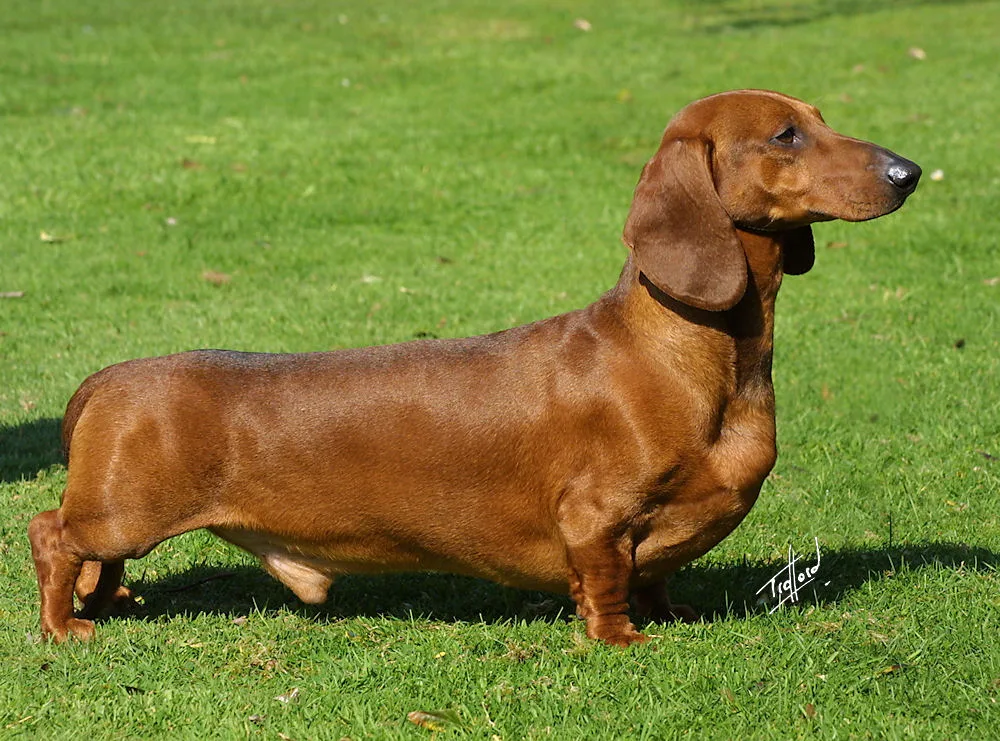
Dachshund health problems trace directly to its build. The breed is among the most recognisable in the world, but its distinctive elongated body and shortened legs come with a significant inherited vulnerability: intervertebral disc disease. Back problems are so prevalent in Dachshunds that the breed has become the primary model species for canine spinal cord injury research.
Beyond disc disease, Dachshunds are also prone to progressive retinal atrophy, patellar luxation, epilepsy, and several other conditions that require informed management throughout their lives.
For a comprehensive overview of Dachshund history, varieties, temperament, and general care, see Dachshund.
The Dachshund's Unusual Biology
The Dachshund's body shape results from chondrodysplasia, a genetic condition causing abnormal cartilage development that shortens the limbs while leaving the body length largely intact. The mutation responsible is a retrogene insertion of FGF4 (fibroblast growth factor 4) on chromosome 12, which is now called the CDDY (chondrodystrophy and intervertebral disc disease) variant.
This same mutation causes the intervertebral discs to undergo early mineralisation (calcification) instead of remaining fibrocartilaginous and supple. Mineralised discs are brittle and prone to sudden rupture into the spinal canal - a mechanism called Hansen Type I disc disease. In standard (non-chondrodystrophic) breeds, disc disease follows a different, slower course. In Dachshunds, it occurs younger, more acutely, and more severely, and it can occur with little or no preceding warning.
"Dachshunds have a lifetime risk of intervertebral disc disease estimated at 19-24%, approximately 10-12 times higher than the general dog population. The breed accounts for approximately 45-70% of all cases of thoracolumbar disc herniation in dogs seen at veterinary referral centres." (Stigen O, Christensen M, Acta Veterinaria Scandinavica, 2006; Goggin JE et al., JAVMA, 1970)
Summary Health Table
| Condition | Estimated Prevalence | Screening / Genetic Test |
|---|---|---|
| Intervertebral disc disease (IVDD) | 19-24% lifetime risk | MRI (imaging); CDDY genetic marker available |
| Progressive Retinal Atrophy (cord1-PRA) | Moderate; miniature Dachshunds elevated | DNA test (cord1 mutation) |
| Progressive Retinal Atrophy (prcd-PRA) | Low-moderate | DNA test |
| Patellar luxation | Moderate (miniature and toy types) | OFA orthopaedic evaluation |
| Epilepsy (idiopathic) | Elevated vs general population | Clinical diagnosis |
| Lafora disease | Low-moderate in miniature Wirehaired Dachshunds | DNA test |
| Acanthosis nigricans | Breed-specific form (Dachshund-specific) | Clinical examination |
| Obesity | Very high (management issue) | Body condition scoring |
| Cushing's disease (hyperadrenocorticism) | Elevated in older Dachshunds | Low-dose dexamethasone suppression test; ACTH stimulation |
| Hypothyroidism | Moderate | OFA thyroid panel |
Intervertebral Disc Disease
Intervertebral disc disease (IVDD) is the defining health problem of the Dachshund and one of the most important conditions in veterinary neurology. The combination of long vertebral column, chondrodystrophic disc mineralisation, and the mechanical stresses of jumping and stair-climbing creates an environment where disc herniation is a near-constant threat.
The spinal column consists of individual vertebral bones separated by intervertebral discs that act as shock absorbers. Each disc has a firm outer layer (annulus fibrosus) and a gel-like inner nucleus (nucleus pulposus). In a healthy disc, the nucleus remains contained within the annulus. In chondrodystrophic discs, the nucleus mineralises and becomes brittle; the annulus also weakens.
Under compressive force, the brittle nucleus can explosively rupture through the annulus and into the spinal canal, compressing the spinal cord or nerve roots.
In Dachshunds, IVDD most commonly occurs in the thoracolumbar region, specifically the disc spaces from T11 through L3, with T12-T13 and T13-L1 being the highest-risk locations. The next most common site is the cervical (neck) region.
Clinical signs depend on the location and severity of compression:
- Mild: spinal pain only - the dog cries when touched along the back, moves stiffly, arches the back, is reluctant to jump or climb
- Moderate: ataxia (uncoordinated, swaying gait), proprioceptive deficits (knuckling of the paws), paresis (weakness in the hindlimbs)
- Severe: complete hindlimb paralysis (paraplegia), incontinence (bladder and bowel)
- Critical: loss of deep pain sensation in the hindlimbs (a critical prognostic indicator)
The presence of deep pain sensation is the single most important prognostic factor. Dogs with intact deep pain and mild-to-moderate signs have very good outcomes with either medical or surgical treatment. Dogs with complete loss of deep pain sensation in the hindlimbs have approximately 50-60% chance of recovery with prompt surgical decompression, and poor prognosis if surgery is delayed.
"A systematic review of outcomes in Dachshunds with thoracolumbar IVDD found that among dogs treated surgically with intact deep pain sensation, >90% regained ambulation. In dogs without deep pain treated within 24 hours of onset, approximately 58% recovered ambulation; this dropped to 33% when surgery was delayed beyond 48 hours." (Levine JM, Levine GJ, Johnson SI et al., Veterinary Surgery, 2007, doi:10.1111/j.1532-950X.2007.00285.x)
Prevention and Risk Reduction
There is no way to eliminate IVDD risk in a Dachshund given the genetic basis of the condition, but several management practices significantly reduce the frequency of acute disc herniation events:
- Weight management: obesity dramatically increases compressive loading on discs. A lean Dachshund has substantially lower disc herniation risk than an overweight one. This is arguably the most impactful preventive measure within owner control.
- Ramps and steps: minimise the compressive impact of jumping down from furniture and into vehicles. The vertical deceleration force when a Dachshund jumps from sofa to floor is disproportionately concentrated in the long spine. Commercially available dog ramps and steps to all frequently used furniture positions are strongly recommended.
- Controlled stair use: frequent stair climbing adds cumulative spinal loading. Where possible, limiting stair use (carrying the dog on stairs) or providing access via ramps is beneficial.
- Harnesses: neck collars should be avoided for walking; harnesses distribute force across the chest rather than the cervical spine.
- Exercise: leash walking, swimming, and controlled play are preferable to high-impact activities involving jumping and twisting.
A genetic test for the CDDY/IVDD marker is available at several commercial laboratories. This does not have immediate utility in standard chondrodystrophic Dachshunds (all chondrodystrophic Dachshunds carry the allele) but has research and breeding implications when considering outcrosses or identifying higher-risk dogs within the population.
Lafora Disease
Lafora disease is an autosomal recessive progressive myoclonic epilepsy caused by a mutation in the EPM2B (NHLRC1) gene. In dogs, the condition has been primarily documented in Miniature Wirehaired Dachshunds, where it is moderately prevalent - studies suggest carrier rates of approximately 20-25% in the Miniature Wirehaired population.
Affected dogs typically begin showing signs between 5 and 9 years of age. The characteristic presentation is stimulus-sensitive myoclonic jerks - sudden brief muscle contractions triggered by flickering light, sudden sounds, or objects approaching from above the head. As the disease progresses, generalised seizures develop.
The myoclonic jerks are distinctive: a dog may suddenly throw its head back or whole-body flinch in response to a sudden movement above it - owners sometimes initially interpret this as startling or anxiety.
A DNA test is available. The condition is autosomal recessive, so two carriers bred together will produce 25% affected offspring. All Miniature Wirehaired Dachshund breeding candidates should be tested. Carriers are phenotypically normal.
"A survey of Miniature Wirehaired Dachshunds in the UK identified a NHLRC1 (EPM2B) mutation carrier rate of approximately 20% and an affected dog rate of approximately 5%, making Lafora disease the most common genetic epilepsy of Miniature Wirehaired Dachshunds." (Lohi H, Young EJ, Fitzmaurice SN, et al., PLOS Genetics, 2005, doi:10.1371/journal.pgen.0010003)
There is no cure for Lafora disease. Management involves anticonvulsant medication (levetiracetam, potassium bromide, phenobarbital) and practical environmental modifications to reduce triggers: avoiding rapid movements approaching the dog from above, maintaining consistent lighting, and using predictable, calm routines.
Progressive Retinal Atrophy
Dachshunds are affected by at least two distinct forms of Progressive Retinal Atrophy (PRA):
The cord1-PRA (cone-rod dystrophy 1) mutation is unique to Dachshunds and was originally identified in the breed. It is caused by a double insertion in the RPGRIP1 gene. This form is unusual because it appears to require a modifier gene at a second locus to cause clinical disease; dogs homozygous for the cord1 mutation may or may not develop PRA depending on the modifier genotype.
Clinical signs include day blindness (photophobia) progressing to complete blindness, often becoming apparent between 4 and 7 years.
The prcd-PRA mutation also occurs in Dachshunds at a lower frequency and causes progressive degeneration beginning with night blindness.
DNA tests are available for both mutations through OFA and commercial laboratories. The CAER ophthalmologist examination provides annual clinical monitoring. Because of the complexity of cord1 penetrance, breeders are advised to test breeding candidates for both mutations.
Acanthosis Nigricans
Acanthosis nigricans is a skin condition characterised by hyperpigmentation (darkening) and thickening of the skin, particularly in the axillae (armpits) and groin. In most dog breeds, acanthosis nigricans is secondary to another condition (atopy, hypothyroidism, obesity). However, in Dachshunds there is a breed-specific primary form - idiopathic Dachshund acanthosis nigricans - that occurs independently of any systemic disease.
Primary acanthosis nigricans in Dachshunds typically begins before age 1, presenting as dark velvety skin in the axillae. It is not painful or itchy in mild cases, but can progress to involve seborrhoeic changes, bacterial overgrowth in skin folds, and discomfort. Treatment with vitamin E supplementation, melatonin, and topical shampoos can manage signs.
Secondary acanthosis nigricans (in older Dachshunds, often due to hypothyroidism or Cushing's disease) requires treating the underlying condition.
Cushing's Disease
Hyperadrenocorticism (Cushing's disease) involves excess cortisol production, most commonly due to a pituitary microadenoma (pituitary-dependent Cushing's). Dachshunds, particularly middle-aged to older individuals, appear to have an elevated rate of pituitary-dependent Cushing's disease compared to many breeds.
Signs include: symmetrical hair loss, pot-bellied appearance from muscle wasting and fat redistribution, polydipsia (excessive thirst), polyuria (excessive urination), polyphagia (excessive appetite), skin thinning, and susceptibility to infections. Many owners initially attribute early signs to normal aging.
Diagnosis requires specific endocrine testing: low-dose dexamethasone suppression test (LDDST) or urine cortisol:creatinine ratio as initial screening, followed by an ACTH stimulation test for confirmation and differentiation of pituitary vs adrenal-dependent forms.
Treatment with trilostane (inhibits cortisol synthesis) or mitotane is effective. Regular monitoring of cortisol response to ACTH stimulation is required throughout treatment. Well-managed dogs can have several years of good quality of life following diagnosis.
Weight Management
Dachshund obesity is a major welfare concern and arguably the most preventable factor exacerbating every other condition on this list. The combination of a visually appealing deep-barrelled body (which conceals early weight gain), extremely high food motivation, and the tendency of owners to supplement with human food creates a perfect storm for obesity.
Excess weight dramatically increases the compressive force on intervertebral discs, exacerbates patellar luxation and joint disease, worsens respiratory effort, and contributes to Cushing's-like metabolic changes. Every kilogram of excess weight matters more in a 7-9 kg dog than in a 30 kg dog.
Body condition scoring (BCS) on a 5- or 9-point scale should be assessed at every veterinary visit. A lean, fit Dachshund should have a visible waist when viewed from above, a visible abdominal tuck when viewed from the side, and ribs that are easily palpable under only a thin layer of fat.
See Pet Exercise and Enrichment Guide for guidance on appropriate low-impact activity for Dachshunds.
Screening Recommendations
| Test | Timing | Recommended Body |
|---|---|---|
| CAER ophthalmology examination | Annual | OFA CHIC |
| cord1-PRA DNA test | Before first breeding | OFA CHIC |
| prcd-PRA DNA test | Before first breeding | OFA CHIC |
| Lafora disease DNA test | Before first breeding (Miniature Wirehaired) | Breed club / commercial labs |
| Patellar evaluation (OFA) | Before first breeding (Miniature/Toy) | OFA CHIC |
What to Ask a Dachshund Breeder
Before purchasing a Dachshund puppy:
- Ask whether both parents have been DNA tested for cord1-PRA and prcd-PRA; request the result documentation
- For Miniature Wirehaired Dachshunds, ask for Lafora disease DNA test results for both parents
- Ask for CAER ophthalmology results (within 12 months)
- Ask for OFA patellar evaluation results for Miniature and Toy parents
- Ask about IVDD history in the line - no genetic test predicts individual risk in standard Dachshunds, but breeders with long histories in the breed will know which lines have higher recurrence
- Ask the breeder's policy on ramps and weight management - a breeder who does not provide ramps and monitors puppy weight is a positive indicator of good husbandry values
- Verify CHIC number at ofa.org
For reference on general preventive health, see Common Dog Illnesses Explained and Signs of a Healthy Dog.
References
- Stigen O, Christensen M. The prevalence of radiographic findings associated with intervertebral disc disease in chondrodystrophic and non-chondrodystrophic dogs. Acta Veterinaria Scandinavica. 2006;48(1):7. doi:10.1186/1751-0147-48-7
- Levine JM, Levine GJ, Johnson SI, Kerwin SC, Hettlich BF, Fosgate GT. Evaluation of the success of medical management for presumptive thoracolumbar intervertebral disk herniation in dogs. Veterinary Surgery. 2007;36(5):482-491. doi:10.1111/j.1532-950X.2007.00285.x
- Lohi H, Young EJ, Fitzmaurice SN, Rusbridge C, Chan EM, Vervoort M, et al. Expanded repeat in canine epilepsy. Science. 2005;307(5706):81. doi:10.1126/science.1102832
- Mellersh CS, Boursnell ME, Pettitt L, et al. Canine RPGRIP1 mutation establishes cone-rod dystrophy in miniature long-haired dachshund as a homologue of human Leber congenital amaurosis. Genomics. 2006;88(3):293-301. doi:10.1016/j.ygeno.2006.05.004
- Orthopedic Foundation for Animals. Breed Statistics: Dachshund. OFA, 2022. Available at: ofa.org
- Parker HG, VonHoldt BM, Quignon P, et al. An expressed Fgf4 retrogene is associated with breed-defining chondrodysplasia in domestic dogs. Science. 2009;325(5943):995-998. doi:10.1126/science.1173275
- Berendt M, Farquhar RG, Mandigers PJJ, et al. International veterinary epilepsy task force consensus report on epilepsy definition, classification and terminology in companion animals. BMC Veterinary Research. 2015;11:182. doi:10.1186/s12917-015-0461-2
Frequently Asked Questions
How common is back disease in Dachshunds?
Intervertebral disc disease (IVDD) is extremely common in Dachshunds, with a lifetime risk estimated at 19-24%. The breed accounts for approximately 45-70% of all thoracolumbar disc herniation cases seen at veterinary referral centres.
The risk stems from the same genetic mutation (FGF4 retrogene on chromosome 12) responsible for the breed’s shortened legs, which also causes early calcification of the intervertebral discs, making them prone to sudden, forceful rupture into the spinal canal.
How can I reduce my Dachshund's risk of back problems?
The most impactful steps are: maintaining a lean body weight (obesity dramatically increases disc loading), providing ramps or steps to all furniture the dog uses regularly to eliminate jump-down impacts, using a harness rather than a neck collar for walking, controlling stair access where possible, and avoiding high-impact activities involving jumping and twisting.
While disc mineralisation is genetic and cannot be prevented, the acute mechanical triggers for herniation can be reduced through these environmental modifications.
What is Lafora disease in Dachshunds?
Lafora disease is an autosomal recessive progressive myoclonic epilepsy caused by a mutation in the NHLRC1 gene. It primarily affects Miniature Wirehaired Dachshunds, with an estimated carrier rate of approximately 20% in that variety. Affected dogs begin showing signs at 5-9 years: sudden muscle jerks triggered by flickering light or movement above the head, progressing to generalised seizures. A DNA test is available.
Breeders should test all Miniature Wirehaired breeding candidates and avoid pairing two carriers.
What is cord1-PRA in Dachshunds?
Cord1-PRA (cone-rod dystrophy 1) is a form of progressive retinal atrophy caused by a double insertion in the RPGRIP1 gene. It is unique to Dachshunds and was originally identified in the breed. The mutation causes progressive degeneration beginning with day blindness (sensitivity to bright light) that progresses to complete blindness, typically becoming apparent between 4 and 7 years. A DNA test is available.
Notably, the mutation requires a second modifier gene to be fully penetrant, so homozygous dogs may not always develop clinical disease, but breeding clear dogs remains recommended practice.
What are the signs of disc disease in a Dachshund?
Early signs include: crying or yelping when touched along the back, arched or hunched posture, reluctance to jump, climb stairs, or be lifted, and stiff, slow movement. More severe signs include an uncoordinated gait, knuckling of the back paws (proprioceptive deficits), weakness in the hindlimbs, and in the most severe cases, complete hindlimb paralysis and inability to urinate voluntarily.
Any back pain or hindlimb weakness in a Dachshund should be treated as an urgent veterinary matter, not a wait-and-see situation, because outcomes are significantly better with prompt treatment.
What genetic tests should Dachshund breeders perform?
All Dachshund breeding dogs should have: cord1-PRA DNA test, prcd-PRA DNA test, and annual CAER ophthalmology examination. Miniature and Toy varieties should also have OFA patellar evaluation. Miniature Wirehaired Dachshunds should additionally have Lafora disease DNA testing. A CHIC certification number, verifiable at ofa.org, confirms all required tests have been completed and results are publicly registered.
Breeders should be transparent about any IVDD or Cushing’s disease history in their lines.