
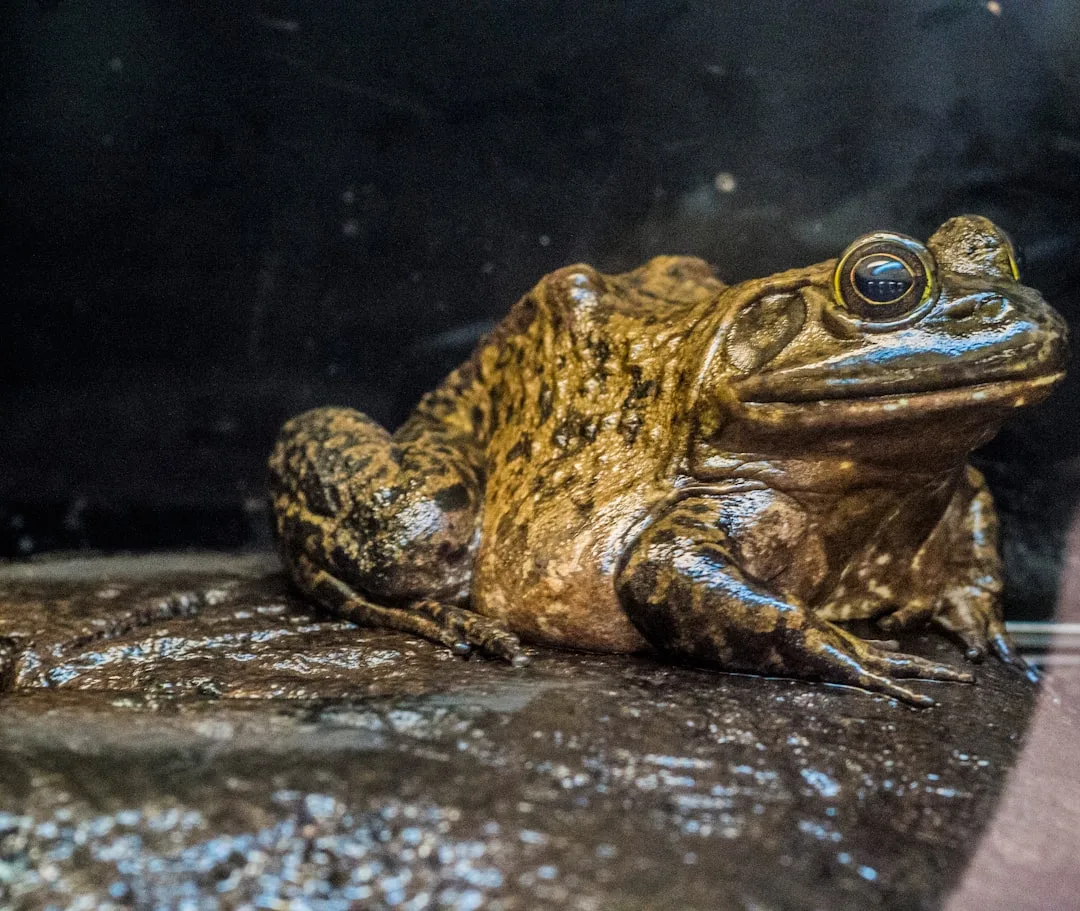
The goliath frog is the largest living frog on Earth. An adult can weigh more than three kilograms, stretch nearly ninety centimetres with the hind legs extended, and launch itself across three metres of river in a single jump. No other extant frog comes close on any of these measures.
Conraua goliath is also one of the strangest anurans alive: it has no vocal sac and produces no mating call, it builds stone nest 'ponds' for its eggs - a behaviour only documented in 2019 - and it survives in a single narrow band of fast-flowing rainforest rivers in Cameroon and Equatorial Guinea, a habitat that is disappearing faster than the species can adapt.
This guide covers every major aspect of goliath frog biology and ecology: size and anatomy, river habitat, diet, the unusual nest-building behaviour, silent courtship, tadpole specialisation, life cycle, conservation status, and the human pressures that have reduced the species to an endangered remnant of its former range. It is a reference entry rather than a summary, so expect specifics - grams, metres, dates, and verified records.
Etymology and Classification
The scientific name Conraua goliath combines the genus Conraua, named by German herpetologist Gustav Nieden in 1908 after Paul Conrau, a colonial-era collector who shipped the first specimens out of Cameroon, and the species epithet goliath, a transparent reference to the giant of 1 Samuel. The name reflects how remarkable the species appeared to early European naturalists who encountered adult frogs larger than any they had ever seen.
The goliath frog sits in the family Conrauidae, a small African family of river-associated frogs sometimes treated as a subfamily of Ranidae. The genus Conraua contains six recognised species, all restricted to sub-Saharan Africa, and all specialists of fast-flowing forest streams. C. goliath is the giant of the genus - its nearest relatives are a fraction of its size.
In local Cameroonian languages the species carries several names, including bebe and nia-moa, reflecting its cultural prominence as both a food source and a striking feature of riverine forest life. The 'largest frog in the world' is not folklore; it has been the scientific record-holder since it was first weighed and measured in the early twentieth century.
Size and Physical Description
Goliath frogs are built like no other anuran alive. Size in this species is so extreme that accurate measurements surprise even experienced herpetologists.
Adult dimensions:
- Snout-to-vent length: 17-32 cm
- Total length with legs extended: up to 87 cm
- Weight: 2.0-3.25 kg in verified specimens
- Hind leg length: roughly equal to body length
- Eye diameter: up to 2.5 cm - among the largest of any frog
Body plan:
The body is heavy, muscular, and broad, with a flattened head, prominent tympanic membranes, and granular, olive-green to brown dorsal skin that provides close camouflage against wet river rocks. The underside is yellow-orange to pale cream.
The hind limbs are enormously powerful and proportionally long, carrying the musculature that powers both the three-metre jumps and the short bursts of swimming used to clear rapids. The forelimbs are shorter but unusually strong for a frog; they absorb the impact of hard landings on rock.
Unusually for a modern frog, adult goliath frogs retain a bony secondary palate in the roof of the mouth - a primitive trait shared with some ancestral amphibian groups. Combined with their size, this anatomical detail has long fascinated palaeontologists interested in how very large frogs were built in deep time.
Sexual size dimorphism is modest. Males and females reach similar maximum sizes, although the largest recorded individuals have usually been males - a pattern consistent with male territoriality around stone nest sites.
River Habitat
Goliath frogs are extreme habitat specialists. The species inhabits a narrow band of West African lowland rainforest along the southern coast of Cameroon and the northern coast of Equatorial Guinea, centred on the drainages of the Mbini, Benito, and associated river systems. No natural population exists outside that band.
Within range, habitat requirements are strict:
- Fast-flowing, oxygen-rich rivers and streams with rocky beds
- Splash zones near waterfalls and cascades
- Dense riparian rainforest cover that keeps water cool and shaded
- Clear water with minimal silt load
- Rocky substrates suitable for tadpole grazing on Dicraeia algae
Adults rest on wet rocks at the river edge, typically at the interface between splash zone and forest floor. They forage along the water margin at dusk and during the night, retreating under rocks or into root cavities during the day. Individuals appear to hold small stretches of river as foraging territories, although precise home-range data are limited.
The combination of narrow geographic range and tight habitat requirements means almost any disturbance to a given stretch of river - logging, mining sediment, dam construction, silt runoff from farms - removes that stretch from goliath frog habitat, often permanently.
Diet and Hunting
Adult goliath frogs are opportunistic carnivores, using ambush rather than active pursuit. A typical foraging adult sits motionless on a rock at the river edge, often partly submerged, and strikes when prey comes within range.
Documented prey items:
- Aquatic and terrestrial insects - beetles, dragonflies, grasshoppers
- Crustaceans - freshwater crabs and shrimp
- Small fish
- Smaller frogs and tadpoles, including juveniles of their own species
- Arachnids, including scorpions and large spiders
- Worms, molluscs, and other soft invertebrates
- Small mammals, nestling birds, and snakes at the upper size range
Prey is captured with a ballistic tongue-strike for smaller items and a full-body lunge followed by a powerful jaw grip for larger ones. The bite is not venomous, but the jaws and the bony palate together generate enough force to hold and swallow vertebrate prey that most frogs would never attempt.
Tadpoles, by contrast, are obligate herbivores with a single-genus diet. They graze riverweed algae of the genus Dicraeia, which grows only on rocks in oxygen-rich, fast-flowing water - the same kind of rapid habitats the adults defend. Suction mouthparts let tadpoles cling to rocks against strong current while feeding. This dietary bottleneck is one of the strongest constraints on where the species can breed: no Dicraeia, no goliath frogs.
Stone Nest Construction - The 2019 Discovery
For most of the species' scientific history, goliath frog reproduction was assumed to follow the standard anuran pattern - eggs deposited in clumps and left to develop on their own. That assumption turned out to be wrong.
In August 2019, a team led by Marvin Schafer published field observations from the Mpoula River in western Cameroon showing that male goliath frogs actively construct nesting pools. The behaviour involves:
- Selecting a shallow, slow-water pocket at the edge of the main river channel
- Clearing leaf litter, sand, and small debris from the pocket floor
- Moving rocks - some weighing up to two kilograms - into a partial ring around the pool
- Guarding the nest site overnight, often with the adult male partially submerged in the pool
These stone nests are the first confirmed case of nest construction in any frog species and, because the task requires deliberate manipulation of heavy objects, the first confirmed case of tool use in frogs. The behaviour fundamentally changed how biologists think about anuran parental investment.
Females lay several hundred eggs in the prepared pool. The males guard the nest against predators - fish, other frogs, and snakes - for several days until the eggs hatch and tadpoles disperse into the main current. The enormous body size of adult goliath frogs makes sense in this context: a three-kilogram frog is large enough to move the rocks, fend off most rival animals, and physically block access to the nest.
Reproduction and Life Cycle
Goliath frog reproduction runs on a slow, highly seasonal schedule tied to the West African rainy season.
Breeding cycle:
- Late dry season - males establish territories along rocky river margins
- Early wet season - males construct and defend stone nest sites
- Peak wet season - females inspect multiple nests, select mates, deposit eggs
- After laying - males guard eggs until hatching (roughly 85-90 hours)
- Post-hatch - tadpoles develop in rapids for several months before metamorphosis
Female mate choice is not driven by acoustic signals. The species has no vocal sac and produces no call, which makes it one of the very few known silent frogs. Exactly which cues females use - nest quality, male size, scent, visual display - remains under active investigation, but nest construction appears to play a central role.
Tadpoles are large, streamlined, and strongly adapted to rapid water. They grip rocks with suction mouthparts and graze the Dicraeia algae film, developing slowly compared with tadpoles of most pond-breeding species. After metamorphosis, juveniles leave the main channel and begin the long period of growth toward adult size.
Sexual maturity takes approximately seven years - an extraordinarily long developmental timeline for a frog and one of the most important facts about goliath frog conservation. A hunted population cannot refill quickly; even a complete hunting moratorium would leave a given stretch of river without breeding adults for most of a decade.
Movement, Jumping, and Daily Activity
Goliath frogs are mostly sedentary but capable of explosive movement when needed.
| Metric | Value |
|---|---|
| Typical daily displacement | a few metres along river margin |
| Longest single jump (recorded) | approximately 3 m |
| Preferred activity period | dusk and night |
| Resting posture | crouched on wet rock, forelegs braced |
| Swimming style | powerful frog kick, short bursts |
| Underwater refuge duration | up to 15 minutes under cover |
Jumping ability is the species' signature athletic feat. A three-metre leap from a standing crouch is enough to cross a narrow rapid, clear a ledge, or escape an approaching predator. The legs generate the acceleration; the forelimbs and a dense connective tissue matrix in the chest absorb the landing.
This jumping ability was exploited in the twentieth century by collectors who shipped live goliath frogs to the United States for novelty 'frog-jumping' competitions - a trade that removed large numbers of breeding adults from Cameroonian rivers before awareness of the species' status caught up.
Population and Range
Goliath frogs exist in one continuous range across southern Cameroon and northern Equatorial Guinea, divided into a patchwork of locally distinct populations along river drainages. Precise global abundance is not known; no species-wide census has been conducted, and the dense rainforest terrain makes survey work slow.
Distribution by country:
| Country | Approximate range share | Key river systems |
|---|---|---|
| Cameroon | ~75% | Mpoula, Nyong tributaries, Sanaga |
| Equatorial Guinea | ~25% | Mbini (Benito) basin, coastal rivers |
Local studies where repeat surveys have been possible paint a consistent picture of decline. Research in the Mpoula region indicates population drops of more than fifty per cent over the past fifteen years. In some formerly well-known sites, goliath frogs appear to have vanished entirely in living memory.
Conservation Status and Threats
The IUCN Red List classifies Conraua goliath as Endangered with a decreasing population trend. The assessment is driven by direct evidence of steep local declines plus clear, ongoing threats across the species' range.
Primary threats:
- Bushmeat hunting. Goliath frogs are large, predictable, slow to mature, and considered high-quality protein. Adult frogs are targeted at night using torches, spears, and nets. Local markets in Cameroon sell goliath frogs by weight, and a single adult can represent meaningful income in rural economies. Hunting pressure has intensified as road access has reached previously remote river basins.
- Pet and curiosity trade. Collection for the international pet trade and for novelty exhibition has removed thousands of breeding adults since the mid-twentieth century. The frog-jumping competition trade from the 1940s through the 1970s was particularly damaging; live specimens were shipped to the United States in large numbers. Modern trade is more tightly regulated but continues at lower intensity.
- Deforestation and sedimentation. Logging, palm-oil expansion, subsistence farming, and small-scale mining along river corridors destroy the closed-canopy riparian forest that keeps streams cool, shaded, and free of silt. Silt-loaded water smothers Dicraeia algae and eliminates the tadpole feeding substrate, even when adult habitat appears intact.
- Dam construction and water infrastructure. Hydropower projects in Cameroon have flooded some stretches of suitable habitat and altered flow regimes in others. Goliath frogs cannot persist in slow or stagnant water.
- Climate-driven flow changes. Shifts in rainy-season timing and intensity threaten the match between tadpole development and stable flow conditions in breeding rapids.
Slow maturation - seven years to first breeding - means that even if every threat were removed today, population recovery would take decades. This is a species that can be eliminated from a river faster than the river can possibly replenish it.
Several conservation measures are active or proposed. Cameroon's Campo Ma'an National Park contains goliath frog habitat, though enforcement against hunting is uneven. Local NGOs work with riverside communities on alternative-protein projects and awareness campaigns. International pet-trade regulation has tightened.
Captive breeding has been attempted but is extremely difficult because the species requires fast-flowing, oxygen-rich water and a specific algal diet for tadpoles - conditions that are expensive and complicated to reproduce outside the wild.
The long-term outlook for the goliath frog depends on whether the intact forest-and-river corridors it needs can be protected in Cameroon and Equatorial Guinea before hunting and habitat loss tip remaining populations below recoverable thresholds.
Goliath Frogs and Humans
Human interaction with goliath frogs spans three phases - traditional, colonial-extractive, and conservation-era.
Traditional relationships in Cameroonian and Equatoguinean communities treat the frog as food, cultural symbol, and occasional ingredient in local medicine. Subsistence harvest, at the scale practised historically, did not appear to threaten the species; the collapse is a modern phenomenon linked to market access and population growth.
The colonial and mid-twentieth-century phase was exploitative. Large adults were collected in bulk for European museums, American zoos, and novelty jumping competitions. Many animals died in transit. Photographs from this era - a handler crouching beside a frog the size of a small dog - made goliath frogs an icon of tropical natural history but also accelerated their decline.
The current phase is a race between conservation action and ongoing pressure. Researchers have documented stone nest construction, measured population decline, and pushed the species onto the IUCN Endangered list. Protected areas cover a fraction of remaining habitat. Community-based programmes attempt to reduce hunting pressure by raising awareness of how slowly the species recovers.
The goliath frog's survival as a wild species now depends on whether those efforts can scale before too many river corridors are lost.
Related Reading
- Frogs and Toads: The Amphibians Vanishing Before Our Eyes
- Glass Frog
- Poison Dart Frog
- Red-Eyed Tree Frog
References
Relevant peer-reviewed and governmental sources consulted for this entry include the IUCN Red List assessment for Conraua goliath, Schafer et al. 2019 (Journal of Natural History) on goliath frog nest construction, population studies from the Mpoula River region of Cameroon, and historical natural-history literature documenting early twentieth-century collection and export. Specific figures reflect the most recent consolidated estimates available as of current IUCN assessments.
Frequently Asked Questions
How big is the goliath frog?
The goliath frog (Conraua goliath) is the largest living frog species on Earth. Adult body length, measured snout to vent, ranges from 17 to 32 centimetres. With the hind legs extended, total length can exceed 80 centimetres - longer than a domestic cat. Healthy adults typically weigh 2 to 3 kilograms, and verified specimens have reached 3.25 kilograms, roughly the mass of a newborn human baby.
Males and females reach similar sizes, although the largest recorded individuals have usually been males. Tadpoles, by contrast, are unremarkably sized at hatching - the enormous growth happens during juvenile life.
Where do goliath frogs live?
Goliath frogs are endemic to a narrow band of West African rainforest that stretches along the fast-flowing rivers of southern Cameroon and northern Equatorial Guinea. The species does not occur naturally anywhere else. Within that range it is highly habitat-specific: adults require clean, oxygen-rich, fast-flowing water with rocky beds and dense riparian forest cover.
Breeding is tied even more tightly to whitewater rapids and splash zones near waterfalls, because the tadpoles can only graze the specialised riverweed algae that grow there. Loss of intact forest corridors and sediment from logging and agriculture quickly renders former streams uninhabitable.
Do goliath frogs really build stone nests?
Yes. In 2019 a team led by Marvin Schafer published field observations from Cameroon showing that male goliath frogs clear, dig, and stack rocks - some weighing up to two kilograms - to create small pool-like depressions at river edges where females then lay their eggs. The behaviour is considered the first confirmed case of nest construction and, by extension, tool use in any frog species.
Males defend the stone nest against predators, and the sheltered pool protects eggs and early tadpoles from strong currents. The discovery reframed goliath frogs from ‘just a very large frog’ to an animal with unusually complex parental behaviour.
Why don't goliath frogs make any sound?
The goliath frog has no vocal sac - the inflatable throat pouch almost every other frog uses to amplify calls - and produces no advertisement call. Males attract mates through the construction and defence of stone nests rather than acoustic displays. This makes Conraua goliath effectively a silent frog, one of very few anuran species in the world where courtship does not involve calling.
Biologists are still investigating which sensory channel drives female choice - visual cues, nest quality, scent, or some combination - but the absence of calling is confirmed through both field recording and anatomical study of the throat.
What do goliath frogs eat?
Adult goliath frogs are opportunistic carnivores. Stomach content studies show a diet that includes aquatic insects, crustaceans such as crabs and shrimp, small fish, smaller frogs, scorpions, spiders, worms, and occasionally small mammals or birds that stray too close to the waterline. Hunting is almost entirely ambush-based - the frog sits motionless on a wet rock at the river edge and lunges when prey moves within range.
Tadpoles follow a completely different strategy: they are obligate grazers on a single genus of riverweed algae, Dicraeia, that grows on rocks in whitewater rapids. This dietary specialisation is one reason the species cannot survive in slow or silt-loaded rivers.
Are goliath frogs endangered?
Yes. The IUCN Red List classifies Conraua goliath as Endangered with a decreasing population trend. Local studies in Cameroon suggest population declines exceeding fifty per cent over the past fifteen years. Three pressures drive the collapse. First, bushmeat hunting: goliath frogs are large, slow, predictable, and prized as food. Second, the international pet and curiosity trade, which targeted large adults for decades.
Third, deforestation and mining along the species’ narrow river corridors, which silts up rapids and destroys the rocky breeding sites that tadpoles need. Slow maturation - about seven years to first breeding - means local populations, once depleted, recover very slowly or not at all.
How far can a goliath frog jump?
Goliath frogs can leap up to three metres in a single bound. This is respectable for a frog and extraordinary for an animal of this mass, since jump distance scales poorly with body size. The enormous hind legs - each roughly as long as the body - generate the acceleration, while strong forelimbs absorb landing impact. In the wild these leaps are used to clear rapids, hop between boulders, and escape predators or pursuing humans.
In the mid-twentieth century the species’ jumping ability made it a target for novelty ‘frog-jumping’ competitions in the United States, and adults were exported in the thousands before the trade was curtailed.
How long do goliath frogs live?
Wild goliath frogs are estimated to live around fifteen years, although precise life-history data are limited because the species is hard to study in the dense rainforest rivers it inhabits. Captive individuals, when conditions are right, have reached approximately twenty-one years. Growth is slow and continuous throughout life - individuals keep adding length and mass for many years, which is why the largest recorded frogs tend to be the oldest.
Sexual maturity is reached at roughly seven years. Combined with the species’ habitat specificity and silent breeding biology, this slow pace of life leaves goliath frog populations acutely vulnerable to sustained hunting or habitat disturbance.