
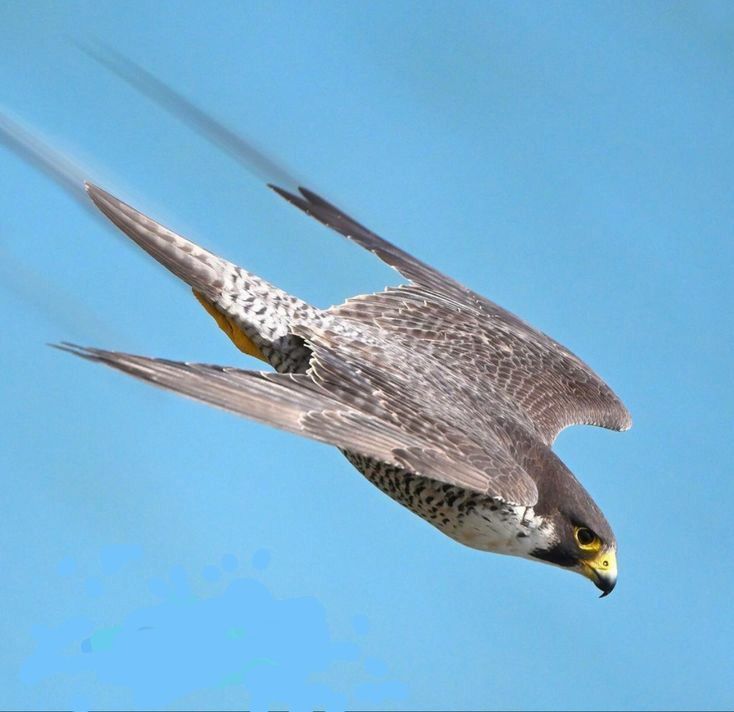
The peregrine falcon is the fastest animal on Earth. No cheetah on land, no swordfish in water, and no swift in level flight comes close to the speed a peregrine reaches during its power dive. In a vertical stoop from altitude, Falco peregrinus has been recorded at 389 kilometres per hour - faster than a Formula 1 car on the straight.
That single number is why the species is famous, but it is only one entry in a much stranger biological story.
Peregrines nest on every continent except Antarctica, occupy habitats from Arctic tundra to the cores of major cities, kill other birds in mid-air with a clenched-fist strike, and staged one of the great conservation comebacks of the twentieth century after DDT nearly wiped them out of the northern hemisphere.
This guide covers every aspect of peregrine biology and ecology: size and sexual dimorphism, the mechanics of the stoop, vision and sensory equipment, hunting technique, diet, reproduction, subspecies, urban adaptation, falconry history, and the DDT recovery. It is a reference entry, not a summary - so expect specifics: kilograms, metres, kilometres per hour, dates, and verified records.
Etymology and Classification
The scientific name Falco peregrinus translates roughly as 'wandering falcon' or 'pilgrim falcon' - peregrinus is the same Latin root that gives English 'peregrine' and 'pilgrim'. The name was applied in medieval falconry to birds taken as passage migrants rather than from the nest, because peregrines move enormous distances between their breeding grounds and wintering quarters.
The genus Falco contains roughly 40 species of true falcons, distinguished from hawks and eagles by narrow pointed wings, a notched beak with a tomial tooth, dark eyes rather than yellow, and a killing bite to the neck rather than a crushing grip with the talons.
Taxonomically the peregrine sits in the order Falconiformes and family Falconidae. Despite superficial similarities, falcons are not closely related to hawks or eagles - molecular phylogenetics in the 2000s showed that Falconiformes are actually the sister group of parrots and songbirds, and share a most recent common ancestor with hawks roughly 60 million years ago.
Within Falco, the peregrine's closest relatives are the barbary falcon, the lanner, and the saker; together these form a species complex whose boundaries are still debated.
Nineteen subspecies of F. peregrinus are currently recognised, covering almost every terrestrial environment the species inhabits. The nominate subspecies F. p. peregrinus breeds across Europe and temperate Asia. F. p. tundrius occupies the high Arctic of North America and Greenland. F. p. anatum is the historic North American form, now genetically mixed with released captive stock.
F. p. pealei inhabits the Pacific coast of North America and is the largest peregrine on Earth, with heavy females approaching 1.5 kg. F. p. madens on the Cape Verde Islands is the smallest and the only subspecies considered globally threatened.
Size and Physical Description
Peregrine falcons show extreme reversed sexual dimorphism, meaning females are substantially larger than males. This pattern is typical of raptors and is thought to reflect a division of labour during breeding: males hunt smaller, more agile prey while females guard and feed nestlings.
Females:
- Length: 45-58 cm from head to tail
- Wingspan: 95-120 cm
- Weight: typically 800-1,500 g; record individuals over 1.6 kg
Males (tiercels):
- Length: 34-45 cm
- Wingspan: 74-100 cm
- Weight: 330-750 g
Chicks at hatching:
- Weight: roughly 30-40 g
- Length: about 8-10 cm
- Covered in cream-white down, blind for first few days
The word 'tiercel', traditionally applied to the male, comes from the Latin tertius - 'a third' - because male peregrines are roughly a third smaller by weight than the females they pair with. A large female of the Pacific subspecies pealei can weigh more than twice as much as a small male of the desert subspecies pelegrinoides.
Peregrines are built as airframes first and predators second. Every feature reduces drag or supports the violence of the stoop. The wings are long and pointed, with a sharp backward sweep that aerodynamicists would recognise as close to optimal for supersonic leading edges on a smaller scale. The breast is deep and keeled, carrying the massive flight muscles required for rapid acceleration.
The tail is relatively short and narrow, used as a rudder rather than a brake. The feet are strong but comparatively small for the bird's size, with long central toes tipped in curved black talons and equipped with rough scales that help grip prey at the instant of impact.
The plumage of an adult is unmistakable. The crown, nape, and 'moustache' below each eye are slate-grey to black. The upperparts are blue-grey barred with darker grey. The underparts are cream or white, cleanly barred with black. Juveniles are brown rather than grey above and vertically streaked rather than barred below, a pattern they keep until their first full moult at 12 to 18 months.
The cere - the fleshy band of skin above the beak - and the ring around each eye shift from pale blue-grey in juveniles to bright lemon-yellow in adults; experienced falconers use this colour change as a quick age indicator.
The Stoop: Fastest Animal on Earth
The stoop is a controlled vertical power dive from altitude. The peregrine climbs several hundred to more than a thousand metres above its prey, folds its wings tight against the body, and tips into a near-vertical descent. Gravity and strong downstrokes from the folded wings drive it past 200 km/h within seconds.
The verified record stands at 389 km/h (242 mph), recorded in 2005 by American skydiver Ken Franklin flying with a trained captive-bred peregrine named Frightful and instrumented with a GPS-linked altimeter. The bird was dropped from a Cessna at roughly 5,000 m, stooped toward a lure, and was timed across a calibrated altitude interval. Speeds of 320-350 km/h have been recorded in multiple independent trials.
Wild stoops are harder to measure precisely but typically fall between 150 and 240 km/h, with the full 300+ km/h descents reserved for long dives from great height.
At these speeds the aerodynamic load is enormous. A stooping peregrine at 300 km/h experiences dynamic pressure that would rupture the lungs of most birds. Two anatomical features keep the peregrine alive through the dive:
- Nasal baffles. Small bony cones sit inside each nostril, breaking up and slowing the oncoming air before it reaches the lungs. Aeronautical engineers copied the same principle in the inlet geometry of early jet engines, because it solves the identical problem: slowing supersonic or near-supersonic airflow enough for a delicate chamber to handle it.
- Nictitating membrane. A translucent third eyelid sweeps across the eye during the stoop, wiping the cornea clean of debris and moisture without blocking vision. This lets the falcon track prey throughout the dive without flinching.
The pull-out at the end of the stoop is itself extraordinary. To avoid smashing into the ground, a peregrine has to rotate its body through as much as 90 degrees in a fraction of a second. Biomechanical models estimate that stooping peregrines pull up to 25 g during the final recovery - more than three times the limit a trained human fighter pilot can sustain without a pressure suit.
Vision and Sensory Equipment
Peregrine vision is extraordinary even by raptor standards. Behavioural and anatomical studies indicate that peregrines resolve fine detail roughly 2.6 times better than humans. A peregrine perched on a skyscraper can track a pigeon-sized bird against cluttered ground more than a kilometre away and judge its speed accurately enough to plan an interception point.
Their eyes are forward-facing and proportionally huge, occupying a larger fraction of skull volume than in almost any other bird. Each retina carries two fovea - a deep central fovea optimised for distance vision and a shallow lateral fovea optimised for binocular depth perception. Photoreceptor densities in the central fovea exceed 1 million cones per square millimetre, roughly five times the density in a human retina.
Peregrines also see into the near-ultraviolet spectrum, which is thought to help them detect feather patterns and subtle colour differences between prey species. The eyes are protected by the nictitating membrane already described, and by a tough scleral ring that prevents deformation under dive loads.
Hunting and Diet
Peregrines are almost exclusively bird-eaters. Diet varies by region but pigeons and doves, shorebirds, ducks, starlings, and mid-sized songbirds dominate most populations. Urban peregrines specialise on feral rock pigeons, which provide a dense, predictable, non-migratory food supply. A few populations add bats taken at dusk, and some island subspecies rely heavily on seabirds. Mammalian prey is vanishingly rare and scavenging is uncommon.
Hunting techniques:
- The classic stoop. From a high perch or soaring position the peregrine spots prey below, climbs if necessary, then folds its wings and dives. The falcon strikes with a clenched foot rather than a grab, delivering a blow calibrated to stun or kill in a single impact, then circles back to collect the falling bird in mid-air.
- The tail-chase. In level flight, especially over open ground or water, the peregrine accelerates behind a fleeing bird and seizes it with a talon strike at full speed. Short bursts can exceed 100 km/h.
- The ringing flight. The peregrine climbs in tight spirals beneath prey that has detected the threat and is trying to gain altitude to escape. Falcon and prey alternate climbs until one exhausts. In many cases the prey stalls first and the falcon rolls on top.
- The perch ambush. Especially common among urban peregrines, where building ledges provide ideal launching platforms. The falcon sits concealed until a pigeon passes within striking range, then drops into a short steep stoop.
The killing bite is delivered with the tomial tooth, a triangular projection on the cutting edge of the upper beak. Peregrines apply it to the cervical vertebrae of prey, severing the spinal cord with a single precise bite. This distinguishes falcons from hawks and eagles, which kill with crushing talon pressure. An adult peregrine consumes roughly 70-150 g of meat per day and frequently caches excess prey on ledges for later.
Strike data:
| Metric | Value |
|---|---|
| Level cruise speed | 65-100 km/h |
| Typical stoop speed | 150-240 km/h |
| Verified record stoop | 389 km/h (Ken Franklin, 2005) |
| Pull-out g-load | up to ~25 g |
| Daily food intake (adult) | 70-150 g |
| Prey detection range | >1 km for pigeon-sized targets |
Life Cycle and Reproduction
Peregrines pair for life in most populations, returning to the same nest ledge - the 'eyrie' - year after year. Courtship begins in late winter with aerial displays: the male climbs above the female and performs a shallow stoop, passing prey to her in a mid-air transfer called a food pass. Pairs renew their bond annually through these flights.
Breeding schedule (temperate northern hemisphere):
- Late February to April: return to eyrie, courtship, copulation
- March to May: clutch laid, 3-4 reddish-brown eggs
- 29-33 days: incubation, mostly by the female
- Late April to June: hatching, chicks (eyases) develop in the nest
- 35-45 days: fledging, first flight from the ledge
- 2-3 months post-fledging: extended hunting education by parents
Peregrines do not build nests. They scrape a shallow depression in gravel, sand, or accumulated debris on a ledge and lay directly into it. Traditional nest sites are cliff ledges overlooking open country, water, or a valley that funnels prey past. Artificial substitutes - skyscraper setbacks, cathedral towers, bridge girders, nest boxes installed by conservation groups - are now used in many cities.
Fidelity to a specific ledge can persist for centuries: the Symonds Yat eyrie in England has been documented in continuous use since at least the 1300s.
Chicks hatch covered in cream-white down, with eyes opening at 5-7 days. They grow with extraordinary speed. By three weeks they have juvenile flight feathers emerging. By six weeks they are fledging. Parents teach hunting through a graduated sequence: first live prey dropped near the nest, then live prey released in flight for the young to catch, then full independent hunts. Juveniles typically disperse from their parents' territory 2-3 months after fledging.
Females typically produce one clutch per year. Most clutches contain three or four eggs; fives are occasional; sixes are very rare. Survival to the first breeding season is low - roughly 60-70% of juveniles die within their first year, mostly from starvation during the learning phase, collisions with man-made structures, predation on nests by great horned owls or eagles, and electrocution on power lines.
Global Distribution and Subspecies
The peregrine has one of the widest natural distributions of any bird. The species breeds on every continent except Antarctica and occupies habitats including Arctic tundra, temperate forests, Mediterranean cliffs, desert ranges, tropical coasts, oceanic islands, and increasingly the centres of major cities.
Recognised subspecies (selection):
| Subspecies | Range | Notes |
|---|---|---|
| F. p. peregrinus | Europe, temperate Asia | Nominate form, mid-size, dark |
| F. p. tundrius | Arctic North America, Greenland | Pale, long-distance migrant |
| F. p. anatum | Temperate North America | Historic form, genetically mixed post-DDT |
| F. p. pealei | Pacific Northwest, Aleutians | Largest subspecies, heavy-built |
| F. p. cassini | South America | Includes striking black 'kleinschmidti' morph |
| F. p. japonensis | Japan, northeast Asia | Island breeder, coastal |
| F. p. macropus | Australia | Reddish underparts |
| F. p. madens | Cape Verde Islands | Smallest, only globally threatened subspecies |
Northern populations are strongly migratory. Arctic birds travel to South America, southern Africa, or south Asia for winter, covering 10,000 km or more in a round trip. Temperate and tropical populations are often year-round residents. Migration routes follow coastlines and mountain ridges and concentrate spectacularly at hawk watch sites during spring and autumn passage.
The DDT Collapse and Recovery
Between 1950 and 1970, peregrine populations across North America, Europe, and parts of Asia collapsed. The cause was a family of synthetic organochlorine pesticides - DDT was the best known, but dieldrin, aldrin, and heptachlor contributed too. These chemicals passed up the food chain, concentrated in raptor tissues, and disrupted calcium deposition during eggshell formation.
Peregrine eggshells became so thin that they cracked under the weight of incubating parents. Breeding success fell to near zero across most affected regions.
The eastern North American population of F. p. anatum was effectively extinct by 1964. British populations fell by roughly 80%. Scandinavian birds crashed. Historic urban eyries in cities such as London, Philadelphia, and Montreal fell silent one by one.
Recovery came through a combination of regulation and direct action. DDT was banned in the United States in 1972, in the United Kingdom in 1984, and across most of Europe and North America in the same window.
Captive breeding programmes - The Peregrine Fund in the United States (founded 1970), the Canadian Wildlife Service, and multiple European projects - bred peregrines in purpose-built facilities and released young birds at historic eyries using a method called hacking. More than 6,000 peregrines were released in North America between 1974 and 1997.
The results were dramatic. Peregrines returned to former ranges, colonised new urban habitats, and expanded to population levels that in several regions now exceed pre-DDT baselines. The IUCN currently lists the species as Least Concern with an increasing global population trend. The peregrine falcon sits alongside the bald eagle as the flagship success story of post-DDT conservation.
Urban Peregrines
By the 1990s it was clear that peregrines were not just surviving in cities - they were thriving. Urban habitat turns out to suit the species almost perfectly:
- Artificial cliffs. Skyscrapers, cathedrals, bridges, and power-station chimneys provide the high exposed ledges with sheer drops that peregrines prefer for nesting and hunting.
- Unlimited pigeons. Feral rock pigeons are abundant, non-migratory, and calorically rich. They form the backbone of urban peregrine diets worldwide.
- Few predators. Great horned owls, golden eagles, and martens that raid wild cliff nests are largely absent from city centres.
- Mild microclimate. Urban heat island effects extend viable breeding seasons and reduce cold-related chick mortality.
- Human support. Conservation groups install nest boxes on buildings, webcams broadcast nests to wide audiences, and legal protection is strong.
Manhattan hosts more than a dozen breeding pairs. Chicago, Cleveland, Toronto, Berlin, London, Paris, Rome, Melbourne, Tokyo, and many other cities support established populations. In some cases urban nesting density exceeds that of surrounding wild habitat. The urban peregrine is also a cultural phenomenon: nest-camera livestreams regularly attract millions of viewers during breeding season, and the return of peregrines to historic city skylines is routinely celebrated in local media.
Falconry History
Humans have flown peregrines in falconry for roughly 4,000 years. Assyrian reliefs from around 2000 BCE show hooded falcons on a gloved fist, and the practice spread through Persia, Arabia, Mongol Central Asia, and medieval Europe, becoming a noble sport across multiple cultures. The species is prized for its speed, range, and willingness to pursue quarry over open ground.
Classical falconry equipment, still in use today, includes the hood that blocks vision and calms the bird, the jesses (leather straps on the legs), the creance (training line), the lure (a feathered weight swung on a cord to simulate prey), and the glove worn on the handler's fist. Training a young peregrine from the egg to reliable hunting takes months of daily work and is still considered one of the most demanding apprenticeships in traditional animal handling.
Modern falconry is regulated by wildlife laws in most countries and typically uses captive-bred birds rather than wild-caught stock. Falconers played a direct and indirect role in peregrine recovery after DDT - the captive breeding, hacking, and release techniques that restored wild populations were developed largely within falconry communities. UNESCO added falconry to its list of intangible cultural heritage in 2010, with peregrines, sakers, and gyrfalcons as the traditional flagship species.
Related Reading
- Peregrine Falcon: Fastest Animal on Earth
- Bald Eagle: America's National Bird
- Eagle Vision: 8 Times Better Than Humans
- Raptors: The Apex Predators of the Sky
- Harpy Eagle: The Strongest Raptor
References
Relevant peer-reviewed and governmental sources consulted for this entry include the IUCN Red List assessment for Falco peregrinus, The Peregrine Fund population monitoring reports, the Cornell Lab of Ornithology species account, and published research in The Auk, Ibis, Journal of Raptor Research, and Journal of Experimental Biology.
Stoop speed figures rely on the 2005 Ken Franklin / Frightful skydive trials and follow-up biomechanical modelling work by Tucker and colleagues. Urban population figures reflect the most recent city surveys as of the 2023 breeding season. Taxonomy follows the Clements Checklist and IOU World Bird List revisions current to 2024.
Frequently Asked Questions
How fast is a peregrine falcon?
The peregrine falcon (Falco peregrinus) is the fastest animal on Earth. In level flapping flight it cruises at 65-100 km/h, comparable to many other large falcons. Its extreme speeds come from the stoop - a near-vertical power dive from altitude. Typical hunting stoops are clocked between 150 and 240 km/h.
The highest scientifically verified speed is 389 km/h (242 mph), recorded in 2005 by skydiver Ken Franklin in tandem with a trained peregrine named Frightful, instrumented with a GPS-linked altimeter. The bird’s streamlined body, pointed wings, and dense feathering minimise drag, while specialised bony baffles inside the nostrils redirect the shock of oncoming air so the lungs do not rupture.
How do peregrine falcons hunt?
Peregrines are aerial hunters specialised to strike other birds in mid-air. A typical hunt begins with the falcon circling at altitudes of 300-1,000 m, scanning below for moving prey. When it spots a target, it folds its wings against its body and enters a stoop, accelerating to 200+ km/h within seconds.
At the moment of impact the peregrine clenches its talons into a fist; the closed foot delivers a blow that usually kills or stuns pigeon-sized prey outright. The falcon then circles back and collects the falling bird in mid-air or follows it to the ground. Peregrines also perform low-level horizontal chases, tail-chases through forest edges, and ambushes from perches, but the high-altitude stoop is the signature technique.
What do peregrine falcons eat?
Peregrines are almost exclusively bird-eaters. Prey varies by region but pigeons and doves, shorebirds, ducks, starlings, and songbirds make up the bulk of most populations’ diets. Large females can take prey the size of a mallard or grouse, while smaller males focus on sparrow- to pigeon-sized birds. Urban peregrines specialise on feral rock pigeons, which provide a dense, abundant year-round food source.
A handful of populations add bats caught at dusk, and a few island subspecies take seabirds. Peregrines very rarely eat carrion or mammals. An adult typically consumes 70-150 g of prey per day, caching excess on ledges for later meals.
Where do peregrine falcons live?
Peregrines have one of the widest natural distributions of any bird - they breed on every continent except Antarctica and occupy habitats ranging from Arctic tundra to tropical cliff coasts, high mountains, temperate forests, deserts, and increasingly the centres of major cities. The species is divided into 19 recognised subspecies adapted to these different environments.
Natural nest sites are typically cliff ledges overlooking open country or water, where a steep drop allows the bird to launch into its stoop. Urban populations substitute skyscrapers, cathedrals, bridges, and power-station chimneys for natural cliffs; New York City, London, Chicago, Berlin, and many others now host established breeding pairs. Northern populations migrate long distances in winter - the name ‘peregrinus’ itself means ‘wanderer’.
Are peregrine falcons endangered?
No. The IUCN currently lists the peregrine falcon as Least Concern with an increasing global population. This is one of the most successful conservation recovery stories of the twentieth century. Between 1950 and 1970, DDT and related organochlorine pesticides entered the food chain, concentrated in raptor tissues, and disrupted calcium deposition in eggshells. Peregrine eggs cracked under the weight of incubating parents, and breeding success collapsed.
The eastern North American population was effectively extinct by 1964, and European populations crashed to historic lows. DDT was banned in the United States in 1972 and across most of Europe shortly after. Captive breeding programmes - notably The Peregrine Fund, founded in 1970 - released thousands of young falcons across former ranges, and the species was delisted in the United States in 1999.
How long do peregrine falcons live?
Wild peregrines typically live 15-20 years, with most mortality concentrated in the first year of life. Roughly 60-70% of juveniles die before their first breeding season, mainly from starvation during the learning phase, collisions with windows and vehicles, predation by great horned owls and larger eagles, and electrocution on power infrastructure. Birds that survive to adulthood have high annual survival rates and can reach 20 years in the wild.
In captivity, with consistent feeding and veterinary care, peregrines have exceeded 25 years. They reach sexual maturity at 1-3 years of age, pair for life in most populations, and return to the same nest ledge year after year.
Why are urban peregrine falcons thriving?
Cities turn out to be excellent peregrine habitat for four reasons. First, skyscrapers, cathedrals, and bridges mimic the cliff ledges peregrines naturally prefer for nesting - high, exposed, with sheer drops for launching hunts. Second, feral rock pigeons provide a dense, year-round, energy-rich food supply that never migrates or hibernates.
Third, cities have far fewer great horned owls, golden eagles, and other predators that kill peregrine chicks at wild cliff nests. Fourth, warmer urban microclimates and reduced persecution allow higher nesting success. Conservation groups actively install nest boxes on buildings in many cities, and webcams broadcasting the nests have built public support.
Manhattan, Chicago, London, Melbourne, and dozens of other cities now host stable urban peregrine populations that in some cases exceed densities observed in surrounding wild habitat.
How are peregrine falcons used in falconry?
Humans have flown peregrines in falconry for roughly 4,000 years. Assyrian reliefs from around 2000 BCE show trained falcons on the fist, and the practice spread through Persia, Arabia, Central Asia, and medieval Europe, becoming an aristocratic sport across multiple cultures. Peregrines are prized in falconry for their speed, their willingness to pursue game birds at range, and their tractability in training.
Traditional falconry uses a hood to keep the bird calm, a lure to encourage stoops during training, and a pair of jesses - leather straps - on the legs. Modern falconry is regulated in most countries under wildlife laws and typically uses captive-bred birds rather than wild-caught stock.
The sport also contributed indirectly to conservation - falconers developed many of the captive breeding and reintroduction techniques that rescued peregrines from DDT-era collapse.