
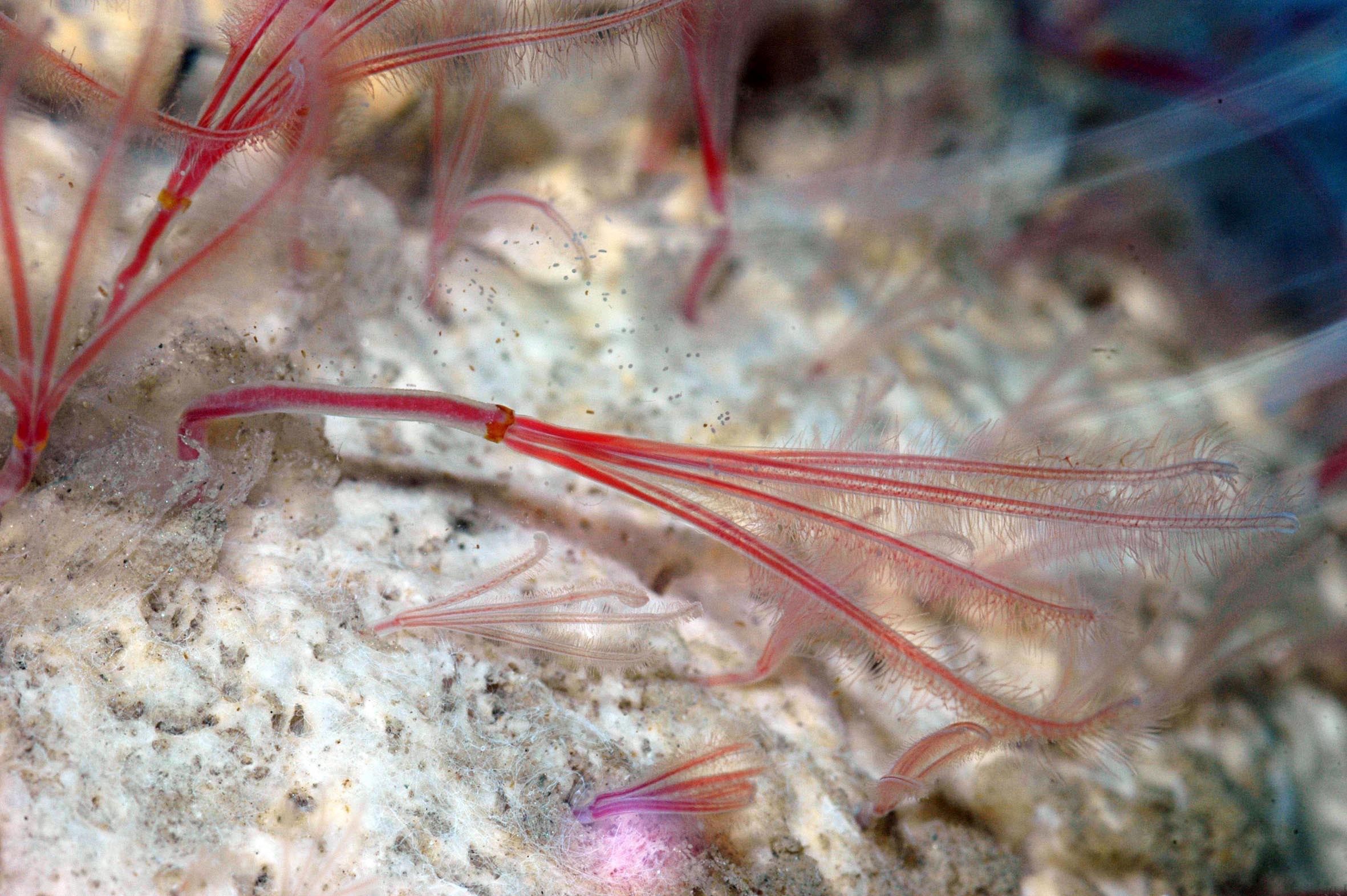
Quick Answer: Osedax, commonly known as bone-eating or zombie worms, are deep-sea annelids that specialize in consuming the bones of dead marine vertebrates, particularly whale falls. These worms lack mouths and stomachs, instead relying on symbiotic bacteria to digest bone material. Osedax play a crucial ecological role in recycling nutrients on the ocean floor, accelerating the decomposition of large carcasses and supporting diverse deep-sea communities.
The discovery of Osedax worms on whale carcasses revolutionized our understanding of deep-sea ecosystems. These remarkable organisms thrive in some of the planet’s most extreme environments, where sunlight never penetrates and food is scarce. The presence of large animal remains, such as whale bones, creates a temporary but rich resource for a specialized community of scavengers and decomposers. Among these, Osedax worms stand out for their unique biology and ecological function.
Unlike most annelids, Osedax have evolved extraordinary adaptations for life on the seafloor. Their bodies lack traditional digestive organs, and instead, they extend root-like structures into bones to extract nutrients. These roots house dense colonies of bacteria that break down fats and proteins, enabling the worms to access energy unavailable to most other organisms.
The worms’ soft, gelatinous bodies and feathery plumes make them well-suited for the cold, dark, and high-pressure conditions of the deep ocean.
The study of Osedax has shed light on the complex processes that govern nutrient cycling in the deep sea. By rapidly breaking down bones, these worms accelerate the return of essential elements to the ecosystem, supporting a cascade of other species.
Their discovery has also prompted new questions about the evolution of symbiosis, the dynamics of whale fall communities, and the resilience of life in extreme environments. The following sections explore the fascinating world of Osedax in detail, from their anatomy and life cycle to their ecological impact and evolutionary origins.
Anatomy and Unique Adaptations of Osedax
Osedax is a genus of deep-sea polychaete worms in the family Siboglinidae, distinguished by their ability to colonize and consume the bones of dead marine vertebrates. The most striking feature of Osedax is the absence of a mouth, gut, or anus. Instead, these worms have developed a set of root-like structures that penetrate bone surfaces, facilitating nutrient extraction through symbiotic relationships with bacteria.
The visible part of an Osedax worm consists of a soft, gelatinous trunk topped with feathery plumes. These plumes serve as gills, enabling gas exchange in the oxygen-poor environment of the deep sea. The trunk leads to a bulbous base from which the roots extend. These roots are not true roots in the plant sense, but highly vascularized extensions of the worm’s body that burrow into bones.
Within these roots, dense populations of endosymbiotic bacteria break down complex organic molecules, such as collagen and lipids, into simpler compounds that the worm can absorb.
Osedax worms exhibit extreme sexual dimorphism. Females are large and conspicuous, often reaching several centimeters in length, while males are microscopic and live inside the gelatinous tubes of females. This adaptation maximizes reproductive efficiency in an environment where finding mates is challenging. The males, numbering in the hundreds, fertilize eggs within the female’s tube, ensuring the continuation of the population.
The root system of Osedax is a key innovation, allowing the worms to exploit a resource that is otherwise inaccessible to most marine life. The symbiotic bacteria housed in the roots are essential for bone digestion, as the worms themselves lack the enzymes needed to break down collagen and lipids. This relationship exemplifies the deep interdependence between host and symbiont in extreme environments.
The worms’ soft bodies and lack of hard parts make them well-suited to the high-pressure, low-temperature conditions of the deep ocean, where flexibility and resilience are critical for survival.
Key Insight: Osedax worms have evolved a unique root system housing symbiotic bacteria, enabling them to extract nutrients from bones in the absence of a mouth or digestive tract.
The Whale Fall Ecosystem and Osedax’s Role
A whale fall occurs when the carcass of a whale sinks to the ocean floor, creating a localized oasis of nutrients in an otherwise barren environment. These events are rare but have profound ecological consequences, supporting complex communities that persist for decades. Osedax worms play a pivotal role in the decomposition of whale bones, accelerating nutrient release and shaping the succession of organisms that colonize the carcass.
The whale fall ecosystem unfolds in several stages. Initially, large scavengers such as sharks and hagfish strip the carcass of soft tissue. As the remains are reduced to bones, a specialized group of organisms, including Osedax, colonizes the site. Osedax worms rapidly invade the bones, using their root systems to access the rich stores of lipids and proteins within.
The activity of these worms breaks down the bone matrix, releasing nutrients that sustain a diverse array of bacteria, invertebrates, and other scavengers.
Osedax’s impact extends beyond nutrient cycling. By degrading bones, these worms alter the physical structure of the whale fall, influencing which species can colonize later stages. The rapid breakdown of bones by Osedax can reduce the duration of the whale fall ecosystem, shifting the balance of species present. This process highlights the dynamic interplay between decomposers and the broader community, with Osedax serving as both a facilitator and a competitor.
The presence of Osedax at whale falls has been documented in deep-sea environments worldwide, from the Pacific to the Atlantic. Their widespread distribution underscores their importance in global nutrient cycling and the maintenance of deep-sea biodiversity.
The study of whale fall ecosystems, including the role of Osedax, has provided valuable insights into the resilience and adaptability of life in the deep ocean. For more on the ecological significance of whale falls, see Britannica’s overview of deep-sea ecosystems.
| Stage of Whale Fall | Dominant Organisms | Duration (years) | Osedax Activity |
|---|---|---|---|
| Scavenger Stage | Sharks, hagfish, amphipods | 0.1 – 2 | Absent |
| Enrichment Stage | Bacteria, worms | 2 – 10 | Osedax colonization |
| Sulfophilic Stage | Chemosynthetic bacteria | 10 – 50 | Peak Osedax activity |
| Reef Stage | Sessile invertebrates | 50+ | Declining Osedax |
Symbiotic Bacteria: The True Digestive Power
The most remarkable aspect of Osedax biology is their reliance on symbiotic bacteria for nutrition. These bacteria reside within the root tissues of the worm, where they perform the crucial task of breaking down bone material. Without this partnership, Osedax would be unable to access the energy stored in bones, as they lack the necessary digestive enzymes.
The bacteria associated with Osedax belong to several lineages, many of which are still being characterized. These microbes metabolize collagen, lipids, and other organic molecules, converting them into compounds that the worm can absorb through its tissues. The relationship is obligate: both the worm and the bacteria depend on each other for survival in the nutrient-poor deep sea. This form of symbiosis is an example of mutualism, where both partners benefit from the association.
The process begins when the worm’s roots penetrate the bone, creating an interface for bacterial colonization. The bacteria secrete enzymes that break down the bone matrix, releasing nutrients that diffuse into the worm’s tissues. In return, the worm provides a stable environment and access to new bone surfaces as it grows. This partnership is so efficient that Osedax can reduce large bones to fragments within months, a process that would otherwise take decades.
The mutualistic relationship between Osedax and its symbiotic bacteria enables rapid bone decomposition, supporting nutrient cycling in deep-sea ecosystems.
Recent research has revealed that different Osedax species may harbor distinct bacterial communities, suggesting a high degree of specialization and co-evolution. This diversity reflects the complexity of deep-sea environments and the selective pressures that shape symbiotic partnerships. For more on symbiosis in marine life, see the Wikipedia entry on symbiosis.
Reproductive Strategies and Sexual Dimorphism
Osedax worms exhibit one of the most unusual reproductive systems among annelids. The pronounced sexual dimorphism in Osedax is characterized by large, egg-producing females and tiny, dwarf males that inhabit the tubes of females. This arrangement is an adaptation to the challenges of finding mates in the vast, sparsely populated deep sea.
Females colonize bones and develop extensive root systems, while males remain microscopic throughout their lives. Dozens to hundreds of males can be found within a single female’s tube, where they fertilize eggs as the female releases them. This system, known as harem polygyny, ensures that fertilization occurs efficiently even when population densities are low. The males subsist on yolk reserves and do not feed, focusing their energy entirely on reproduction.
The reproductive cycle of Osedax is closely tied to the availability of bones. Females release thousands of eggs, which develop into free-swimming larvae. These larvae drift with ocean currents until they encounter a suitable bone substrate, where they settle and metamorphose into either males or females depending on environmental cues. The first larvae to colonize a bone typically become females, while subsequent arrivals develop as males if females are already present.
This reproductive strategy maximizes the chances of successful colonization and rapid population growth in the unpredictable deep-sea environment. The ability to produce large numbers of offspring and the flexibility in sex determination are key factors in the success of Osedax as bone specialists. For more on sexual dimorphism and reproductive strategies in marine invertebrates, refer to Stanford University’s marine biology resources.
Diversity and Distribution of Osedax Species
Since their discovery, more than thirty species of Osedax have been described, each with unique morphological and ecological traits. These worms are found at depths ranging from a few hundred to several thousand meters, inhabiting ocean basins across the globe. The diversity of Osedax reflects the wide range of bone substrates available in the deep sea, from whale and fish remains to the bones of large marine reptiles in ancient times.
Osedax species differ in the structure of their plumes, root systems, and reproductive organs, adaptations that may reflect specialization for different types of bones or environmental conditions. Some species are restricted to particular ocean basins, while others have a cosmopolitan distribution. The dispersal of Osedax larvae by ocean currents enables colonization of new whale falls and other bone-rich habitats over vast distances.
The discovery of Osedax on non-whale bones, such as those of large fish and even ancient marine reptiles, suggests that these worms have a long evolutionary history. Fossil evidence indicates that bone-eating worms similar to Osedax may have existed for tens of millions of years, predating the rise of modern whales. This ancient lineage highlights the adaptability and resilience of Osedax in exploiting ephemeral resources in the deep sea.
Osedax worms are globally distributed, with species diversity reflecting adaptation to a variety of bone substrates and deep-sea habitats.
For a comprehensive overview of Osedax diversity, see the Wikipedia page on Osedax.
Evolutionary Origins and Fossil Evidence
The evolutionary origins of Osedax are a subject of ongoing research. Molecular analyses suggest that Osedax is closely related to other siboglinid worms, such as Riftia and Lamellibrachia, which also rely on bacterial symbionts for nutrition. The divergence of Osedax from its relatives likely coincided with the emergence of large marine vertebrates, providing a new ecological niche for bone-eating specialists.
Fossilized bones from the Eocene and Oligocene epochs exhibit characteristic borings attributed to Osedax-like worms. These trace fossils provide evidence that bone-eating annelids have been present in marine ecosystems for at least 30 million years. The ability to exploit bones as a food source may have evolved in response to the availability of large carcasses following the evolution of whales and other marine megafauna.
The persistence of Osedax and its ancestors through multiple mass extinction events underscores the resilience of symbiotic partnerships in extreme environments. The evolutionary success of Osedax is linked to its capacity for rapid colonization, efficient nutrient extraction, and flexible reproductive strategies. These traits have enabled Osedax to persist and diversify in the deep sea, shaping the dynamics of whale fall ecosystems and influencing nutrient cycling on a global scale.
Fossil evidence of Osedax borings in ancient bones indicates a long evolutionary history of bone-eating annelids in marine environments.
For more on the evolutionary history of deep-sea organisms, consult the Britannica entry on deep-sea biology.
Ecological Impact and Interactions with Other Species
The ecological impact of Osedax extends far beyond the decomposition of bones. By accelerating the breakdown of large vertebrate remains, Osedax worms facilitate the flow of nutrients into the deep-sea food web. This process supports a diverse assemblage of organisms, from bacteria and small invertebrates to larger scavengers and predators.
Osedax activity influences the succession of species at whale falls, shaping the composition and structure of the community over time. The rapid degradation of bones by Osedax can limit the availability of hard substrates for sessile invertebrates, such as sponges and corals, in later stages of the whale fall. This interaction highlights the complex balance between competition and facilitation in deep-sea ecosystems.
In addition to their role as decomposers, Osedax worms serve as prey for other organisms. Crustaceans, polychaetes, and even fish have been observed feeding on Osedax, integrating them into higher trophic levels. The worms’ tubes and root systems also provide microhabitats for a variety of small invertebrates, enhancing local biodiversity.
The presence of Osedax at whale falls accelerates nutrient cycling and supports a cascade of ecological interactions, underscoring the importance of decomposers in maintaining deep-sea biodiversity.
For further reading on ecological interactions in the deep sea, see the Encyclopedia of Life’s overview of whale fall communities.
Adaptations to Extreme Deep-Sea Environments
Survival in the deep sea requires a suite of physiological and behavioral adaptations. Osedax worms are well-equipped for this environment, with features that enable them to withstand high pressure, low temperature, and limited food availability. Their soft, flexible bodies minimize the risk of damage under pressure, while their reliance on symbiotic bacteria allows them to exploit a stable, energy-rich resource.
The ability to colonize bones rapidly is a key adaptation, as whale falls and other large carcasses are unpredictable and transient. Osedax larvae are capable of long-distance dispersal, increasing the likelihood of encountering suitable substrates. The worms’ reproductive flexibility, including the production of large numbers of eggs and environmentally determined sex, further enhances their capacity to exploit ephemeral resources.
The metabolic rates of Osedax are adapted to the cold, oxygen-poor conditions of the deep sea. The worms’ plumes maximize gas exchange efficiency, while their symbiotic bacteria are capable of functioning at low temperatures. These adaptations enable Osedax to persist and thrive in one of the most challenging habitats on Earth.
Common Misconceptions about Osedax
Despite growing scientific interest, several misconceptions about Osedax persist. One common myth is that these worms feed exclusively on whale bones. In reality, Osedax can colonize a variety of bone substrates, including those of large fish and, historically, marine reptiles. Their ability to digest different types of bones reflects their ecological versatility.
Another misconception is that Osedax are parasites. Unlike true parasites, Osedax do not harm living hosts but instead specialize in decomposing the remains of dead animals. Their role is that of a decomposer, not a pathogen. This distinction is important for understanding their ecological function and evolutionary history.
Finally, some believe that Osedax are rare or limited to a few ocean basins. In fact, these worms are globally distributed and have been found at whale falls and other carcasses in oceans worldwide. Their widespread presence underscores their significance in deep-sea ecosystems.
The Broader Significance of Osedax in Deep-Sea Ecology
Osedax worms exemplify the extraordinary adaptations and ecological roles that define life in the deep sea. Their discovery has transformed our understanding of nutrient cycling, symbiosis, and the resilience of biological communities in extreme environments. By breaking down bones and recycling nutrients, Osedax support the persistence of diverse assemblages of organisms, from microbes to megafauna.
The study of Osedax continues to yield new insights into the complexity of deep-sea ecosystems. Ongoing research explores the genetic diversity of Osedax, the evolution of their symbiotic partnerships, and their responses to changing ocean conditions. These investigations have broader implications for understanding the stability and functioning of marine ecosystems in the face of environmental change.
The ecological and evolutionary significance of Osedax highlights the interconnectedness of life in the deep sea and the importance of decomposers in sustaining biodiversity and ecosystem health.
Frequently Asked Questions
How do Osedax worms find whale bones in the vast ocean?
Osedax larvae drift with ocean currents until they encounter suitable bones, where chemical cues trigger settlement and metamorphosis.
Are Osedax worms dangerous to living animals?
No, Osedax worms only consume dead bones and do not attack or parasitize living animals.
Can Osedax worms survive without their symbiotic bacteria?
Osedax worms cannot digest bone material without their symbiotic bacteria, making the partnership essential for survival.
How long does it take Osedax to decompose a whale bone?
Osedax can reduce large whale bones to fragments within a few months, rapidly accelerating decomposition compared to natural decay.
Do Osedax worms only live on whale falls?
No, Osedax can colonize bones from various large marine animals, including fish and ancient marine reptiles.
What happens to Osedax when the bones are fully consumed?
Once the bone resource is exhausted, Osedax populations decline, and the worms die or disperse as larvae to find new bones.