
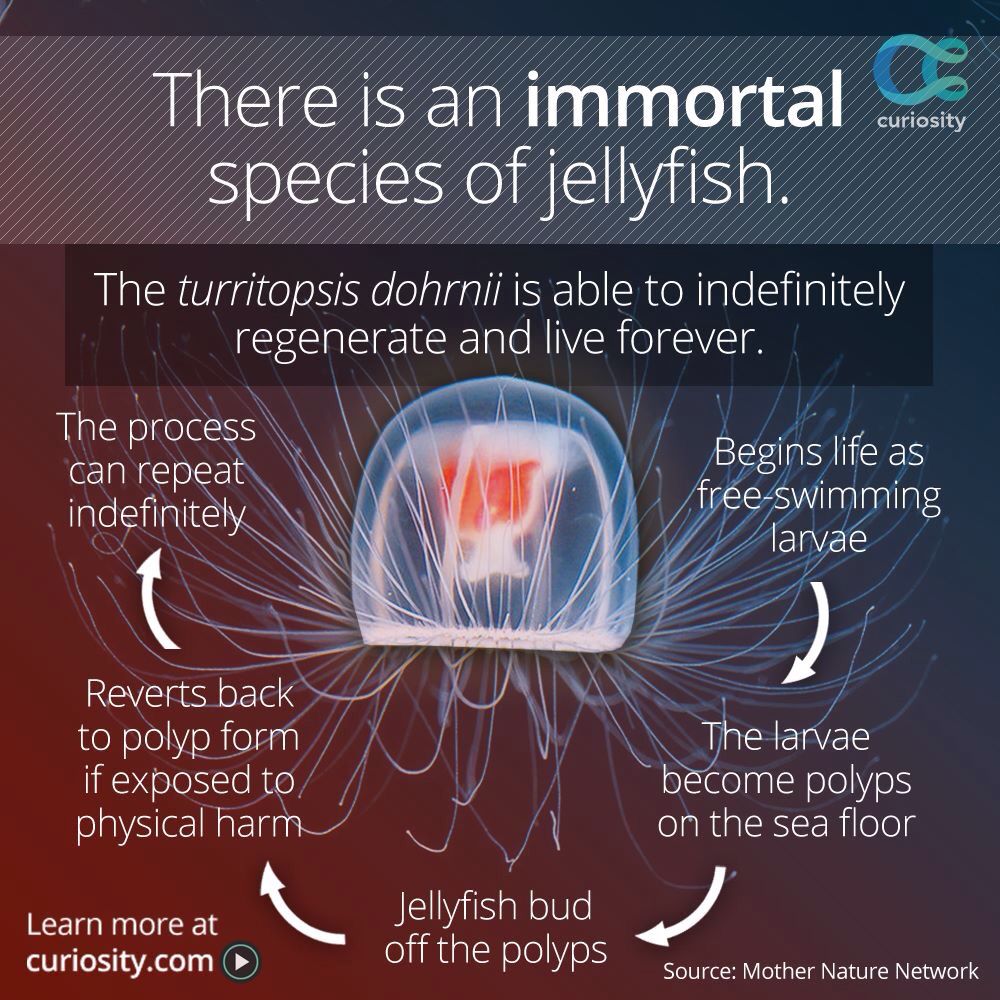
The immortal jellyfish is the only animal known to science that can reverse its life cycle naturally, cheating biological death not by living forever but by reverting to an earlier life stage. Turritopsis dohrnii is a tiny hydrozoan - adults reach only 4 to 5 millimetres across - and for most of its 140-year recorded history it was just another unremarkable member of the Mediterranean plankton community.
In 1988 an accidental observation in a jar at the Stazione Zoologica in Naples changed that, and the species has since become one of the most studied organisms in aging biology.
This guide covers every aspect of the immortal jellyfish: its anatomy, its reproduction, the mechanism of its famous life-cycle reversal, the history of its discovery, its global spread, the laboratories that keep colonies alive, and the real limits of its immortality. It is a reference entry, not a summary, so expect specifics: millimetres, weeks, gene families, tank temperatures, and the names of the biologists who figured it out.
Etymology and Classification
The genus Turritopsis was established in the nineteenth century for a small group of hydrozoans distinguished by their tall, bell-shaped medusae with a ring of stinging tentacles along the margin. The specific epithet dohrnii honours Anton Dohrn, the German zoologist who founded the Stazione Zoologica in Naples in 1872.
Dohrn's institute was - and remains - one of the world's leading centres for marine invertebrate research, and a large number of Mediterranean species carry his name. Turritopsis dohrnii was originally described by August Weismann in 1883 and spent more than a century on the books as an ordinary, unremarkable member of the Mediterranean plankton.
In modern taxonomy Turritopsis dohrnii sits in the phylum Cnidaria, class Hydrozoa, order Anthoathecata, and family Oceaniidae. That phylum also contains corals, sea anemones, and the true jellyfish of class Scyphozoa. Hydrozoans differ from scyphozoans in having a more prominent polyp stage in their life cycle and much smaller, simpler medusae.
Turritopsis dohrnii is not a "true" jellyfish in the scyphozoan sense - it is a hydromedusa, a structurally simpler animal with a stalked colony stage that dominates most of its lifetime.
The genus contains several closely related species including Turritopsis nutricula, Turritopsis rubra, and Turritopsis polycirrha. For years these species were confused in the scientific literature, and the most famous popular-science reports of "the immortal jellyfish" often cited T. nutricula when the reverse-aging observations had actually been made on T. dohrnii.
A 2007 review by Miglietta and colleagues clarified the taxonomy and established T. dohrnii as the species with documented life-cycle reversal.
Size and Physical Description
Turritopsis dohrnii is among the smallest of the recognised jellyfish species. The adult medusa is bell-shaped, nearly transparent, and measures only about four to five millimetres in diameter - roughly the size of a grain of rice or a small lentil. A fully grown adult sits comfortably on a fingernail. Individual polyps in the colony stage are less than a millimetre tall.
Adult medusa:
- Bell diameter: 4-5 mm
- Bell height: roughly equal to diameter
- Tentacles: 80-90 slender, stinging
- Body transparency: near-complete
- Stomach: bright red or orange, visible through bell
- Weight: essentially negligible - measured in micrograms
Polyp colony:
- Individual polyp height: 0.5-1.0 mm
- Colony footprint: typically 1-5 cm^2 on substrate
- Appearance: branching, almost plant-like
Juvenile stages:
- Planula larva: about 0.2 mm, ciliated, free-swimming
- Early medusa bud: 0.5-1 mm when released from polyp
The bell is hemispherical with a thickened apex. The mesoglea - the jelly layer between the outer and inner tissue layers - is thin compared with large scyphozoan jellyfish. A distinctive bright red ring surrounds the stomach and radial canals, which is the easiest field identifier under a microscope.
The 80 to 90 tentacles trail from the bell margin and carry stinging cells called nematocysts that the animal uses to capture plankton. The sting is harmless to humans - the animal is far too small and its nematocysts far too weak to penetrate human skin.
The Polyp-Medusa Life Cycle
Like most hydrozoans, Turritopsis dohrnii has a two-stage life cycle: a sessile polyp and a free-swimming medusa. What makes this species unique is the direction of movement between stages.
Normal hydrozoan life cycle:
- Adult medusae spawn; egg and sperm combine in the water
- Fertilised egg develops into a ciliated planula larva
- Planula settles onto a hard surface and develops into a polyp
- Polyp grows into a colony and buds small medusae
- Medusae drift off, mature, spawn, and eventually die
Turritopsis dohrnii variation:
- All of the above, PLUS:
- Under stress, the adult medusa can reverse the process
- Bell contracts, tentacles retract, animal settles
- Within 24-72 hours the medusa transforms into a cyst
- Cyst reorganises into a new polyp colony
- Polyp colony can bud new medusae, starting the loop again
The reversion is not triggered by a single signal but by general physiological stress. Documented triggers include starvation, injury, sudden temperature change, and certain chemical shocks. In the laboratory, biologists can induce reversion reliably by starving a medusa for several days or by damaging its bell. In the wild, how often reversion happens is unknown - field surveys are extremely difficult for an animal only a few millimetres wide.
The medusa stage itself lasts only two to four weeks under normal conditions. A medusa that escapes predation and finds enough food can mature, spawn, and then reproduce normally. A stressed medusa instead reverts. The two possibilities are not mutually exclusive: a single animal can contribute genes through sexual reproduction and then, later in life, reset to the polyp stage.
Transdifferentiation: The Cellular Mechanism
The key biological process behind the immortal jellyfish's life-cycle reversal is called transdifferentiation. In most animals, adult cells are terminally differentiated. A mature muscle cell stays a muscle cell for life, a mature nerve cell stays a nerve cell. Reprogramming a differentiated cell into a different type almost always requires first dedifferentiating it to a stem-cell-like state. Turritopsis dohrnii skips this intermediate step.
During reversion, cells in the jellyfish bell switch their gene expression programs directly. Muscle cells can become digestive cells. Nerve cells can become skin cells. The extent of the reprogramming is dramatic: researchers studying the process have documented changes in the expression of thousands of genes over a few days.
Key observations about transdifferentiation in T. dohrnii:
- Takes approximately 24 to 72 hours from stress trigger to cyst formation
- Polyp emergence from cyst takes a further 1 to 3 days
- No passage through a classical stem-cell stage required
- Many, possibly most, adult cell types can participate
- Genes involved in DNA repair, chromatin remodelling, and cellular plasticity are upregulated
- Process can be repeated many times by the same individual
A 2022 comparative genomics study by Pascual-Torner and colleagues, published in the Proceedings of the National Academy of Sciences, sequenced the genome of Turritopsis dohrnii and compared it with that of a closely related non-immortal species, Turritopsis rubra.
The researchers identified expansions and unique variants in gene families linked to DNA repair, telomere maintenance, stem-cell population control, oxidative damage resistance, and cellular senescence. These candidate genes do not explain the reversion ability on their own, but they point toward the molecular toolkit that makes it possible.
Transdifferentiation in small, limited ways exists in other animals - axolotls can regrow limbs, some fish can regenerate heart tissue, and zebrafish can convert certain cell types - but no other known animal deploys the process to reverse an entire adult-to-juvenile life-cycle transition.
Discovery and Research History
The scientific discovery of the immortal jellyfish's reverse-aging ability is one of the more famous accidents in modern biology.
In 1988, a German biology student named Christian Sommer was working on a research project at the Stazione Zoologica in Naples, Italy. He was collecting hydrozoans from coastal waters and keeping them in glass containers to study their life cycles.
His specimens of Turritopsis dohrnii behaved unexpectedly: instead of aging and dying after reproduction, the adult medusae shrank, settled onto the glass, and within days had reorganised themselves into polyp colonies. Sommer, together with Giorgio Bavestrello, published early observations, though the initial reports did not immediately attract wide attention.
In 1992 Bavestrello, Christian Sommer, and Michele Sara published a paper describing the phenomenon in greater detail, initially attributed to a species they called Turritopsis nutricula. The formal description of the reverse-aging life cycle came in 1996 from Ferdinando Boero and Stefano Piraino at the University of Salento.
Piraino's group published in the journal Biological Bulletin, providing laboratory confirmation that the reversion was repeatable and describing the cyst-formation sequence in detail. This 1996 paper is the canonical citation for the species' immortality and the point at which it entered mainstream scientific literature.
Since then the animal has been studied intensively in a handful of laboratories around the world.
Major research centres:
- University of Salento, Italy - Stefano Piraino's group, founding work on reversion
- Stazione Zoologica Anton Dohrn, Naples - original collection site, continuing research
- Kyoto University Seto Marine Biological Laboratory, Japan - Shin Kubota's long-running cultures
- University of Oviedo, Spain - Pascual-Torner et al. 2022 comparative genomics
- National University of Ireland Galway - developmental and molecular biology studies
Professor Shin Kubota of Kyoto University has been the most persistent and visible researcher of the species. He has kept live cultures of Turritopsis dohrnii in his laboratory for more than three decades, hand-feeding small brine shrimp and recording repeated reversion events. Kubota has documented the same individual jellyfish cycling between medusa and polyp more than ten times.
He is also famous among marine biologists for composing songs and singing them in tribute to the immortal jellyfish, a quirky outreach campaign that has brought the species considerable public attention.
Habitat and Global Distribution
Turritopsis dohrnii was first described from the Mediterranean Sea and was long considered endemic to that region. The picture has changed dramatically since the mid-twentieth century. Molecular surveys now confirm populations on coasts across the world's temperate and tropical oceans.
Confirmed populations include:
- Mediterranean Sea (original range)
- Atlantic coast of the United States
- Gulf of Mexico
- Panama
- Japan, including Kyoto Prefecture
- Indo-Pacific (parts of Australia and Southeast Asia)
- Parts of the Black Sea
The dispersal mechanism is almost certainly human-assisted. The polyp stage is tiny, hardy, and can survive for long periods attached to a hard surface. Ship ballast water - the water that container vessels take on to balance their loads and then release at foreign ports - is known to transport many species of planktonic hydrozoans.
A colony of polyps growing on the inside of a ballast tank can be delivered to a new coast on the other side of the world. From the polyp colony, medusae bud and enter the local plankton. This mechanism has driven the global spread of many coastal invertebrates since the expansion of transoceanic shipping.
Once in a new environment, Turritopsis dohrnii survives well because it tolerates a wide range of temperatures and salinities, feeds on common plankton, and - thanks to the reverse-aging ability - can ride out poor conditions by reverting to polyp form. Whether the species outcompetes native hydrozoans in its introduced ranges is not well studied.
Diet and Feeding
Turritopsis dohrnii is a carnivorous plankton feeder at both life stages.
Adult medusa diet:
- Copepods and other microscopic crustaceans
- Rotifers
- Fish eggs
- Larval stages of other marine invertebrates
- Microscopic algae (occasionally, as incidental intake)
Polyp colony diet:
- Similar plankton, captured individually by each polyp
- Usually smaller prey sizes due to smaller mouth openings
The adult medusa pulses its bell gently to move through the water, sweeping plankton-laden water past its 80 to 90 tentacles. Stinging cells called nematocysts on the tentacles fire tiny barbed threads into passing prey, immobilising them. The prey is then passed to the central mouth and digested in a simple gastrovascular cavity. Digestion takes a few hours, and waste is expelled through the same opening - cnidarians do not have a separate anus.
Feeding and starvation both influence the reversion process. A well-fed adult medusa with abundant food will typically continue in medusa form, mature, spawn, and die or revert after an extended life. A starving adult medusa is much more likely to revert to the polyp stage. Biologists interpret this as an adaptive response: polyp colonies can survive leaner conditions than free-swimming medusae because they do not need to spend energy swimming and can remain dormant for long periods.
Limits of Immortality
The name "immortal jellyfish" is evocative, but it overstates the case. Turritopsis dohrnii is biologically immortal in a specific, limited sense: the species does not undergo senescence, the age-related decline in cellular function that normally leads to death in most animals. That does not mean individual jellyfish cannot die.
Causes of death in wild populations:
- Predation - fish, sea slugs, larger jellyfish, and some crustaceans prey on the medusa
- Disease - bacterial and parasitic infections can kill polyps and medusae
- Starvation - usually triggers reversion, but complete reversion failure is fatal
- Physical damage - harmful wave action, boat strikes, sediment burial
- Environmental shock - extreme temperature, salinity changes, pollution
- Pollution - chemicals, plastics, chronic contamination
In practice, the vast majority of wild Turritopsis dohrnii are eaten, crushed, or washed up long before they ever get a chance to demonstrate the reversion trick. The species is a routine item in the diet of plankton-feeding fish and invertebrate predators.
What the reversion does accomplish is the removal of one specific cause of death that is inevitable for almost every other multicellular animal: old age. No Turritopsis dohrnii has ever been documented dying because its cells wore out. Individual medusae kept in laboratory culture and protected from predators and disease can continue cycling between medusa and polyp indefinitely.
Research Importance and Medical Interest
The scientific significance of Turritopsis dohrnii has less to do with jellyfish biology than with what its cellular machinery might reveal about aging, cellular identity, and tissue regeneration more broadly.
Areas of current research:
| Research direction | Focus |
|---|---|
| Genomic characterisation | Identifying genes unique to or expanded in T. dohrnii |
| Transdifferentiation mechanism | Molecular pathway by which cells switch identity |
| Comparative aging biology | Differences from non-immortal close relatives |
| Regenerative medicine parallels | Potential analogues for mammalian cell reprogramming |
| Invasive species ecology | Impact of global spread on native communities |
The eventual medical application of this research is speculative. Cnidarians and mammals diverged more than 500 million years ago, and their cells differ in fundamental ways. A process that works in a four-millimetre jellyfish with a handful of tissue types is unlikely to transfer directly to a human body made of dozens of specialised tissues.
Still, the existence of a multicellular animal that performs natural cellular reprogramming at scale suggests that the biochemical obstacles to rewriting cell identity are not insurmountable. Even partial insights could inform regenerative medicine, wound healing, and treatments for age-related tissue failure.
Relation to Humans
Turritopsis dohrnii is not a threat to human health. Its stinging cells are too small and weak to penetrate human skin, and the animal is too tiny to interact with swimmers or boaters in any noticeable way. Ecologically, its main impact on human activities is indirect - as a globally dispersed invertebrate, it contributes marginally to the ongoing transformation of coastal plankton communities by ballast-water-driven species introductions.
Culturally, the species has become a powerful symbol in popular writing about biology, aging, and the limits of life.
Magazine features and documentaries have returned to Turritopsis dohrnii repeatedly since the mid-2000s, often framing it as "the jellyfish that holds the secret to eternal youth." Marine biologists are usually more measured: the mechanism is fascinating, the animal is genuinely unique, and the science is active - but the organism is not a medical miracle and its reset trick does not scale in any simple way to human biology.
Related Reading
- Jellyfish: Brainless Drifters That Rule the Ocean
- Box Jellyfish: The Most Venomous Sea Creature
- Moon Jellyfish: The Most Common Jellyfish
- Lion's Mane Jellyfish: The Largest Jellyfish
References
Primary references for this entry include Piraino et al. (1996) in Biological Bulletin for the original description of reverse-life-cycle behaviour; Miglietta et al. (2007) for the taxonomic revision clarifying T. dohrnii as the species responsible for the phenomenon; Pascual-Torner et al.
(2022) in the Proceedings of the National Academy of Sciences for the comparative genome analysis; and long-running culture work from the Kyoto University Seto Marine Biological Laboratory under Shin Kubota. Distribution records are drawn from the World Register of Marine Species and peer-reviewed surveys of ballast-water-introduced hydrozoans.
Frequently Asked Questions
Is the immortal jellyfish really immortal?
Not in the everyday sense. Turritopsis dohrnii is biologically immortal, which is a specific scientific concept meaning the animal does not undergo senescence - the gradual deterioration of function that normally ends in death from old age. Instead of dying of old age, a stressed or injured adult medusa can revert to an earlier life stage (the polyp) and begin its development again.
However, the animal is still easily killed by predators, disease, starvation, physical damage, and unfavourable environmental conditions. In the wild, the vast majority of Turritopsis dohrnii individuals are eaten, crushed, or washed up long before they ever have a chance to demonstrate the reversion trick. So the species has an escape hatch from aging, not from death itself.
How does transdifferentiation work?
Transdifferentiation is the direct conversion of one specialised adult cell type into another without first returning to a generic stem cell state. In Turritopsis dohrnii, when an adult medusa is stressed - usually by starvation, injury, or temperature shock - its bell contracts, tentacles retract, and the animal settles onto a surface. Over the next few days its cells reorganise.
Cells that had been performing specialised roles such as muscle contraction, digestion, or sensing switch gene expression programs and transform into polyp cells. The resulting cyst develops into a new polyp colony. This process effectively resets the biological clock. Transdifferentiation is known in a handful of other animals in small, limited ways, but Turritopsis dohrnii is unique in using it to reverse an entire adult-to-juvenile transition.
Where do immortal jellyfish live?
Turritopsis dohrnii was originally described from the Mediterranean Sea and was considered endemic to that region. Over the past few decades it has been identified in coastal waters around the world - Japan, the Atlantic coast of North America, Panama, the Gulf of Mexico, and along parts of Australia and the Indo-Pacific. Molecular studies suggest the species has been transported globally as polyps attached to ship hulls and inside ballast water.
The polyp stage is tiny, hardy, and sessile, which makes it an ideal long-distance hitchhiker. Adult medusae prefer temperate to warm coastal waters and are usually found near the surface or at moderate depths. Because they are only four to five millimetres across and nearly transparent, they are rarely noticed by beachgoers.
How big are immortal jellyfish?
Extremely small. Adult medusae measure roughly 4 to 5 millimetres in bell diameter - about the size of a grain of rice or a pencil eraser. A fully grown adult can comfortably sit on a fingernail. The polyp colonies are even smaller: individual polyps are typically less than a millimetre tall, and a whole colony might cover a few square centimetres of substrate.
Because of this tiny size, the species is effectively invisible in ordinary beach or boat observations. Most research specimens are collected by towing fine-mesh plankton nets or by scraping polyp colonies from harbour surfaces, then identifying them under a microscope. Their transparent tissue and a ring of bright red pigment around the stomach are the main visual identifiers.
Who discovered the immortal jellyfish?
The reverse-aging ability of Turritopsis dohrnii was discovered essentially by accident in 1988. Christian Sommer, a biology student from Germany, was studying hydrozoans at the Stazione Zoologica in Italy. He collected specimens and stored them in containers for observation. Instead of dying as expected, the stressed adult jellyfish shrank, settled onto the glass, and reorganised into polyps. He and Giorgio Bavestrello published early observations.
In 1996 Ferdinando Boero and Stefano Piraino at the University of Salento published the formal description of the species’ unique reverse-life-cycle behaviour in the journal Biological Bulletin, establishing it as a scientific phenomenon rather than a laboratory artefact. Professor Shin Kubota of Kyoto University has been the most persistent modern researcher of the species, maintaining live cultures for decades.
What do immortal jellyfish eat?
Immortal jellyfish are carnivorous plankton feeders. Adult medusae capture tiny prey using stinging cells on their 80 to 90 slender tentacles. Typical prey includes copepods and other microscopic crustaceans, rotifers, fish eggs, and larval stages of other marine invertebrates. The bell pulses gently to move the animal through the water, which sweeps prey-laden water past the tentacles.
Captured food is transferred to the central mouth and digested in a simple gastrovascular cavity. Polyp-stage colonies feed similarly, extending tiny stinging tentacles from each polyp to snatch plankton drifting by. Starvation is one of the triggers that can cause an adult medusa to revert to the polyp stage, which may be an adaptive response to low food availability: a polyp colony can survive leaner conditions than a free-swimming adult.
Can humans benefit medically from immortal jellyfish research?
Researchers hope so, but realistic applications are still distant. The main scientific interest lies in understanding how transdifferentiation is controlled at the molecular level. If scientists can identify the genes and signalling pathways that allow Turritopsis dohrnii cells to rewrite their identity, that knowledge could inform regenerative medicine, tissue engineering, and treatments for age-related diseases.
A 2022 comparative genome study identified several gene families linked to DNA repair and cell plasticity that appear expanded or uniquely regulated in Turritopsis dohrnii compared with a closely related non-immortal species. However, jellyfish are cnidarians with much simpler body plans than mammals, and translating their reset mechanism into human biology is likely to be extremely difficult.
For now the species is a model organism, not a source of a drug.
Why is the species called 'dohrnii'?
The species name ‘dohrnii’ honours Anton Dohrn, a German zoologist who founded the Stazione Zoologica marine research institute in Naples in 1872. Dohrn’s laboratory has long been one of the most important centres for marine invertebrate biology in the world, and it was there that much of the early work on Turritopsis and related hydrozoans was carried out. Many Mediterranean marine species bear Dohrn’s name in recognition of the institute’s contributions.
Turritopsis dohrnii was originally described by Anton Andres Weismann in 1883 - long before its reverse-aging ability was recognised. Scientists classified the species as an ordinary small hydrozoan for more than a century before the 1988 observations changed how the animal was understood.