
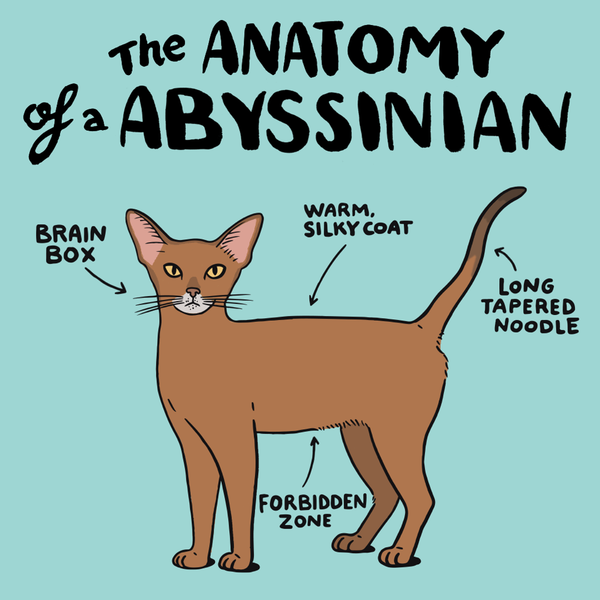
The Abyssinian is one of the most ancient and distinctive cat breeds in the world, a lithe, athletic, perpetually curious cat whose ticked coat creates the impression of a small wild animal compressed into a domestic package. It is not a lap cat. It is a cat that climbs to the highest point in any room, investigates every object within reach, and participates actively and loudly in every household activity.
Understanding the Abyssinian means understanding a cat built for motion, exploration, and engagement, and one that comes with both the rewards and the responsibilities that those qualities bring.
This guide covers the Abyssinian's disputed origins and genetic history, the biology of the ticked coat, colour varieties, temperament and behavioural requirements, known genetic health conditions and DNA testing options, lifespan, and what daily life with this particular breed genuinely requires.
Origins: A Disputed History
The Abyssinian's name suggests a clear geographic origin, Abyssinia is the historical name for Ethiopia, and for much of the breed's recorded history, the Ethiopian origin story was accepted without serious scrutiny. The earliest documented Abyssinian in the West was a cat named Zula, brought to England in 1868 by a British soldier returning from the Abyssinian Expedition.
Contemporary accounts described the cat as resembling wild cats from the Abyssinia region. This origin story became embedded in breed lore.
Modern genetic analysis has substantially complicated this picture. A landmark population genetics study by Lipinski et al., published in Genomics in 2008, examined microsatellite markers across 37 cat breeds and worldwide random-bred populations.
The study found that the Abyssinian's closest genetic relatives are not African cats but rather cats from Southeast Asia and the Indian Ocean region, specifically the coastal populations of South and Southeast Asia that were connected by centuries of maritime trade.
The authors suggested that ticked-coat cats were probably traded along Indian Ocean sea routes and that the breed's ancestors were more likely to have come from this trading network than from Ethiopia specifically.
The genetic findings do not definitively disprove the Ethiopian connection, the maritime trade networks of the 19th century Indian Ocean made cat movement across vast distances plausible. But they significantly weaken the straightforward narrative of an Ethiopian origin and suggest that the Abyssinian's heritage is more complex and geographically distributed than the name implies.
What is clear from the historical record is that once the breed arrived in Britain, it was enthusiastically developed by British breeders through the late 19th and early 20th centuries. The first breed standard was published by the National Cat Club in England in 1882.
The breed was imported to the United States in the early 20th century, and American breeding programs contributed significantly to the modern Abyssinian's type and colour range. The CFA recognised the Abyssinian as a championship breed in 1917.
The Ticked Coat: Biology and Appearance
The Abyssinian's most immediately distinctive feature is its coat, and specifically the ticking, a pattern in which each individual hair carries alternating bands of dark and light pigmentation.
This pattern is called the agouti pattern, and in the Abyssinian it is expressed in its most complete form: the ticking runs through the coat so uniformly that the cat appears to have no pattern at all from a distance, presenting a warm, glowing solid colour. Only on close examination, or in bright light that separates the individual hairs, does the banded structure become clear.
The genetic mechanism is the agouti signalling protein, which controls whether melanin-producing cells (melanocytes) produce dark (eumelanin) or light (phaeomelanin) pigment. In most tabby cats, the agouti gene switches between dark and light along the length of each hair, but also creates macroscopic pattern contrasts, stripes, spots, whorls, across the body.
In the Abyssinian, the ticked tabby gene (Ta) suppresses the macroscopic patterning while retaining the microscopic banding within each hair. The result is the wild, unstriped appearance that makes Abyssinians resemble small wild cats, agouti-coated species such as jungle cats, African wildcats, and several other felids share this pattern.
The ticking creates a depth of colour visible in natural light that is unlike any other coat pattern. The warm ruddy tone of a well-ticked ruddy Abyssinian shifts visibly as the cat moves, with the lighter bands within each hair creating highlights.
| Colour Variety | Description | Genetic Basis |
|---|---|---|
| Ruddy (usual) | Warm reddish-brown base with black ticking; brick-red nose leather | B- (black), aa (non-agouti not expressed), T^a (ticked tabby) |
| Chocolate (sorrel) | Coppery-orange base with chocolate ticking | bb (chocolate), T^a |
| Cinnamon | Lighter warm brown base with cinnamon ticking | b^l b^l (cinnamon) |
| Blue | Blue-grey base with steel blue ticking (dilute black) | B-, dd (dilute) |
| Fawn | Warm cream base with light ticking (dilute cinnamon) | b^l b^l, dd |
| Lilac | Pinkish-grey base with mauve ticking (dilute chocolate) | bb, dd |
The standard requires a minimum of four bands of ticking per hair on the body, with the base colour (lighter) at the hair root and a dark tip. The spine typically shows a dark dorsal stripe, and the legs carry darker markings at the toes. The tail is ticked along its length with a dark tip. The face has M-shaped markings on the forehead, dark lines from the outer corners of the eyes, and lighter tones on the muzzle, chin, and lower jaw.
Physical Characteristics and Size
The Abyssinian is a medium-sized cat with a physical type that emphasises lean athleticism over mass. The body is lithe, well-muscled, and neither cobby nor extreme in length. Adults typically weigh between 3.5 and 5.5 kg, with males at the upper end of that range. The impression is of a compact but powerful cat, dense muscle with no excess weight, built for explosive movement rather than sustained endurance.
The head is a modified wedge, neither as extreme as a Siamese nor as round as a British Shorthair. The ears are large and alert, wide at the base, and set at a slight outward angle. They are one of the breed's most expressive features: an Abyssinian's ears are in near-constant motion, tracking sounds and indicating the cat's attentional state. The eyes are large, almond-shaped, and vivid, typically amber, gold, or green, with a distinctive dark outline that accentuates their expressiveness.
The legs are long and slender relative to body size, and the paws are small and oval. The cat stands with a slight forward lean, an effect of the long legs and the athletic build, that gives it a permanent posture of readiness. The tail is long, tapering, and well-ticked.
| Physical Characteristic | Abyssinian |
|---|---|
| Weight (adult male) | 4-5.5 kg |
| Weight (adult female) | 3.5-4.5 kg |
| Lifespan | 9-15 years |
| Body type | Medium, lithe, athletic |
| Head type | Modified wedge |
| Eye colour | Amber, gold, or green; dark outlined |
| Coat pattern | Ticked tabby, no macroscopic striping |
| Activity level | Very high |
Temperament: The Clown of Cats
The Abyssinian has been called the clown of the cat world, a label that captures something real about the breed's relentless engagement with its environment. An Abyssinian is not a passive presence.
It is a cat that is always doing something, climbing to the highest available surface, batting objects off shelves with the systematic thoroughness of an experimenter, pushing through doors that are not quite latched, supervising food preparation from an elevated position, and vocalising its opinions in a chirping, talkative voice that is impossible to ignore.
The energy level is genuine and sustained. Abyssinians retain kitten-like play motivation well into adulthood and into old age. A five-year-old Abyssinian may be as active as a five-month-old domestic cat. This sustained energy is one of the breed's most celebrated characteristics among enthusiasts and its most challenging characteristic among owners who were unprepared for it.
The breed is not a lap cat in the conventional sense. An Abyssinian typically prefers to be near its people rather than on them, watching from a perch above the sofa, sitting beside (not on) a keyboard, investigating the contents of grocery bags. The emotional bond with its people is strong, but the expression of that bond is active and participatory rather than passive and warm.
Owners describe the experience as having a small, highly intelligent companion that takes a genuine interest in everything they do.
"The Abyssinian is a cat that needs a partner more than a caretaker. It wants to be involved, in your projects, your routines, your meals. It is one of the breeds that most clearly demonstrates that cats are not indifferent to human activity." Fogle, B., The New Encyclopedia of the Cat, Dorling Kindersley, 2001
Dog-like traits are frequently noted. Abyssinians can be leash-trained and harness-trained more readily than most cats, particularly when training begins in kittenhood. They learn their names reliably, come when called, and can learn trick behaviours through positive reinforcement. Some individuals play fetch spontaneously. The breed's dog-like engagement with training and interactive play is one of its most remarked-upon characteristics and is consistent with its high general intelligence.
Abyssinians are not well-suited to long periods of solitude. A cat with this energy level and intelligence, left alone without environmental engagement for extended periods, will redirect that energy in ways that owners typically find destructive. Puzzle feeders, tall climbing structures, interactive toys, and, ideally, a feline companion provide the stimulation required.
For specific enrichment strategies, Enrichment Activities for Indoor Cats provides practical guidance applicable to high-energy breeds.
Climbing behaviour is intense and should be anticipated structurally. Abyssinians will reach the highest surface available, which means tall cat trees (floor-to-ceiling if possible), stable wall-mounted shelving at multiple heights, and acceptance that the cat will occupy elevated spaces that might not have been intended for it. The breed's physical jumping ability is exceptional.
For context on what domestic cats can accomplish athletically, see How High Can Cats Jump. The Abyssinian represents the upper end of the capability range.
For insight into the cognitive abilities that underlie the Abyssinian's problem-solving behaviour and social intelligence, How Smart Are Cats provides scientific context. The Abyssinian reliably performs at the high end of any cat intelligence assessment.
Comparison with High-Energy Breeds
The Bengal Cat is the other domestic breed most often discussed in the same category as the Abyssinian for energy and activity level. The two breeds share an active, curious temperament and a "wild" aesthetic.
Key differences: Bengals are typically larger and more muscular; their activity is more physical-athletic where the Abyssinian's is more investigative; Bengals can be more intensely demanding in their social requirements. The Abyssinian's ticked coat pattern is produced by domestic cat genetics; the Bengal's spotted coat derives from Asian leopard cat hybridisation.
Health Conditions and Genetic Testing
The Abyssinian carries several known hereditary health conditions. Responsible breeders test for the conditions with available DNA tests and screen breeding animals through veterinary examination for others.
Progressive Retinal Atrophy (rdAc-PRA) is the most serious inherited condition in the Abyssinian. The rdAc (retinal degeneration, autosomal recessive, Abyssinian-associated) mutation causes progressive degeneration of the photoreceptor cells in the retina, leading to gradual loss of vision. Affected cats typically begin showing vision loss at around three to five years of age and may become completely blind.
The condition is autosomal recessive, both parents must carry the mutation for affected offspring to be produced. A DNA test is commercially available. Carrier cats (one copy of the mutation) are clinically normal and can be used in breeding programs when paired with a non-carrier. Responsible breeders test all breeding animals and disclose carrier status to buyers.
Pyruvate Kinase Deficiency (PK Deficiency) is a hereditary haemolytic anaemia caused by a deficiency of the enzyme pyruvate kinase in red blood cells. Affected cats develop chronic anaemia that varies from mild to severe. The condition is autosomal recessive and has a DNA test available. Severity varies considerably between affected individuals. Management depends on the degree of anaemia. Severe cases may require blood transfusions; mild cases may not require treatment beyond monitoring.
Familial Renal Amyloidosis is a hereditary kidney condition in which amyloid proteins are deposited in the kidneys, leading to progressive kidney disease. The condition has been documented in Abyssinians and is associated with significant morbidity. It is heritable but the specific genetic mechanism is not as cleanly characterised as PK deficiency or rdAc-PRA, and no commercial DNA test is currently available.
Breeding stock should be evaluated for kidney function, and cats from lines with known renal amyloidosis history should be excluded from breeding programs.
Patellar Luxation, displacement of the kneecap, occurs in Abyssinians with higher frequency than in the average domestic cat population. The condition can be mild and self-resolving or severe enough to require surgical correction. Physical examination by a veterinarian is the standard assessment tool.
Dental Disease follows the same pattern as domestic cats generally. Regular dental care, toothbrushing, dental diets, and annual professional cleaning, is recommended.
| Health Condition | Inheritance | DNA Test | Clinical Signs |
|---|---|---|---|
| Progressive Retinal Atrophy (rdAc-PRA) | Autosomal recessive | Yes | Progressive vision loss from ~3-5 years; eventual blindness |
| Pyruvate Kinase Deficiency | Autosomal recessive | Yes | Haemolytic anaemia; variable severity |
| Familial Renal Amyloidosis | Heritable; mechanism incompletely characterised | No | Progressive kidney disease |
| Patellar Luxation | Polygenic | No | Kneecap displacement; lameness in severe cases |
For a comprehensive discussion of Abyssinian health conditions and management, see Abyssinian Health Problems. For guidance on the full range of Abyssinian care requirements, see Abyssinian Care Guide.
Lifespan and Preventive Care
Well-managed Abyssinians from tested bloodlines typically live 9-15 years. The wide range reflects the impact of the hereditary conditions described above, particularly renal amyloidosis (which can cause early death when severe) and rdAc-PRA (which affects quality of life but not typically lifespan directly). Abyssinians from breeding programs that test for rdAc-PRA and PK deficiency and that have no known renal amyloidosis history are more likely to reach the upper end of the lifespan range.
Routine preventive care follows standard protocols: annual veterinary examination, vaccination, parasite control, dental assessment, and body weight monitoring. The breed's high activity level and low body fat mean that weight management is less challenging than in sedentary breeds, but obesity does occur in older or less active individuals and should be monitored.
Feeding the Abyssinian
The Abyssinian's high activity level creates correspondingly elevated metabolic demands. A lean, active Abyssinian in its prime may require proportionally more calories per kilogram of body weight than a sedentary breed. High-protein, low-carbohydrate diets aligned with feline obligate carnivore physiology are appropriate. Many Abyssinian owners report good results with wet food-based diets, which also support hydration and urinary tract health.
The breed does not typically struggle with overeating during the active phase of its life, but older, less active individuals can gain weight if rations are not adjusted downward to match declining energy expenditure.
Living with an Abyssinian
The Abyssinian is a transformative companion for owners prepared for its specific character. It is not a breed for people who want a quiet, undemanding presence. It is a breed for people who want genuine engagement, a curious, intelligent, active partner that participates in household life with intensity and enthusiasm.
The practical requirements flow directly from the temperament: abundant climbing structure, daily interactive play sessions, puzzle feeders, and ideally another cat or regular human contact throughout the day. An Abyssinian in a well-enriched, attentively managed household is one of the most rewarding companion animals available. An Abyssinian in a barren, unstimulating environment becomes an unhappy, destructive presence.
Prospective owners should visit the breed before purchasing. The Abyssinian experience is genuinely different from most other cats, and observing an adult in a home environment communicates what text descriptions cannot fully convey.
References
Lipinski, M.J., et al. (2008). "The ascent of cat breeds: genetic evaluations of breeds and worldwide random-bred populations." Genomics, 91(1), 12-21. https://doi.org/10.1016/j.ygeno.2007.10.009
Menotti-Raymond, M., et al. (2010). "Widespread retinal degeneration disease mutation (rdAc) discovered among a large number of popular cat breeds." The Veterinary Journal, 186(1), 32-38. https://doi.org/10.1016/j.tvjl.2009.07.036
Grahn, R.A., et al. (2012). "Erythrocyte pyruvate kinase deficiency mutation identified in multiple breeds of domestic cats." BMC Veterinary Research, 8, 207. https://doi.org/10.1186/1746-6148-8-207
DiBartola, S.P., et al. (1986). "Familial renal amyloidosis in Abyssinian cats." Journal of the American Veterinary Medical Association, 189(11), 1280-1287. PMID 3793362.
Cat Fanciers' Association (CFA). (2023). Abyssinian Breed Profile and Standard. Retrieved from https://cfa.org/abyssinian/
The International Cat Association (TICA). (2023). Abyssinian Breed Standard. Retrieved from https://tica.org/breeds/browse-all-breeds
Frequently Asked Questions
Are Abyssinian cats good pets for families?
Abyssinians are excellent pets for active, engaged households that are prepared for a high-energy, curious, interactive cat. They are playful, intelligent, and bond closely with their people. They are not well-suited to households that want a quiet, undemanding companion or where the cat will be left alone for long periods without enrichment. They coexist well with other cats and with children who can engage with them actively.
Their high activity level and need for environmental stimulation are the main considerations for family suitability.
What is the ticked coat in Abyssinians?
The ticked coat is the Abyssinian’s defining characteristic. It is produced by the agouti ticked tabby gene (Ta), which causes each individual hair to carry alternating bands of dark and light pigmentation, a pattern called ticking. Unlike striped or spotted tabby patterns, the ticking in Abyssinians suppresses macroscopic body patterning, giving the cat an apparently solid coloured coat that only reveals its banded structure on close examination.
The effect creates the warm, glowing, ‘wild’ appearance that makes Abyssinians resemble small wild cats.
Do Abyssinian cats have health problems?
Abyssinians carry several known hereditary conditions. Progressive retinal atrophy (rdAc-PRA) can cause gradual blindness from around three to five years of age; a DNA test is available. Pyruvate kinase deficiency causes haemolytic anaemia; a DNA test is available. Familial renal amyloidosis causes progressive kidney disease; no DNA test is currently available, but breeding lines with known history of this condition should be avoided.
Responsible breeders test for rdAc-PRA and PK deficiency and provide documentation. Patellar luxation also occurs in the breed at elevated rates.
Are Abyssinian cats really from Ethiopia?
The breed is named for Abyssinia (historical Ethiopia) and the first documented Abyssinian brought to Britain in 1868 reportedly came from that region. However, a 2008 genetic study by Lipinski et al. found the breed’s closest genetic relatives are not African cats but cats from Southeast Asia and the Indian Ocean coast, suggesting the ancestors of the Abyssinian were more likely part of the Indian Ocean maritime trade network than specifically Ethiopian.
The geographic origin of the breed remains debated among researchers.
How active are Abyssinian cats?
Abyssinians are among the most active domestic cat breeds. They are in near-constant motion during waking hours, climbing to the highest available surface, investigating every object within reach, and engaging vocally with their owners. They retain kitten-like play motivation well into adulthood. The breed requires multiple interactive play sessions daily, abundant climbing structure, and, ideally, a feline companion for social engagement.
An Abyssinian in an understimulating environment will redirect its energy into destructive behaviour.
Can Abyssinian cats be leash-trained?
Yes, Abyssinians are one of the cat breeds most amenable to leash and harness training, particularly when training begins in kittenhood. The breed’s high intelligence, curiosity, and dog-like responsiveness to positive reinforcement make it receptive to structured training. Many Abyssinians develop genuine enthusiasm for supervised outdoor walks on harness, treating the outing as an enrichment activity.
Some individuals also learn to fetch and respond to their name reliably, reinforcing the breed’s reputation for dog-like trainability.