
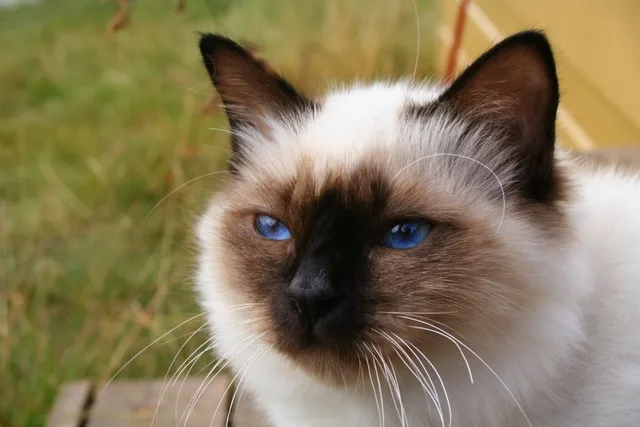
The Birman, known as the Sacred Cat of Burma, is one of the most visually striking pedigree cat breeds in existence, a colorpoint semi-longhaired cat with the distinctive feature that separates it from every other colorpoint breed: pure white paws, called gloves, on all four feet.
The white gloves end precisely at the transition from paw to leg, a line so specific in the breed standard that it is evaluated as carefully as any other feature in the show ring. No other pedigree breed has this marking in its standard.
The combination of deep blue eyes, silky semi-long coat, colorpoint coloring, and white gloves gives the Birman an appearance that is both exotic and elegant. The breed's temperament matches its presentation, gentle, social, quiet, and deeply attached to its human family. Among the colorpoint breeds, the Birman is generally considered the most docile and the least demanding, a quality that has made it consistently popular with families and older owners alike.
The Legend of the Sacred Gloves
The origin story of the Birman's white paws is one of the more detailed legends in cat breed mythology. According to the story, the Kittah people of Burma kept sacred white cats at the temple of Lao-Tsun, where a golden goddess named Tsun-Kyan-Kse was worshipped. The head priest, Mun-Ha, had a beloved white cat named Sinh.
When Khmer soldiers raided the temple and Mun-Ha died, Sinh pressed his paws against the dying monk's body and faced the golden goddess. As he did so, his white fur took on a golden cast, his eyes turned the deep blue of the goddess's eyes, and his extremities, except where his paws touched the sacred white body of the priest, turned dark brown like the earth. The paws where he touched the holy man remained pure white.
Sinh refused food after Mun-Ha's death and died seven days later, carrying the monk's soul to paradise. When the other temple cats gathered the next morning, they had all taken on the same coloring.
Historical documentation of the Birman's actual origin is considerably murkier than this legend. There are competing claims about French imports, about cats given to French soldiers who assisted in defending a temple, and about the wartime near-extinction of the breed.
What the documentary record confirms is that the Birman was developed in France, possibly from crosses involving Siamese and Angora or other longhaired cats, and was recognized as a distinct breed by the French cat registry in 1925.
Physical Characteristics
The Birman is a medium to large cat with a long, stocky body that suggests substance without heaviness. It does not have the elongated type of the Siamese or Oriental breeds, nor the extreme roundness of the Persian. The overall effect is of a well-balanced, sturdy cat with an aristocratic bearing.
| Characteristic | Details |
|---|---|
| Weight | 3.6-7.3 kg |
| Build | Long, stocky, substantial |
| Head | Broad, rounded, strong chin |
| Eyes | Nearly round, deep blue |
| Coat | Semi-long, silky, minimal undercoat |
| Color | Colorpoint in multiple colors |
| Paw marking | Pure white gloves on all four feet |
| Lifespan | 12-16 years |
| CFA/GCCF recognition | Yes |
The head is broad and somewhat rounded with full cheeks, a Roman nose, and a strong chin. The ears are medium-sized and set wide apart. The eyes are nearly round, a rounder shape than the almond eyes of the Siamese, and are a deep, vivid blue in all color varieties. Eye color intensity is evaluated in the show ring and is considered a breed hallmark.
The coat is semi-long, silky, and lies relatively flat against the body; it does not have the full undercoat volume of the Persian or the Maine Coon, which means it is significantly easier to maintain and much less prone to matting. The ruff around the neck and longer hair on the tail and hind legs give the breed its decorative appearance without requiring intensive grooming.
The White Gloves
The Birman's white paws are the breed's definitive feature and the most technically demanding aspect of the breed standard to achieve consistently. The gloves must be white, pure, and evenly matched across all four paws. They must end in a straight line across the front paws, while on the hind paws they extend further up the back of the leg in a pointed extension called the "laces."
The genetics of the white gloves are not fully understood. The marking appears to be controlled by a separate genetic mechanism from the colorpoint gene and the semi-long coat gene, and achieving consistent, symmetrical gloving across all four paws in every kitten in a litter is the central challenge of Birman breeding. Kittens with uneven, patchy, or absent gloving cannot be shown but may be placed as pets.
White paws that extend too far up the leg ("high-gloves" or "gauntlets") or that have any colored patches within them are considered faults. The precision required reflects the breed's legendary origin story, in which the white paws symbolized the purity of the monk's soul.
Colorpoint Patterns
Like the Siamese, the Birman is a colorpoint breed, the face, ears, legs, and tail are darker than the body, and this contrast deepens with age as the cat matures and as cooler ambient temperatures allow more pigment expression in the extremities. The body remains relatively pale throughout life.
The Birman is recognized in a wider range of colorpoint patterns than the traditional Siamese. In addition to the classic seal, blue, chocolate, and lilac point colors, many registries also recognize red point, cream point, tortie point, and tabby (lynx) point Birmans. The white gloves must appear in all color varieties without exception.
Seal point Birmans have deep brown points contrasting with a golden-beige body. Blue point Birmans have cool grey-blue points with a bluish-white body. Chocolate points are warmer brown, and lilac points, a diluted chocolate, have a pinkish-lavender tone.
Temperament
The Birman is among the gentlest and most socially inclined of all pedigree cat breeds. The breed forms strong attachments to its human family and prefers to be in the company of people, but it achieves this without the demanding, vocal intensity of the Siamese or the hyperactivity of the Bengal. Birmans are dog-like in their social orientation; they follow their owners from room to room, greet visitors calmly, and express affection through presence rather than insistence.
"Birmans are among the most consistently gentle and human-oriented breeds we evaluate. Their social drive is high, but their vocalization and activity levels are moderate, which creates a balance that works particularly well in family settings and with elderly owners." Dr. Sharon Crowell-Davis, DVM, PhD, behavioral specialist, University of Georgia College of Veterinary Medicine
The breed is quiet relative to most cats. Birmans do vocalize and will communicate their preferences, but they lack the penetrating voice and relentless communication style of the Siamese. Their vocalizations tend to be soft and melodic rather than loud and demanding.
Birmans are adaptable to multi-pet households and generally coexist well with other cats and with gentle dogs. They are patient with children and tend to be less likely to scratch or bite in response to handling than more reactive breeds. This patience has limits; they will retreat from uncomfortable situations rather than escalating, but their baseline tolerance is high.
Health Profile
The Birman's primary hereditary health concern is hypertrophic cardiomyopathy (HCM), the same MYBPC3-linked condition found in several other pedigree breeds. DNA testing is available and responsible breeders should screen breeding animals, though the specific mutation identified in Maine Coons and some other breeds may not be the only HCM risk in the Birman population.
Kidney disease is an important concern in aging Birmans, with both chronic kidney disease (CKD) and specific hereditary forms reported in the breed. Studies in European Birman populations have found relatively high rates of kidney pathology compared to some other breeds.
| Health Concern | Prevalence | Management |
|---|---|---|
| Hypertrophic cardiomyopathy (HCM) | Documented in breed | DNA test; echocardiogram screening |
| Chronic kidney disease (CKD) | Elevated in aging individuals | Annual bloodwork after age 7 |
| Neurological conditions | Reported in some lines | Veterinary investigation if signs appear |
| Dental disease | Common with age | Regular dental care |
A rare neurological syndrome has been reported in some Birman lines, characterized by tremors, coordination problems, and other neurological signs appearing in young kittens. This condition, sometimes called Birman kitten syndrome, appears to affect a very small subset of the population but warrants mention in any complete health discussion.
"The prevalence of hypertrophic cardiomyopathy in Birmans warrants systematic echocardiographic screening of breeding animals in addition to available DNA tests, as the full genetic architecture of HCM in this breed is not yet fully characterized." Granstrom, S., et al., Journal of Veterinary Cardiology, 2011
Grooming Requirements
The Birman's semi-long coat is considerably easier to maintain than a Persian coat. The absence of a heavy undercoat means the coat does not mat readily, and weekly combing is usually sufficient for an indoor cat not exposed to anything that would soil or tangle the fur. A fine-toothed metal comb works best, working gently through the ruff and the longer hair on the hindquarters and tail where tangles are most likely to form.
Seasonal shedding occurs in spring and to a lesser extent in autumn. Additional brushing during these periods prevents loose hair from accumulating on furniture. Birmans are generally cooperative with grooming when introduced to it as kittens, and regular grooming sessions become an opportunity for bonding rather than a management challenge.
The white paws require no special maintenance beyond the general cleanliness of any indoor cat. They will naturally stay white without intervention provided the cat is kept indoors and is not exposed to substances that would stain the coat.
Breeding Challenges
Breeding Birmans presents the particular challenge of maintaining consistent, symmetrical white gloving across all four paws while also managing the colorpoint gene and the semi-long coat gene. Litters from two Birman parents will contain kittens with varying degrees of gloving, and a significant percentage of kittens in any litter may have gloving that is imperfect for show purposes.
This makes the Birman breeding program more complex than breeds where the defining feature is controlled by a simple dominant gene. Breeders who prioritize perfect gloving across large litters must maintain careful records of which pairings produce the most consistent results.
For general cat lifespan context see How Long Do Cats Live.
Comparison with the Ragdoll
The Birman is frequently compared with the Ragdoll, another large, semi-longhaired, blue-eyed colorpoint breed with a gentle temperament. The two breeds are distinct, the Ragdoll is larger (males to 9 kg), and its origin is entirely different, but they occupy a similar niche in the companion cat world.
The key visual differences are the Birman's white gloves (absent in Ragdolls), the Birman's more moderate body size, and differences in head shape. The Ragdoll tends to be more floppy and passive, the breed was selected specifically for extreme limpness when picked up, while the Birman is somewhat more interactive and less sedentary.
For care information see Birman Care Guide. For health detail see Birman Health Problems. For comparison with another colorpoint breed see Ragdoll and Persian Cat.
References
- Granstrom, S., Godiksen, M.T., Christiansen, M., et al. "Prevalence of hypertrophic cardiomyopathy in a cohort of British Shorthair cats in Denmark." Journal of Veterinary Internal Medicine, 2011. https://doi.org/10.1111/j.1939-1676.2011.00694.x
- Meurs, K.M. et al. "Cardiac myosin binding protein C mutations in domestic cat hypertrophic cardiomyopathy." Veterinary Record, 2013. https://doi.org/10.1136/vr.101522
- Jamieson, P.M. "The Birman Cat: History and Breed Standards." GCCF Breed Advisory Committee Notes. 2019.
- Ferasin, L. "Feline myocardial disease: Classification, pathophysiology and clinical presentation." Journal of Feline Medicine and Surgery, 2009. https://doi.org/10.1016/j.jfms.2009.09.003
- Cat Fanciers' Association. "Birman Breed Standard." CFA.org, 2023. https://cfa.org/birman/
Frequently Asked Questions
Why does the Birman have white paws?
According to breed legend, a temple cat named Sinh pressed its paws against a dying Buddhist monk and received the golden goddess’s blessing, which turned its coat golden and eyes blue while leaving the paws where it touched the holy man pure white. The actual genetic mechanism is a separate marking gene distinct from the colorpoint gene, and consistent white gloving on all four paws is the central challenge of Birman breeding.
Litters from Birman parents frequently contain kittens with imperfect or asymmetrical gloving.
Is the Birman the same as the Ragdoll?
No, they are distinct breeds. Both are semi-longhaired, blue-eyed colorpoint cats with gentle temperaments, but the Birman has white gloves on all four paws (absent in Ragdolls), is smaller in body size, and has a different head shape. The Ragdoll was developed in California in the 1960s by Ann Baker, while the Birman was recognized as a breed in France in 1925.
Personality-wise, Ragdolls tend toward extreme passivity while Birmans are somewhat more interactive and playful.
Do Birmans have health problems?
The primary concerns are hypertrophic cardiomyopathy (HCM), for which DNA testing is available, and kidney disease, which is reported at elevated rates in aging Birman populations compared to some other breeds. Annual bloodwork from age seven onwards is recommended to catch early-stage kidney decline. A rare neurological syndrome affecting some young kittens has also been reported in Birman lines.
Are Birmans easy to groom?
Yes, considerably easier than Persians despite having a semi-long coat. The Birman lacks the dense undercoat that makes Persian grooming so demanding, and the coat does not mat readily. Weekly combing is usually sufficient for an indoor Birman, with extra attention needed during seasonal shedding in spring. The white paws require no special treatment.
How vocal are Birmans?
Birmans are relatively quiet compared to other colorpoint breeds. They communicate with soft, melodic voices and do not have the penetrating, demanding vocalization style associated with Siamese cats. They are social and will seek attention, but they express this more through following their owners around and being present than through persistent loud calling.
Where did the Birman breed actually come from?
The documented history is French rather than Burmese. The breed was recognized in France in 1925, and the most credible accounts suggest it was developed from crosses between cats with Siamese-type coloring and longhaired breeds, possibly including Persians or Angoras. The Burmese temple origin story is legend rather than documented history. The breed was nearly lost during World War II and was rebuilt in the 1950s and 1960s through judicious outcrossing.