
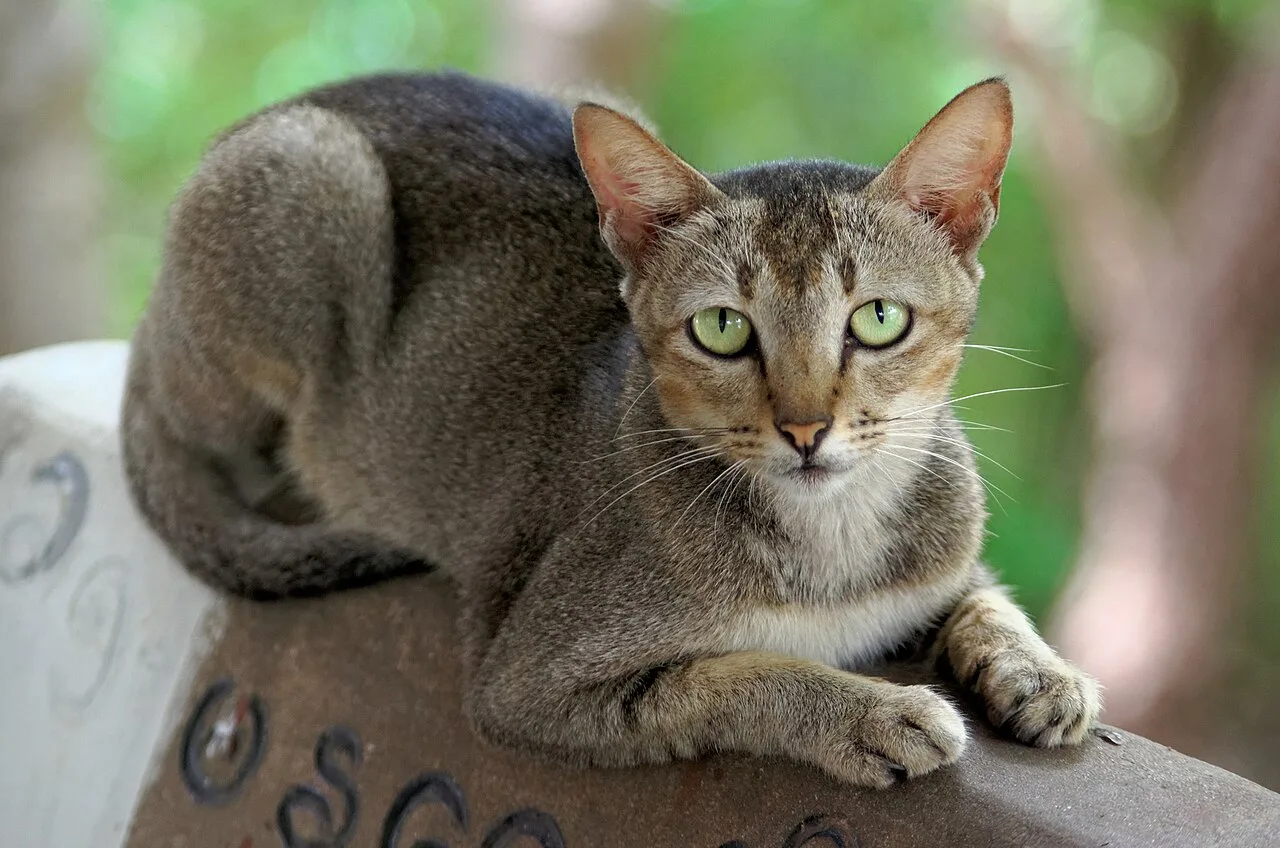
Burmese cat care is shaped by temperament: this is one of the most people-oriented cat breeds in existence, a compact, glossy, deeply social animal that has been described by breed enthusiasts as more dog than cat, and by behaviourists as one of the domestic cat breeds most dependent on human company for psychological wellbeing.
Every Burmese alive today traces its ancestry to a single individual: a small, walnut-brown cat named Wong Mau, brought from Burma (now Myanmar) to the United States in 1930. From that one cat, a breed of remarkable consistency and exceptional longevity was established.
This guide covers the Burmese's unique origin story, the American and European type divergence, the distinctive satin coat and colour range, the breed's extreme sociability and its practical implications for ownership, known genetic health conditions including Burmese hypokalaemic polymyopathy, the breed's exceptional lifespan, and what living with one of the most human-bonded domestic cats actually involves.
Origins: All Roads Lead to Wong Mau
The Burmese breed has an origin story more precisely documented than almost any other cat breed. In 1930, Dr. Joseph Thompson, a psychiatrist and sailor based in San Francisco, acquired a small, compact, walnut-brown cat during a voyage to Southeast Asia. The cat, named Wong Mau, was unlike any cat Thompson had encountered. She was darker than a Siamese, more compact, and her colouring was an even, warm brown rather than the pointed pattern of the Siamese breeds Thompson knew.
Thompson, interested in genetics, collaborated with Virginia Cobb, Billie Gerst, and geneticist Clyde Keeler to analyse Wong Mau's type and develop her into a breed. Because no other cats of her exact type were available, Thompson initially bred Wong Mau to a Siamese male named Tai Mau.
The resulting kittens revealed Wong Mau's genetic identity: she was not a pure-breeding brown cat but rather a hybrid; she carried one copy of the Burmese gene (cb, producing the Burmese sepia colouration) and one copy of the pointed Siamese gene (cs). In modern genetic terminology, she was cb/cs, the Tonkinese pattern, producing an intermediate between full expression and pointed restriction.
When Wong Mau was subsequently bred to her son (a dark brown male from the original litter), the resulting offspring included three types: pointed (Siamese-patterned), Tonkinese-type (intermediate, like Wong Mau), and solid dark brown with no pointing, the true Burmese type, homozygous cb/cb. This last type was the foundation of the breed.
"Wong Mau's genetic contribution to the Burmese breed represents one of the most remarkable instances of an entire pedigree breed tracing to a single founder animal. The founding bottleneck this created has had measurable consequences for the breed's genetic diversity that responsible breeders continue to manage through careful selection." Robinson, R., Genetics for Cat Breeders, Pergamon Press, 1977
The breeding program proceeded rapidly. By the late 1930s, enough consistent dark brown cats had been produced to establish a recognisable type, and the CFA granted the Burmese championship status in 1936. The early program is notable for the inclusion of geneticists and the systematic application of Mendelian genetics, unusually rigorous for cat breeding of that era.
The American-European Type Division
A significant divergence in Burmese type occurred during the mid-20th century, with American and British/European programs developing along different lines. This divergence produced what are effectively two distinct breeds that share the same name and history.
The American Burmese was developed toward an increasingly rounded, compact type. Successive generations of selection in American programs produced a cat with a rounder head, more prominent rounded forehead, shorter nose, rounder eyes, and a more cobby body compared with the original Wong Mau type.
The extreme end of this development produced cats with facial structures approaching the brachycephalic profile of Persians, a trait that, as described in the health section below, carries genuine medical consequences.
The European Burmese (also called the Traditional or British Burmese) maintained a type closer to Wong Mau herself, a more angular head with a wedge shape, a longer muzzle, wider-set ears, less extreme facial rounding, and a more athletic body. European lines also expanded the colour range significantly beyond the original sable.
The two types are recognised as separate breeds by some registries. TICA recognises them as separate. The CFA registers the American type under the Burmese name and the European type separately. In countries that follow FIFe standards, the European type predominates. Prospective buyers should confirm which type a breeder works with, as the temperament, health risks, and appearance differ meaningfully.
| Feature | American Burmese | European Burmese |
|---|---|---|
| Head shape | Round, prominent forehead | Wedge, more angular |
| Muzzle | Short, wide | Longer, less extreme |
| Facial profile | Slightly brachycephalic tendency | Non-brachycephalic |
| Body type | Cobby, compact, heavy for size | More athletic, moderate |
| Eye shape | Round, large | Slightly almond, wide-set |
| Craniofacial defect risk | Present in some lines | Minimal |
| Colour range (CFA) | Sable, champagne, blue, platinum | Sable, champagne, blue, platinum |
| Colour range (GCCF/FIFe) | N/A | All above + red, cream, tortoiseshell, lilac |
The Coat: Satin Close-Lying Gloss
The Burmese coat is one of the most distinctive in domestic cats, not for its length or colour complexity, but for its texture. The coat is short, close-lying, and has a glossy, satin-like finish that reflects light in a way that gives the cat's body a sculptural, polished appearance. The coat requires minimal grooming because it is too short to mat and has a natural lustrous quality that owners can maintain with weekly hand-stroking alone, distributing skin oils through the coat.
The textural quality of the coat is best appreciated by touch. The satin characteristic means the coat slides under the hand rather than pushing back, giving an unusually smooth sensation quite unlike the denser plush of the Russian Blue or the softer feel of breeds with more traditional short coats. The coat also lies so flat against the body that the Burmese's muscular physique is evident even at a casual glance.
Colour in the American Burmese is restricted to four:
Sable is the original colour, a rich, warm, dark brown throughout the body, with the points (face, ears, tail, feet) slightly darker than the body. The warm brown is caused by the cb/cb genotype interacting with a non-agouti background. The nose leather and paw pads are brown.
Champagne is a warm beige or honey-tan, the dilution equivalent of sable in some colour schemes, produced by the chocolate gene interaction.
Blue is a medium grey with a silvery cast, the dilute of sable.
Platinum is the lightest colour, a pale silver-grey, almost white with warm undertones.
European Burmese additionally include red (warm orange), cream, tortoiseshell (sable, blue, or chocolate base with orange patches), and lilac (pale pinkish-grey) in their recognised colour range.
Temperament: The Most People-Oriented Cat Breed
The Burmese temperament is, by the consensus of cat breed assessments and the experience of owners, at the extreme end of the social spectrum. This is a cat that does not merely tolerate human company or benefit from it; it requires it, depends on it, and organises its entire existence around it.
Burmese cats follow their people through the house. They want to be in the same room at all times. They initiate physical contact, climbing onto laps, pressing against legs, draping themselves across keyboards, and positioning themselves at face level during any horizontal human activity.
They greet returning owners with a persistence and enthusiasm that owners consistently compare to dogs. They learn the schedules of their households and anticipate human arrivals and departures with apparent accuracy.
The bond that Burmese cats form is also often selective, many individuals identify one person as their primary attachment figure and relate to that person with an intensity that can surprise households expecting a more evenly distributed social cat. The chosen person may find that the Burmese follows exclusively them, waits for them specifically, and shows demonstrably different behaviour when that person is absent versus present.
"In clinical behaviour consultations, the Burmese is one of the breeds most frequently presented with separation-related disorders. The breed's exceptional social attachment capacity, a genuine strength in a well-matched household, becomes a vulnerability when the attachment figure is regularly unavailable." Overall, K.L., Manual of Clinical Behavioral Medicine for Dogs and Cats, Elsevier, 2013
The voice is distinctive: a low, raspy, persistent sound that is quieter than a Siamese's but more regular and penetrating than most breeds. Burmese will use their voice to maintain contact with their people, to request interaction, and, importantly, to express frustration when their social needs are not being met. A Burmese that is vocalising persistently is communicating something real about its state.
The implication for ownership is direct: a Burmese cannot be left alone for long stretches routinely without consequences for its psychological wellbeing. Households where all occupants are away for eight or more hours daily should either provide a feline companion (ideally another Burmese, which tends to produce stable mutual bonding) or seriously reconsider whether the breed is appropriate.
For households with reliable human presence through the day, the Burmese's social nature becomes a sustained source of warmth and engagement that owners describe as unlike any other cat they have owned.
For comparison with a breed of similar attachment profile but different character, see Siamese Cat. For apartment suitability across social breeds, see Best Cats for Apartments.
Genetic Health Conditions
The Burmese carries several known hereditary health conditions. The founding bottleneck through Wong Mau and the subsequent closed breeding population have contributed to elevated rates of some genetic conditions compared with outbred cats.
Burmese Hypokalaemic Polymyopathy (BHM) is the most breed-specific condition. BHM is a periodic muscle weakness disorder caused by abnormally low blood potassium (hypokalaemia). Affected cats show episodic weakness, typically affecting the neck (causing the head to hang down), the limbs (causing the cat to walk with an abnormal flexed-limb gait), and occasionally all major muscle groups simultaneously.
Episodes can be triggered by stress or exercise and typically last from minutes to hours before the cat recovers. The condition is autosomal recessive, a DNA test is available. Breeders should test all breeding animals. Affected cats can be managed with potassium supplementation; the condition is not typically life-threatening when diagnosed and managed correctly.
Craniofacial Defect is a severe congenital abnormality associated with the extreme facial rounding in some American Burmese lines. Kittens homozygous for the gene responsible for the rounded-head phenotype develop lethal head deformities, malformed skulls that are incompatible with life. Heterozygous kittens (one copy) develop the rounded head that is the type ideal in American show lines.
This means that two show-type American Burmese, both carrying the rounded-head gene, will statistically produce a proportion of affected kittens that do not survive. The ethical implications parallel those of the Scottish Fold fold gene and are the subject of ongoing discussion within American Burmese breeding communities.
Flat-Chested Kitten Syndrome (FCKS) is a congenital deformity in which the kitten's thorax develops abnormally flat, compressing the lungs and heart. Affected kittens show respiratory distress. The condition occurs in the Burmese at elevated rates compared with the general cat population. Mild cases may resolve with supportive care; severe cases are typically fatal.
Burmese Orofacial Pain Syndrome (BOPS) is a painful neurological condition that appears to affect primarily Burmese and Burmese-related cats. Affected cats show face-rubbing, jaw-pawing, and frantic licking behaviour consistent with facial or oral pain. Episodes can be severe. The condition has a possible genetic basis and tends to be triggered by stress or tooth eruption in young cats. Management involves pain relief and stress reduction.
| Health Condition | Type | DNA Test | Management |
|---|---|---|---|
| Burmese Hypokalaemic Polymyopathy (BHM) | Autosomal recessive | Yes | Potassium supplementation; episodic; manageable |
| Craniofacial Defect (American lines) | Homozygous lethal | No | Avoid pairing two extreme-type American Burmese |
| Flat-Chested Kitten Syndrome (FCKS) | Congenital | No | Supportive care; severe cases fatal |
| Burmese Orofacial Pain Syndrome (BOPS) | Likely genetic | No | Pain management; stress reduction |
For comprehensive coverage of Burmese health conditions, see Burmese Cat Health Problems. For full care guidance including diet, enrichment, and veterinary monitoring schedules, see Burmese Cat Care Guide.
Lifespan: Among the Longest-Lived Cat Breeds
The Burmese is one of the longest-lived pedigree cat breeds. Lifespans of 16-18 years are typical for well-managed cats, and individuals living to 20 years or beyond are documented regularly enough to be considered part of the breed's character rather than exceptional outliers.
This longevity is one of the most compelling aspects of Burmese ownership. A Burmese acquired as a kitten is a commitment for potentially two decades, longer than many dogs, significantly longer than most pedigree cat breeds. The intensity of the bond this breed forms with its people, sustained over that timeframe, creates a depth of relationship that owners who have lost an elderly Burmese consistently describe as among the most significant losses they have experienced.
The practical implication is that veterinary costs, dietary management, and health monitoring must be considered over a longer timeline than with shorter-lived breeds. A Burmese that develops kidney disease at age 14, common in elderly cats of any breed, will require management for potentially several more years.
For longevity comparison across pedigree breeds, see How Long Do Cats Live. For insight into the depth and nature of the human-cat bond that the Burmese exemplifies most intensely, see Do Cats Recognize Their Owners.
Physical Characteristics: Heavy for Size
One of the Burmese's most consistently remarked-upon physical qualities is that it is substantially heavier than it looks. The breed has been described as "a brick wrapped in silk" the dense, muscular physique contained in a compact, short-coated body creates a weight that surprises people when they first pick up a Burmese.
Adult males typically weigh 4-6 kg; females 3-4.5 kg. These numbers may not appear exceptional, but the density is unusual. The Burmese is not large by cat breed standards, but its musculature for its size is among the highest of any domestic breed. The combination of a short, close-lying coat (which does not add apparent mass) and dense muscle creates the characteristic "heavy brick" quality.
The body is compact and well-balanced, with a rounded chest and a level topline. The legs are moderately long with oval paws. The tail is straight and of medium length, tapering slightly to a rounded tip. All these structural elements combine to give the Burmese an impression of contained power rather than the long-limbed athleticism of the Abyssinian or the imposing bulk of the Maine Coon.
Feeding and Weight Management
The Burmese is not a breed prone to obesity under normal management, largely because its activity level and metabolism are moderate to high during its active years. However, neutered or spayed cats, particularly those that become less active after middle age, can gain weight if rations are not managed.
High-protein, low-carbohydrate diets appropriate for an obligate carnivore are recommended. Given the breed's propensity for BHM, diets formulated to support potassium intake are relevant for cats from BHM-affected lines or for those with confirmed diagnosis. Veterinary dietary guidance should be sought for cats under potassium supplementation to ensure appropriate electrolyte balance.
Fresh water availability is important. Burmese are enthusiastic drinkers, and wet food or water fountain access supports kidney health in the breed's long senior years.
Living with a Burmese
The Burmese is, for the right household, one of the most rewarding cat breeds in existence. Its loyalty, warmth, intelligence, and sheer physical delight in human contact create a companion experience that owners consistently describe in the strongest terms. The breed's longevity means this experience can extend for nearly two decades.
The conditions for that experience to be positive rather than difficult are specific. The Burmese needs human presence. It needs interactive engagement, daily play sessions, conversation (the breed is genuinely responsive to being talked to), physical contact on its own terms. It benefits from a feline companion, particularly in households with regular absences.
It needs the health monitoring appropriate to its known genetic conditions and to the gradual vulnerabilities of a long-lived cat aging through its senior years.
For households that can provide these things, the Burmese delivers in full measure. For households where the cat will be largely alone, where stimulation will be limited, or where the commitment to a potentially 18-20 year relationship feels daunting, a less attachment-intensive breed is a more honest choice.
The reward for honest matching is a cat that will know your schedule, remember your absences, greet your returns, and maintain an active, engaged relationship with you for the better part of two decades. In the domestic cat world, that is a rare proposition.
References
Thompson, J.C., Cobb, V.M., Keeler, C.E., & Gerst, B. (1943). "Inheritance in the Burmese cat." Journal of Heredity, 34(4), 97-100. https://doi.org/10.1093/oxfordjournals.jhered.a105281
Malik, R., et al. (1990). "Hereditary myopathy of Devon Rex cats." Journal of Small Animal Practice, 31(10), 511-516. https://doi.org/10.1111/j.1748-5827.1990.tb00686.x
Gandolfi, B., et al. (2010). "A novel mutation in MYBPC3 is associated with hypertrophic cardiomyopathy in Maine Coon cats and homozygosity worsens the phenotype." Journal of Internal Veterinary Medicine, 24(3), 527-532. https://doi.org/10.1111/j.1939-1676.2010.0490.x
Bhatti, S.F., et al. (2006). "Orofacial pain syndrome in Burmese cats." Journal of Feline Medicine and Surgery, 8(3), 196-203. https://doi.org/10.1016/j.jfms.2006.01.002
Cat Fanciers' Association (CFA). (2023). Burmese Breed Standard and Profile. Retrieved from https://cfa.org/burmese/
The International Cat Association (TICA). (2023). Burmese and European Burmese Breed Standards. Retrieved from https://tica.org/breeds/browse-all-breeds
Frequently Asked Questions
Are Burmese cats the most affectionate cat breed?
Burmese cats are consistently rated among the most people-oriented and affectionate cat breeds by both breed organisations and cat behaviourists. They follow their owners through the house, initiate physical contact persistently, bond intensely with their primary person, and are significantly more dependent on human company than most cat breeds. The intensity of Burmese attachment is sometimes compared to dogs.
Whether this makes them the single most affectionate breed depends on individual cats, but they reliably occupy the top tier of any affection-level ranking.
What is Burmese hypokalaemic polymyopathy?
Burmese hypokalaemic polymyopathy (BHM) is a hereditary muscle weakness disorder caused by abnormally low blood potassium levels. Affected cats experience episodic weakness, most characteristically a hanging head posture caused by neck muscle weakness, and may show stiffness or abnormal gait during episodes. The condition is autosomal recessive and a DNA test is available. Responsible breeders test all breeding animals.
Affected cats can be managed with potassium supplementation and the condition is not typically life-threatening when properly diagnosed and treated.
How long do Burmese cats live?
Burmese cats are among the longest-lived pedigree cat breeds. Typical lifespans are 16-18 years, and individuals living to 20 years or beyond are not uncommon. This exceptional longevity is one of the breed’s most valued characteristics. It also means that acquiring a Burmese kitten is a commitment that may extend for nearly two decades, and prospective owners should consider long-term veterinary, dietary, and care costs over that timeline.
What is the difference between American and European Burmese?
American Burmese were developed toward an increasingly rounded, cobby type with a rounder head, shorter muzzle, and more prominent forehead. European Burmese maintain a type closer to the founding cat Wong Mau, a more wedge-shaped head, longer muzzle, and more athletic body. The American type carries a risk of craniofacial defects in some lines due to extreme facial rounding.
The European type has a broader colour range and is the type recognised by FIFe and GCCF. Some registries treat them as separate breeds. Temperament is similar in both types.
Can a Burmese cat be left alone during the day?
Burmese cats are among the breeds least suited to regular long periods of solitude. Their social attachment needs are genuinely high, and cats left alone consistently for full work days can develop anxiety, depression, or stress-related behaviour problems. The best solution for households with regular long absences is to provide a feline companion, ideally another Burmese, which tends to produce stable mutual bonding.
If a companion cat is not possible, maximising enrichment and keeping absent periods as predictable as possible reduces stress. The breed is not a good fit for households that want a low-maintenance independent companion.
Are Burmese cats good for apartments?
Yes, Burmese cats are well-suited to apartment living provided their social needs are met. They have moderate activity levels, are not aggressive climbers like Abyssinians, and adapt well to indoor-only living. Their suitability for apartments depends primarily on the owner’s availability rather than the apartment’s size. A Burmese in a small apartment with a home-working owner is happier than a Burmese in a large house where it is alone all day.
Social companionship, not physical space, is the primary requirement.