
The Newfoundland is one of the most remarkable working dogs ever developed, a giant, gentle, water-loving breed from the island of Newfoundland, Canada, that has been saving drowning victims from the sea for centuries.
Built like a bear, swimming like an otter, and with the temperament of a devoted guardian, the Newfoundland combines extraordinary physical capability with one of the most genuinely gentle and loving personalities in the dog world. Nana, the beloved nursemaid dog in J.M. Barrie's Peter Pan, was a Newfoundland, and those who know the breed recognize that characterization as entirely apt.
Origins on the Island of Newfoundland
The Newfoundland's origins are connected to the Canadian island of the same name, one of the world's major fishing territories, where the breed was developed by European fishermen and settlers from the 17th century onward.
The specific ancestry of the Newfoundland is debated: it likely descends from large working dogs brought to North America by European fishermen (particularly from England, France, and Portugal who all fished the Grand Banks off Newfoundland), possibly crossed with indigenous dogs kept by the native peoples of the island.
What is clear is that by the 18th century, a distinctively large, heavily coated, water-loving working dog was firmly established on the island. These dogs worked alongside fishermen in the brutal North Atlantic conditions: hauling fishing nets and lines from the water, retrieving gear dropped overboard, pulling carts loaded with fish, and most significantly, rescuing people who had fallen or been swept overboard.
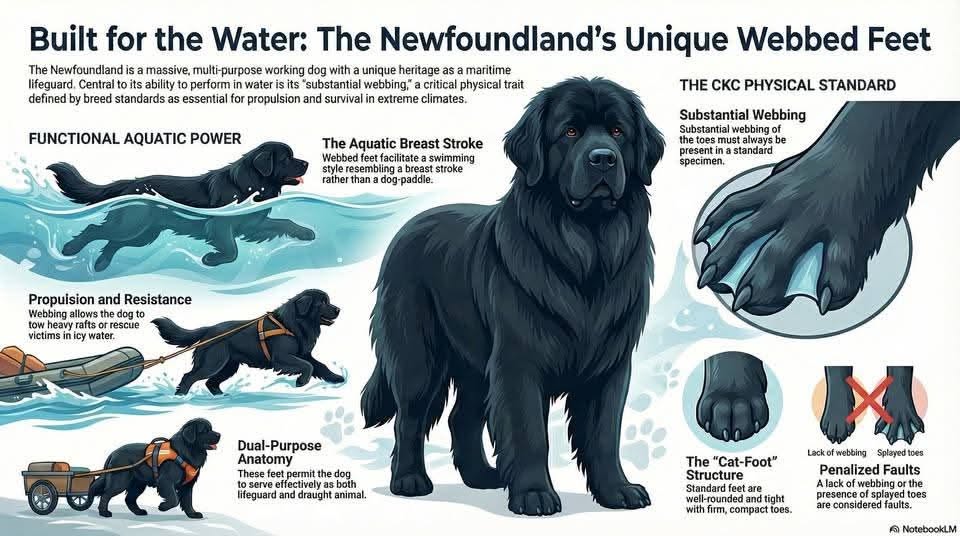
The Newfoundland's anatomy reflects this heritage precisely. The broad, powerful chest and muscular hindquarters provide the power needed for sustained swimming. The thick, oily, water-resistant double coat provides thermal protection in cold North Atlantic water. Most importantly, the feet are large and slightly webbed, the webbing between the toes increases the surface area of each stroke in water, providing significant propulsive advantage.
"The Newfoundland's physical design for water work is among the most complete of any breed. The combination of water-resistant coat, webbed feet, powerful swimming musculature, and the instinct to retrieve and support rather than simply fetch places it in a unique category among working dogs." Dr. Helen Zulch, MRCVS, CCAB, University of Lincoln
The AKC recognized the Newfoundland in 1886, placing it in the Working Group.
Physical Characteristics
The Newfoundland is a giant breed, one of the largest recognized by major kennel clubs, though generally slightly lighter than the Saint Bernard. It is an impressively powerful, well-proportioned dog with a massive head, a broad, deep chest, and a thick, water-resistant coat.
| Physical Characteristic | Males | Females |
|---|---|---|
| Height | ~71 cm (28 in) | ~66 cm (26 in) |
| Weight | 65-80 kg (143-176 lbs) | 45-55 kg (100-121 lbs) |
| Build | Large, powerful, substantial, muscular | |
| Coat | Heavy, dense, water-resistant double coat, coarse outer coat, soft undercoat | Same |
| Coat colors | Black, brown, grey, Landseer (black and white) | Same |
| Feet | Large, slightly webbed | Same |
| Tail | Long, broad, strong | Same |
| Drool | Significant, similar to Saint Bernard | Same |
| Lifespan | 8-10 years | 8-10 years |
The Landseer color, black and white, deserves special mention. In North America, Landseer Newfoundlands are considered a color variety of the Newfoundland breed and are shown in the same class. In some European countries (particularly Germany and Scandinavian nations), Landseer dogs are registered as a separate breed (Landseer ECT). The color is named after the English painter Edwin Landseer (1802-1873), whose paintings of black and white Newfoundlands helped popularize the color pattern.
Nana and the Breed in Literature
J.M. Barrie's Peter Pan (first performed 1904, novel 1911) features Nana, a large, responsible, devoted nursemaid dog who cares for the Darling children. Barrie owned a Newfoundland (and later a Saint Bernard), and Nana is unmistakably based on the Newfoundland breed: large, gentle, reliable, and with an instinctive protective concern for children.
Barrie's characterization is remarkably accurate to the breed's real temperament, Newfoundlands are noted among all giant breeds for their particular patience with and protectiveness of children. Many Newfoundland breeders and owners regard Barrie as having captured something genuine and important about the breed's character.
Temperament: Gentle, Patient, Devoted
The Newfoundland's temperament is one of its most celebrated characteristics. The breed is typically described as the most gentle of the giant breeds, patient, calm, sweet-natured, and deeply devoted to its people. Their instinct in water and on land appears to be to support and rescue rather than to dominate or confront; this shapes a fundamentally benevolent personality.
They are excellent with children, patient enough to tolerate the enthusiastic affections of young people, large enough to serve as a genuine physical support or companion in outdoor activities, and attentive enough to react if a child is in difficulty. Many Newfoundland owners describe their dogs as having a particular awareness of children's distress and vulnerability that goes beyond typical canine social sensitivity.
Newfoundlands get along well with other dogs and typically with other pets. They are not aggressive or territorial and lack the strong prey drive of Arctic or sighthound breeds.
Health: Subvalvular Aortic Stenosis (SAS)
Subvalvular aortic stenosis (SAS) is the most breed-specific serious heart condition in the Newfoundland, the breed is significantly overrepresented in SAS case statistics compared to most other breeds. SAS is a congenital defect in which a ring of fibrous tissue forms just below the aortic valve, partially obstructing blood flow out of the left ventricle. The obstruction forces the heart to work harder, and the turbulence created damages the aortic valve over time.
Severity ranges from mild (often subclinical and well-tolerated throughout life) to severe (causing heart failure, syncope, sudden death, and exercise intolerance). Moderate to severe SAS is identified by the presence of a heart murmur, detected through auscultation or definitively diagnosed by echocardiography.
Breeding stock should be evaluated by a board-certified veterinary cardiologist; dogs with significant SAS should not be bred. The OFA Congenital Cardiac Database accepts cardiac evaluations for Newfoundlands and the breed club recommends cardiac certification as a standard health screening.
| Health Condition | Prevalence/Notes | Screening |
|---|---|---|
| Subvalvular aortic stenosis | Significant breed overrepresentation | OFA cardiac exam |
| Hip dysplasia | ~24% (OFA) | OFA/BVA X-ray |
| Elbow dysplasia | ~29% (OFA, high) | OFA X-ray |
| Cystinuria | Urinary stones, DNA test | DNA test available |
| Hypothyroidism | Reported | Thyroid panel |
| Dilated cardiomyopathy | Present | Cardiac echo |
| Osteosarcoma | Elevated (giant breed) | Lameness monitoring |
Health: Elbow Dysplasia and Hip Dysplasia
The Newfoundland has notably high rates of both elbow dysplasia (~29%) and hip dysplasia (~24%) in OFA data. The elbow rate in particular is among the higher rates documented in any breed. These figures make OFA certification of both parents an absolute requirement before purchasing a Newfoundland puppy.
Elbow dysplasia causes lameness, pain, and progressive arthritis in the front limbs, often presenting as a subtle intermittent forelimb lameness in young dogs. Various forms of elbow dysplasia (fragmented medial coronoid process, osteochondrosis, united anconeal process) require different surgical and management approaches. Severe elbow dysplasia in an 80 kg Newfoundland represents a significant welfare issue.
Health: Cystinuria
Cystinuria, an inherited defect in the renal tubular transport of the amino acid cystine, leading to cystine crystal and stone formation in the urinary tract, occurs in Newfoundlands at higher rates than in most breeds. Cystine stones (uroliths) can cause urinary obstruction, which is a life-threatening emergency, particularly in males.
A DNA test for Type I cystinuria in Newfoundlands is available and should be used in all breeding decisions. See Newfoundland Health Problems for comprehensive health guidance. For spay/neuter considerations relevant to giant breed health see Spaying and Neutering Dogs Explained.
"Cystinuria in the Newfoundland is one of the best-characterized examples of inherited aminoaciduria in dogs. The identification of the SLC3A1 mutation causative in this breed allowed development of a DNA test that has materially reduced the incidence of the condition in well-managed breeding programs." Giger, U., & Casal, M.L. (1997). Journal of the American Veterinary Medical Association
Water Work and Swimming
The Newfoundland's swimming ability is extraordinary. The breed is used in modern times for water rescue training, where they work with handlers in boats or from shore to retrieve swimmers in difficulty, support exhausted swimmers in the water, and pull small boats or life rings. Several international organizations (including the Italian Water Dog Federation) maintain formal water rescue training and certification programs specifically for Newfoundlands.
Their swimming stroke differs from most dogs, rather than the dog paddle used by most breeds, Newfoundlands swim with a more powerful, breaststroke-like motion that generates sustained forward movement in open water. Combined with their waterproof coat and webbed feet, this makes them genuinely exceptional swimmers.
For related giant breed comparisons see Saint Bernard and Great Dane. For lifespan context see How Long Do Dogs Live.
Exercise and Care
Despite their size, Newfoundlands have moderate exercise requirements. Adults benefit from 30-60 minutes of daily exercise, longer sessions of moderate activity such as walking and swimming are preferable to short, intense activity. Swimming is particularly valuable for the breed: it provides full-body exercise, engages the dog's deepest working instincts, and is gentle on the joints.
Giant breed puppies should have controlled, moderate exercise until skeletal maturity (approximately 2 years). Avoid repetitive high-impact activities during growth.
The Newfoundland's heavy, dense coat requires regular brushing, at least two to three times weekly, with more intensive brushing during seasonal shedding. The coat should never be shaved. Ear cleaning is important; the pendulous ears with dense hair can trap moisture. Significant drooling is unavoidable; towels and acceptance are the management approach.
Living Conditions
Newfoundlands are best suited to homes with sufficient space for their size and ideally access to outdoor areas and water. They are gentle enough and calm enough indoors to manage in a variety of home sizes, but their physical size means that small apartments are challenging. They do not cope well with heat and are best suited to cool and temperate climates.
The feeding cost, veterinary cost, grooming time, and physical management of a 70-80 kg dog are substantially greater than for smaller breeds. These practical realities should be assessed honestly before committing to Newfoundland ownership.
Summary
The Newfoundland is a breed of remarkable capability, ancient working purpose, and extraordinary gentleness. Its water rescue heritage, Nana-like devotion to children, and calm, patient temperament make it one of the most beloved of all giant breeds. Health priorities include cardiac screening for SAS, OFA hip and elbow certification, and DNA testing for cystinuria. The giant breed lifespan of 8-10 years is an honest reality to be understood before choosing this magnificent breed.
References
Tidholm, A. (1997). Retrospective study of congenital heart defects in 151 dogs. Journal of Small Animal Practice, 38(3), 94-98. https://doi.org/10.1111/j.1748-5827.1997.tb03437.x
Giger, U., & Casal, M.L. (1997). Fanconi syndrome in Basenjis: Studies of amino acid transport. Journal of the American Veterinary Medical Association, 211(3), 308-311.
Orthopedic Foundation for Animals. (2023). Newfoundland breed statistics. https://www.ofa.org/diseases/hip-dysplasia/statistics/
Michell, A.R. (1999). Longevity of British breeds of dog and its relationships with sex, size, cardiovascular variables and disease. Veterinary Record, 145(22), 625-629. https://doi.org/10.1136/vr.145.22.625
American Kennel Club. (2023). Newfoundland breed information. https://www.akc.org/dog-breeds/newfoundland/
Newfoundland Club of America. (2022). Health testing recommendations. https://www.ncanewfs.org/health/
Frequently Asked Questions
Was Nana in Peter Pan really a Newfoundland?
Yes. J.M. Barrie based Nana the nursemaid dog on the Newfoundland breed, which he kept himself (as well as a Saint Bernard). The characterization of Nana as large, gentle, protective, and genuinely devoted to the children in her care is widely recognized as an accurate reflection of the Newfoundland’s real temperament. It remains one of the most affectionate portrayals of the breed in literature.
What is subvalvular aortic stenosis in Newfoundlands?
Subvalvular aortic stenosis (SAS) is a congenital heart defect in which fibrous tissue below the aortic valve obstructs blood flow from the left ventricle. The Newfoundland breed is significantly overrepresented in SAS cases. Severity ranges from mild and subclinical to severe, causing exercise intolerance, syncope, and sudden death. OFA cardiac evaluation by a veterinary cardiologist is a required health screening for Newfoundland breeding stock.
Can Newfoundlands really save drowning people?
Yes. Newfoundlands are used in formal water rescue training programs today, including by the Italian Water Dog Federation and similar organizations. Their combination of webbed feet, water-resistant coat, powerful swimming ability, and instinct to retrieve and support (rather than simply fetch) makes them genuinely effective water rescue dogs. Historical accounts of Newfoundlands saving drowning fishermen in the North Atlantic are well-documented.
What are Landseer Newfoundlands?
Landseer Newfoundlands are black and white in color, named after English painter Edwin Landseer (1802-1873) whose paintings helped popularize this color pattern. In North America, Landseers are a recognized color variety shown in the same class as black Newfoundlands. In some European countries, the Landseer is classified as a separate breed (Landseer ECT).
What is the Newfoundland's elbow dysplasia rate?
The Newfoundland has approximately 29% elbow dysplasia prevalence in OFA data, among the higher rates documented in any breed. Combined with approximately 24% hip dysplasia, this makes orthopedic health screening of both parents absolutely essential before purchasing a Newfoundland puppy. OFA or equivalent certification should be required.
How much exercise does a Newfoundland need?
Newfoundlands have moderate exercise needs, 30-60 minutes of daily moderate activity suits most adults. Swimming is an ideal exercise given the breed’s affinity for water and the joint-friendly nature of aquatic activity. Giant breed puppies need controlled, low-impact exercise until skeletal maturity at approximately 2 years. Avoid repetitive high-impact activities during the growth period.