
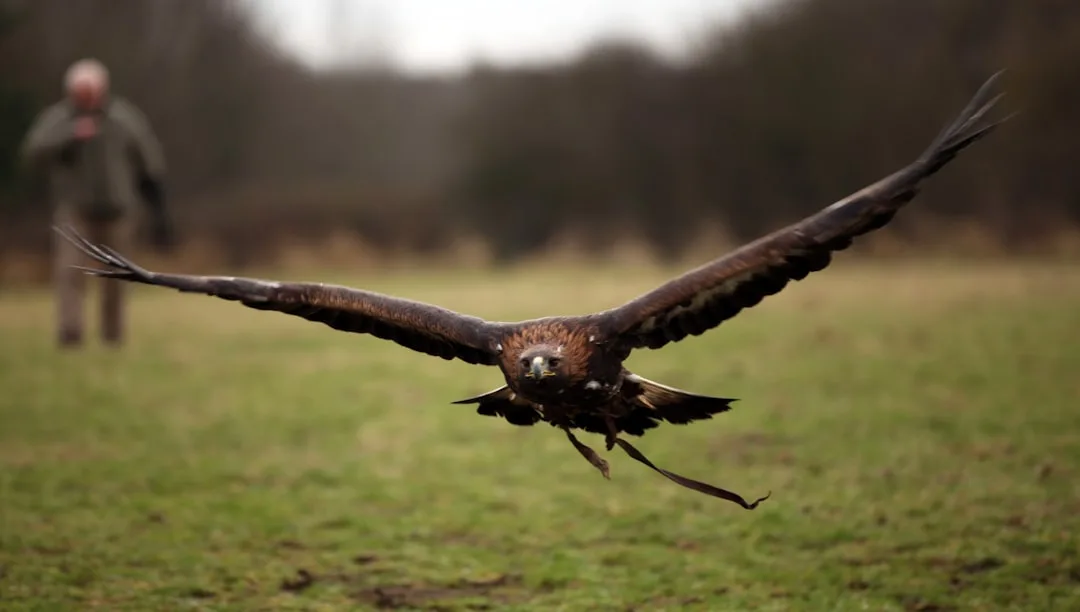
The golden eagle is the most widely distributed large eagle on Earth and one of the most recognisable predatory birds in human history.
Across the entire Northern Hemisphere - from the mountains of western North America to the Scottish Highlands, the Alps, the steppes of Central Asia, the cliffs of Japan, and the Atlas Mountains of Morocco - Aquila chrysaetos occupies roughly the same ecological role: the dominant aerial predator of open and semi-open country.
It is powerful enough to kill adult wolves under the right conditions, fast enough to overtake almost any bird in a dive, and culturally central enough to appear on the flags and coats of arms of at least five sovereign states.
This guide covers every aspect of golden eagle biology and ecology: taxonomy, size, flight performance, hunting technique, prey range, reproduction, the four-thousand-year-old Kazakh falconry tradition that grew up around the species, its status as a national bird, conservation threats, and the ways in which golden eagles have shaped and been shaped by people.
It is a reference entry, not a summary - so expect specific figures: grams, kilometres per hour, square kilometres, clutch sizes, and verified records.
Etymology and Classification
The scientific name Aquila chrysaetos was formalised by Linnaeus in the tenth edition of Systema Naturae in 1758. Aquila is the Latin word for eagle, a term of uncertain origin that some etymologists trace to a Proto-Indo-European root meaning 'dark-coloured' or possibly 'swift'. The specific epithet chrysaetos is a compound of two Greek roots: chrysos, meaning gold, and aetos, meaning eagle.
The name refers to the golden-buff wash of long pointed feathers that covers the nape and crown of an adult bird, visible in good light from considerable distance. These feathers gave the species its common name in English, German (Steinadler or 'rock eagle' is also used), Spanish (aguila real), and many other languages.
Golden eagles belong to the family Accipitridae, the hawks and eagles, and more specifically to the subfamily Aquilinae, often called the 'booted eagles' because feathering extends all the way down the tarsus to the base of the toes. This is a useful field mark: most large raptors in the golden eagle's range show bare yellow tarsi, while Aquila chrysaetos shows feathered legs above heavy black claws.
The genus Aquila contains roughly a dozen species of large Old World and New World eagles, including the eastern imperial eagle, Spanish imperial eagle, tawny eagle, steppe eagle, and wedge-tailed eagle of Australia.
Molecular work since the 1990s has repeatedly reshuffled the relationships within this genus, but the golden eagle itself is consistently placed near the centre of the group rather than on any isolated branch.
Six subspecies are currently recognised. A. c. chrysaetos occupies Europe, from Scotland and Scandinavia south to the Mediterranean and east to the western Russian steppe. A. c. homeyeri is a slightly smaller and darker form found in North Africa, the Iberian Peninsula, and parts of the Middle East.
A. c. daphanea, often called the berkut or Asian golden eagle, occupies Central Asia from Kazakhstan east through the Himalayas and Mongolia, and includes the largest birds in the species - large females regularly exceed seven kilograms. A. c. japonica is restricted to Japan and a small part of the adjacent mainland and is the smallest subspecies. A. c. kamtschatica breeds across eastern Siberia.
A. c. canadensis occupies North America from Alaska and the Yukon south through the Rocky Mountains and the Mexican highlands. The differences among the six are real but subtle, mostly involving size, tone of the head feathering, and darkness of the juvenile plumage.
Size and Physical Description
Golden eagles are large by any reasonable measure but not the largest eagles in the world. That title belongs to a shifting tie between the Steller's sea eagle, the harpy eagle, and the Philippine eagle, all of which outweigh a typical golden eagle on average. What the golden eagle loses in raw mass it gains in reach, agility, and open-country performance.
Females:
- Length: 80-102 cm from bill tip to tail tip
- Wingspan: 2.05-2.34 m, occasionally more in daphanea
- Weight: 3.9-6.4 kg, record 7.7 kg
Males:
- Length: 66-90 cm
- Wingspan: 1.80-2.10 m
- Weight: 3.0-4.5 kg
As in almost all raptors, females are larger than males - a pattern called reverse sexual dimorphism. The extent in golden eagles is moderate: a typical female outweighs her mate by roughly a third. Hypotheses for why female raptors are larger include division of labour at the nest (the larger female defends, the smaller male hunts and delivers food), prey size partitioning between sexes, and selection for an especially aggressive female phenotype during courtship.
Adult plumage is a deep chocolate brown with the diagnostic pale golden wash across the nape, sides of the neck, and crown. The tail is dark with faint grey barring. Juveniles are obvious at a distance: they show large white patches at the base of the primaries and secondaries on each wing and a broad white tail with a clean black terminal band.
These white markings fade gradually across the first five years of life as the bird acquires adult plumage. A second-year eagle still looks piebald; a fifth-year bird looks like a somewhat worn adult. Full adult plumage is reached at about the same age the bird becomes capable of breeding.
Structurally, the golden eagle is built for soaring and stooping over open terrain. The wings are long and broad with seven clearly emarginated primary feathers at the tip, producing the 'fingered' silhouette characteristic of large buteonine and aquiline raptors. The tail is relatively long and slightly wedge-shaped, used as a primary control surface in high-speed manoeuvres.
The feet are enormous: the hind talon of a large female can exceed 6 cm on its outer curve, and the grip pressure of that foot has been estimated from force-plate measurements at around 400 pounds per square inch, roughly ten times the crushing force of a healthy adult human hand. These are the tools that make the species such an effective killer of mammals much larger than itself.
The eye, like that of other diurnal raptors, is disproportionately large. A golden eagle's eye weighs more than its brain. Visual acuity is estimated at roughly eight times the acuity of a healthy human, with a dense fovea packed with cone photoreceptors and a second retinal specialisation called the fovea centralis that provides magnified central vision. The bird can resolve a hare-sized object at a range of approximately two kilometres under good light.
Distribution and Habitat
Golden eagles breed across nearly the entire Northern Hemisphere above roughly 20 degrees north latitude. The species is absent from the tropics, from the interior of dense rainforest, and from the deep polar tundra in the darkest months, but otherwise occupies almost every type of large, open landscape where suitable nest sites exist.
Core habitat types:
- Alpine and subalpine mountain ranges with cliff-face nest sites
- Open tundra and high steppe
- Upland moor and heath
- Semi-desert and high desert with rocky outcrops
- Boreal forest edges and clearings
- Coastal cliffs in a handful of regions including Scotland and California
Strong, well-studied populations occur in the western United States (Idaho, Wyoming, Nevada, California), western Canada, Alaska, the Scottish Highlands, the Alps, the Carpathians, the Apennines, the Caucasus, the Central Asian highlands of Kazakhstan, Kyrgyzstan, and Mongolia, the Japanese archipelago, and the Atlas Mountains of Morocco. Density varies enormously.
In the best Scottish glens a pair occupies roughly 30-50 km2; in the thin productivity of Alaska's interior a pair may need 200 km2 or more.
The golden eagle is largely absent from three broad regions: the eastern United States east of the Mississippi, where the species was extirpated in the nineteenth century and has only partially recolonised; most of the Indian subcontinent south of the Himalayan front; and almost all of Southeast Asia. It never occurred natively in the Southern Hemisphere.
Its ecological equivalents in the south are the wedge-tailed eagle (Aquila audax) in Australia, Verreaux's eagle in southern Africa, and the black-chested buzzard eagle in South America.
Golden eagles are partial migrants. Birds breeding above roughly 50 degrees north in North America and 55 degrees north in Eurasia move south in autumn; birds in the southern part of the range are largely resident, defending the same territory year-round. A few spectacular long-distance migrations have been documented by satellite telemetry, with individual birds travelling more than 4,000 km between breeding grounds in northern Alaska and wintering grounds in the southwestern United States.
Hunting and Diet
Golden eagles are opportunistic hypercarnivores. The prey base varies enormously by region, but across the species the mainstay is medium-sized mammals of roughly 0.5 to 5 kg body mass.
Primary prey across most of the range:
- European rabbit and brown hare
- Mountain hare and snowshoe hare
- Ground squirrels and marmots
- Jackrabbits in North America
- Red fox, arctic fox, and corsac fox
- Grouse, ptarmigan, and large galliforms
Secondary and regionally important prey:
- Young ibex, chamois, and roe deer
- Lambs and kids of domestic sheep and goats (locally significant)
- Saiga antelope calves in Central Asia
- Pronghorn fawns in North America
- Waterbirds including geese and cranes
- Reptiles - especially tortoises, snakes, and monitor lizards
- Carrion from ungulates, particularly in winter
The upper end of the prey range is remarkable. Golden eagles have been documented killing animals weighing more than 30 kg - roughly five times the eagle's own body mass. Attacks on adult wolves have been recorded in Mongolia, Kazakhstan, and parts of Russia, occasionally captured on camera by researchers working with Kazakh falconers.
A full-grown wolf is not a routine target - these attacks appear to involve trained birds, aggressive individuals, or wolves in poor condition - but they do occur, and a large female eagle is physically capable of killing such an animal by driving her talons into the skull or neck.
Hunting techniques:
- Soaring search. The default method across most of the range. The bird soars at 100-300 m on thermals and slope lift, scanning the ground beneath it. When prey is spotted, the eagle begins a long, angled glide that converts altitude into speed.
- The stoop. In steep attacks the bird closes the wings partly against the body and dives at angles of 45 to 70 degrees. Terminal speed in a full stoop has been measured at up to 240 km/h, placing the golden eagle among the fastest diving birds on Earth, behind only the peregrine falcon.
- Low contour flight. In open country with wind, golden eagles often fly extremely low, using ground contours and ridges to ambush prey around corners. Hares and grouse flushed by this technique rarely escape.
- Cooperative hunting. Breeding pairs sometimes hunt together, with one bird flushing prey and the other striking. Tandem attacks have been documented on large prey such as adult deer and wolves.
- Cliff-drop predation. Perhaps the most striking technique. Golden eagles have been filmed deliberately knocking goats, chamois, and young ibex off cliff ledges. The eagle drives the animal over the edge with a concussive strike and then either kills the injured prey at the bottom or leaves it for a second visit.
Success rates vary by prey and method. Studies in the American west report kill rates of around twenty per cent for jackrabbit hunts, with experienced adults significantly outperforming young birds. In poor prey years eagles may subsist almost entirely on carrion, a dietary flexibility that has both saved populations from starvation during prey crashes and exposed them to the lead contamination discussed under conservation below.
Flight and Dive Performance
Golden eagles are among the most accomplished fliers in the raptor world. Their combination of long soaring wings, powerful pectoral musculature, and exceptional eyesight allows them to cover enormous distances at low energetic cost and to close on prey with astonishing speed when required.
| Metric | Typical value | Extreme documented |
|---|---|---|
| Level cruising speed | 45-50 km/h | 80 km/h |
| Wing loading | ~70 N/m2 | - |
| Maximum dive (stoop) speed | 190-240 km/h | 320 km/h (claimed, unverified) |
| Typical hunting altitude | 100-300 m | 4,000+ m |
| Daily foraging range (breeding) | 20-100 km | 200+ km |
| Longest measured migration | 4,000 km one way | - |
In a full hunting stoop, the golden eagle partly folds its wings, pulling the wrist joints close to the body and flaring the primaries for pitch control. Air resistance during the dive is reduced to a small fraction of that in level flight, and gravity alone would be enough to produce speeds above 200 km/h from 500 m of altitude.
The bird enters the final stages of the stoop travelling roughly twice as fast as a falling skydiver with parachute deployed. At impact it may either strike the prey directly with the talons at full speed - the kinetic energy is sufficient to kill a hare or fox outright - or it may flare the wings at the last instant to brake, grabbing the prey at lower velocity and applying grip pressure to finish the kill.
Only the peregrine falcon exceeds the golden eagle in stoop speed, with verified peregrine dives above 320 km/h. The golden eagle is substantially heavier than a peregrine and carries proportionally more muscle, so although it is slower it carries more force at impact. A 6 kg eagle striking at 200 km/h delivers impact energy comparable to a small motorbike at the same speed.
Reproduction and Life Cycle
Golden eagles form long-term monogamous pair bonds and defend a breeding territory year-round in the resident parts of the range. Courtship and territorial display peak in late winter, with both members of the pair performing spectacular undulating sky-dance flights over the territory. In these displays the bird climbs to height, then stoops, then pulls up into another climb, repeating the pattern as many as a dozen times in succession.
Nest:
- Called an eyrie or aerie
- Built on cliff ledges, very old trees, or (in some regions) power pylons
- A single nest may be used and enlarged over decades, reaching 2 m across and 1.5 m deep
- Pairs typically maintain two to four alternate nests in a territory, rotating between them across years
Clutch and incubation:
- Egg-laying: late February to April depending on latitude
- Clutch size: 1-3 eggs, most commonly 2
- Incubation: 41-45 days, shared between sexes but female does most
- Hatching: asynchronous, producing a size difference between siblings
Hatching asynchrony produces one of the more brutal phenomena in raptor biology. Where two chicks hatch, the first-hatched sibling is often several days older and substantially larger than the second. In many nests the older chick attacks the younger - pecking, pushing, and eventually killing it - and the parents do not intervene.
This phenomenon is called cainism, after the biblical Cain, and it is common in Aquila eagles although not universal. Where food is abundant both chicks may fledge; where food is limited, the surviving chick acts as insurance against the failure of its sibling to thrive.
In golden eagles cainism is less severe than in some congeners, and two-chick broods fledging both young are regularly recorded, especially in North America.
Chick development:
- Weight at hatching: ~100 g
- Weight at fledging: 3-4 kg
- Fledging: 65-80 days after hatching
- Independence: 2-3 months after fledging
- Sexual maturity: 4-5 years
Juvenile survival is the main bottleneck in the life cycle. Between thirty-five and fifty per cent of fledglings die in their first year, mostly from starvation, collisions, and inexperience with prey handling. Birds that survive to breeding age show high annual survival - above ninety per cent - and can live for more than thirty years in the wild.
The oldest documented European wild bird was ringed as a nestling and recovered dead at 32 years. A captive individual at Zurich Zoo reached 46 years, and several other captive birds have exceeded 40.
The Kazakh Eagle Hunters
The berkutchi - Kazakh and Kyrgyz eagle hunters - maintain one of the oldest continuous falconry traditions in the world. Rock art and textual references indicate that nomadic peoples on the Central Asian steppe have hunted with golden eagles for at least 4,000 years, and possibly longer. Marco Polo described the practice at the Mongol court of Kublai Khan in the thirteenth century.
The tradition survives today primarily among ethnic Kazakhs in the Bayan-Olgii province of western Mongolia, with smaller practising communities in Kazakhstan, Kyrgyzstan, and parts of northwestern China.
A berkutchi traditionally takes a young female golden eagle from the nest at around eight weeks of age. The female is chosen because she is larger and a more powerful hunter than the male. The hunter trains the bird over one to two years using a combination of food rewards, weight management, and a small decoy made of fox fur and stuffed with lambswool.
Training culminates in the eagle's first live hunt, typically on a captive-released fox. A successful first hunt creates the functional partnership: for the rest of her working life the bird will hunt under the hunter's direction, return to his arm after each flight, and accept food from no other source.
Typical berkutchi hunting quarry:
- Red fox and corsac fox - primary quarry, prized for winter fur
- Steppe hare - taken for the pot
- Corsac and saiga in larger hunts
- Adult wolves in rare, large-pair or group hunts
A working berkut (the Kazakh term for an adult female eagle) weighs 5 to 7 kg and sits on a wooden forked perch on the saddle of a horse. The hunter wears a thick leather gauntlet up the full length of the arm and a counterweight crutch, because holding that weight off the saddle for an eight-hour hunting day is beyond human muscle strength unsupported.
The eagle is hooded until the hunter sees quarry, at which point the hood is removed and the bird is cast from the fist. The hunter follows on horseback, often for several kilometres, to the kill site.
Traditionally the relationship between hunter and bird lasts ten to fifteen years. At the end of the working partnership the master ceremonially releases his bird back to the wild with a ritual meal and a prayer, ensuring that the eagle returns to breed and pass her strengthened bloodline back into the wild population. This release is not symbolic: ringed study birds released by master berkutchi have been subsequently documented breeding successfully in remote territories.
The annual Golden Eagle Festival held each October in Bayan-Olgii has attracted international attention since the 1990s and became the subject of the 2016 documentary The Eagle Huntress, which followed a young female apprentice berkutchi named Aisholpan. UNESCO inscribed falconry - including berkutchi and related traditions across a dozen countries - on the Representative List of the Intangible Cultural Heritage of Humanity in 2010, with the list subsequently expanded in 2012 and 2016.
Cultural Significance
The golden eagle is among the most heraldic animals on Earth. No other bird of prey appears on more national flags, coats of arms, military insignia, and currency.
National bird or animal status:
| Country | Status |
|---|---|
| Mexico | National bird; on flag and coat of arms |
| Albania | National bird; on flag (double-headed) |
| Austria | National bird; on coat of arms |
| Germany | National bird; on coat of arms |
| Kazakhstan | National bird |
| Scotland | National animal |
Mexico's case is historically the most developed. The Mexican coat of arms - and the green-white-red national flag that carries it - depicts a golden eagle perched on a prickly pear cactus, devouring a rattlesnake.
The image comes from the Aztec foundation myth, recorded in the Codex Mendoza and other post-conquest sources: the god Huitzilopochtli told the wandering Mexica people that they should build their capital on the spot where they saw an eagle perched on a cactus, devouring a serpent.
They found this sign on a small island in Lake Texcoco in 1325 and founded Tenochtitlan, which became Mexico City after the Spanish conquest. Mexican law specifies that the bird depicted is Aquila chrysaetos, not the bald eagle (which is sometimes shown on lower-quality reproductions abroad).
In Europe the golden eagle has been a military symbol since the Roman legions carried the aquila standard in the second century BCE. The Holy Roman Empire adopted a stylised eagle as its central symbol in the early medieval period, and that double-headed variant survives on the flags of Albania and Montenegro. Austrian and German coats of arms descend directly from the Holy Roman tradition.
In Scotland the golden eagle has been informally associated with the Highlands for centuries and was formally designated the national animal in the 2010s.
Beyond flags, the golden eagle appears on the insignia of multiple air forces, on the coins of several nations, and in the names of professional sports teams from the Kazakh premier football league to the Adelaide Crows' mascot lineage (though the latter is an Australian wedge-tailed eagle, a near-relative).
The Gaelic title iolair bhuidhe ('yellow eagle') is applied to golden eagles in Scottish folklore and poetry, and several Scottish clan chiefs are entitled by ancient custom to wear three golden eagle feathers in the bonnet.
Conservation Status
The IUCN Red List classifies the golden eagle as Least Concern, reflecting an enormous geographic range and a total world population estimated at 170,000 to 250,000 individuals. That global assessment masks regional declines of serious concern.
Subspecific and regional concern:
- A. c. japonica is listed as endangered in Japan, with fewer than 500 individuals remaining and a long-term declining trend.
- Populations in the Iberian Peninsula have declined markedly since the 1970s.
- North African populations, particularly in Morocco and Algeria, are fragmented and declining.
- Eastern North American populations remain a small remnant of a once much larger breeding population.
Primary threats:
- Lead poisoning. Golden eagles scavenge carrion, particularly in winter. When that carrion is an ungulate shot with lead ammunition, fragments of lead embedded in the meat are ingested. Chronic and acute lead toxicity is now documented as a significant cause of golden eagle mortality across North America and Europe, with blood lead levels above clinical thresholds found in a substantial fraction of sampled birds.
- Collisions with wind turbines and power lines. Golden eagles are particularly vulnerable to turbine blade strikes in poorly sited wind farms. Several facilities in California's Altamont Pass killed dozens of eagles per year during peak operations before mitigation; mortality continues at lower but still significant levels across newer installations in migration corridors.
- Electrocution on uninsulated utility poles. A large raptor that perches on a high-voltage cross-arm may bridge two conductors with its wings and die instantly. Retrofitting poles in breeding areas has reduced mortality where implemented.
- Illegal persecution. Shooting, trapping, and poisoning by livestock owners - particularly in parts of Scotland, the Alps, and the American West - continues despite legal protection.
- Habitat loss. Conversion of upland and semi-open country to intensive agriculture, forestry, and infrastructure reduces both nest-site availability and prey density.
- Disturbance at nests. Human activity near nest cliffs during incubation and early brood-rearing can cause abandonment. This is a rising issue as recreational climbing and drone photography expand.
Protection instruments:
In the United States, golden eagles are protected by the Bald and Golden Eagle Protection Act of 1962, which prohibits taking, transport, sale, or disturbance of the species without a permit. In the United Kingdom the species is protected by the Wildlife and Countryside Act 1981, which schedules it at the highest level of protection.
The European Union Birds Directive places golden eagles on Annex I, requiring member states to designate Special Protection Areas for the species. CITES lists the golden eagle on Appendix II, regulating international trade.
Population monitoring is extensive in North America, the British Isles, and parts of continental Europe and Japan, and patchier elsewhere. The long-term trajectory of the species globally is probably stable or slightly declining, with strong regional variation driven by the specific balance of threats in each area.
Golden Eagles and Humans
Human relationships with golden eagles cover almost every possible mode, from the intimate partnership of the berkutchi and their birds to systematic persecution by nineteenth-century shepherds who believed (usually wrongly) that the eagles were decimating their flocks.
In the American West, a federal bounty on golden eagles remained in force in some states into the 1950s, and aerial shooting of eagles from light aircraft was practised over ranchlands until it was banned. More than 20,000 golden eagles were killed in Texas and New Mexico alone during the peak of the aerial shooting campaigns.
The 1962 Bald and Golden Eagle Protection Act finally brought federal protection, but illegal killing continues at a smaller scale and is the subject of regular prosecutions.
Scottish crofting communities had a similarly troubled history with golden eagles, with populations reaching a low of perhaps 500 breeding pairs in the mid-twentieth century before protection, persecution declines, and active reintroduction brought numbers back above that level.
The South of Scotland Golden Eagle Project, launched in 2018, has translocated young eagles from productive Highland nests to historically occupied but long-vacant territories in the Borders, with the first confirmed breeding attempt in 2023 representing the species' return to the region after an absence of roughly 150 years.
Golden eagle tourism now provides meaningful economic value across several regions. Scottish wildlife operators running eagle-watching tours in Mull, Skye, and the Cairngorms, Kazakh and Mongolian operators running berkutchi experiences for visitors to the Bayan-Olgii region, and American operators running migration-count viewing in locations such as Hawk Mountain in Pennsylvania all derive revenue from the species, and that revenue creates local incentives for conservation.
Modern falconry outside Central Asia generally works with smaller birds such as Harris's hawks, red-tailed hawks, or peregrine falcons. Golden eagles are kept and flown by a small number of experienced falconers, particularly in Germany, Austria, and the Czech Republic, where eagles are used for traditional fox hunting in mountainous country. The physical demands are substantial: a 6 kg bird on the glove is not a beginner's tool, and no jurisdiction permits inexperienced falconers to keep one.
Related Reading
- Bald Eagle (Haliaeetus leucocephalus)
- Peregrine Falcon (Falco peregrinus)
- Harpy Eagle (Harpia harpyja)
- Osprey (Pandion haliaetus)
- Raptors: The Apex Predators of the Sky
References
Relevant peer-reviewed and governmental sources consulted for this entry include the IUCN Red List assessment for Aquila chrysaetos (most recent revision), Watson's monograph The Golden Eagle (2nd edition, T & AD Poyser), the U.S.
Fish and Wildlife Service eagle management reports, RSPB and Scottish Natural Heritage Scottish golden eagle surveys, the Handbook of the Birds of the World raptor volume, published research on golden eagle predation in Journal of Raptor Research, Journal of Wildlife Management, and Ibis, and ethnographic work on the berkutchi tradition held in the archives of the Kazakh Academy of Sciences and UNESCO's Intangible Cultural Heritage documentation.
Specific population and mortality figures reflect the most recent consolidated estimates available at the time of writing.
Frequently Asked Questions
How big are golden eagles?
Golden eagles (Aquila chrysaetos) measure 66-102 cm from beak to tail, with wingspans of 1.8-2.34 m and body weights of 3-6.4 kg. Like most raptors, females are larger than males - a phenomenon called reverse sexual dimorphism. A large female from the Central Asian berkuta subspecies can exceed 7 kg in exceptional cases, making it one of the largest true eagles in the world. Standing on a perch, an adult is roughly 90 cm tall.
Despite the impressive wingspan, golden eagles weigh only a fraction of a comparably sized mammal because their bones are hollow and their feather mass exceeds their skeletal mass.
Where do golden eagles live?
Golden eagles hold the title of the most widely distributed large eagle on Earth. Their breeding range covers the entire Northern Hemisphere across North America, Europe, Asia, and North Africa. Core habitat is open or semi-open country - mountains, upland moors, tundra, steppe, and high deserts - where prey is visible from the air and cliff or large-tree nest sites exist.
Strong populations occur in the western United States, the Scottish Highlands, the Alps and Carpathians, the Caucasus, the steppes of Kazakhstan and Mongolia, the Japanese archipelago, and the Atlas Mountains of Morocco. They avoid dense lowland forests and densely populated agricultural landscapes.
What do golden eagles eat?
Golden eagles are opportunistic hypercarnivores. The mainstay of the diet across most of the range is medium-sized mammals: hares, rabbits, marmots, ground squirrels, and foxes. They also take grouse, ptarmigan, and other large ground birds. In mountainous regions they hunt young ibex, chamois, and roe deer, sometimes by forcing the prey off cliff ledges. Carrion is an important secondary food source, especially in winter.
Famously, golden eagles in Mongolia have been documented attacking and killing adult wolves. Prey size ranges from 0.5 kg voles up to animals weighing more than 30 kg - roughly five times the eagle’s own body mass.
How fast can a golden eagle fly?
Level cruising speed is 45-50 km/h, comparable to most large raptors. What distinguishes the golden eagle is the hunting stoop - a near-vertical dive with wings partly folded. In full stoop a golden eagle can reach 240 km/h, a figure confirmed through radar tracking and high-speed videography. Only the peregrine falcon exceeds this, with stoop speeds of 320+ km/h.
The stoop allows the eagle to cover the last hundred metres to its prey before the animal can react. The bird then either strikes directly with its talons at tremendous kinetic energy or brakes hard with its wings at the final moment to grab the prey with precision.
How long do golden eagles live?
Wild golden eagles typically live 20-25 years, with exceptional individuals reaching 32 years. Captive birds have exceeded 44 years - one famous individual at Zurich Zoo reached 46. First-year mortality is the highest risk period, with roughly 35-50% of fledglings failing to survive their first year due to starvation, collisions, and inexperience. Once a bird reaches breeding age - typically four to five years - annual survival climbs above 90%.
Golden eagles pair for life and can hold the same territory for decades, with successive generations inheriting productive nest cliffs.
Are golden eagles endangered?
The IUCN lists the golden eagle as Least Concern, reflecting a large global population and an enormous geographic range. Nevertheless, the species is declining in parts of Europe, North Africa, and the American Southwest.
Major threats include lead poisoning from bullet fragments in scavenged carrion, collisions with wind turbines and power lines, illegal persecution by livestock owners, habitat loss to agriculture and development, and electrocution on uninsulated utility poles. In the United States the species is protected under the Bald and Golden Eagle Protection Act. Japan’s subspecies (A. c. japonica) is considered endangered, with fewer than 500 birds remaining.
What is Kazakh eagle hunting?
Kazakh and Kyrgyz nomads have hunted with golden eagles for at least 4,000 years, making berkutchi (eagle hunters) one of the oldest living falconry traditions in the world. Traditionally a young female eagle is taken from the nest, trained over several years, and used to hunt foxes, hares, and occasionally wolves across open steppe.
The relationship is intense: a master hunter may keep the same bird for 10-15 years before ceremonially releasing her to the wild to breed. The annual Golden Eagle Festival held in the Bayan-Olgii province of western Mongolia celebrates this tradition, and UNESCO inscribed falconry - including berkutchi - on the Representative List of the Intangible Cultural Heritage of Humanity in 2010.
Why is the golden eagle on Mexico's flag?
Mexico’s coat of arms shows a golden eagle perched on a prickly pear cactus devouring a rattlesnake. The image comes from the Aztec foundation myth: the god Huitzilopochtli told the wandering Mexica people to build their capital where they saw this exact sign. They found it on an island in Lake Texcoco and founded Tenochtitlan - modern Mexico City - around 1325.
The eagle on the flag is specifically identified in Mexican law as Aquila chrysaetos, the golden eagle, not the bald eagle. Beyond Mexico, the golden eagle is the national bird of Albania, Austria, Germany, and Kazakhstan, and the national animal of Scotland, making it one of the most heraldic animals on Earth.