
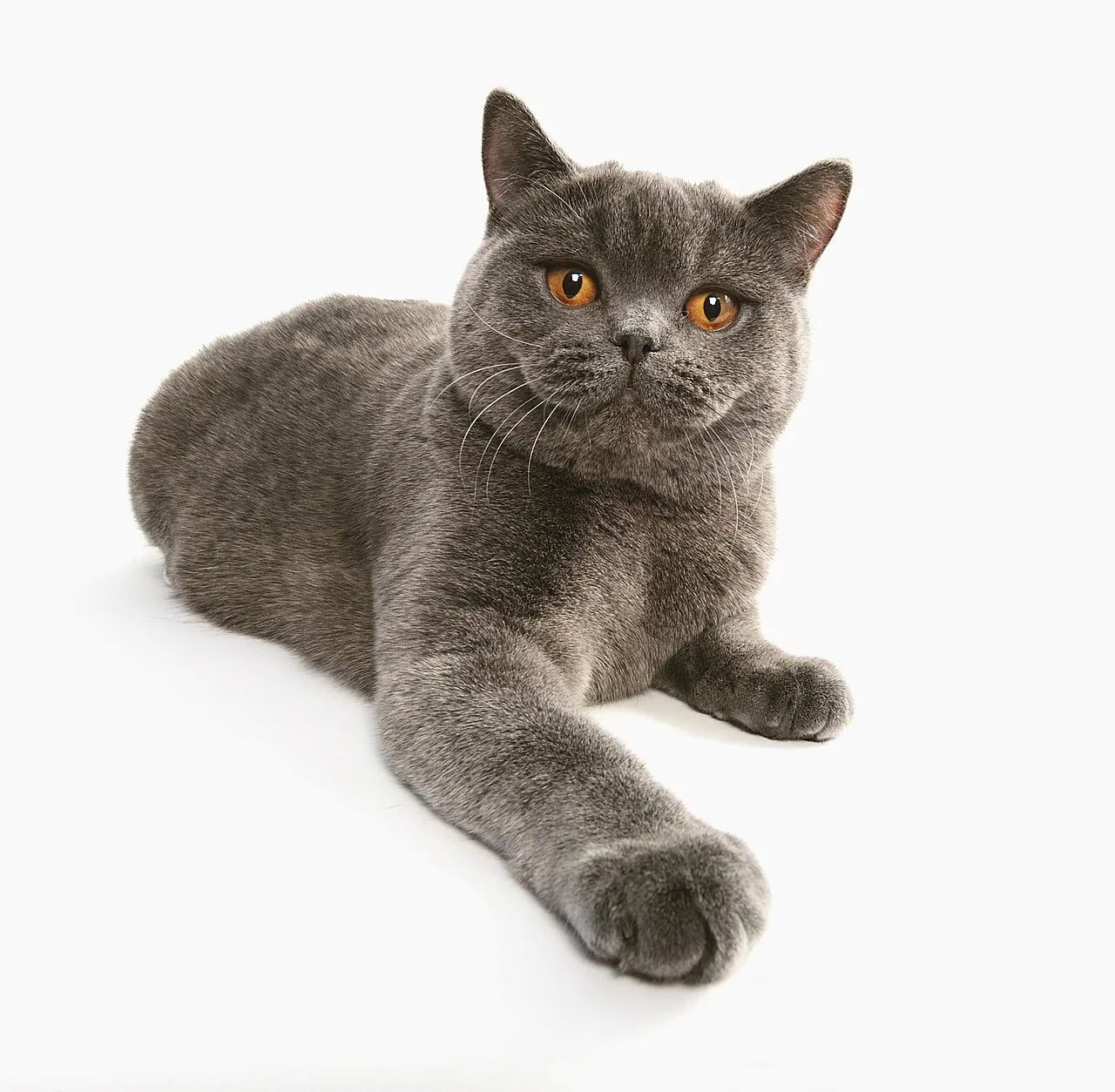
The British Shorthair is the oldest pedigree cat breed in Britain, and one of the most distinctive in the world. Its defining visual quality is completeness of roundness: a round head, full round cheeks, large round eyes, round paws, and a dense, plush coat that stands away from the body rather than lying flat.
No other established breed achieves the same combination of robust physical substance and teddy-bear aesthetic. This appearance is not incidental; it reflects a breed built for durability, developed from working cats that survived and thrived in the British climate over two millennia, then shaped by deliberate breeding to emphasise the characteristics that had proved most successful.
The British Shorthair's temperament matches its appearance. The breed is calm, self-possessed, and affectionate without being demanding. It tolerates solitude better than most highly social breeds, adapts readily to indoor life, and coexists peacefully with dogs, other cats, and children. It is not a lap cat by inclination, but it maintains constant, quiet loyalty to its household.
This guide covers the breed's ancient origin, the influence of Harrison Weir, the near-extinction and rebuilding after World War II, the genetics of the British Blue colour, the full range of coat varieties, the breed's health profile including cardiac concerns, and the practical considerations of life with the breed.
Origins: Roman Cats and the Foundation of Britain's Oldest Pedigree Breed
The British Shorthair's origin is deeper than any other pedigree cat breed's documented history. The cats from which the breed derives were brought to Britain by Roman legions beginning in 43 CE. The Romans were systematic carriers of domestic cats throughout their empire, cats served as efficient rodent controllers for grain stores, and legionary supply infrastructure created conditions under which cats accompanied the army's movements.
The cats that arrived in Britain from Rome were likely the descendants of the North African wild cat domesticates that had been progressively bred in Egypt and the Near East over thousands of years. Established in Roman Britain, they spread into the civilian population, working in farms, granaries, and settlements.
Over the subsequent seventeen centuries, through the Anglo-Saxon period, the Norman conquest, the medieval era, and into early modern Britain, these cats reproduced without human selection for appearance, shaped only by the demands of survival in the British climate.
The result was a physically robust, dense-coated, broadly proportioned cat: a cat built for cold, damp conditions rather than the warm North African climate of its ancestors. Natural selection in Britain favoured a larger body (for heat retention), a denser coat (for insulation), and a broad, sturdy skeletal structure. These traits became the foundation of the British Shorthair type long before any deliberate breeding program formalised them.
The formal history of the British Shorthair as a pedigree breed begins with Harrison Weir, the Victorian artist, writer, and cat fancier who organised the world's first major cat show at Crystal Palace, London, in 1871.
Weir had strong aesthetic and philosophical convictions about the value of the working British cat and exhibited his own British Shorthair cats at the show, advocating for their recognition as a distinct breed worthy of documentation and standardisation.
His written standard for the breed described exactly what natural selection had produced: a muscular, round-headed, dense-coated, cobby-bodied cat with a calm, undemanding temperament.
The British Shorthair was popular through the late Victorian and Edwardian periods, competing successfully against Persians and Angoras in early cat shows. The First World War disrupted breeding programs, and the Second World War nearly ended them entirely. Food shortages, economic collapse, and the deaths of many breeders in the conflict caused catastrophic losses in registered British Shorthair numbers. By the end of the war, the breed had been reduced to critically low population levels.
Post-War Rebuilding and the Persian Influence
The reconstruction of the British Shorthair breed after World War II required outcrossing to other breeds to rebuild numbers. The breeds used most extensively for this purpose were Persians and Russian Blues, with Persians making by far the larger contribution.
The Persian crosses were necessary but not without consequence. Persian cats differ substantially from British Shorthairs in several key characteristics: Persians have flatter faces (brachycephalic conformation), longer, denser coats with a different texture, and a somewhat different body proportion.
The British Shorthair breed standard required breeders to select against these influences over subsequent generations, maintaining the short coat, the non-brachycephalic head structure, and the distinctive British proportions, while accepting the slight additional roundness and plushness that the Persian crosses contributed.
The net effect on the breed's appearance was subtle but visible. Post-war British Shorthairs are, in the assessment of many breed historians, slightly rounder-faced and fuller-coated than pre-war examples. The Persian contribution added some plushness to the coat texture, enhancing the breed's signature stuffed-animal quality. The coat structure was maintained as shorthaired, but its density increased.
A significant health concern introduced through the Persian outcrossing is polycystic kidney disease (PKD). PKD, caused by a dominant mutation in the PKD1 gene, is the most common genetic disease in Persians. The mutation was inevitably introduced into British Shorthair lines during the post-war rebuilding. British Shorthairs with Persian ancestry in their pedigrees can carry the PKD1 mutation, and testing is recommended for all breeding animals in lines where Persian ancestry is present.
Appearance: The Anatomy of Roundness
The British Shorthair's physical appearance is so consistently described by a single characteristic that it is worth examining exactly what creates the impression of roundness.
The skull is wide and rounded, with a flat or slightly domed top. The forehead is well-rounded. The cheeks are prominently full, a feature that distinguishes the British Shorthair from most other shorthaired breeds, which have relatively flat cheeks. The muzzle is short, wide, and rounded. The chin is firm and well-defined. Together, these features create a face that is genuinely circular in frontal view.
The eyes are large and round, set well apart, giving the face its characteristic open, surprised expression. Eye colour depends on coat colour but is always vivid: deep gold or copper in British Blues and most other solid colours; green in silver tabbies; blue in colourpoint varieties. The intensity of eye colour is a primary evaluation criterion in show standards.
The ears are medium-sized, wide at the base, and rounded at the tips. They are set well apart, consistent with the broad head, and positioned to continue the rounded outline of the skull rather than adding angular points.
The body is described as cobby: short in relation to its depth, with a broad chest, level back, and short, strong legs. The paws are round and compact. The tail is short to medium in length, thick at the base, and rounded at the tip. Every structural element reinforces the overall impression of compact, robust roundness.
The coat deserves specific attention. The British Shorthair's coat is described as dense, plush, and crisp; it stands away from the body due to the density of the undercoat, rather than lying flat. Running a hand against the direction of the coat, the hairs spring back to position rather than collapsing.
This texture is one of the breed's defining characteristics and a principal reason for the teddy-bear comparison. It is softer to the touch than the coat of a typical domestic shorthair and substantially denser.
Coat Colours and Pattern Diversity
The British Shorthair exists in more than one hundred recognised colour and pattern combinations, making it one of the most diverse cat breeds in terms of coat variety.
British Blue is by far the most iconic and widely recognised variety. The blue (cool grey) solid coat is the colour most associated with the breed, appearing in the majority of breed photographs and most frequently cited when the British Shorthair is described.
The blue coat in cats is produced by dilution of the black eumelanin pigment, the same mutation that produces blue in Russian Blues, Chartreux, and Korats, though the British Shorthair's breed-specific coat texture creates a distinctively different visual effect.
Beyond blue, the British Shorthair appears in solid black, white, cream, and red; tabby patterns (classic, mackerel, ticked, spotted) in all base colours; tortoiseshell; calico; bicolour (white with any colour); colourpoint varieties; silver and golden varieties; and smoke varieties (the hair shaft carries colour only at the tip, with a white base, producing a shimmering effect).
The CFA and TICA standards accept virtually all genetically possible colour combinations within the British Shorthair type.
| Coat Category | Common Examples | Eye Colour |
|---|---|---|
| Solid | Blue, black, white, cream, red | Gold/copper in most; blue or odd-eyed in white |
| Tabby | Classic, mackerel, ticked | Gold/copper or green (silver tabbies) |
| Silver/smoke | Silver tabby, black smoke, chinchilla | Green (silver tabby); gold/copper (smoke) |
| Tortoiseshell/calico | Tortie, blue tortie, calico | Gold/copper |
| Colourpoint | All point colours | Blue |
| Bicolour | Blue and white, black and white | Gold/copper |
Temperament: Calm, Independent, and Quietly Loyal
The British Shorthair temperament is as characteristic as the appearance and equally distinct. The breed is emotionally even-keeled in a way that stands in marked contrast to the intense social bonding of Siamese or Ragdolls. It is affectionate without being needy, loyal without being clingy, playful without being manic.
The British Shorthair is not a lap cat. It will typically choose to sit beside its owner rather than on them, maintaining proximity without demanding physical contact. This behaviour reflects genuine contentment in the cat's company rather than indifference, a British Shorthair that follows you from room to room and settles near your feet is expressing its attachment. The distinction from more demonstratively affectionate breeds is one of style rather than depth of bond.
The breed manages solitude well relative to most other sociable breeds. An adult British Shorthair in a suitably enriched environment, with access to windows, scratching posts, and toys, can manage a typical working day without the stress responses seen in more anxious breeds.
This makes the British Shorthair a popular choice for households where people are away for significant portions of the day. For guidance on which breeds adapt best to apartment and working-household environments, see Best Cats for Apartments.
British Shorthairs are tolerant of children when introduced and socialised appropriately. They are not fragile in the way that some longhaired or fine-boned breeds can be, and they de-escalate conflict with children through calm withdrawal rather than aggression. They are similarly tolerant of dogs and other cats.
The breed is described as relatively undemanding compared with high-energy breeds, but it is not sedentary. Kittens are playful and curious, and adult British Shorthairs benefit from interactive play sessions that engage their hunting instincts. They tend toward lower-intensity play styles than Bengals or Abyssinians, and their energy expenditure reflects their cobby, moderate conformation rather than the lean athletics of high-energy breeds.
Health Conditions
The British Shorthair has a generally excellent health constitution, reflecting its origin in working cats shaped by natural selection rather than extreme morphological selection. However, the breed does have known hereditary health concerns.
Hypertrophic Cardiomyopathy (HCM) is the most serious. The same MYBPC3 gene associated with HCM in Maine Coons and Ragdolls has also been identified in British Shorthairs. The prevalence in British Shorthairs is not as extensively documented as in Maine Coons, but the condition occurs at rates that make cardiac screening a standard recommendation for the breed. Responsible breeders conduct annual echocardiograms on breeding animals and, where possible, DNA testing for known MYBPC3 variants.
"Hypertrophic cardiomyopathy is found across multiple cat breeds and in mixed-breed cats. Breeds with documented elevated prevalence include the Maine Coon, Ragdoll, and British Shorthair. Cardiac screening by echocardiography is the most reliable method for early detection, as genetic tests detect only known mutations and may miss novel variants." Paige, C.F., et al. (2009), Journal of Veterinary Internal Medicine, on HCM prevalence in cat breeds
Polycystic Kidney Disease (PKD) affects British Shorthairs in lines with Persian ancestry, a legacy of the post-war rebuilding. PKD is caused by a dominant mutation in the PKD1 gene that causes fluid-filled cysts to develop progressively in the kidneys, eventually leading to renal failure. DNA testing for the PKD1 mutation is accurate and commercially available.
Cats testing positive for the PKD1 mutation should not be used in breeding programs; a single negative result in a breeding cat substantially reduces the risk of passing PKD to offspring.
"Polycystic kidney disease due to the PKD1 mutation is the most common inherited disease in domestic cats worldwide, with the highest prevalence in Persian and Persian-derived breeds. British Shorthairs with Persian ancestry in their pedigrees should be tested, as a positive test identifies at-risk individuals before clinical signs develop." Lyons, L.A., et al. (2004), Journal of the American Society of Nephrology, on PKD1 in cats
Obesity is a practical risk in British Shorthairs. The breed's naturally stocky build and its sedentary indoor tendencies create conditions where weight gain can be gradual but substantial. An overweight British Shorthair may not appear dramatically different because the breed's dense build makes excess weight less visually obvious than in leaner breeds. Regular veterinary weigh-ins and measured meal portions are recommended throughout the cat's life.
| Health Condition | Cause | Test | Recommendation |
|---|---|---|---|
| Hypertrophic Cardiomyopathy | MYBPC3 mutation (and others) | DNA + echocardiogram | Annual echo for breeding cats; DNA test for known variants |
| Polycystic Kidney Disease | PKD1 dominant mutation | DNA swab | Test all breeding animals; positive cats excluded |
| Obesity | Diet + sedentary tendency | Body condition scoring | Measured meals; avoid free-choice feeding |
For a full review of British Shorthair health conditions and management, see British Shorthair Health Problems.
Lifespan: One of the Healthiest Major Breeds
The British Shorthair has one of the longest lifespans of any major pedigree breed, commonly reaching 14 to 20 years when properly screened and maintained. The breed's longevity reflects its origin in naturally selected working cats: unlike breeds developed through rapid selection for extreme morphological traits, the British Shorthair has avoided the structural health problems (brachycephalic syndrome, skeletal abnormalities, extreme leanness) that shorten lives in other breeds.
The primary threats to British Shorthair longevity are HCM (if present and unmanaged) and obesity-related complications. Cats from DNA-tested, echocardiogram-screened breeding programs that are maintained at appropriate body weight routinely achieve the upper end of the 14-20 year range.
For comprehensive lifespan comparison across breeds, see How Long Do Cats Live. For guidance on recognising the signs of good health in a mature cat, see Signs of a Healthy Cat.
Grooming and Maintenance
The British Shorthair coat is deceptively easy to maintain. Despite its density, the short length means it does not tangle or mat. Weekly brushing with a rubber curry comb or a fine-toothed stainless steel comb removes dead undercoat, prevents loose hair from accumulating in the home, and distributes the skin's natural oils through the coat to maintain its characteristic crisp texture.
During seasonal moults, spring in particular, shedding increases substantially and twice-weekly brushing becomes appropriate. The British Shorthair is not a heavy year-round shedder relative to longhaired breeds, but the density of the coat means that seasonal moult volumes can be considerable.
Bathing is rarely necessary for coat maintenance but is tolerated by most British Shorthairs when required. The coat dries relatively quickly compared with longhaired breeds, and the plush texture is maintained well after bathing.
The face requires occasional attention: the full cheeks of the British Shorthair can trap moisture at the inner corner of the eyes, leading to staining. Gentle daily wiping with a damp cloth keeps this area clean. Ear cleaning as needed and regular dental care complete the routine.
For a detailed care guide including seasonal grooming schedules, see British Shorthair Care Guide.
Feeding the British Shorthair
The British Shorthair is not a high-energy breed, and feeding programs should reflect the breed's moderate metabolic demands and obesity risk. Adult British Shorthairs typically require around 200-280 kcal of metabolisable energy per day, depending on size, activity level, and reproductive status.
High-protein, meat-based diets appropriate to the cat's life stage are suitable. The cobby build and moderate activity level mean that freely available dry food or frequent feeding of calorie-dense foods will produce weight gain over time. Scheduled wet-food meals, measured portions, and the use of puzzle feeders to slow eating and provide enrichment are appropriate strategies for the breed.
Kittens and adolescents (up to two years) require diets formulated for growth with higher protein and caloric density than adult maintenance diets.
Comparing the British Shorthair to Similar Breeds
The Maine Coon shares the British Shorthair's reputation for calm temperament and family-friendliness but differs in virtually every physical parameter: the Maine Coon is one of the largest breeds to the British Shorthair's medium size, has a three-layered semi-longhaired coat requiring more maintenance, and is significantly more active and playful in adulthood.
The Persian Cat is the British Shorthair's closest relative due to post-war outcrossing and shares some temperamental qualities, particularly the calm, undemanding quality. The Persian differs in its flat-faced structure (brachycephalic conformation), its much longer and denser coat requiring daily grooming, and its greater fragility.
The Chartreux is a French breed that resembles the British Blue so closely that the two were once classified as the same breed in some registries. Key differences: the Chartreux has a more wedge-shaped head with a narrower muzzle (sometimes described as a "smiling" expression from the muzzle structure), a slightly finer bone structure, and a coat that is slightly less dense and more woolly in texture. The two breeds are distinct by current registry standards.
Living with a British Shorthair
The British Shorthair's combination of low maintenance demands, good health prospects, and quiet affection makes it one of the most practical of all pedigree cat breeds for a wide range of household situations. It is the antithesis of the high-demand cat: it does not require constant attention, does not fill the house with vocalisation, does not destroy furniture in frustration, and does not suffer dramatically from a working owner's absence.
What it offers in return is steady, dignified companionship, a cat that will be present in your home for potentially two decades without generating crises, that will meet new situations with calm curiosity, and that will develop a deep familiarity with its household's routines without becoming demanding about them.
The one obligation the breed's health profile imposes is cardiac monitoring. Given HCM risk in the breed, an annual veterinary examination and, from middle age, periodic cardiac echocardiography is a prudent commitment for any British Shorthair owner. The investment is manageable; the alternative, undetected HCM progressing without management, is not.
References
Lyons, L.A., et al. (2004). "Feline polycystic kidney disease mutation identified in PKD1." Journal of the American Society of Nephrology, 15(10), 2548-2555. https://doi.org/10.1097/01.ASN.0000141776.46131.46
Paige, C.F., Abbott, J.A., Elvinger, F., & Pyle, R.L. (2009). "Prevalence of cardiomyopathy in apparently healthy cats." Journal of the American Veterinary Medical Association, 234(11), 1398-1403. https://doi.org/10.2460/javma.234.11.1398
Meurs, K.M., et al. (2007). "A cardiac myosin binding protein C mutation in the Maine Coon cat with familial hypertrophic cardiomyopathy." Human Molecular Genetics, 16(7), 764-773. https://doi.org/10.1093/hmg/ddm024
O'Brien, S.J., et al. (2008). "The promise of comparative genomics in mammals." Science, 286(5439), 458-481. https://doi.org/10.1126/science.286.5439.458
Cat Fanciers' Association (CFA). (2023). British Shorthair Breed Standard and Profile. Retrieved from https://cfa.org/british-shorthair/
The International Cat Association (TICA). (2023). British Shorthair Breed Standard. Retrieved from https://tica.org/breeds/browse-all-breeds
Governing Council of the Cat Fancy (GCCF). (2023). British Shorthair Breed Standard. Retrieved from https://www.gccfcats.org/breeds/british-shorthair/
Frequently Asked Questions
Are British Shorthair cats good for first-time owners?
British Shorthairs are widely regarded as one of the best breeds for first-time cat owners. They are calm, adaptable, tolerant of various household situations, and low-maintenance in terms of coat care. They manage solitude better than most sociable breeds, making them practical for working owners. They are not prone to separation anxiety and do not fill the house with demanding vocalisation.
The primary commitment they require beyond standard cat care is awareness of their cardiac health risks and appropriate veterinary screening.
Do British Shorthair cats like to be held?
British Shorthairs are generally not lap cats. They typically prefer to sit beside their owners rather than on them, and most will tolerate but not actively seek prolonged holding. This is a breed characteristic rather than standoffishness, British Shorthairs form genuine attachments and will follow their owners through the house and seek proximity consistently.
Owners who want a cat that actively seeks physical contact may find the British Shorthair less demonstrative than they expected, while those who appreciate a calm, present but non-clinging companion find the temperament ideal.
What is the difference between a British Shorthair and a Chartreux?
The British Shorthair and Chartreux are sometimes confused because both appear in a blue-grey colour and are broadly built with full cheeks. Key distinctions: the Chartreux has a narrower, more tapered muzzle (creating a characteristic slightly upturned expression), a slightly finer bone structure, and a coat that is slightly less dense with a more woolly texture.
The British Shorthair is broader across every dimension and has the more pronounced roundness in head and eye shape. The two breeds have separate registrations and distinct breed standards in all major registries.
How much do British Shorthair cats shed?
British Shorthairs shed at moderate levels year-round and more heavily during seasonal moults, particularly in spring. The density of the coat means that moult periods produce a significant volume of loose hair despite the short length. Weekly brushing reduces shedding accumulation in the home under normal conditions; twice-weekly or daily brushing during the spring moult is recommended.
The coat does not mat or tangle due to its short length, making maintenance straightforward compared with longhaired breeds.
Do British Shorthairs have heart problems?
Hypertrophic cardiomyopathy (HCM) occurs in British Shorthairs at elevated rates. A mutation in the MYBPC3 gene associated with HCM in multiple breeds has been identified in British Shorthairs. Annual cardiac echocardiograms for breeding animals are recommended by veterinary cardiologists, and breeding cats should be DNA tested for known HCM variants.
Early detection via echocardiography allows veterinary management that can extend quality of life and lifespan. The condition is manageable with medication when detected; undetected progression is the primary risk.