
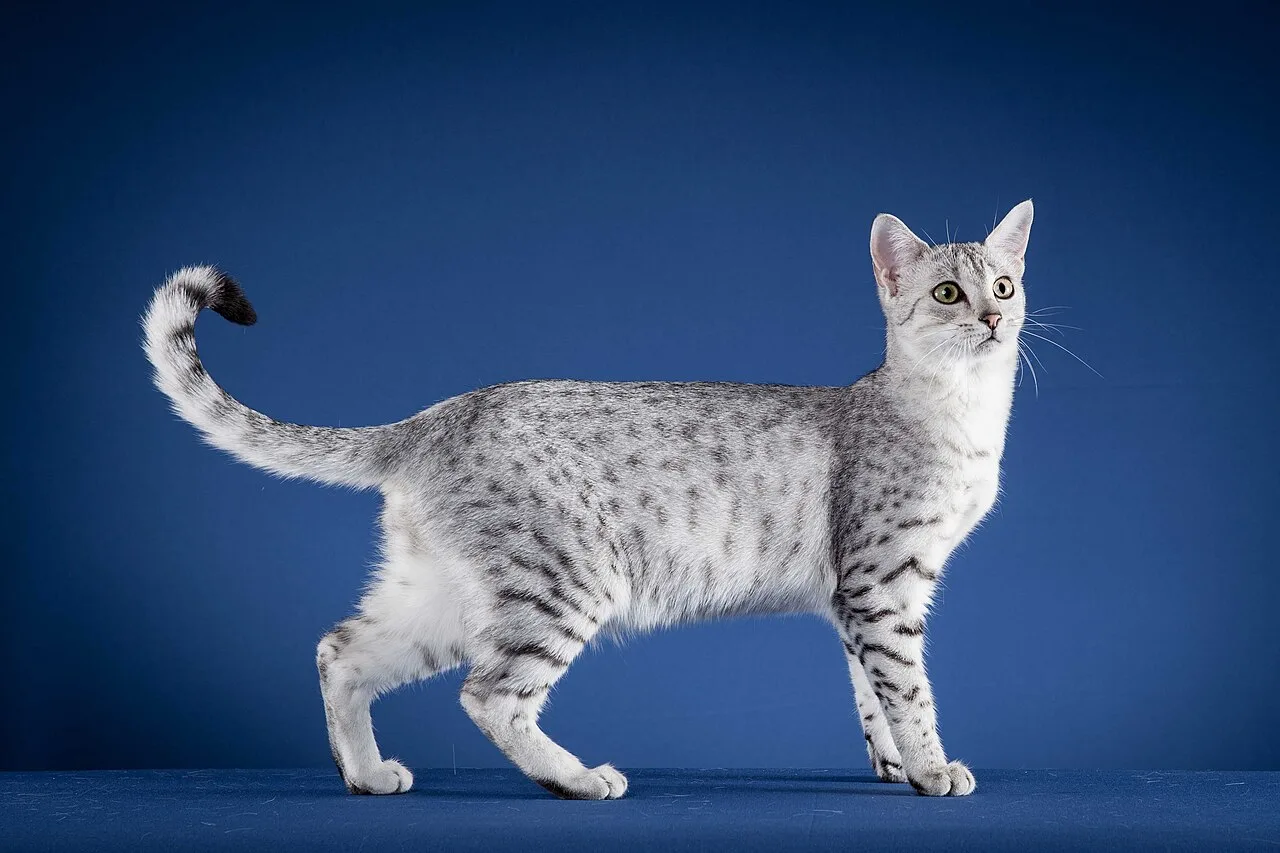
The Egyptian Mau is the only naturally spotted domestic cat breed in the world, and the distinction is meaningful. The Bengal's spotted appearance is a coat-level pattern; the spots are in the fur. The Egyptian Mau's spots are in the skin itself, visible on the hairless areas of the belly and identifiable even on shaved areas of the coat.
This is not a selective breeding artifact; it is the same type of spotting seen in wild cats, and it connects the Egyptian Mau directly to the cats depicted in ancient Egyptian art.
The name says everything about the breed's historical claim: "Mau" is the Egyptian word for cat, and depictions in Egyptian paintings from as early as 1550 BCE show spotted cats with markings virtually identical to those of the modern Egyptian Mau. The breed may well represent the most direct descendant of the original domesticated cats of ancient Egypt that exists in pedigree form today, though establishing a direct genetic continuity between ancient and modern is complicated.
The breed's modern history began with a chance encounter in Rome in the 1950s, when a Russian émigré princess named Nathalie Troubetskoy met a Syrian diplomat who had a young Egyptian kitten brought from Cairo. That kitten, named Baba, became the foundation of the Western Egyptian Mau breed program.
From Ancient Egypt to Modern Breeding
The cats of ancient Egypt were not merely pets or pest controllers; they were sacred animals associated with the goddess Bastet, protected by law, and mummified after death. The spotted domestic cat appears repeatedly in Egyptian art: in the famous painting from the tomb of Nebamun (circa 1350 BCE) showing a cat with spotted markings catching birds in a papyrus thicket, and in numerous religious artifacts depicting cats with the same distinctive mackerel-spotted or random-spotted pattern.
Whether a direct genetic line can be drawn from these cats to the modern Egyptian Mau is scientifically contested. A 2007 genetic study by Carlos Driscoll and colleagues found that domestication occurred in the Near East and that Egyptian cats were likely derived from Near Eastern populations rather than being independently domesticated. However, the Egyptian Mau's distinctive spotted coat pattern and its genetic markers do suggest a connection to the Eastern Mediterranean cat population.
The modern breed's documented history begins with Princess Nathalie Troubetskoy, who imported spotted cats from Egypt and Cairo and began a breeding program in Rome. She brought her cats to the United States in 1956, where they were registered with CFA. The breed achieved CFA Championship status in 1977.
The Natural Spots
The Egyptian Mau's spots are the central visual feature and the most genetically interesting aspect of the breed. Unlike the Bengal, whose spotting is produced by selective breeding from Asian leopard cats to create a particular coat pattern, the Mau's spots arise from a different genetic mechanism, one that affects the skin's melanocyte distribution rather than just the hair shaft pattern.
In practice, this means that the spots are visible on the skin underlying the coat, on shaved areas or on the skin of the abdomen, which is relatively hairless in most cats. The spots are described as "random" in the breed standard; they should not be arranged in regular rows or create a mackerel-tabby striped effect. They should appear as distinct, well-defined dark spots on a lighter ground color, with each spot dark at the edges and lighter in the center in some individuals.
The base colors recognized in the CFA standard are silver (charcoal spots on silver), bronze (dark brown spots on bronze-toned ground), and smoke (dark spots visible through a lighter smoke coat). Each color has a characteristic "ground color" and the spots must show good contrast.
| Characteristic | Details |
|---|---|
| Weight | 2.3-5.9 kg |
| Build | Medium, muscular, slightly wild-looking |
| Head | Slightly rounded wedge |
| Eyes | Gooseberry green (preferred); amber permitted |
| Coat | Short, dense, silky |
| Spots | Random spotting IN skin, not just coat |
| Flap of skin | From flank to hind knee, like cheetah |
| Lifespan | 12-15 years |
| CFA recognition | 1977 |
The Fastest Domestic Cat
The Egyptian Mau holds an extraordinary distinction: it is the fastest domestic cat breed. Measured speed estimates of up to 48 km/h have been documented in controlled conditions, making the Mau significantly faster than any other domestic breed.
The anatomical basis for this speed is visible: a distinctive loose flap of skin that runs from the flank to the back of the hind knee, resembling the feature seen in cheetahs. This skin fold allows the hind legs to extend further back and forward with each stride, increasing the length of the running gait without requiring longer legs. The Mau's longer-than-average hind legs further contribute to its stride length.
"The Egyptian Mau's flank-to-knee skin fold allows a greater range of hip joint extension than is possible in cats lacking this feature. The biomechanical consequence is a longer stride cycle, translating directly to higher maximum running speed." Turner, D.C. and Bateson, P. (eds.), The Domestic Cat: The Biology of Its Behaviour, 3rd edition, Cambridge University Press, 2013
The Mau also runs with a unique gait, a loose-limbed stride that observers describe as resembling a cheetah in miniature. The hind legs are slightly longer than the forelimbs, which gives the breed a characteristic stance with the hindquarters slightly elevated relative to the shoulders.
For jumping capabilities see How High Can Cats Jump. For intelligence information see How Smart Are Cats. For care guidance see Egyptian Mau Care Guide.
Temperament
The Egyptian Mau is an active, intelligent, and somewhat independent cat with a personality that reflects its wild-appearing aesthetics. The breed is affectionate with its own family but can be reserved or cautious with strangers, a selectivity that reflects a more ancestral cat psychology than many of the more socially promiscuous modern breeds.
Within its trusted circle, the Mau is vocal, interactive, and entertainingly engaged. The voice is distinctive, a chortling, chirping quality that differs from the standard meow and adds to the impression of a cat with something specific to communicate. The breed is known for "chattering" at birds seen through windows, a behavior also seen in other breeds but particularly pronounced in the Mau.
The activity level is high. Egyptian Maus need interactive play, climbing opportunities, and mental stimulation. They hunt with extraordinary focus and will stalk, spring, and capture toys with a precision and speed that demonstrates the breed's predatory heritage.
Health Profile
| Health Concern | Details | Management |
|---|---|---|
| Hypertrophic cardiomyopathy (HCM) | Reported in breed | Echocardiogram screening |
| Leukodystrophy | Rare hereditary neurological condition | Veterinary investigation if signs appear |
| Environmental sensitivity | Can be cold-sensitive | Indoor management; warmth |
| Dental disease | Common with age | Regular dental care |
A hereditary leukodystrophy, a neurological condition affecting the white matter of the brain and spinal cord, has been reported in some Egyptian Mau lines in Europe. This condition is rare, but it warrants mention in complete breed health discussions.
For comparison with another spotted breed see Bengal Cat and Abyssinian.
References
- Driscoll, C.A., et al. "The Near Eastern origin of cat domestication." Science, 2007. https://doi.org/10.1126/science.1139518
- Turner, D.C. and Bateson, P. (eds.) The Domestic Cat: The Biology of Its Behaviour, 3rd edition. Cambridge University Press, 2013. ISBN 978-1107015968.
- Ottoni, C., et al. "The palaeogenetics of cat dispersal in the ancient world." Nature Ecology and Evolution, 2017. https://doi.org/10.1038/s41559-017-0139
- Cat Fanciers' Association. "Egyptian Mau Breed Standard." CFA.org, 2023. https://cfa.org/egyptian-mau/
- Lyons, L.A., et al. "Whole genome sequencing in cats, for variant discovery, and Mendelian trait analysis." Scientific Data, 2016. https://doi.org/10.1038/sdata.2016.113
Frequently Asked Questions
Are Egyptian Mau cats related to ancient Egyptian cats?
The Egyptian Mau’s spotted pattern closely resembles the cats depicted in ancient Egyptian art from as early as 1550 BCE. Genetic studies have found that domestication occurred in the Near East and that Egyptian cats were descended from Near Eastern populations, and the Mau’s genetic markers suggest Eastern Mediterranean origin.
While a direct genetic lineage cannot be conclusively proven, the Mau represents the best documented connection to the cats of ancient Egypt that exists in modern pedigree cat breeding.
Why is the Egyptian Mau the fastest domestic cat?
The Egyptian Mau has a distinctive anatomical feature shared with cheetahs, a loose fold of skin running from the flank to the hind knee that allows the hind legs to extend further in each stride than a cat lacking this feature. Combined with longer-than-average hind legs and a naturally athletic body type, this gives the Mau a stride length and running mechanics that produce speeds measured at up to 48 km/h.
No other domestic cat breed approaches this speed.
How are Egyptian Mau spots different from Bengal spots?
Egyptian Mau spots are natural markings that appear in the skin itself; they are visible on the skin of the abdomen and in shaved areas, not just as a pattern in the fur. Bengal spots are a coat-level pattern produced by selective breeding from Asian leopard cats and are present in the fur but do not penetrate to the skin.
The Egyptian Mau’s spots arise from a different genetic mechanism involving melanocyte distribution in the skin, while Bengal spotting results from specific coat pattern genetics.
What colors are Egyptian Maus recognized in?
CFA recognizes three Egyptian Mau colors: silver (charcoal spots on a silver ground), bronze (dark brown spots on a warm bronze ground), and smoke (dark spots visible through a light smoke coat). All three varieties must show distinct random spotting on both the coat and the skin. Green gooseberry eye color is preferred in the breed standard across all three colors.
Are Egyptian Maus good family cats?
Egyptian Maus are excellent family cats for active households that can engage with them. They are affectionate with their own family, playful, and interactive, but they tend to be selective with strangers, more reserved on first contact than breeds like the Ragdoll or Maine Coon. High activity level and strong hunting drive mean they need interactive play and enrichment.
They are less tolerant of forced handling or unexpected loud noises than calmer breeds.
How did the Egyptian Mau come to Western cat breeding?
The modern breed’s Western history begins in Rome in the 1950s, when Russian princess Nathalie Troubetskoy obtained spotted cats from Cairo through a Syrian diplomat. She developed a small breeding program in Italy and brought her cats to the United States in 1956, where CFA registration began. The breed achieved Championship status in 1977.
The Ankara Zoo in Turkey has also maintained spotted cats as part of its feline heritage conservation, contributing to broader Near Eastern cat genetics research.