
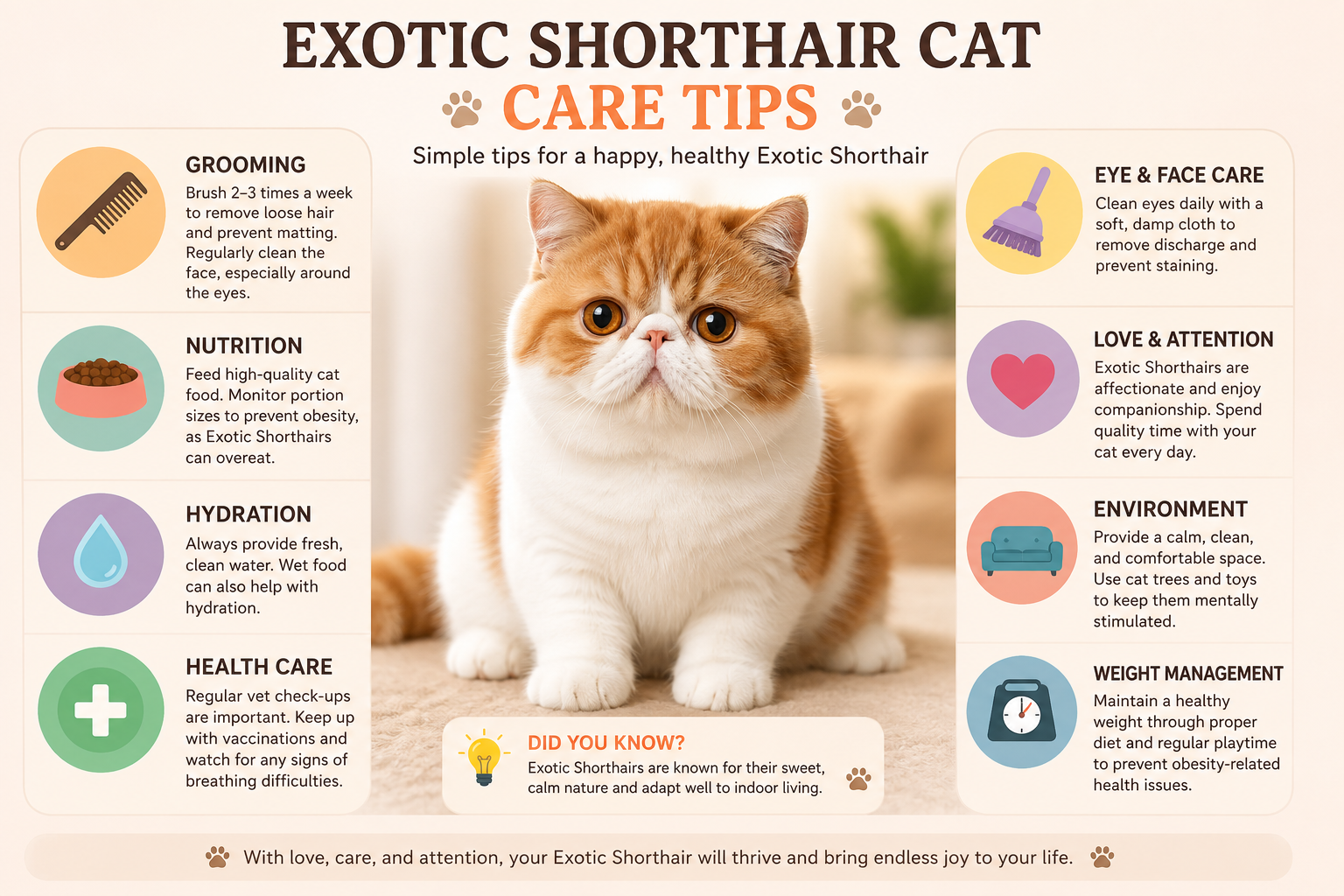
The Exotic Shorthair is often described as the "lazy man's Persian" a description that is simultaneously reductive and entirely accurate. It was created by crossing Persian cats with American Shorthairs and other shorthaired breeds specifically to produce a cat with the Persian's distinctive rounded face, plush body, and gentle temperament, but with a coat that requires a fraction of the grooming commitment.
The strategy succeeded completely, and since CFA recognition in 1967 the Exotic Shorthair has grown to become one of the most popular pedigree cat breeds in the world.
The appeal is self-evident: a face that is broadly considered among the most appealing in domestic cat breeding, a temperament that is calm and affectionate, a coat that can be maintained with twice-weekly brushing instead of daily combing, and, crucially, the same sweet expression without the daily grooming labor that keeps many prospective Persian owners from making the commitment.
For those who love the Persian aesthetic but lead busy lives, the Exotic Shorthair presents a compelling alternative.
The trade-off is that the Exotic Shorthair shares all of the Persian's health concerns, and understanding those concerns, particularly brachycephalic obstructive airway syndrome, polycystic kidney disease, and ocular issues, is essential for anyone considering this breed.
Origin and Development
The Exotic Shorthair came about through deliberate crossing in the 1950s and 1960s by American breeders who admired the Persian's conformation but wanted a shorthaired alternative. The most significant early crosses were between Persian cats and American Shorthairs, with the intent of introducing the Persian's round head and cobby body into the American Shorthair frame while retaining the shorthaired coat.
The Persian genes proved dominant over the shorthaired genes in ways breeders initially underestimated, and the resulting cats looked considerably more Persian than American Shorthair. The round face and plush body persisted even with one Persian parent. Breeders continued refining the type, and by the time CFA recognized the breed in 1967, it was established as a distinct breed rather than simply a shorthaired variant of the Persian.
CFA initially called the breed the "Sterling" (for the silver-tipped variants that were common in early breeding), but the name Exotic Shorthair was adopted to reflect the breed's hybrid origins and short coat. The CFA now considers the Exotic Shorthair and the Persian to be closely related breeds with the same standard applied to everything except coat length and texture.
In the UK and under the Governing Council of the Cat Fancy (GCCF), the breed is known simply as the "Exotic" because both shorthaired and longhaired versions are possible (longhaired Exotics are the result of two copies of the recessive shorthair gene being absent, producing a Persian-length coat; these are typically registered as Persians).
Physical Characteristics
The Exotic Shorthair is a medium to large cat with a distinctive cobby body type, short-legged, broad-chested, and compact, sitting low to the ground. The overall impression is of a round, plush, cushion-like cat with a flat face, large eyes, and a notably short nose.
| Characteristic | Details |
|---|---|
| Weight | 3.6-5.9 kg |
| Build | Cobby, broad, low-slung |
| Head | Round, large, flat-faced (brachycephalic) |
| Nose | Very short, pushed in |
| Eyes | Large, round, prominent |
| Coat | Short, dense, plush, stands away from body |
| Coat texture | Distinctly different from American Shorthair |
| Lifespan | 12-15 years |
| CFA recognition | 1967 |
The head is round and large with full cheeks, a broad skull, and a nose that is set deep between the eyes. The nose leather should, by CFA standard, be positioned no lower than the bottom of the eye sockets; this is the standard intended to ensure sufficient facial airway, though in practice the modern Exotic Shorthair is substantially more brachycephalic than earlier generations of the breed.
The eyes are round, large, and set wide apart. The prominent, globular eye shape contributes to the breed's appeal but also to its vulnerability to corneal damage, chronic epiphora (tearing), and the staining that results when tear overflow tracks down the face grooves.
The coat is the breed-defining feature that separates the Exotic from the Persian. It is short, much shorter than the Persian, but it is not flat and close-lying like the American Shorthair coat. Instead, it is dense and plush, standing away from the body and giving the cat a noticeably padded, rounded appearance. This coat texture is unique to the Exotic Shorthair among shorthaired breeds and is evaluated as a key breed feature in the show ring.
Brachycephaly and Health Implications
The Exotic Shorthair's flat face is its most distinctive feature and its most significant health liability. Brachycephaly, the shortening of the facial bones that creates the flat profile, compresses the anatomy of the upper respiratory tract in ways that can cause lifelong breathing difficulties and related complications.
Brachycephalic Obstructive Airway Syndrome (BOAS) in cats, as in dogs, encompasses a combination of anatomical abnormalities that restrict airflow: narrowed nostrils (stenotic nares), an elongated soft palate that partially blocks the airway, and a relatively small trachea. Cats with severe BOAS show noisy breathing, snoring, exercise intolerance, difficulty eating, and in extreme cases respiratory distress.
Surgical correction of narrowed nostrils and shortened soft palate is possible and improves quality of life significantly in affected individuals.
"Brachycephalic cats present with a range of conformational abnormalities affecting the nasal passages, nasopharynx, and soft palate that are directly analogous to those documented in brachycephalic dog breeds. The degree of impairment is highly variable but is correlated with the degree of facial flattening." Farnworth, M.J., et al., PLOS ONE, 2016
The flat face also creates the ocular issues associated with the Persian and Exotic. The shallow eye sockets provide less protection to the prominent eyes, increasing risk of corneal injuries and exposure keratitis. The facial folds that develop around the nose in some individuals can trap moisture and create conditions for skin fold dermatitis. Regular cleaning of the face folds and inner eye corners is necessary maintenance.
Polycystic Kidney Disease
Polycystic kidney disease (PKD) is a hereditary condition in the Persian breed and its derivatives, including the Exotic Shorthair, Himalayan, and other Persian-derived breeds, that has historically affected large proportions of these populations. PKD causes the progressive formation of fluid-filled cysts in kidney tissue, reducing functional kidney mass over time and eventually leading to chronic kidney failure.
A DNA test for the specific PKD1 mutation found in Persian-derived breeds is available and has been used since the early 2000s by responsible breeders to eliminate the mutation from their breeding programs. Breeding only PKD1-negative animals to other PKD1-negative animals produces litters guaranteed to be free of this specific mutation.
Before DNA testing became widespread, prevalence estimates of PKD in Persian and Exotic Shorthair populations reached 40% or higher in some studies. In responsibly managed breeding programs using DNA testing, this prevalence has fallen dramatically. When purchasing an Exotic Shorthair, buyers should ask for documentation of PKD1 testing on both parents.
| Health Concern | Details | Testing Available |
|---|---|---|
| Polycystic kidney disease (PKD) | Hereditary; PKD1 mutation | DNA test, ask for results |
| BOAS | Brachycephalic airway syndrome | Clinical assessment |
| HCM | Hypertrophic cardiomyopathy | Echocardiogram |
| Epiphora | Chronic tear overflow, facial staining | Clinical management |
| Skin fold dermatitis | Moisture-trapping facial folds | Regular cleaning |
"The PKD mutation in Persian-derived breeds is autosomal dominant, meaning only one copy is required to cause disease. DNA testing of breeding animals is the only reliable method for eliminating this condition from breeding programs." Lyons, L.A., et al., Genomics, 2004. https://doi.org/10.1016/j.ygeno.2004.01.007
Temperament
The Exotic Shorthair has inherited the Persian's calm, affectionate, and gentle temperament, with a slight increase in playfulness attributed to the American Shorthair influence. These are quiet cats that enjoy being in the presence of their owners without being demanding or highly vocal. They tend to find a comfortable spot in the home's activity center and participate in family life from that vantage point.
Exotics are less sedentary than the modern Persian; they show more interest in interactive play and are willing to engage with toys and games. They are not hyperactive or athletic, but they have a moderate energy level that keeps them engaged without creating management challenges. Play sessions with wand toys or feather toys are enjoyed and provide useful physical and mental stimulation.
The breed is well-suited to apartment living. The low activity level, minimal vocalization, and adaptability to calm domestic environments make the Exotic Shorthair one of the most recommended breeds for people in apartments or smaller living spaces. For more on this see Best Cats for Apartments.
Grooming the Exotic Shorthair Coat
The coat requires brushing twice a week with a soft slicker brush or metal comb. The dense, plush texture does not mat as readily as a Persian coat, but it does accumulate loose hair and can develop small tangles in the densest areas if neglected. The twice-weekly brushing schedule removes loose hair, prevents tangles, and distributes skin oils through the coat.
Face cleaning is a daily requirement. The facial folds, inner eye corners, and the area around the nose leather accumulate tear staining and debris. Daily gentle wiping with a moistened cotton pad removes the buildup before it hardens into dark, difficult-to-remove staining. The Exotic's face can look pristine or look neglected depending entirely on how consistently this daily cleaning is performed.
For more detailed care information see Exotic Shorthair Care Guide. For health detail see Exotic Shorthair Health Problems.
Comparison with the Persian
The Exotic Shorthair and the Persian are evaluated against the same breed standard in every respect except coat. The Persian's coat is long, flowing, and requires daily combing to prevent the severe matting that develops rapidly in a neglected Persian coat. The Exotic's coat is short enough to be managed with twice-weekly attention.
Everything else, the round head, flat face, cobby body, gentle temperament, PKD risk, BOAS vulnerability, eye tearing issues, is the same. Buyers choosing between them are essentially choosing how much grooming commitment they want to take on, not a fundamentally different cat.
For a comparison see Persian Cat and British Shorthair.
References
- Farnworth, M.J., Chen, R., Packer, R.M.A., et al. "Flat Feline Faces: Is Brachycephaly Associated with Respiratory Abnormalities in the Domestic Cat?" PLOS ONE, 2016. https://doi.org/10.1371/journal.pone.0161777
- Lyons, L.A., Biller, D.S., Erdman, C.A., et al. "Feline polycystic kidney disease mutation identified in PKD1." Journal of the American Society of Nephrology, 2004. https://doi.org/10.1097/01.ASN.0000107734.35030.04
- Meurs, K.M. et al. "A substitution mutation in the myosin binding protein C gene in ragdoll hypertrophic cardiomyopathy." Genomics, 2007. https://doi.org/10.1016/j.ygeno.2007.02.007
- Cat Fanciers' Association. "Exotic Shorthair Breed Standard." CFA.org, 2023. https://cfa.org/exotic/
- Gunn-Moore, D.A. "Cognitive dysfunction in cats: Clinical assessment and management." Topics in Companion Animal Medicine, 2011. https://doi.org/10.1053/j.tcam.2011.01.005
Frequently Asked Questions
What is the difference between an Exotic Shorthair and a Persian?
The Exotic Shorthair has the same round head, flat face, cobby body, and gentle temperament as the Persian, but with a short, plush coat instead of the Persian’s long, flowing fur. Both breeds are evaluated against the same CFA standard in every respect except coat. The Exotic requires twice-weekly brushing rather than daily combing, making it significantly less demanding to maintain. Both share the same health concerns including PKD, BOAS, and HCM.
Do Exotic Shorthairs have breathing problems?
Many do, to varying degrees. Brachycephalic Obstructive Airway Syndrome (BOAS) results from the anatomical compression caused by the flat face: narrowed nostrils, elongated soft palate, and sometimes a reduced tracheal diameter all restrict airflow. Snoring, noisy breathing at rest, and exercise intolerance are common signs. Surgical correction of the most severe structural problems is possible and significantly improves quality of life in affected cats.
What is PKD and should I test for it before buying an Exotic Shorthair?
Polycystic kidney disease (PKD) is a hereditary condition causing the formation of fluid-filled cysts in kidney tissue that progressively reduce kidney function. It is transmitted by an autosomal dominant mutation (PKD1) found in Persians and Persian-derived breeds including the Exotic Shorthair, Himalayan, and Ragamuffin. A DNA test identifies carrier and affected animals.
Before purchasing an Exotic Shorthair, ask the breeder for documented PKD1-negative test results on both parents.
Are Exotic Shorthairs good apartment cats?
Yes, the Exotic Shorthair is among the most apartment-suitable pedigree breeds. The low activity level, minimal vocalization, and calm temperament mean the breed adapts well to smaller living spaces. The main management requirement in an apartment setting is ensuring some daily interactive play to prevent the obesity that can develop in very sedentary cats.
How much grooming does an Exotic Shorthair need?
The coat requires brushing twice a week, far less than a Persian’s daily grooming requirement. However, the flat face requires daily attention: the facial folds, inner eye corners, and the area around the nose leather need to be wiped clean daily to prevent tear staining and skin fold irritation. Neglecting facial cleaning leads to dark, hardened staining that is difficult to remove.
Are Exotic Shorthairs playful?
More so than Persians. The American Shorthair influence introduced a slightly higher activity level, and Exotic Shorthairs show genuine interest in interactive play with wand toys and puzzle feeders. They are not athletic or hyperactive, but they are not purely sedentary either. Regular play sessions help maintain healthy weight and provide mental stimulation.