
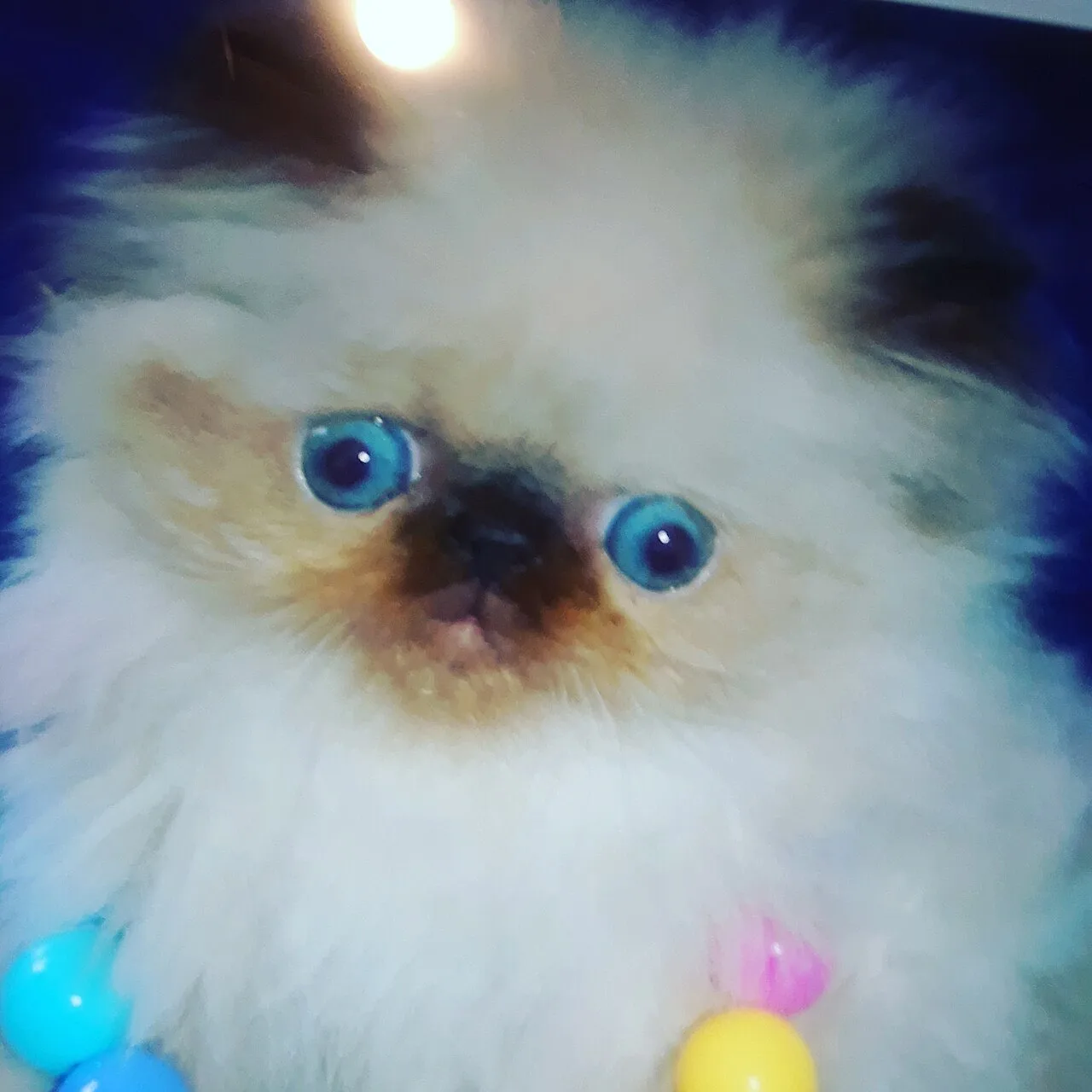
The Himalayan is a deliberate hybrid of the Persian and the Siamese, a cat with the Persian's long, flowing coat and cobby body structure combined with the Siamese's colorpoint coloring and vivid blue eyes. It was the product of a systematic breeding experiment begun in the 1930s by Virginia Cobb and Dr. Clyde Keeler of Harvard, who set out to understand the genetics of colorpoint coloring by crossing the breeds.
The result of their work, and of subsequent breeders' refinements, is a breed that delivers the Persian's visual drama (the flowing coat, round face, compact body) in a range of colorpoint patterns that the Persian cannot produce, with the Siamese's distinctive blue eyes making the colorpoint markings even more striking.
The Himalayan occupies an ambiguous position in pedigree cat classifications. CFA classifies the Himalayan as a division of the Persian rather than a separate breed, reflecting the view that the Himalayan is essentially a colorpoint Persian. TICA recognizes the Himalayan as a separate breed. This ambiguity in registration reflects the fact that the Himalayan is genetically a Persian that carries the colorpoint (cs) gene, and the two breeds are essentially indistinguishable except for color.
What is not ambiguous is the health profile: the Himalayan inherits every health concern of the modern Persian, including all of the consequences of extreme brachycephaly, plus the colorpoint gene's known associations with certain neurological and ocular conditions.
Origin and Development
The deliberate development of a colorpoint Persian began with Virginia Cobb and Dr. Clyde Keeler's experiments at Harvard in 1931-1935. Their goal was academic; they wanted to understand the inheritance of the colorpoint pattern, but the cats they produced were beautiful, and other breeders recognized the commercial potential. The early crosses produced colorpoint kittens only after several generations of selective breeding to fix the combined traits.
British breeder Brian Stirling-Webb worked in parallel in the United Kingdom during the 1940s and 1950s, developing what became known as the Colourpoint Longhair in the UK, which GCCF recognized as a distinct breed. In North America, the Himalayan name was adopted, referencing the colorpoint pattern of Himalayan rabbits and other animals from the region (the coloring appears in several mountain species, though the cat breed itself has no geographic connection to the Himalayas).
CFA recognized the Himalayan as a championship breed in 1957 but subsequently reclassified it as a division of the Persian rather than a separate breed, a classification it maintains today, resulting in CFA show classes for Persian (solid) and Persian (pointed/Himalayan) rather than separate breed classes.
Physical Characteristics
The Himalayan has the full Persian body type, a cobby, compact, heavily boned cat with short legs, a broad chest, and a round head. Combined with the colorpoint coloring and blue eyes, this creates a distinctive look that is unmistakably its own.
| Characteristic | Details |
|---|---|
| Weight | 3.6-6.4 kg |
| Build | Cobby, compact, heavily boned, Persian type |
| Head | Round, large, flat-faced (brachycephalic) |
| Eyes | Round, large, vivid blue |
| Coat | Long, flowing, dense double coat |
| Points | Seal, blue, chocolate, lilac, red, cream, tortie, lynx |
| Lifespan | 9-15 years |
| CFA status | Division of the Persian breed |
The coat is the same full Persian coat, long, dense, and with a woolly undercoat that mats severely if not maintained daily. This is the primary practical difference between the Himalayan and the Balinese, which has a similar colorpoint appearance but a non-matting, easier-care semi-long coat.
The colorpoint pattern deepens with age and in cooler environments, as in all colorpoint breeds. Blue point Himalayas develop richer blue-grey points in cold conditions; the body color remains relative pale throughout.
The Same Health Concerns as the Persian
The Himalayan's most important health consideration is that it inherits the Persian's full suite of health problems associated with brachycephaly, and these are significant.
"Himalayan cats share the full brachycephalic health burden of the modern Persian, including BOAS, PKD, HCM, epiphora, and skin fold dermatitis. The colorpoint gene adds convergent strabismus risk. Prospective owners must understand this before acquisition." Farnworth, M.J., et al., PLOS ONE, 2016
Polycystic kidney disease (PKD) is among the most critical hereditary health concerns. The PKD1 dominant mutation from the Persian foundation is present in Himalayan cats, and DNA testing of both parents is essential before any Himalayan purchase. Prevalence of PKD in untested Persian-derived populations has historically been extremely high, some studies report 40% or greater in tested cohorts before DNA screening became widespread.
Brachycephalic Obstructive Airway Syndrome (BOAS) results from the Himalayan's flat face. Narrowed nostrils, elongated soft palate, and reduced nasal passage volume create varying degrees of respiratory compromise. Surgical correction is available for the most severe cases.
| Health Concern | Details | Testing |
|---|---|---|
| PKD (polycystic kidney disease) | PKD1 dominant mutation from Persian | DNA test, essential |
| BOAS | Brachycephalic airway compromise | Clinical assessment |
| HCM | Hypertrophic cardiomyopathy | Echocardiogram |
| Epiphora | Chronic tear overflow; facial staining | Daily management |
| Skin fold dermatitis | Facial fold moisture trapping | Regular cleaning |
| Convergent strabismus | Colorpoint gene eye effect | Veterinary assessment |
"The PKD1 mutation is autosomal dominant and present in a significant proportion of Himalayan cats due to their Persian ancestry. Testing programs have reduced prevalence in responsibly managed breeding lines, but buyer vigilance, requiring documented PKD1-negative parents, remains essential." Lyons, L.A., Journal of the American Society of Nephrology, 2004
For PKD context see Himalayan Cat Health Problems. For grooming guidance see Himalayan Cat Grooming Guide. For comparison see Persian Cat and Ragdoll. For apartment suitability see Best Cats for Apartments.
Temperament
The Himalayan personality is primarily Persian-influenced, with the Siamese contribution manifesting more in the colorpoint genetics than in the temperament. Himalayans tend to be calm, placid, and gentle, more sedentary than the Siamese or Balinese, less demanding in their social needs.
The breed is well-suited to quiet homes and to owners who appreciate a decorative, affectionate cat that does not demand constant engagement. Himalayans enjoy gentle interaction and petting but do not typically vocalize with the persistence of the Siamese or follow their owners with the intensity of the Abyssinian.
Activity level is low to moderate. The breed is content with a comfortable perch and regular gentle interaction. Interactive play is enjoyed but not required at the intensity needed by more active breeds.
Daily Grooming Requirements
The Himalayan's Persian coat requires daily grooming. Without daily combing with a wide-toothed metal comb, the coat develops mats within days, mats that must be cut out if allowed to develop. The daily grooming commitment is the central practical consideration of Himalayan ownership.
Face cleaning is also a daily requirement, identical to the Exotic Shorthair: the facial folds, inner eye corners, and nose leather area accumulate tear staining that must be wiped clean daily to prevent hardened, difficult-to-remove dark staining.
Prospective owners who cannot commit to daily grooming should seriously consider the Exotic Shorthair, which has the same Persian face with a manageable short coat.
References
- Lyons, L.A., Biller, D.S., Erdman, C.A., et al. "Feline polycystic kidney disease mutation identified in PKD1." Journal of the American Society of Nephrology, 2004. https://doi.org/10.1097/01.ASN.0000107734.35030.04
- Farnworth, M.J., Chen, R., Packer, R.M.A., et al. "Flat Feline Faces: Is Brachycephaly Associated with Respiratory Abnormalities in the Domestic Cat?" PLOS ONE, 2016. https://doi.org/10.1371/journal.pone.0161777
- Meurs, K.M. et al. "Cardiac myosin binding protein C mutations in domestic cat hypertrophic cardiomyopathy." Veterinary Record, 2013. https://doi.org/10.1136/vr.101522
- Cat Fanciers' Association. "Persian/Himalayan Breed Standard." CFA.org, 2023. https://cfa.org/persian/
- Little, S.E. (ed.) The Cat: Clinical Medicine and Management. Elsevier Saunders, 2012. ISBN 978-1437706208.
Frequently Asked Questions
Is the Himalayan a separate breed from the Persian?
This depends on the registry. CFA classifies the Himalayan as a division of the Persian breed, not a separate breed, the distinction being colorpoint (Himalayan) vs. non-colorpoint (Persian/Exotic Shorthair). TICA recognizes the Himalayan as a separate breed. In practical terms, the Himalayan is a Persian carrying the colorpoint (cs) gene from Siamese ancestry, producing colorpoint markings and vivid blue eyes that the Persian cannot produce.
What is PKD and why is it a concern in Himalayan cats?
Polycystic kidney disease (PKD) is caused by an autosomal dominant mutation (PKD1) inherited from the Persian side of the Himalayan’s ancestry. It causes progressive cyst formation in kidney tissue, eventually leading to kidney failure. Even one copy of the mutation causes disease. Before DNA testing became available, PKD prevalence in Persian-derived breeds reached 40% or more.
Both parents of any Himalayan kitten should have documented PKD1-negative DNA test results; this is non-negotiable from a health standpoint.
Do Himalayan cats have breathing problems?
Many do. The Himalayan’s flat, brachycephalic face creates the same BOAS (Brachycephalic Obstructive Airway Syndrome) problems as the Persian: narrowed nostrils, elongated soft palate, and restricted nasal passages. Snoring, noisy breathing, and exercise intolerance are common. The severity varies, some Himalayans breathe normally, others require surgical correction. Buyers should observe both parents breathing at rest before purchasing.
How much grooming does a Himalayan need?
Daily grooming is required; this is not optional. The long, dense Persian coat with its woolly undercoat mats severely within days if not combed daily with a wide-toothed metal comb. Additionally, the flat face requires daily cleaning of facial folds, inner eye corners, and the area around the nose leather to prevent hardened tear staining. The daily grooming commitment of the Himalayan is the single most significant practical consideration of the breed.
What point colors do Himalayan cats come in?
Himalayan cats are recognized in a wide range of colorpoint patterns: seal, blue, chocolate, lilac, red, cream, tortoiseshell, and lynx (tabby) points in various combinations. All Himalayans have vivid blue eyes regardless of point color. The body remains relatively pale, with the colorpoint areas (face, ears, legs, tail) showing the deeper color, a contrast that deepens with age and in cooler environments.
Are Himalayan cats good apartment cats?
Yes. The Himalayan’s low activity level, minimal vocalization, and calm temperament make it one of the more apartment-suitable longhaired breeds. The breed does not require large spaces and is content with a comfortable environment and regular gentle interaction. The main practical challenges are the daily grooming commitment and the veterinary costs associated with managing the brachycephalic health issues that commonly affect the breed.