
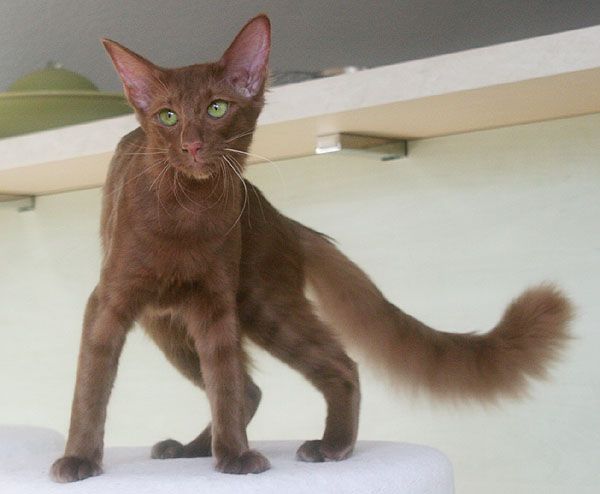
The Javanese cat breed is the colorpoint variant of the Oriental Longhair, sharing the Balinese's semi-long silky coat and the Oriental Shorthair's extended range of non-traditional point colors. In practical terms, a Javanese is a long-haired Siamese-type cat that comes in point colors beyond the traditional four (seal, blue, chocolate, and lilac), including red, cream, tortie, and lynx/tabby points.
It is the fourth member of what breeders call the four-breed complex: Siamese, Balinese, Oriental Shorthair, and Javanese, all sharing identical genetics except for the genes that control coat length and colorpoint restriction.
The breed's recognition history is somewhat complicated. The Cat Fanciers' Association recognized the Javanese as a separate breed for decades, primarily to accommodate the non-traditional point colors not included in the traditional Balinese standard.
In 2008, CFA restructured its breed classifications and merged the Javanese into the Balinese category, treating the additional colors as Balinese color variants rather than a separate breed. TICA continues to recognize the Javanese as a distinct breed.
The name "Javanese" follows the geographic naming pattern established by "Balinese" both names evoke Southeast Asian islands without any actual connection to those islands. There are no native cats of this type in Java.
Origin and Development
The Javanese arose from the same long-haired Siamese genetics as the Balinese, but with the addition of coat colors beyond the traditional four Siamese colorpoints. As breeders working with Siamese-type genetics crossed Siamese and Balinese with Oriental Shorthairs and other cats, they produced long-haired cats with colorpoint patterns in red, cream, tortoiseshell, and tabby (lynx) point patterns. These combinations are not recognized in the traditional Balinese standard.
American breeder Helen Smith, who coined the Balinese name, is sometimes credited with beginning the Javanese development as well, though the full breed development involved multiple breeders working in parallel from the 1960s onward. CFA began accepting Javanese for championship competition in 1987.
The 2008 CFA merger of Javanese into Balinese reflects a recognition that the genetic distinction between the two breeds is essentially zero, the only difference is color. Whether the cat is called a Javanese (non-traditional colorpoint, semi-long coat) or a Balinese (traditional colorpoint, semi-long coat) depends entirely on color combination, not on any meaningful biological distinction.
Physical Characteristics
The Javanese is identical in body type to the Siamese, Balinese, and Oriental Shorthair. The wedge-shaped head, very large ears, long tubular body, and fine bone structure are shared across all four breeds.
| Characteristic | Details |
|---|---|
| Weight | 2.7-5 kg |
| Build | Long, lean, tubular, Siamese type |
| Head | Long wedge |
| Ears | Very large, wide-set |
| Eyes | Vivid blue; almond-shaped |
| Coat | Semi-long, silky, no dense undercoat |
| Points | Red, cream, tortie, lynx (tabby) points; plus traditional colors |
| Lifespan | 15-20 years |
| TICA recognition | Yes; CFA merged into Balinese in 2008 |
The coat is the same silky, non-matting semi-long coat as the Balinese, a coat that flows rather than mats, requires weekly rather than daily grooming, and is significantly less maintenance-intensive than the Persian despite its length. The full tail plume is present and is one of the breed's most decorative features.
Eye color is vivid blue throughout the colorpoint range, the colorpoint gene that creates the darker points on the extremities also interacts with the iris to produce the characteristic blue coloration.
The Extended Color Range
The Javanese's primary distinction from the Balinese is its extended color range. Traditional Balinese point colors are seal, blue, chocolate, and lilac. Javanese colors add:
| Point Color | Description |
|---|---|
| Red point | Deep warm orange-red points |
| Cream point | Very pale orange-cream points |
| Tortie point | Mixed red and seal or other base color points |
| Lynx (tabby) point | Striped points, visible tabby markings in the darker areas |
| Red lynx | Tabby markings in red point coloring |
| Seal lynx | Tabby markings in seal point coloring |
The lynx points, sometimes called tabby points, are particularly visually distinctive, because the tabby striping becomes visible in the colorpoint areas (face, legs, tail), while the body remains pale. The striped facial markings around the eyes and the rings on the tail give lynx-pointed cats a wilder appearance than solid-pointed colorpoints.
Temperament: Fully Siamese
The Javanese personality is Siamese in every respect. This means all the qualities that define the Siamese-type temperament: high vocalization, intense social bonding, demanding of attention, highly intelligent, playful throughout life.
The Javanese will fill any available silence with commentary. It will follow its owner from room to room, demand to be included in activities, vocalize loudly when left alone, and communicate its preferences with specificity. These characteristics are not reducible and are not trainable away; they are fundamental to the genetic temperament of the entire Siamese four-breed complex.
"All four members of the Siamese complex, Siamese, Balinese, Oriental Shorthair, and Javanese, share the same behavioral genetics. The temperament is not a product of specific breeding within individual breed lines but is a fundamental characteristic of the Siamese genetic background." Bradshaw, J., Cat Sense, 2013
For the Siamese family overview see Siamese Cat. For the short-haired extended-color version see Oriental Shorthair. For the traditional colorpoint semi-long version see Balinese Cat. For lifespan data see How Long Do Cats Live. For Javanese care see Javanese Cat Care Guide.
Health Profile
The Javanese shares the Balinese and Siamese health profile precisely. Every health concern documented in the Siamese applies equally.
| Health Concern | Details | Management |
|---|---|---|
| Dilated cardiomyopathy (DCM) | Heart muscle thinning | Echocardiogram screening |
| Progressive retinal atrophy | Vision loss | DNA testing where available |
| Convergent strabismus | Cross-eye; colorpoint gene effect | Veterinary assessment |
| Amyloidosis | Organ protein deposits | Monitoring |
| Dental disease | Progressive | Regular dental care |
The long-term health outcomes for Javanese cats are generally favorable, the Siamese-type body has good longevity when not complicated by conformational disease. Lifespans of 15 to 20 years are reported with consistency.
Grooming
Weekly combing with a fine-toothed comb or slicker brush removes loose hairs and prevents the minor tangles that occasionally develop in the tail plume and around the neck ruff. The coat does not require daily attention, making the Javanese one of the more practical longhaired breeds for owners who want a beautiful coat without intensive maintenance.
References
- Bradshaw, J. Cat Sense: How the New Feline Science Can Make You a Better Friend to Your Pet. Basic Books, 2013. ISBN 978-0465031016.
- Ferasin, L. "Feline myocardial disease 2: Diagnosis, management, and prognosis." Journal of Feline Medicine and Surgery, 2012. https://doi.org/10.1177/1098612X12464462
- Turner, D.C. and Bateson, P. (eds.) The Domestic Cat: The Biology of Its Behaviour, 3rd edition. Cambridge University Press, 2013. ISBN 978-1107015968.
- Cat Fanciers' Association. "Balinese/Javanese Breed Standard." CFA.org, 2023. https://cfa.org/balinese/
- The International Cat Association. "Javanese Breed Standard." TICA.org, 2022. https://tica.org/
Frequently Asked Questions
What is the difference between a Javanese and a Balinese?
Both are semi-long-coated Siamese-type cats sharing identical genetics and temperament. The distinction is color: Balinese is recognized in the four traditional Siamese colorpoint colors (seal, blue, chocolate, lilac), while Javanese includes non-traditional colorpoint colors such as red, cream, tortoiseshell, and lynx (tabby) points.
The Cat Fanciers’ Association merged Javanese into Balinese in 2008, treating the extended colors as Balinese color variants. TICA continues to recognize the Javanese as a separate breed.
What are lynx point colors in the Javanese?
Lynx points, also called tabby points, are colorpoint patterns where the points (face, legs, tail) show visible tabby striping rather than solid color. The striped markings appear in the darker colorpoint areas while the body remains pale. Lynx point Javanese cats show distinctive facial markings with ‘mascara’ lines around the eyes, striped legs, and ringed tails.
The pattern can combine with any base point color, seal lynx, blue lynx, red lynx, and other combinations are recognized.
Why did CFA merge the Javanese into the Balinese?
CFA’s 2008 restructuring of its breed classifications reflected the genetic reality that Javanese and Balinese cats are identical except for their color combinations. Having two separate breed registrations for what is essentially the same animal in different colors was seen as unnecessarily duplicative. The merger placed all semi-long-coated Siamese-type colorpoints under the Balinese name regardless of color combination.
TICA maintains a different position, treating the Javanese as a separate breed.
Are Javanese cats vocal?
Yes, with the full intensity of the Siamese temperament. Javanese cats vocalize persistently, communicate purposefully, and do not accept being ignored. The voice is the characteristic Siamese voice, penetrating, varied, and expressive. This is a fundamental genetic temperament trait shared by the entire Siamese four-breed complex and is not reducible through training. Owners who want a quiet companion should choose a different breed entirely.
How long do Javanese cats live?
Javanese cats typically live 15 to 20 years, sharing the exceptional longevity documented in Siamese and Balinese cats. The lean, athletic Siamese body type, combined with the absence of extreme conformational features, supports long life when health is managed responsibly. Annual veterinary care, dental attention, and cardiac monitoring contribute to achieving the upper end of this range.
Do Javanese cats have health problems?
Javanese share the Siamese health profile: dilated cardiomyopathy (DCM), progressive retinal atrophy in some lines, convergent strabismus linked to the colorpoint gene, amyloidosis in older individuals, and dental disease. The DCM that affects Siamese-type cats involves thinning and weakening of the heart muscle, different from the hypertrophic cardiomyopathy more common in other breeds, and echocardiographic screening of breeding animals is recommended.