
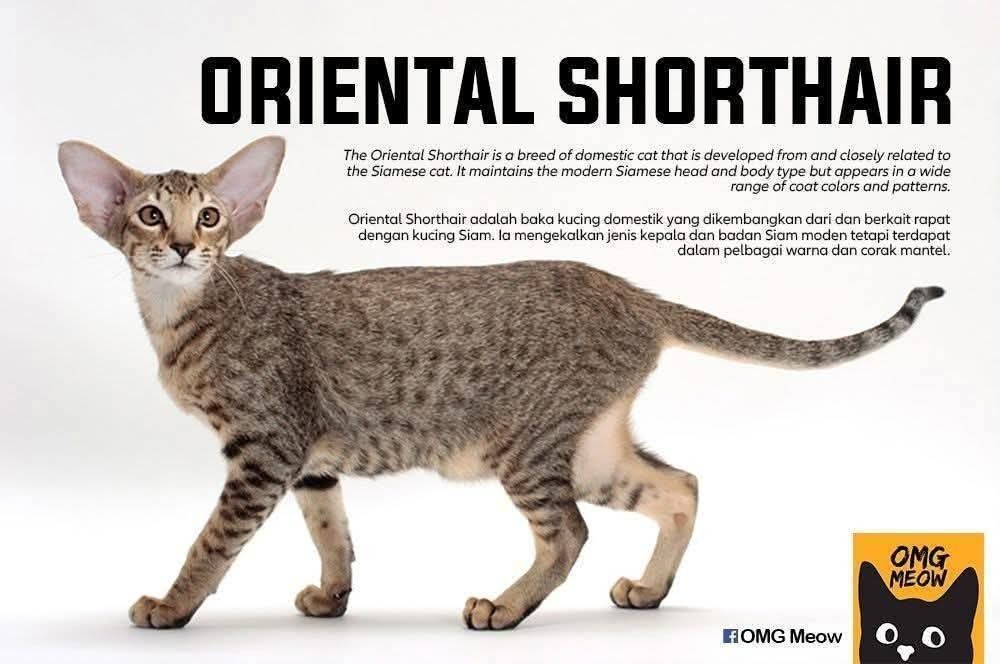
The Oriental Shorthair is, in genetic terms, a Siamese in any color, the same breed, the same body, the same voice, the same personality, simply freed from the colorpoint restriction that limits the Siamese to dark points on a pale body. Where the Siamese standard permits only four point colors, the Oriental Shorthair is recognized in over three hundred color and pattern combinations, making it the most colorful pedigree cat breed in the world by any metric.
The Cat Fanciers' Association granted the Oriental Shorthair full championship status in 1977 after years of development by breeders who wanted to preserve the Siamese type while exploring the entire range of feline coat colors. The result is a breed that combines the Siamese's extraordinary personality, intense, vocal, demanding, deeply bonded to humans, with a visual diversity that no other breed approaches.
Understanding the Oriental Shorthair requires understanding the Siamese, because they are functionally the same cat. Everything that makes the Siamese one of the most distinctive and sometimes challenging breeds to own applies equally to the Oriental Shorthair. The color is different. The cat is not.
Origin and Development
The development of the Oriental Shorthair as a distinct breed from the Siamese was a deliberate project by British and later American breeders who recognized that the Siamese's distinctive body type and personality were worth preserving in a wider range of colors and patterns than the colorpoint standard allowed.
In the United Kingdom, cats of Siamese type but non-colorpoint coloring were being bred and shown as early as the 1950s under various names. The solid-colored variants were called "Foreign Shorthairs" with specific colors having their own names (Foreign White, Foreign Black, and so on). The tabby-patterned variants were called "Oriental Tabbies." In the United States, breeders pursued similar goals under the single umbrella name "Oriental Shorthair."
The CFA accepted Oriental Shorthairs for registration in 1972 and granted full championship status in 1977. TICA recognizes both the Oriental Shorthair and the Oriental Longhair (a parallel development with a semi-long coat). In the United Kingdom, the GCCF still largely maintains the older system of separate breed names for different Oriental color groups.
The foundation breeding involved crosses between Siamese and domestic shorthaired cats of various colors, as well as crosses with Abyssinians, Russian Blues, and other breeds to introduce specific colors and patterns. All modern Oriental Shorthairs carry the Siamese genetic backbone, including the narrow wedge head, large ears, long body, and the genes associated with Siamese-related conditions.
Physical Characteristics
The Oriental Shorthair and the Siamese are identical in conformation. The breed standard for the Oriental Shorthair in CFA is essentially the same as the Siamese standard except for the color section, which is dramatically expanded to encompass hundreds of possibilities.
| Characteristic | Details |
|---|---|
| Weight | 3.6-5 kg |
| Build | Long, lean, tubular, "foreign type" |
| Head | Long wedge, flat skull |
| Ears | Very large, wide-set, pointed |
| Eyes | Almond-shaped; any color except blue (except pointed) |
| Nose | Long, straight |
| Coat | Short, fine, glossy, close-lying |
| Colors | 300+ combinations |
| Lifespan | 10-15 years |
| CFA recognition | 1977 |
The head is a long, pointed wedge with a flat skull and no break in the profile from the top of the skull to the tip of the nose. The very large, wide-set ears follow the lines of the wedge head, flaring outward and emphasizing the angular appearance.
The overall head shape is one of the most extreme in domestic cats, the modern show-type Oriental/Siamese has a significantly more elongated head than the original type, and this trend toward extreme elongation is a subject of ongoing welfare discussion in the cat fancy.
The body is long, lean, and tubular with fine bone structure and a tight, flat coat. Oriental Shorthairs are noticeably lighter than they look, what appears to be a substantial cat often weighs less than four kilograms.
Eye color in the Oriental Shorthair is green in most color varieties, though some colors produce other eye colors. The brilliant green eyes against a solid-colored coat, particularly the ebony (solid black) variety, is one of the most striking visual effects in the pedigree cat world.
300 Colors: The Full Spectrum
The Oriental Shorthair's color range encompasses virtually the entire genetic palette available in the domestic cat, solid colors, tabby patterns, tortoiseshell, bicolor, smoke, shaded, tipped, and combinations thereof, all in a range of base colors from white through the full spectrum of browns, reds, creams, blues, and greys.
Solid colors include ebony (black), blue, chestnut (chocolate), lavender (lilac), red, cream, cinnamon, fawn, and white. Tabby patterns include classic, mackerel, spotted, and ticked, each available in all base colors. Tortoiseshell patterns combine red and black-based colors in the random distribution characteristic of multiple patchy coat gene expression. Bi-color and parti-color patterns are also recognized.
The shaded and smoke series deserve particular mention. A smoke Oriental Shorthair has a pale silver undercoat with deeply colored guard hairs, at rest the cat appears solidly colored, but when moving the pale undercoat flashes through in an effect of extraordinary visual depth. The shaded series produces similar depth with a lighter expression.
This color diversity is the Oriental Shorthair's USP, but it is worth emphasizing that the temperament and personality are fully Siamese, whatever the coat. Buyers attracted by a beautiful Oriental color should make sure they understand what Siamese ownership entails before acquiring one.
Temperament: Siamese in All Colors
The Oriental Shorthair inherits the Siamese temperament completely. This means an extraordinarily social, vocal, intelligent, and demanding cat that will not accept being ignored and will escalate its communication until acknowledged. Owners who find Siamese personality enchanting will find Oriental Shorthairs enchanting. Owners who want a quiet, independent cat should look elsewhere.
"Oriental type cats, Siamese, Oriental Shorthair, Balinese, and their relatives, are the most intensely interactive and demanding of human engagement of any cat breed group. Their social requirements are genuinely higher than other cats and should be matched with owners who have time and inclination to provide it." Dr. John Bradshaw, Cat Sense, 2013
Oriental Shorthairs vocalize frequently and with purpose. They comment on their environment, demand attention, express displeasure, greet their owners, and maintain running commentary on household events. The voice is not always loud; it is often a constant, varied, melodious series of sounds, but it is persistent. Owners who want silence should reconsider the breed.
The breed is highly intelligent and needs mental stimulation. Puzzle feeders, interactive play, and opportunities to investigate their environment are genuinely necessary for behavioral health rather than optional enrichment. Bored Oriental Shorthairs become destructive, anxious, or both.
For more on cat communication see Why Do Cats Meow. For owner recognition see Do Cats Recognize Their Owners.
Health Profile
The Oriental Shorthair shares the Siamese's health vulnerabilities. The most significant hereditary cardiac concern is dilated cardiomyopathy (DCM), a condition in which the heart muscle becomes thin and weakened rather than thickened, different from the hypertrophic cardiomyopathy (HCM) seen in many other breeds. DCM in Oriental-type cats reduces the heart's ability to contract effectively and can lead to congestive heart failure.
| Health Concern | Details | Management |
|---|---|---|
| Dilated cardiomyopathy (DCM) | Heart muscle thinning; Siamese/Oriental type | Echocardiogram screening |
| Progressive retinal atrophy | Inherited in some lines | DNA test in some lines |
| Cross-eye / nystagmus | Linked to colorpoint gene; not exclusive to pointed | Clinical assessment |
| Dental disease | Common in adult individuals | Regular dental care |
| Amyloidosis | Protein deposits in organs | Monitoring in older cats |
Ocular conditions linked to the colorpoint gene, cross-eye (convergent strabismus) and nystagmus (involuntary eye movements), appear in some Oriental Shorthairs even though they lack colorpoint coloring. The underlying neurological mechanism that creates these signs in Siamese is linked to the colorpoint pigmentation pathway and affects the visual pathway in ways that are partially decoupled from coat color.
"Dilated cardiomyopathy in Siamese and Oriental type cats represents a distinct pathological entity from HCM and requires separate echocardiographic evaluation. The prognosis differs, and treatment protocols are adapted accordingly." Ferasin, L., Journal of Feline Medicine and Surgery, 2012
Living with an Oriental Shorthair
Oriental Shorthairs are best suited to owners who actively want a highly interactive, communicative, people-oriented cat and who have the time and lifestyle to support that. They should not be left alone for extended periods without companionship. Many Oriental owners keep pairs or keep the cat with another Oriental or Siamese for company.
The breed is athletic and agile. Tall cat trees, climbing structures, and window perches are important. Oriental Shorthairs jump well, move quickly, and will investigate every accessible surface in the home. Child-proof and breakage-resistant organization of high surfaces is advisable.
The fine coat sheds minimally and requires only occasional brushing. Grooming is the least demanding aspect of Oriental Shorthair ownership, the social and mental demands are where the investment lies.
For the longhaired version of this breed see Balinese Cat. For the parent breed see Siamese Cat. For Oriental health see Oriental Shorthair Health Problems.
References
- Ferasin, L. "Feline myocardial disease 2: Diagnosis, management, and prognosis." Journal of Feline Medicine and Surgery, 2012. https://doi.org/10.1177/1098612X12464462
- Bradshaw, J. Cat Sense: How the New Feline Science Can Make You a Better Friend to Your Pet. Basic Books, 2013. ISBN 978-0465031016.
- Lyons, L.A. "Feline genetics: Clinical applications and genetic testing." Topics in Companion Animal Medicine, 2010. https://doi.org/10.1053/j.tcam.2010.09.002
- Cat Fanciers' Association. "Oriental Shorthair Breed Standard." CFA.org, 2023. https://cfa.org/oriental/
- Hartwell, S. "Oriental Shorthair History." MessyBeast.com. https://messybeast.com/breeds/oriental.htm
Frequently Asked Questions
Is an Oriental Shorthair the same as a Siamese?
Genetically and structurally, yes. The Oriental Shorthair has the same body type, bone structure, and personality as the Siamese but is not restricted to colorpoint coat patterns. Where the Siamese standard permits only seal, blue, chocolate, and lilac point colors on a pale body, the Oriental Shorthair is recognized in over 300 color and pattern combinations including solids, tabbies, torties, smokes, and bicolors.
The personality, health risks, and care requirements are identical.
How vocal are Oriental Shorthairs?
Extremely vocal. Oriental Shorthairs inherit the Siamese’s communication style, constant, varied, and persistent. They vocalize to demand attention, comment on their environment, express displeasure, and maintain social contact with their owners. The voice is not always loud but it is relentless. Owners who want a quiet cat should seriously reconsider the breed.
Those who find the communication style endearing will find Oriental Shorthairs deeply engaging companions.
What health problems do Oriental Shorthairs have?
The primary cardiac concern is dilated cardiomyopathy (DCM), in which the heart muscle becomes thin and weak rather than thickened as in HCM. Other concerns include progressive retinal atrophy in some lines, cross-eye and nystagmus linked to the colorpoint gene pathway, dental disease, and amyloidosis in older individuals. Annual echocardiographic screening is recommended for breeding animals.
Can Oriental Shorthairs be left alone during the day?
Not easily. Oriental Shorthairs have high social needs and do not tolerate isolation well. Extended time alone can result in anxiety, destructive behavior, or excessive vocalization. Many Oriental owners keep pairs or keep their cat with another social cat for company during working hours. If a single Oriental must be left alone, substantial enrichment and play sessions before and after work help manage the social deficit.
How many colors do Oriental Shorthairs come in?
The Oriental Shorthair is recognized in over 300 color and pattern combinations, more than any other pedigree cat breed. This includes all solid colors (ebony, blue, chestnut, lavender, red, cream, cinnamon, fawn, and white), all tabby patterns (classic, mackerel, spotted, ticked) in all base colors, tortoiseshell patterns, smoke and shaded series, bicolor, and combinations.
The breed holds the distinction of being the most colorful pedigree cat breed in the world.
Are Oriental Shorthairs related to Balinese cats?
Yes. The Balinese is the semi-long-coated variant of the Siamese, and the Oriental Longhair (recognized by TICA as the Javanese in some registries) is the semi-long-coated variant of the Oriental Shorthair. All four breeds, Siamese, Balinese, Oriental Shorthair, and Oriental Longhair, share the same genetic foundation, body type, and personality. The differences are coat length and color restrictions.