
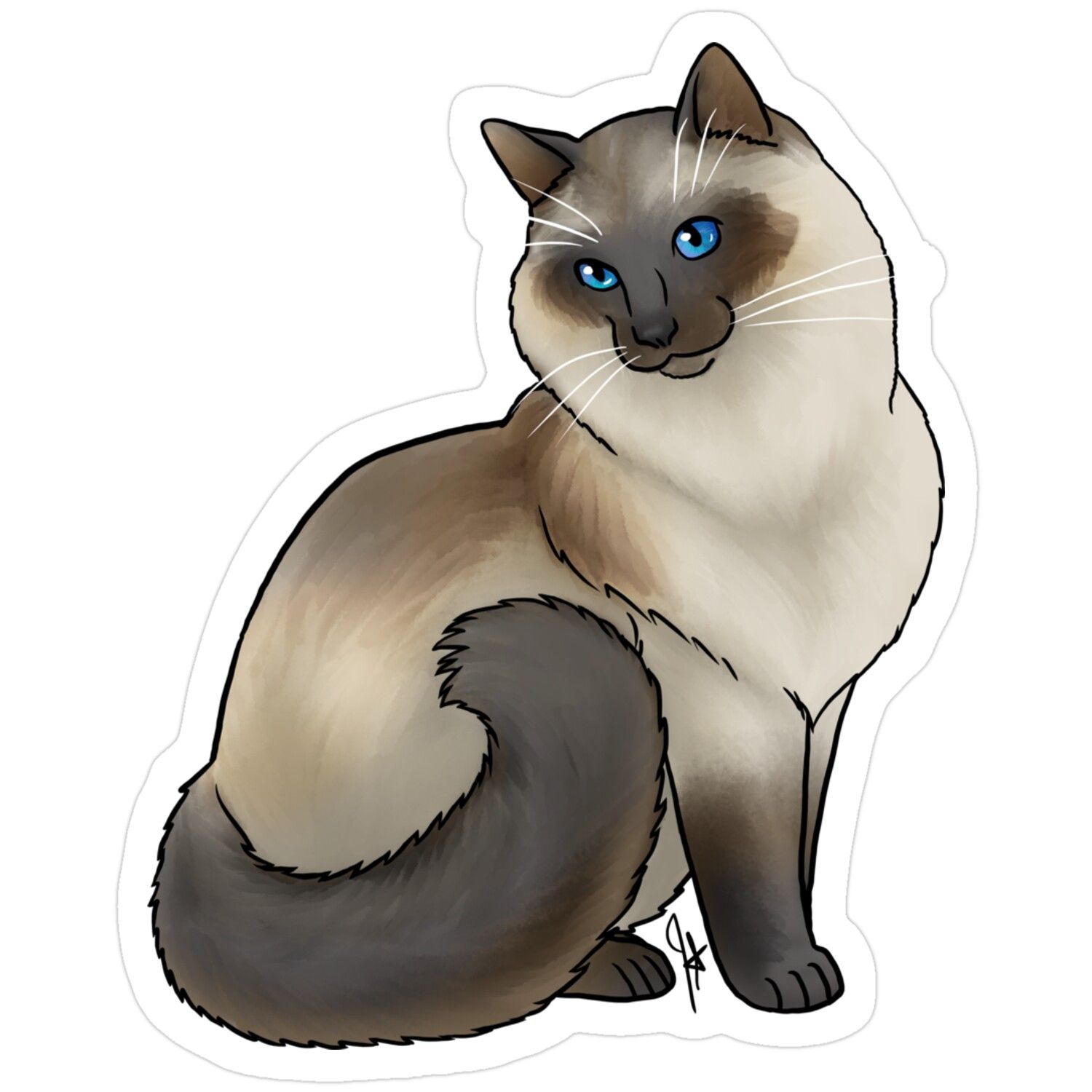
The Balinese cat is the long-haired Siamese, a breed that carries the same genetics, body type, and personality as the Siamese, with the single addition of a recessive gene that produces a semi-long, silky coat. The two breeds are genetically identical except at the coat-length locus, and understanding the Balinese therefore requires understanding what the Siamese is, because the personality, health profile, and social demands are the same.
The Balinese was developed in the United States during the 1950s from long-haired kittens that occasionally appeared in Siamese litters, a consequence of the long-coat gene that had apparently entered the Siamese gene pool at some earlier point. These kittens were initially treated as pet-quality animals and placed outside the breeding program, but breeders Marion Dorsey and Helen Smith recognized their distinctive beauty and began selectively breeding for the trait.
The name "Balinese" was chosen by Helen Smith to evoke the graceful movement of Balinese dancers, not because the breed has any connection to the island of Bali. There are no native cats of this type in Bali; the name is purely aesthetic.
Coat: All Siamese, Different Length
The Balinese coat is the only respect in which the breed differs from the Siamese. It is semi-long, silky, and lies relatively flat against the body; it does not have the dense, matting-prone undercoat of the Persian or the heavy flowing coat of the Maine Coon. This means it requires significantly less grooming than most longhaired breeds: the coat does not mat readily, and weekly combing is usually sufficient for an indoor Balinese.
The coat is single-layered, or at most very lightly double-layered, which gives it a flowing, silky quality in motion. The tail plume is the most dramatic feature, developing into a full, flowing plume that fans out when the cat moves. The neck ruff is present but moderate.
| Characteristic | Details |
|---|---|
| Weight | 2.7-5 kg |
| Build | Long, lean, elegant, Siamese type |
| Head | Long wedge, same as Siamese |
| Eyes | Deep vivid blue; almond-shaped |
| Coat | Semi-long, silky, no dense undercoat |
| Points | Colorpoint; seal, blue, chocolate, lilac |
| Lifespan | 15-20 years |
| CFA recognition | 1961 |
The colorpoint pattern is the same as the Siamese: the face, ears, legs, and tail are darker than the body, with the contrast deepening with age and in cooler ambient temperatures. The four traditional point colors, seal, blue, chocolate, and lilac, are recognized in CFA's traditional Balinese standard. Some registries recognize additional point colors (red, cream, tortie, lynx/tabby point) under the Balinese name; CFA classifies these extended-color long-haired Siamese type cats as Javanese.
Temperament: Siamese in Every Way
The Balinese personality is the Siamese personality. This means a highly vocal, socially demanding, deeply people-oriented cat that requires significant owner engagement and does not thrive in isolation or low-stimulation environments. The qualities that make Siamese ownership rewarding, the intelligence, the intensity of the bond, the entertaining communication, are all present in the Balinese.
"Long-haired or short-haired, the Siamese genetic temperament is one of the most consistent breed characteristics in the domestic cat fancy. Balinese cats show the same high social motivation, vocalization frequency, and owner-oriented behavior as Siamese cats, regardless of their coat length." Turner, D.C. and Bateson, P. (eds.), The Domestic Cat: The Biology of Its Behaviour, 2013
The Balinese is vocal. The voice is the Siamese's penetrating, varied, expressive communication style, not the conversational moderation of the Tonkinese or the occasional commentary of the Ragdoll. Owners who find the Siamese voice endearing will enjoy the Balinese. Owners who prefer quieter cats should consider another breed.
The breed forms deep bonds with its primary person and will follow them through the house, greet them at the door, and insert itself into every activity. This is not occasional attention-seeking; it is a consistent, daily commitment to human company that the cat expects to be reciprocated.
Intelligence is high. Balinese cats learn routines quickly, respond reliably to their names, solve simple problems, and communicate their needs and preferences with impressive specificity. Puzzle feeders, interactive toys, and environmental complexity are genuine needs rather than optional enrichment.
For communication behavior see Why Do Cats Meow. For care see Balinese Cat Care Guide.
Health Profile
The Balinese shares all of the Siamese's hereditary health concerns.
Progressive retinal atrophy (PRA) is reported in Siamese-type cats. Convergent strabismus (cross-eye) is a hereditary trait linked to the colorpoint gene's effect on the visual pathway, the same neural mechanism that causes nystagmus in some colorpoint cats. These are primarily cosmetic in mild cases but can affect vision more significantly in severe instances.
Dilated cardiomyopathy (DCM) has been reported in Siamese and oriental-type cats. Unlike the hypertrophic cardiomyopathy (HCM) seen in Maine Coons and American Shorthairs, DCM involves thinning and weakening of the heart muscle rather than thickening.
Amyloidosis, abnormal protein deposition in organs, has been reported in Siamese and Balinese, affecting liver and kidney tissue.
| Health Concern | Details | Management |
|---|---|---|
| Convergent strabismus | Cross-eye; linked to colorpoint gene | Cosmetic in most cases; veterinary assessment |
| Progressive retinal atrophy | Vision deterioration | DNA testing in some lines |
| Dilated cardiomyopathy (DCM) | Heart muscle weakening | Echocardiogram screening |
| Amyloidosis | Organ protein deposits | Monitoring in older cats |
| Dental disease | Progressive with age | Regular dental care |
"The Siamese and its related breeds show convergent strabismus at elevated rates attributable to a developmental effect of the colorpoint gene on the optic nerve. In most affected cats this manifests as a cosmetic asymmetry; in some it affects binocular vision to a clinically significant degree." Petersen-Jones, S.M., Veterinary Ophthalmology, 2012
For comparison with the parent breed see Siamese Cat. For the related colorful variety see Javanese Cat and Oriental Shorthair. For lifespan context see How Long Do Cats Live.
Grooming
The Balinese coat is one of the most manageable longhaired coats in the pedigree cat world. The silky, non-matting single layer requires only weekly combing during normal periods, with slightly more attention during seasonal shedding. The full tail plume benefits from regular brushing to maintain its appearance.
Owners transitioning from a Persian or Maine Coon to a Balinese often comment with relief on how much less intensive the Balinese coat maintenance is. The coat does not develop the felted mats of neglected Persian fur, and it recovers well from brief periods of reduced grooming.
References
- Turner, D.C. and Bateson, P. (eds.) The Domestic Cat: The Biology of Its Behaviour, 3rd edition. Cambridge University Press, 2013. ISBN 978-1107015968.
- Petersen-Jones, S.M. "Canine and feline ocular genetics: A practical overview." Veterinary Ophthalmology, 2012. https://doi.org/10.1111/j.1463-5224.2011.00972.x
- Ferasin, L. "Feline myocardial disease: Classification, pathophysiology and clinical presentation." Journal of Feline Medicine and Surgery, 2009. https://doi.org/10.1016/j.jfms.2009.09.003
- Cat Fanciers' Association. "Balinese Breed Standard." CFA.org, 2023. https://cfa.org/balinese/
- Little, S.E. (ed.) The Cat: Clinical Medicine and Management. Elsevier Saunders, 2012. ISBN 978-1437706208.
Frequently Asked Questions
Is the Balinese different from the Siamese?
The Balinese is genetically identical to the Siamese except for carrying two copies of the recessive long-coat gene. The body type, personality, health risks, colorpoint pattern, and blue eye color are all the same. The Balinese simply has a semi-long, silky coat instead of the Siamese’s short coat, and a full plumed tail rather than the Siamese’s tapering short-haired tail.
Any difference in temperament between individual Balinese and Siamese is individual variation, not breed-level difference.
Does the Balinese coat mat?
Not readily. The Balinese coat is semi-long and silky but lacks the dense woolly undercoat that causes rapid matting in Persians. The coat self-manages to a reasonable degree and weekly combing is usually sufficient. This is one of the most practical aspects of the breed for owners who appreciate the beauty of a longer coat but do not want the intensive daily grooming commitment of the Persian.
Are Balinese cats vocal?
Yes, exactly as vocal as Siamese cats. The Balinese has the Siamese’s full communication repertoire, constant, varied, purposeful vocalization that expresses preferences, demands attention, comments on the environment, and maintains social contact. The voice is penetrating and persistent. This is a fundamental breed characteristic and is not reducible through training. Owners who want a quiet cat should look at different breeds.
How long do Balinese cats live?
Balinese cats are among the longer-lived pedigree cat breeds, with a typical lifespan of 15 to 20 years. This longevity is shared with the Siamese and reflects the breed’s lean, athletic body type, absence of extreme conformational features, and generally good genetic health when managed responsibly. Many individual Balinese are reported to reach 18 to 20 years with good care.
What does Balinese mean?
The name Balinese was chosen by breeder Helen Smith to evoke the graceful movement of traditional Balinese dancers from the island of Bali. It has no geographic accuracy; there are no native cats of this type in Bali, and the breed has no connection to the island. The name is purely aesthetic, chosen to complement the breed’s elegant appearance and graceful movement.
What health problems do Balinese cats have?
Balinese share the Siamese’s health profile: dilated cardiomyopathy (DCM) affecting heart muscle, progressive retinal atrophy in some lines, convergent strabismus (cross-eye) linked to the colorpoint gene’s effect on the visual pathway, amyloidosis in older individuals, and dental disease.
DCM is a thinning and weakening of the heart wall, different from the hypertrophic cardiomyopathy (HCM) seen in many other breeds, and requires echocardiographic monitoring.