
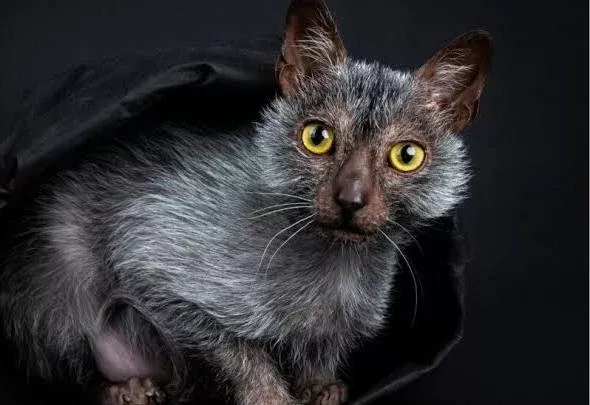
The Lykoi, widely known as the werewolf cat, is one of the most visually striking breeds in existence, a cat that looks like it belongs in a horror film rather than a living room. The breed's appearance is the result of a natural genetic mutation that affects the hair follicle, producing a patchy, roan coat pattern in which areas of skin show through sparse or absent fur.
The overall effect, particularly on the facial mask area where hair is often almost entirely absent, has earned the breed the unambiguous nickname "the werewolf cat."
The Lykoi is not a hairless cat, nor is it a sick cat. It is a distinct mutation in domestic cats that has been studied by veterinary dermatologists and found to result from a naturally occurring variant gene affecting follicle development. The breed is generally healthy, of normal temperament, and distinctive in appearance in a way that no breeding programme has manufactured; it arose spontaneously.
Origins: A Natural Mutation from Feral Populations
The Lykoi did not begin in a deliberate breeding programme. It began with stray cats.
In 2010 and 2011, two separate groups of unusual-looking domestic cats were identified, one from a feral colony in Virginia and one from a shelter in Tennessee. The cats had sparse, patchy coats, partially bare faces, and an unusual appearance that, to anyone unfamiliar with the mutation, could suggest disease (mange, ringworm) rather than genetics.
Johnny Gobble DVM and Brittney Gobble, along with Patti Thomas, recognised that the appearance might be genetic rather than pathological. Dr. Gobble, a cardiologist, worked with veterinary dermatologists and feline geneticists to evaluate the cats. Cardiac, dermatological, and genetic evaluations confirmed that the unusual coat was due to a naturally occurring dominant gene mutation affecting hair follicle development, and that the cats were otherwise healthy.
The International Cat Association (TICA) granted the Lykoi Championship status in 2016, a remarkably rapid recognition for a newly developed breed, reflecting both the breed's distinctive characteristics and the thoroughness of the initial health evaluations.
The Genetics: Roan Mutation
The Lykoi mutation affects the hair follicle's cycling mechanism. Normal cat hair follicles go through growth, transition, and resting phases in a coordinated pattern. In Lykoi cats, hair follicles lack an inner root sheath component and sometimes lack the hair follicle itself in certain areas, leading to hair that cycles rapidly and inconsistently, some follicles producing hair, others temporarily or permanently inactive.
The overall effect is a roan pattern, a mix of pigmented hairs and bare skin, similar to the roan pattern seen in horses and some dog breeds, though produced by a completely different mechanism. The distribution is not uniform: the facial mask area (around the eyes and nose) tends to have the least hair, while the body may have moderate to dense patchy coverage.
The mutation is dominant, one copy is sufficient to produce the Lykoi appearance. Cats with one copy of the mutation are "standard" Lykoi. Whether homozygous Lykoi (two copies) have a different or more extreme phenotype is still being studied.
Kittens are born with fur; they are not born hairless. Over the first few weeks of life, they lose much of their initial kitten coat and develop the characteristic Lykoi roan pattern. The extent of hair loss varies by individual.
Appearance
The Lykoi's most distinctive feature is its facial mask, the area around the eyes, muzzle, and nose that typically has little to no hair, giving the cat a skeletal, otherworldly expression. The rest of the body has patchy, wiry-textured fur interspersed with bare skin.
The coat's texture is unusual, not soft and smooth like most domestic cats, but wiry and somewhat coarse. This relates to the incomplete hair follicle structure: the fur that does grow lacks a normal inner structure.
Lykoi come in black roan as the standard colour, with lighter and darker areas depending on the degree of roan mixing. Other colours have been produced but black roan is the standard.
Physical Characteristics at a Glance
| Feature | Detail |
|---|---|
| Body type | Medium, slender, semi-foreign |
| Weight | 2.5-4.5 kg typical |
| Coat | Patchy roan; wiry texture; facial mask area often nearly bare |
| Colour | Black roan standard; other colours in development |
| Eye colour | Yellow to yellow-green (adults) |
| Skin | Exposed skin may appear pink to grey |
| Lifespan | 12-15 years (still being documented) |
Moulting Cycle
Lykoi cats go through distinct moulting cycles in which they shed much of their coat and appear nearly completely bald, then regrow fur. This cycling is more dramatic than in normal cats and follows the hair follicle's irregular cycling pattern.
An owner who acquires a Lykoi during a fully-furred phase will be surprised when the cat subsequently sheds almost all its coat. This is normal and expected. The moulting cycle typically occurs seasonally, with the cat appearing balder in summer and more furred in winter.
Temperament
Despite the dramatic appearance, the Lykoi has a normal domestic cat temperament, curious, playful, and affectionate. Breed descriptions by owners and breeders consistently emphasise:
High prey drive. Lykoi cats show particularly strong hunting and stalking behaviour, even compared to other active cat breeds. This may relate to the feral backgrounds of the founding cats.
Affectionate with family. The breed bonds well with its household and enjoys contact and interaction with trusted people.
Cautious with strangers. Initially cautious with unfamiliar people, the Lykoi is not aggressive but takes time to warm up.
Playful throughout life. The breed retains high play drive into adulthood.
Health
The Lykoi has been assessed by cardiologists, dermatologists, and geneticists since its initial discovery, and the current picture is reassuring:
- No cardiac abnormalities were found in the founding cats or their offspring in initial evaluations
- The skin exposed in bare areas is normal skin, not fragile or prone to disease beyond the need for sun protection in outdoor cats
- No breed-specific heritable conditions have been identified at high frequency
Given the youth of the breed, ongoing health monitoring is important. TICA-affiliated breeders maintain health records and participate in ongoing genetic studies.
Cross-Links and Related Articles
- Sphynx Cat
- Donskoy
- Peterbald
- Kitten Feeding Schedule by Age
- How Long Do Cats Live
References
Gobble J, et al. "Characterization of the Lykoi cat mutation." Journal of Feline Medicine and Surgery. 2017;19(3):320-328. doi:10.1177/1098612X15609497
Lyons LA, et al. "Feline genetics: clinical applications and genetic diversity of cats." Veterinary Clinics of North America: Small Animal Practice. 2012;42(5):1111-1127. doi:10.1016/j.cvsm.2012.08.001
International Cat Association (TICA). "Lykoi Breed Standard." TICA Official Publication, 2023. tica.org
Henik RA, Stepien RL, Bortnowski HB. "How to approach the diagnosis of cardiac disease in cats." Veterinary Medicine. 2004;99:140-151.
Robinson R. Genetics for Cat Breeders. 3rd ed. Oxford: Pergamon Press; 1991.
Lorimer HE. The Complete Illustrated Encyclopedia of Cat Breeds. New York: Lorenz Books; 2004.
Frequently Asked Questions
Why does the Lykoi look like a werewolf?
The Lykoi’s unusual appearance results from a naturally occurring dominant gene mutation that disrupts normal hair follicle cycling. Some follicles fail to produce or maintain hair, creating a patchy roan pattern. The facial mask area, around the eyes and muzzle, typically has the least hair, giving the cat a skeletal, masklike expression. The effect is most pronounced after seasonal moulting, when cats can appear almost completely bald.
Is the Lykoi cat sick or mangy?
No. The Lykoi’s appearance results from a genetic mutation, not illness or parasites. When the cats were first identified from feral populations, the appearance suggested mange or ringworm, but veterinary dermatological and genetic evaluations confirmed a natural gene mutation. The cats are healthy; their skin is normal; and no disease or infestation is responsible for the coat pattern.
Are Lykoi cats hairless?
No. Lykoi cats are not hairless; they are roan-patterned, meaning areas of fur are interspersed with bare skin. The amount of fur present varies by individual and by season. Kittens are born with fur and lose much of it in the first weeks before developing their characteristic Lykoi pattern. In winter, most Lykoi have significantly more fur than in summer.
When was the Lykoi officially recognised?
The International Cat Association (TICA) granted the Lykoi Championship status in 2016, approximately 5-6 years after the first Lykoi cats were identified and evaluated. This was unusually rapid recognition, facilitated by the thoroughness of the health and genetic evaluations conducted by Dr. Johnny Gobble and his collaborators from the outset.
What is the Lykoi's temperament?
The Lykoi has a normal domestic cat temperament despite its unusual appearance. The breed is curious, playful, and affectionate with its family. It shows a particularly strong prey drive and stalking behaviour. It is initially cautious with strangers but not aggressive. The breed retains playful energy well into adulthood.
Do Lykoi cats need special care?
The areas of bare skin in Lykoi cats require some attention. Outdoor cats should be protected from prolonged sun exposure to reduce sunburn risk on exposed skin. The coat does not require brushing (there is not enough fur to tangle), but the skin should be kept clean. The breed should be kept warm in cold environments as the sparse coat provides less insulation than normal cat fur.