
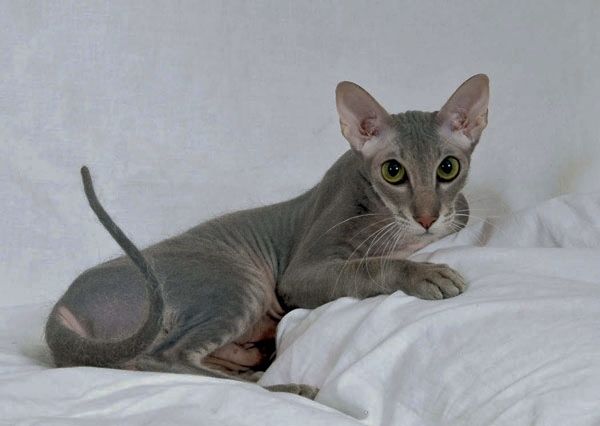
The Peterbald is a Russian hairless cat breed created in 1994 by crossing an Oriental Shorthair with a Don Sphynx. The result was a cat with the long, elegant body type of the Oriental breeds combined with the hairlessness gene from the Don Sphynx, producing a hairless or nearly hairless cat that is visually and genetically distinct from both the Sphynx and the Donskoy.
The Peterbald is notable for having the most coat variety of any cat breed, five distinct coat types can be present within a single litter, from completely bald to a full coat of wavy fur.
History and Development
The Peterbald was created in St. Petersburg, Russia in 1994 by felinologist Olga Mironova. Mironova crossed a Don Sphynx male (Afinogen Myth) with an Oriental Shorthair female (Radma von Jagerhof). The resulting kittens combined the Oriental body type with hairlessness.
The name "Peterbald" reflects both the breed's St. Petersburg origin and the hairlessness characteristic ("bald" from the Don Sphynx contribution).
The World Cat Federation (WCF) and The International Cat Association (TICA) both recognised the Peterbald. The breed is particularly popular in Russia and Eastern Europe.
The Five Coat Types
The Peterbald's most unusual characteristic is its range of coat types, all resulting from combinations of the hairlessness gene and the long-hair gene.
Bald (rubber bald): Completely hairless, like the Canadian Sphynx. The skin is warm to the touch, feels like a heated suede, and shows all the body's musculature and wrinkles.
Flock (velour): A very short, fine coat less than 2 mm long that gives the skin a soft, velvety texture. These cats may become bald with age.
Velour: Short, wavy or curly hair up to approximately 1 cm long with bald areas on the points (face, ears, paws). These cats typically become less hairy with age.
Brush: A wiry, sparse coat with a brush-like texture; the most variable coat type. Some brush Peterbalds retain their coat throughout life.
Straight: A normal domestic cat coat. Straight-coated Peterbalds do not carry the hairlessness gene and are not considered true Peterbalds in show competition, though they may be produced in litters as carrier-free offspring.
The hairlessness in Peterbalds is caused by a dominant gene, one copy is sufficient to produce hairlessness. This is the same gene responsible for the Donskoy's hairlessness and is different from the Sphynx's recessive hairlessness gene.
Physical Characteristics at a Glance
| Feature | Detail |
|---|---|
| Body type | Long, slender, Oriental-type (tubular) |
| Male weight | 3.5-5 kg |
| Female weight | 2.5-4 kg |
| Coat | 5 varieties: bald, flock, velour, brush, or straight |
| Eye colour | Any colour |
| Lifespan | 10-15 years |
| Distinguishing from Sphynx | Oriental body type; dominant hairlessness gene |
Comparison: Peterbald vs Sphynx vs Donskoy
| Feature | Peterbald | Sphynx | Donskoy |
|---|---|---|---|
| Origin | Russia, 1994 | Canada, 1966 | Russia, 1987 |
| Body type | Oriental (elongated) | Cobby, muscular | Medium, muscular |
| Hairlessness gene | Dominant (from Don Sphynx) | Recessive | Dominant |
| Coat types | 5 (bald through brush) | Primarily bald/peach-fuzz | 4 (bald through brush) |
| Ancestor breeds | Oriental Shorthair + Don Sphynx | Domestic shorthair mutation | Domestic shorthair mutation |
Temperament
The Peterbald reflects the Oriental Shorthair's temperament strongly, active, vocal, curious, and deeply people-oriented.
The breed is known for:
High energy and vocality. Peterbalds are not quiet, undemanding cats. They communicate actively, seek attention, and become distressed with prolonged isolation.
Sociable and demonstrative. The breed seeks physical contact and interaction. It bonds strongly with its family.
Intelligent and curious. The breed explores its environment actively and engages with interactive toys and puzzle feeders.
Care Requirements
Skin care. Like the Sphynx, bald and near-bald Peterbalds require regular skin cleaning. Without fur to absorb skin oils and dead cells, oils accumulate on the skin surface. Weekly bathing with a gentle cat-appropriate shampoo is standard care. The ears also accumulate debris and require regular cleaning.
Temperature sensitivity. Hairless cats lose body heat rapidly and should be kept in warm environments. Sweaters and blankets are not unnecessary affectation; they serve a real thermal regulation function.
Sun protection. Skin exposed to direct sunlight can sunburn. Peterbalds should not have prolonged outdoor sun exposure.
Cross-Links and Related Articles
- Sphynx Cat
- Donskoy
- Siamese Cat
- Kitten Feeding Schedule by Age
- Senior Cat Nutrition Guide
References
Lyons LA, et al. "Feline genetics: clinical applications and genetic diversity of cats." Veterinary Clinics of North America: Small Animal Practice. 2012;42(5):1111-1127. doi:10.1016/j.cvsm.2012.08.001
International Cat Association (TICA). "Peterbald Breed Standard." TICA Official Publication, 2023. tica.org
Fogle B. The Encyclopedia of the Cat. New York: DK Publishing; 1997.
Robinson R. Genetics for Cat Breeders. 3rd ed. Oxford: Pergamon Press; 1991.
Lorimer HE. The Complete Illustrated Encyclopedia of Cat Breeds. New York: Lorenz Books; 2004.
World Cat Federation (WCF). "Peterbald Breed Standard." WCF Official Publication, 2023. wcf-online.org
Frequently Asked Questions
What is the difference between a Peterbald and a Sphynx?
The Peterbald and Sphynx are both hairless cats but are genetically and physically distinct. The Peterbald has an Oriental Shorthair body type, long, slender, and tubular, while the Sphynx has a cobby, muscular body. The Peterbald’s hairlessness gene is dominant (from the Don Sphynx); the Sphynx’s is recessive. The Peterbald also has five distinct coat types (bald through brush), while most Sphynx are primarily bald or have minimal peach-fuzz.
What are the Peterbald's coat types?
The Peterbald has five coat types: Bald (completely hairless, rubber-feeling skin), Flock (very short velvety coat under 2mm), Velour (short wavy hair to ~1cm with bald areas on points), Brush (wiry sparse coat), and Straight (normal domestic coat, does not carry hairlessness gene). Bald, flock, and velour cats may become more hairless with age. Multiple coat types can appear in a single litter.
Do Peterbald cats need special care?
Yes. Bald and near-bald Peterbalds require weekly bathing with gentle cat shampoo to remove oil and debris accumulation on bare skin. Ears require regular cleaning. The breed needs a warm indoor environment with blankets or sweaters available as they lose body heat rapidly. Prolonged sun exposure should be avoided to prevent sunburn on exposed skin.
Is the Peterbald a healthy breed?
The Peterbald is generally considered healthy. The dominant hairlessness gene does not produce the associated health problems seen in some other genetic mutations. No breed-specific heritable diseases are documented at high frequency. Given its Oriental ancestry, the breed has the activity level and metabolism of Oriental-type cats and does well with appropriate stimulation and nutrition.
What is the Peterbald's personality?
The Peterbald is active, vocal, curious, and people-oriented, reflecting its Oriental Shorthair ancestry strongly. It communicates actively and seeks attention and physical contact. The breed is not well-suited to solitary environments or infrequent human interaction. It bonds closely with its family, is demonstrative, and engages energetically with interactive toys and play.
Where do Peterbald cats originate?
The Peterbald was created in St. Petersburg, Russia in 1994 by felinologist Olga Mironova, who crossed a Don Sphynx male with an Oriental Shorthair female. The name combines the breed’s St. Petersburg origin with a reference to its hairless characteristic. TICA and the WCF (World Cat Federation) recognise the breed.