
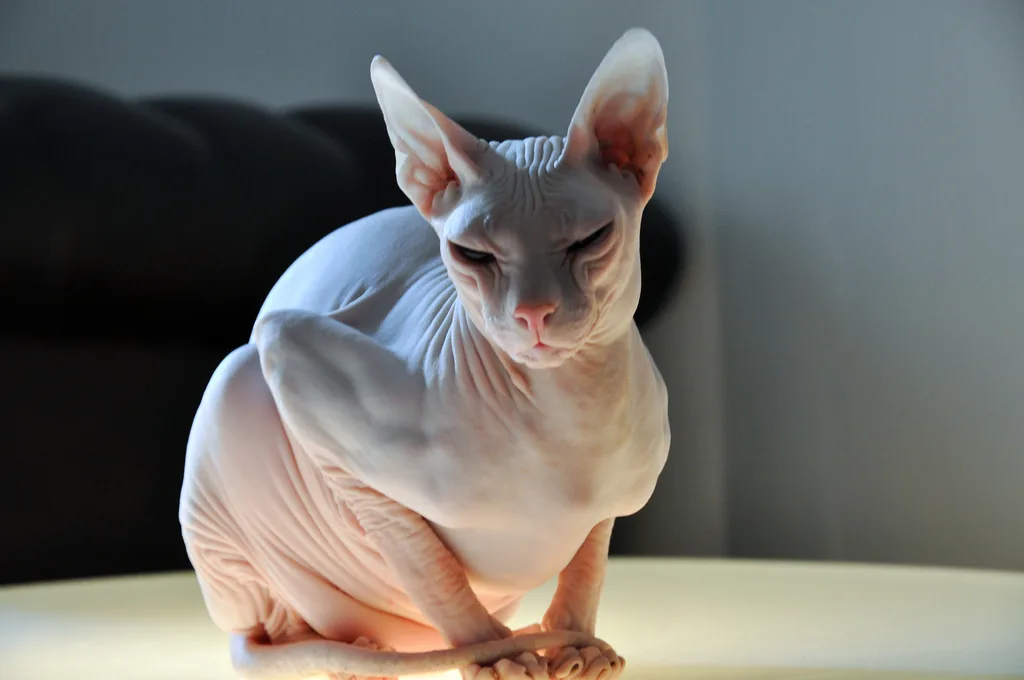
The Donskoy, also known as the Don Sphynx or Don Hairless, is a Russian hairless cat breed that arose independently of the Canadian Sphynx and carries a completely different gene responsible for hairlessness. Where the Sphynx's hairlessness results from a recessive mutation, the Donskoy's hairlessness is dominant, meaning one copy of the gene is sufficient to produce hairlessness. The two breeds look superficially similar but are genetically unrelated in their defining characteristic.
The Donskoy is the parent breed of the Peterbald, created by crossing Donskoy with Oriental Shorthairs. Both breeds share the dominant hairlessness gene.
Origins: A Found Cat in Russia
The Donskoy originates from a chance discovery. In 1987 in Rostov-on-Don, Russia, Elena Kovaleva found a small kitten in distressing circumstances; it was being tormented by children and showed significant fur loss. Kovaleva rescued the kitten, named her Varvara, and observed that despite good nutrition and care, the kitten continued to lose fur rather than growing it back.
When Varvara was eventually bred, some of her kittens were born without hair, confirming that the hair loss was genetic rather than a disease or parasite. A Russian breeder named Irina Nemikina worked with these cats to develop a formal breed, which was recognised by the World Cat Federation (WCF) in 1997 and subsequently by TICA.
The breed is named for the Don River region of Russia where Varvara was found.
Dominant vs Recessive Hairlessness
The genetic distinction between the Donskoy and Sphynx hairlessness is fundamental and practically important for breeders:
Sphynx hairlessness: Caused by a recessive mutation. A cat must inherit two copies (one from each parent) to be hairless. One copy produces a normal-coated cat that is a carrier.
Donskoy hairlessness: Caused by a dominant mutation. One copy is sufficient to produce hairlessness. Two copies (homozygous) produce a more extreme hairlessness. Donskoy breeding involves managing this dominant gene.
In Donskoy breeding, when two hairless Donskoys are bred:
- 25% of offspring may be homozygous (two dominant hairless genes), these cats are more completely hairless and may have some health considerations
- 50% will be heterozygous (one dominant hairless gene), standard Donskoy hairlessness
- 25% will be non-hairless (two normal genes), normal-coated cats
Coat Varieties
Like the Peterbald, the Donskoy has four coat varieties, all resulting from the expression of the dominant hairlessness gene at varying levels:
Rubber bald (born bald): Completely hairless from birth. The skin has a warm, suede-like feel. Stays bald throughout life.
Flocked: Very short, barely visible coat (less than 1mm) giving a velvety texture. These cats often become more hairless with age and may be bald by adulthood.
Velour: Wavy, curly coat approximately 1-2cm long at birth. Bald areas appear on the head and neck. May become partially or completely bald by 2 years.
Brush: The most variable type, with irregular, patchy, wiry fur. Some brush Donskoys retain significant coat throughout life; others thin considerably.
Physical Characteristics at a Glance
| Feature | Detail |
|---|---|
| Body type | Medium, muscular, sturdy |
| Male weight | 3.5-5.5 kg |
| Female weight | 2.5-4 kg |
| Coat | 4 varieties: bald, flocked, velour, brush |
| Skin | Warm, elastic, wrinkled, particularly on face and neck |
| Eye colour | Any colour; almond-shaped |
| Lifespan | 10-15 years |
Skin Characteristics
The Donskoy's bare skin has several distinctive properties:
Warmth. Hairless cats have a higher surface temperature than furred cats; this is not due to elevated body temperature but to the absence of insulating fur between skin and environment. Being held by a Donskoy-owner is often described as holding a warm living cushion.
Skin folds and wrinkles. The Donskoy has particularly prominent skin folding on the forehead, neck, and body, creating a characteristic wrinkled appearance. These folds require attention during bathing to clean accumulated skin oils and debris.
Elastic skin. The Donskoy's skin has notable elasticity, when stretched gently it returns to position. This has been commented on as an unusual property compared to most domestic cats.
Temperament
The Donskoy is social, affectionate, and people-oriented, a consistent theme among hairless cat breeds, possibly reflecting the fact that the breed requires human cooperation for warmth and may have been selected toward sociable individuals.
Key characteristics:
Warmth-seeking. Donskoy cats actively seek warm places, laps, under blankets, sunny windows, next to radiators. This thermoregulatory behaviour is practical given the absence of insulating fur.
Social and affectionate. The breed does not do well with prolonged isolation. It forms close bonds with its family and seeks interaction.
Playful and curious. Active throughout life with high engagement with interactive play.
Tolerant. Generally tolerant of handling and new situations. Good with children and other animals.
Care Requirements
Bathing. Weekly bathing with a mild shampoo is standard. Without fur, skin oils and dust accumulate on the surface. The skin folds require particular attention.
Ear cleaning. The ears lack fur to filter dust and accumulate more debris than furred cats. Weekly ear cleaning with a veterinarian-approved ear cleaner is recommended.
Temperature management. Indoor-only is strongly recommended. The breed requires warm environments; outdoor exposure in cold weather risks hypothermia.
Sun protection. Direct, prolonged sun exposure should be avoided to prevent sunburn.
Cross-Links and Related Articles
- Sphynx Cat
- Peterbald
- Lykoi
- Kitten Feeding Schedule by Age
- Senior Cat Nutrition Guide
References
Lyons LA, et al. "Feline genetics: clinical applications and genetic diversity of cats." Veterinary Clinics of North America: Small Animal Practice. 2012;42(5):1111-1127. doi:10.1016/j.cvsm.2012.08.001
International Cat Association (TICA). "Donskoy Breed Standard." TICA Official Publication, 2023. tica.org
World Cat Federation (WCF). "Don Sphynx Breed Standard." WCF Official Publication, 2023. wcf-online.org
Robinson R. Genetics for Cat Breeders. 3rd ed. Oxford: Pergamon Press; 1991.
Fogle B. The Encyclopedia of the Cat. New York: DK Publishing; 1997.
Lorimer HE. The Complete Illustrated Encyclopedia of Cat Breeds. New York: Lorenz Books; 2004.
Frequently Asked Questions
What is the difference between a Donskoy and a Sphynx?
The Donskoy (Don Sphynx) and Canadian Sphynx both lack fur but carry different genes. The Donskoy’s hairlessness is caused by a dominant gene, one copy is sufficient to produce hairlessness. The Sphynx’s hairlessness is caused by a recessive gene, a cat needs two copies to be hairless. The Donskoy also has a more muscular, less cobby body type than the Sphynx and has four coat varieties.
The breeds are genetically unrelated in their defining characteristic.
How was the Donskoy breed created?
The Donskoy originated in 1987 in Rostov-on-Don, Russia, when Elena Kovaleva rescued a kitten named Varvara from being mistreated. The kitten had significant fur loss that continued despite good care, revealing a genetic rather than pathological cause. When Varvara was bred, some kittens were born without hair, confirming the genetic basis. Breeder Irina Nemikina developed the cats into a formal breed, recognised by the World Cat Federation in 1997.
What are the Donskoy's coat types?
The Donskoy has four coat types: Rubber bald (completely hairless from birth, permanently bald), Flocked (very short barely visible velvety coat, often becomes bald with age), Velour (wavy coat at birth that typically thins considerably, often bald by 2 years), and Brush (irregular patchy wiry fur, variable across life). Multiple coat types can appear within a single litter.
Is the Donskoy the same as the Peterbald?
No, but they are closely related. The Peterbald was created in 1994 by crossing a Donskoy with an Oriental Shorthair. The Peterbald inherited the Donskoy’s dominant hairlessness gene but has the Oriental Shorthair’s long, slender body type rather than the Donskoy’s more muscular medium build. The Donskoy is the parent breed; the Peterbald is the offspring breed.
Do Donskoy cats need special care?
Yes. Donskoy cats require weekly bathing to remove accumulated skin oils and debris that fur would normally absorb. Skin folds on the face, neck, and body require particular attention during cleaning. Ears need regular cleaning. The breed must be kept in warm environments and should not have prolonged outdoor exposure in cold weather. Prolonged sun exposure risks sunburn on bare skin.
What is the Donskoy's personality?
The Donskoy is social, affectionate, and warmth-seeking. The breed bonds closely with its family and actively seeks laps, blankets, and warm spots. It is playful and curious throughout life and does not thrive with prolonged isolation. Generally tolerant with children and other animals. The breed is often described as more dog-like than most cats in its social orientation.