
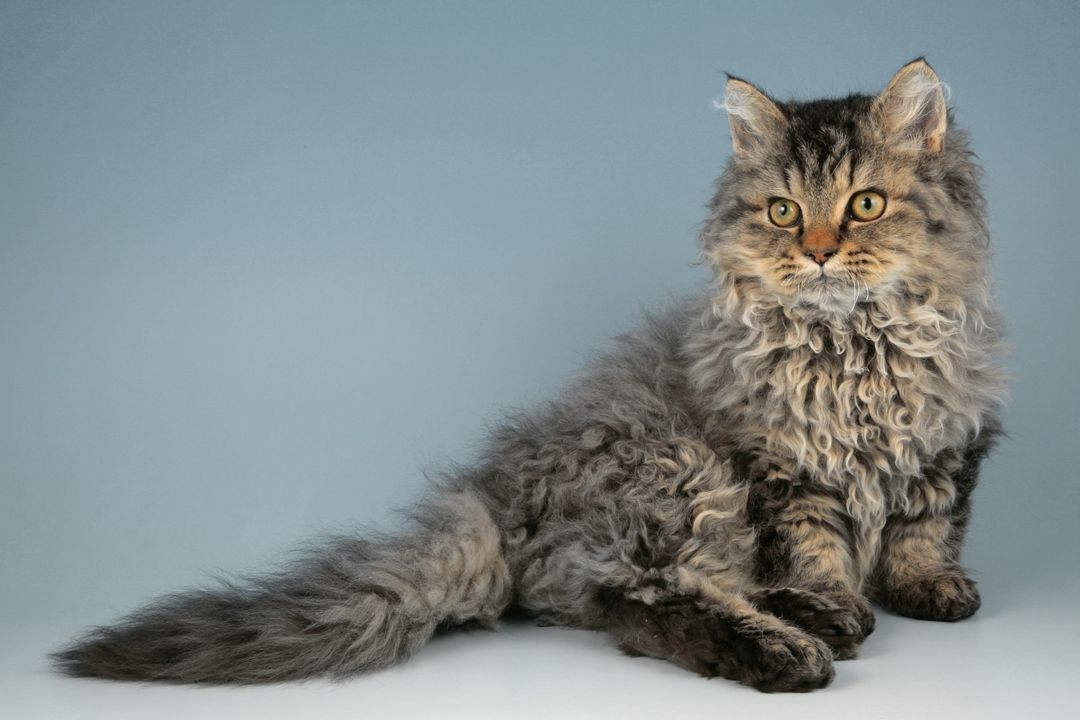
The Selkirk Rex cat breed is the largest and most robust of the four rex breeds, Devon, Cornish, LaPerm, and Selkirk, and the only one to carry a dominant curl gene rather than a recessive one.
This genetic distinction has practical consequences: a single copy of the Selkirk curl gene produces a curly coat, which means that every Selkirk Rex kitten born from a Selkirk Rex parent has a chance of inheriting the curl regardless of what the other parent looks like. The breed can be reliably produced without the complex double-carrier genetics required by the Devon and Cornish Rex programs.
The breed's origin story begins in a shelter in Helena, Montana, in 1987, a single curly-coated kitten noticed among otherwise straight-haired littermates and adopted by Persian breeder Jeri Newman, who named the kitten Miss DePesto of NoFace. When Miss DePesto was bred to Newman's Persian, half of the kittens in the resulting litter had curly coats, confirming the dominant nature of the mutation.
Newman named the breed after the Selkirk Mountains in honor of her stepfather, becoming the first person in the history of the cat fancy to name a breed after a person.
The Selkirk Rex's plush, woolly, teddy-bear coat and substantial body make it one of the most immediately appealing rex breeds to the general public. Where the Devon Rex's elfin appearance and the Cornish Rex's greyhound build are somewhat acquired tastes, the Selkirk Rex's rounded face and dense curls create an undeniably appealing stuffed-animal effect.
Origin and Foundation
Miss DePesto of NoFace was born in a litter of otherwise straight-haired kittens in a shelter in Helena, Montana. Her curly coat was noticed by Jeri Newman, a Persian breeder who recognized its potential. Newman adopted the kitten and, when Miss DePesto was old enough, bred her to Newman's Persian male, Photo Finish of Deekay.
The litter confirmed Newman's hypothesis about dominant inheritance: three of the six kittens had curly coats. This is the expected ratio for a dominant heterozygote, approximately half the offspring of one curly-coated parent and one straight-coated parent will be curly. All three curly kittens and three straight-haired kittens from this litter became the foundation of the Selkirk Rex breed.
Newman chose to incorporate Persian breeding into the Selkirk program from the outset, which gave the breed its substantial body and rounded head but also introduced the PKD1 mutation that is prevalent in Persian populations. This inheritance has made PKD testing an essential part of responsible Selkirk Rex breeding.
The breed was recognized by TICA in 1992 and by CFA in 2000. Both shorthaired and longhaired variants are recognized, with the longhaired version's curls particularly dramatic and dense.
Genetics of the Selkirk Curl
The Selkirk curl is caused by a dominant mutation in the KRT71 gene, the same gene affected in some other rex mutations, though the specific mutation differs. One copy of the gene (heterozygous) produces a curly coat with loose, soft curls. Two copies of the gene (homozygous) produce tighter, denser curls.
This dominant inheritance pattern contrasts sharply with the Devon Rex and Cornish Rex, both of which require two copies of their respective recessive genes to produce a curly coat. A Selkirk Rex kitten can be born curly from a single Selkirk Rex parent regardless of what the other parent is, which simplifies breeding but also means that not all kittens from Selkirk x non-Selkirk matings will be curly.
| Genetic State | Copies of Curl Gene | Coat Effect |
|---|---|---|
| Non-Selkirk | 0 | Straight coat |
| Heterozygous Selkirk | 1 | Soft, loose curls |
| Homozygous Selkirk | 2 | Tight, dense curls |
Kittens are born curly if they inherit the Selkirk gene, but the coat goes through a phase of relative straightening during adolescence before the adult curl pattern develops fully at approximately two years of age. Breeders and potential buyers should be aware that a Selkirk Rex kitten's adult coat may look quite different from its kitten coat.
Physical Characteristics
The Selkirk Rex is a large, substantial cat with a round head, full cheeks, and a robust body reminiscent of the British Shorthair or Persian in overall effect, but covered in plush, loose curls rather than a straight plush coat.
| Characteristic | Details |
|---|---|
| Weight | 4.5-7.3 kg |
| Build | Large, substantial, rounded |
| Head | Round, full-cheeked |
| Eyes | Large, round |
| Coat | Plush, woolly, curly, shorthair and longhair versions |
| Curl gene | KRT71 dominant mutation |
| Lifespan | 10-15 years |
| CFA recognition | 2000 |
The coat is available in all colors and patterns, and in both shorthaired and longhaired versions. The longhaired Selkirk Rex has the most dramatic visual impact, the long, plush curls create a look unlike any other longhaired breed, somewhere between a Persian and an extremely fluffy stuffed animal. The shorthaired version is more restrained but still noticeably textured compared to any straight-coated breed.
The coat can tangle and mat if not maintained, particularly the longhaired version. The woolly texture traps dead hair and creates tangles more readily than silky longhaired coats. Regular, gentle combing is important for longhaired Selkirk Rex cats.
Temperament
The Selkirk Rex has a balanced, easygoing personality that reflects both its Persian heritage and the working-cat genetics of the foundation. The breed is calm and affectionate without the high-maintenance social demands of breeds like the Siamese or Oriental. It is playful and interactive without the hyperactivity of the Cornish Rex.
"Selkirk Rex cats show a combination of the Persian's calm affection and a somewhat higher activity level that is consistent across the breed. Their tolerance of handling and their social flexibility make them particularly suitable for family households." TICA Selkirk Rex Breed Profile, 2021
The breed is good with children and with other animals, and adapts readily to multi-pet households. It is not particularly vocal and does not demand attention with the intensity of the Oriental-type breeds. Owners looking for a relaxed, affectionate companion that also has visual distinction will find the Selkirk Rex to be a well-balanced choice.
Health Profile
The Persian heritage in the Selkirk Rex foundation introduces PKD (polycystic kidney disease) as a primary health concern. The PKD1 mutation found in Persian-derived breeds is autosomal dominant, one copy causes disease, and is prevalent in any breeding program that used Persian cats without systematic DNA testing before the test became available.
| Health Concern | Details | Testing |
|---|---|---|
| Polycystic kidney disease (PKD) | PKD1 dominant mutation from Persian ancestry | DNA test, essential |
| Hypertrophic cardiomyopathy (HCM) | Reported in breed | Echocardiogram screening |
| Hip dysplasia | Reported; possible from Persian background | Radiographic assessment |
| Dental disease | Progressive in middle age | Regular dental care |
"The PKD1 mutation in Selkirk Rex cats is directly attributable to the use of Persian cats in the foundation breeding program. DNA testing of all breeding Selkirk Rex cats for PKD1 is essential, as the dominant mutation means a single tested-positive animal can pass the disease to 50% of its offspring." Lyons, L.A., Journal of the American Veterinary Medical Association, 2004
When purchasing a Selkirk Rex, confirmation of PKD1 DNA testing on both parents, with negative results documented, is non-negotiable from a health perspective.
For grooming guidance see How to Groom a Cat at Home. For rex breed comparisons see Devon Rex and Cornish Rex. For a large semi-longhaired breed comparison see Maine Coon. For grooming detail see Selkirk Rex Grooming Guide.
Grooming
The Selkirk Rex coat requires more attention than the Devon or Cornish Rex coats. The woolly texture traps loose hair and can form mats, particularly in the longhaired version and in the armpits, behind the ears, and in the groin area where friction occurs. Gentle combing two to three times a week with a wide-toothed comb, not a slicker brush, which can straighten the curls, maintains the coat without breaking the curl pattern.
Bathing occasionally helps reset the coat and remove accumulated oils. The Selkirk Rex coat requires gentle, thorough rinsing and gentle drying to preserve the curl. Vigorous toweling or heat from a hair dryer can disrupt the curl pattern.
References
- Lyons, L.A. "Feline polycystic kidney disease: Diagnosis, genetics, and genomics." Journal of the American Veterinary Medical Association, 2004. https://doi.org/10.2460/javma.2004.225.858
- Gandolfi, B., et al. "Correlation between Selkirk Rex coat type and a KRT71 variant." Journal of Heredity, 2013. https://doi.org/10.1093/jhered/est038
- The International Cat Association. "Selkirk Rex Breed Standard." TICA.org, 2022.
- Cat Fanciers' Association. "Selkirk Rex Breed Standard." CFA.org, 2023. https://cfa.org/selkirk-rex/
- Little, S.E. (ed.) The Cat: Clinical Medicine and Management. Elsevier Saunders, 2012. ISBN 978-1437706208.
Frequently Asked Questions
Why is the Selkirk Rex different from other rex breeds?
The Selkirk Rex carries a dominant curl gene, meaning only one copy is needed to produce a curly coat. Devon Rex and Cornish Rex both require two copies of their respective recessive genes. This means that every Selkirk Rex bred to any cat has a 50% chance of producing curly kittens, making the breed easier to produce without the complex double-carrier pairings required by the other rex breeds.
The Selkirk is also the largest and heaviest of the four rex breeds.
Why does PKD testing matter for Selkirk Rex cats?
Persian cats were used in the Selkirk Rex foundation breeding program, introducing the PKD1 polycystic kidney disease mutation into the gene pool. PKD1 is autosomal dominant, one copy causes progressive kidney cyst formation and eventual kidney failure. Because the mutation entered from Persians before systematic DNA testing was routine, it is present in some Selkirk Rex lines.
Both parents of any prospective Selkirk Rex kitten should be documented as PKD1-negative by DNA test.
Do Selkirk Rex kittens look curly from birth?
Yes, kittens born with the curl gene are curly at birth, but the adult curl pattern only becomes fully established at around two years of age. There is a transitional adolescent phase when the coat appears somewhat less curly before the full adult texture develops. Buyers should ask breeders about this normal developmental progression rather than expecting a kitten to show its full adult coat.
How do you groom a Selkirk Rex?
Gentle combing two to three times per week with a wide-toothed comb is the recommended approach, slicker brushes can straighten or damage the curls. The woolly texture traps loose hair and can mat, particularly in the longhaired version, in friction areas like armpits and groin. Occasional bathing helps remove accumulated oils. Vigorous toweling or high-heat drying should be avoided to preserve the curl pattern.
Are Selkirk Rex cats good family pets?
Yes. The Selkirk Rex has a balanced, easygoing personality that makes it well-suited for families. It is calm and affectionate without being demanding, playful without being hyperactive, and tolerant of handling without being indifferent. The breed gets along well with children and with other cats and dogs. The overall personality profile is considerably less demanding than Siamese-family breeds and somewhat more interactive than the Persian.
What is the difference between the Selkirk Rex and the Persian?
The Selkirk Rex descended from Persian crosses and shares some of the Persian’s rounded conformation, but it is a distinct breed with a curly rather than straight coat and a more active temperament. The Persian’s coat is long and requires daily grooming to prevent severe matting; the Selkirk’s curly coat needs gentler, less frequent attention.
The Persian’s flat face creates brachycephalic health concerns that are generally less severe in the Selkirk Rex, which has a less extreme facial structure.