
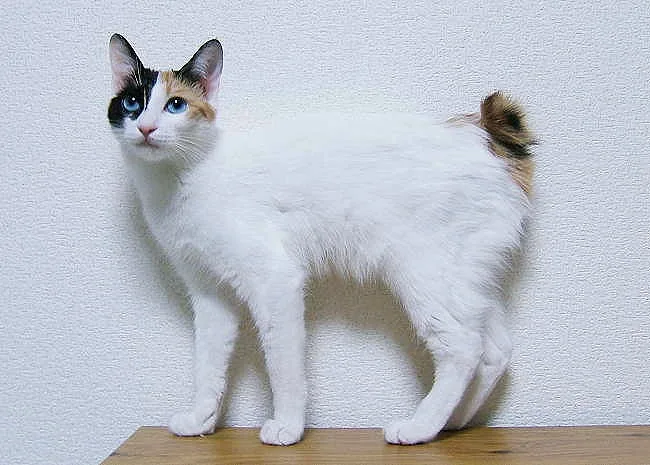
The Japanese Bobtail is one of the oldest and most culturally significant cat breeds in the world. For more than a thousand years, this naturally short-tailed cat has lived alongside the Japanese people, appearing in art, literature, and folklore long before formal cat breeding programmes existed anywhere on earth.
Today the breed is recognised by major registries worldwide, celebrated for its distinctive bobbed tail, its lively and affectionate personality, and its deep historical connections to Japanese cultural identity.
Understanding the Japanese Bobtail means understanding both its genetics, the bobbed tail results from a recessive gene with no associated health problems, and the cultural context that elevated a working cat to national symbol. This is a breed shaped as much by history as by biology.
History and Origins
Cats are not native to Japan. They were introduced from continental Asia, most likely via Korea and China, approximately 1,000-1,500 years ago, primarily brought to protect manuscripts and grain stores from rodents. The earliest written accounts of cats in Japan date to the Heian period (794-1185 CE), and court records indicate that cats were initially so prized that they were kept exclusively in imperial and aristocratic households.
The Japanese Bobtail's distinctive short tail was already a consistent feature in Japanese cats by at least the 10th century. Whether this mutation arose in Japan or was imported is unknown, but the mutation became fixed in Japanese cat populations over centuries of geographic isolation and possibly cultural preference for the unusual tail form.
During the Edo period (1603-1868), Japanese cats were increasingly released from aristocratic enclosures to work as pest controllers in silk warehouses and homes. This contact with the general population spread the bobtail gene through the wider cat population. By the 19th century, the short-tailed cat was the standard type throughout Japan.
The breed was formally introduced to North America in 1968 by Judy Crawford, who imported several Japanese Bobtails and began a breeding programme. The Cat Fanciers' Association (CFA) granted championship status to the shorthair Japanese Bobtail in 1976 and to the longhair variety in 1993. The breed is also recognised by TICA and most international registries.
The Maneki-Neko Connection
No discussion of the Japanese Bobtail is complete without the Maneki-neko, the "beckoning cat" figurine found in businesses, homes, and temples across Japan and increasingly worldwide. These ceramic and plastic figurines, depicting a cat with one paw raised in a beckoning gesture, are ubiquitous symbols of good luck and prosperity.
The Maneki-neko is almost certainly modelled after the Japanese Bobtail. Both the raised-paw posture and the characteristic curled, short tail of the figurine correspond to the Japanese Bobtail's physical type. The figurine's most auspicious version is the tricolour (calico or mi-ke) pattern, white, black, and red, which corresponds precisely to the most prized colour combination in living Japanese Bobtails.
The most famous legend associated with the Maneki-neko involves a 17th-century daimyo (feudal lord) who sought shelter from a storm under a tree near the Gotoku-ji temple in Edo (modern Tokyo). A cat sat at the temple gate beckoning with its paw. The daimyo followed the cat inside, and moments later the tree under which he had sheltered was struck by lightning. The grateful daimyo became the temple's patron, and the cat was honoured after its death with the Maneki-neko figure.
The Mi-ke: Tricolour and Good Fortune
In Japanese cat culture, the mi-ke (三毛, "three colours") pattern, calico, is considered the most auspicious and was historically the most sought-after colour combination in Japanese Bobtails.
The mi-ke pattern consists of white, black (or dark), and red (or orange) in varying combinations. The genetics of this pattern are interesting: the orange and black colours in calico cats are both X-linked traits. A cat requires two X chromosomes to express both colours, meaning that calico cats are almost invariably female. Rare male calico cats are XXY (Klinefelter syndrome) and are virtually always sterile.
In Japanese tradition, mi-ke cats were believed to bring exceptional luck, ward off evil, and protect ships from storms. Japanese fishermen particularly prized tricolour cats and considered them essential shipboard companions.
The Bobbed Tail: Genetics and Biology
The Japanese Bobtail's tail results from a naturally occurring gene mutation. The genetics of the Japanese Bobtail tail are distinctly different from those of the Manx, a feature worth understanding precisely because the two breeds are superficially comparable.
In the Japanese Bobtail:
- The bobtail gene is recessive
- Both parents must carry the gene for it to be expressed in offspring
- Cats with two copies of the gene (homozygous) are not more severely affected than those with one copy expressed
- There are no documented health consequences associated with the gene in the Japanese Bobtail
In the Manx:
- The taillessness gene is dominant
- Only one copy is needed for expression
- Homozygous Manx (two copies) are lethal in utero; this is why Manx cats cannot be reliably bred together without stillbirths
- Manx syndrome (spinal defects, neurological problems) is an associated risk
The practical consequence of the recessive genetics in Japanese Bobtails is that breeders can produce consistently bobtailed offspring without the lethality concerns of the Manx gene. Breeding two Japanese Bobtails together does not produce deaths in the litter.
Each Japanese Bobtail's tail is unique. No two tails are exactly alike in length, curve, or kink pattern. Tails range from a tight pompom to a more extended bob of several centimetres. The tail hairs often spread outward from the base, creating the characteristic pompom appearance.
Physical Characteristics
The Japanese Bobtail is a medium-sized cat of elegant, athletic build, what registries describe as a "cobby" or "semi-foreign" type, meaning neither the extremely slender build of the Oriental breeds nor the compact, heavy build of Persian-type breeds.
Adult males typically weigh between 3.5 and 5 kg. Females are smaller, typically 2.5-4 kg. The body is well-muscled and lean, with a distinctive high-hipped posture when standing.
The head is an equilateral triangle in shape when viewed from the front, with high cheekbones and a distinct break in the nose profile. The eyes are large, oval, and set at a slight slant; the traditional Japanese ideal values vivid, clear eye colour. In mi-ke cats, odd eyes (one blue, one gold) are highly prized.
The ears are large, set upright and at an alert angle, adding to the breed's characteristic expression of active attention.
The coat comes in two lengths: shorthair and longhair. Both have a single-layered coat with minimal undercoat, meaning the breed sheds less than double-coated breeds and is relatively easy to groom.
Physical Characteristics at a Glance
| Feature | Detail |
|---|---|
| Body type | Medium, athletic, semi-foreign |
| Male weight | 3.5-5 kg |
| Female weight | 2.5-4 kg |
| Coat | Short or semi-long, minimal undercoat |
| Colours | All colours except pointed; tricolour (mi-ke) most traditional |
| Eye colour | All colours; odd eyes common and prized |
| Tail | Unique bobbed tail 5-10 cm, pompom appearance |
| Lifespan | 12-16 years |
Temperament and Personality
The Japanese Bobtail is among the most active, communicative, and people-oriented cat breeds. Owners consistently describe the breed's personality as dog-like; it follows its people from room to room, greets arrivals at the door, participates in household activities, and seeks interaction rather than observation.
The breed is highly vocal but does not have the continuous, demanding vocalisation of some Oriental breeds. Its voice is soft and musical, often described as a chirping trill rather than a standard meow. Some owners report that their Japanese Bobtails appear to have a vocabulary of different sounds for different contexts.
Japanese Bobtails are highly playful throughout their lives. They retain kitten-like energy and curiosity well into adulthood. Interactive play, fetch, puzzle feeders, wand toys, is essential for this breed's mental and physical wellbeing.
They generally do well with children, other cats, and cat-friendly dogs. The breed's natural confidence means it is rarely intimidated by household activity or change.
Health
The Japanese Bobtail is one of the healthiest pedigree cat breeds, with no documented breed-specific heritable diseases of significant frequency. The bobbed tail gene does not cause spinal or neurological problems, a question frequently asked by prospective owners comparing the breed to the Manx.
Life expectancy is typically 12-16 years, with many individuals reaching 15+ years in good health.
Routine health maintenance, annual or semi-annual veterinary examinations, dental care, vaccination, and parasite control, is appropriate. No specialised screening is currently recommended for the breed.
Cross-Links and Related Articles
- Manx Cat
- Kitten Feeding Schedule by Age
- Senior Cat Nutrition Guide
- Siamese Cat
- How Long Do Cats Live
References
Lyons LA, et al. "Feline genetics: clinical applications and genetic diversity of cats." Veterinary Clinics of North America: Small Animal Practice. 2012;42(5):1111-1127. doi:10.1016/j.cvsm.2012.08.001
Imes DL, et al. "Albinism in the domestic cat (Felis catus) is associated with a tyrosinase (TYR) mutation." Animal Genetics. 2006;37(2):175-178. doi:10.1111/j.1365-2052.2005.01409.x
Cat Fanciers' Association. "Japanese Bobtail Breed Profile." CFA Breed Standard, 2023. cfainc.org
Fogle B. Cats. New York: DK Publishing; 2006.
Kaelin CB, Barsh GS. "Genetics of pigmentation in dogs and cats." Annual Review of Animal Biosciences. 2013;1:125-156. doi:10.1146/annurev-animal-031412-103659
International Cat Association (TICA). "Japanese Bobtail Breed Standard." TICA Official Publication, 2023. tica.org
Frequently Asked Questions
Is the Japanese Bobtail related to the Manx cat?
No. Both have shortened tails but the genetic mechanisms are entirely different. The Japanese Bobtail’s bobtail is caused by a recessive gene with no associated health problems. The Manx taillessness is caused by a dominant gene that is lethal in homozygous form, two copies cause death in utero. Breeding two Japanese Bobtails does not produce stillbirths or spinal problems.
What is the mi-ke Japanese Bobtail?
Mi-ke (three colours) refers to the tricolour or calico pattern: white, black, and red/orange in combination. It is the most traditionally prized and culturally significant colour pattern in Japanese Bobtails, considered especially lucky in Japanese tradition. The same pattern is depicted on the Maneki-neko figurine. Calico cats are almost always female because the colour genetics are X-linked.
Is the Japanese Bobtail a healthy breed?
Yes. The Japanese Bobtail is considered one of the healthiest pedigree cat breeds. The bobbed tail gene does not cause spinal or neurological problems. There are no documented breed-specific heritable diseases of significant frequency. Life expectancy is typically 12-16 years.
What is the Japanese Bobtail's personality like?
The Japanese Bobtail is active, playful, highly social, and people-oriented. The breed tends to follow its owners, greet visitors, and participate actively in household life, often described as dog-like. It is vocal but with a soft, musical voice rather than the demanding vocalisation of some Oriental breeds. It does well with children, other cats, and cat-friendly dogs.
What is the Maneki-neko and is it a Japanese Bobtail?
The Maneki-neko (‘beckoning cat’) is a Japanese lucky cat figurine depicted with one raised paw, widely believed to bring good fortune. It is widely considered to be modelled on the Japanese Bobtail, both the characteristic curled short tail and the traditional tricolour (mi-ke) colouring of the most auspicious Maneki-neko correspond to the Japanese Bobtail’s physical type.
How rare is the Japanese Bobtail?
The Japanese Bobtail is relatively uncommon in Western countries compared to popular breeds like the Maine Coon or British Shorthair, but it is not extremely rare. In Japan, the short-tailed type was historically the standard domestic cat. Reputable breeders exist in North America and Europe. Expect waiting lists at quality catteries.