
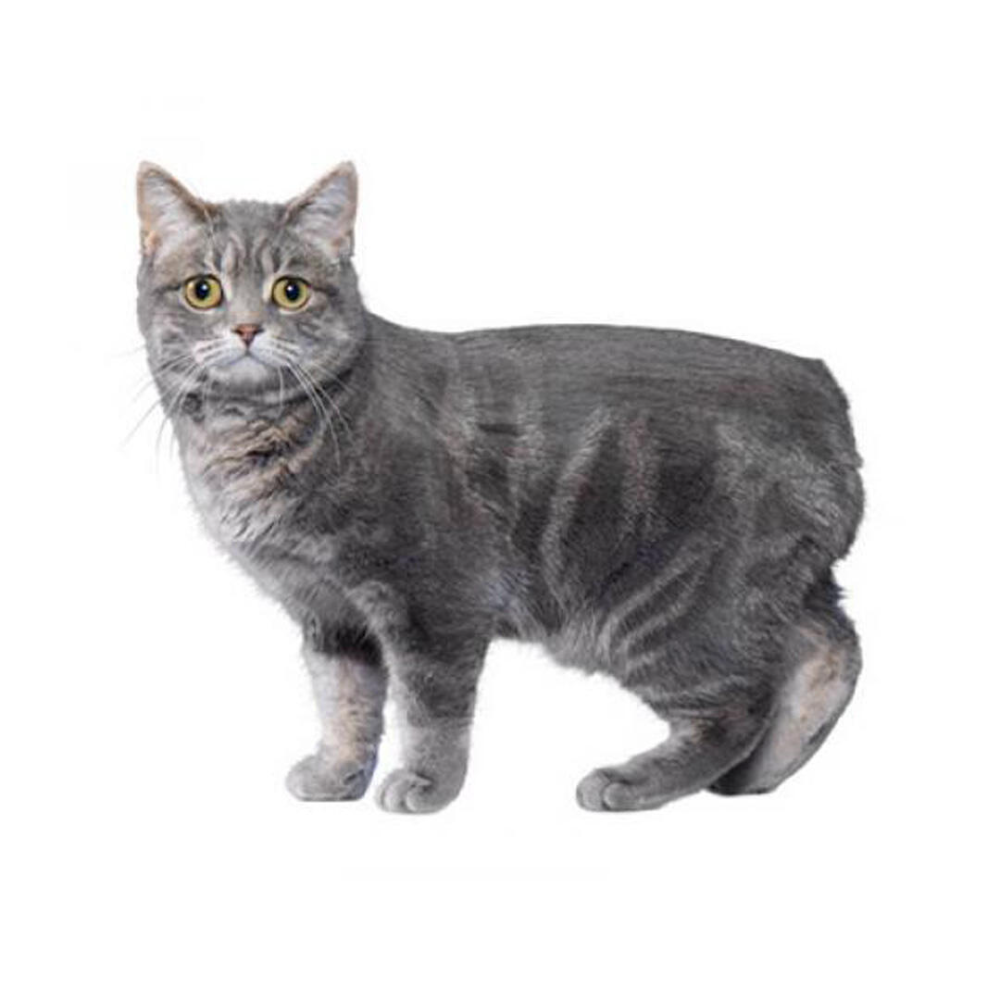
The Manx is one of the oldest and most immediately recognisable cat breeds in the world, defined by its extraordinary absence: the Manx either has no tail at all, a stub of a tail, a short tail, or very occasionally a near-normal tail, all varieties occurring within the same breed and all caused by the same dominant genetic mutation.
The breed originated on the Isle of Man, a self-governing British Crown dependency in the Irish Sea, where geographic isolation allowed a spontaneous mutation to become fixed in the island's cat population.
The Manx is also the most genetically complicated of the "bobtailed" cat breeds, because the gene responsible for its taillessness can cause significant health problems when inherited in double dose, a characteristic that fundamentally shapes how the breed must be managed.
Origins: The Isle of Man
The Isle of Man is a small island, roughly 572 square kilometres, located in the Irish Sea between Great Britain and Ireland. It is large enough to have supported a cat population but small enough that a novel mutation could spread through that population over several generations.
The tailless mutation almost certainly arose as a spontaneous event in a single cat on the island, probably during the 17th or 18th century. Because the island was geographically isolated and cats could not easily arrive from or leave to the mainland cat population, the mutation spread. By the time formal documentation of Manx cats began in the 19th century, tailless cats were common on the island and regarded as a distinctive local type.
The breed received recognition in the early cat fancy. It was shown at one of the earliest cat shows at Crystal Palace in 1871. The Cat Fanciers' Association recognised the Manx as a founding breed. TICA also recognises both shorthair and longhair (Cymric) varieties.
Several folk legends attempt to explain the tailless Manx. One story claims that Noah shut the door of the ark on the cat's tail just as it boarded. Another claims the Manx descended from Phoenician traders who brought cats from Japan, explaining the similarities to the Japanese Bobtail. These stories are entertaining but genetically implausible, the Manx mutation is completely distinct from the Japanese Bobtail mutation.
The Manx Gene: Dominant and Lethal in Homozygous Form
The genetics of Manx taillessness are crucial to understand, and they distinguish this breed from all other bobtailed breeds in a clinically significant way.
Taillessness in the Manx is caused by a single dominant gene designated M (for Manx). "Dominant" means that only one copy of the gene is required to produce the tailless or shortened-tail phenotype.
The critical complication: cats with two copies of the Manx gene (MM homozygous) die in utero. The Manx gene affects spinal development, and having two copies causes such severe developmental disruption that the embryo cannot survive. This means that:
- All living Manx cats are heterozygous; they carry one copy of the M gene and one copy of the normal tail gene (Mm)
- Breeding two Manx cats together always produces some MM embryos that die before birth
- A typical Manx x Manx litter will be on average 25% MM (lethal), 50% Mm (Manx), and 25% mm (normal-tailed)
- The effective litter size is typically smaller than non-Manx breeds for this reason
This is why reputable Manx breeders often breed Manx cats with non-Manx cats (producing 50% Manx and 50% normal-tailed kittens) rather than Manx to Manx, to avoid the high rate of fetal loss and reduce the risk of Manx syndrome (described below).
Tail Length Varieties
The Manx's variable tail length is a consequence of the gene's variable expression (penetrance). The four recognised tail types are:
Rumpy: Completely tailless. A small dimple or hollow at the base of the spine where a tail would be. This is the "classic" Manx type and is required for show competition in most organisations.
Rumpy-riser: A small number of fused vertebrae forming a short knob at the tail base. Visible but not extending beyond the rump.
Stumpy: A short, moveable tail stump of 1-5 centimetres. Often curved, kinked, or irregular. Stumpies are not permitted in CFA show competition but are fully healthy pets.
Longy: A tail that is shorter than normal but substantially longer than a stumpy. Some longies have nearly full-length tails. These cats are genetically Manx (Mm) but their gene expression produces near-normal tail development.
The longhair variety of the Manx is known as the Cymric, named for the Celtic word for Wales, though the breed originated on the Isle of Man. The Cymric has the same genetics as the shorthair Manx but carries the recessive long-hair gene as well.
Manx Syndrome
Manx syndrome is the most significant health concern specific to this breed, and every prospective Manx owner should understand it.
When the Manx gene's developmental effects extend beyond the tail to affect the sacral (lower) spine and pelvis, the result can be a condition resembling sacral spina bifida, incomplete closure or formation of the sacral vertebrae. The consequences range from mild (subtle abnormalities visible only on X-ray) to severe (paralysis, urinary and faecal incontinence, and inability to walk normally).
Severely affected kittens typically become apparent within the first few months of life. Signs include:
- Bunny-hopping gait (both hind legs moving together)
- Urinary or faecal incontinence
- Weakness or paralysis of the hind limbs
- Skin sensitivity or lack of sensation in the hindquarters
Kittens with severe Manx syndrome are typically euthanised. Kittens with mild forms may live normal lives or may have manageable problems.
The risk of Manx syndrome is higher in:
- Rumpy (completely tailless) cats, because complete taillessness tends to correlate with more severe spinal developmental effects
- Offspring of Manx x Manx matings, compared to Manx x non-Manx matings
Reputable breeders test their stock, keep records of syndrome occurrence, and do not breed from lines with high incidence. Prospective buyers should ask about Manx syndrome rates in a breeder's lines.
Physical Characteristics
The Manx has a compact, rounded, heavy-boned body type that reflects centuries of natural development on a cold island environment. The overall impression is one of roundness: a round head, round eyes, and a round rump.
| Feature | Detail |
|---|---|
| Body type | Compact, cobby, heavily muscled |
| Male weight | 4-6 kg |
| Female weight | 3.5-5 kg |
| Coat (shorthair) | Double coat; thick, plush outer coat with dense undercoat |
| Coat (longhair/Cymric) | Semi-long, silky outer coat with thick undercoat |
| Colours | All colours and patterns except pointed |
| Eye colour | All colours |
| Hind leg length | Longer than forelegs, gives distinctive hopping gait |
| Lifespan | 12-15 years |
The hind legs of the Manx are noticeably longer than the forelegs, giving the rump a raised appearance and producing a characteristic rolling or hopping walk. This is normal for the breed and not a sign of spinal problems in healthy Manx cats.
Temperament
The Manx is known for an exceptionally friendly, loyal, and dog-like personality. Breed descriptions consistently emphasise the Manx's tendency to bond deeply with its family, to follow owners around the house, and to greet visitors with confidence rather than hiding.
The breed is playful and enjoys interactive games, particularly fetch, an unusual behaviour in cats that many Manx individuals exhibit naturally. Manx cats are generally adaptable and tend to adjust well to different living situations, children, and other pets.
They are moderately vocal, not silent, but not as demanding in vocalisation as Oriental-type breeds.
Grooming
The Manx's double coat requires weekly brushing to remove dead hair and prevent matting, particularly around the rump and flanks. The Cymric's longer coat needs more frequent attention, 2-3 brushings per week, especially during seasonal shedding. Neither variety requires professional grooming in most circumstances.
The Manx sheds moderately year-round with heavier shedding seasonally.
Cross-Links and Related Articles
- Japanese Bobtail
- British Shorthair
- Scottish Fold
- Senior Cat Nutrition Guide
- How Long Do Cats Live
References
Lyons LA, et al. "Feline genetics: clinical applications and genetic diversity of cats." Veterinary Clinics of North America: Small Animal Practice. 2012;42(5):1111-1127. doi:10.1016/j.cvsm.2012.08.001
Deforest ME, Basrur PK. "Malformations and the Manx syndrome in cats." The Canadian Veterinary Journal. 1979;20(11):304-314. PMID:498890
Indrieri RJ, et al. "Neurological complications of cervical spondylomyelopathy in the Great Dane." Journal of the American Animal Hospital Association. 1980;16:973.
Cat Fanciers' Association. "Manx Breed Standard." CFA Official Publication, 2023. cfainc.org
Todd NB. "Inheritance of the catnip response in domestic cats." Journal of Heredity. 1962;53(2):54-56.
International Cat Association (TICA). "Manx/Cymric Breed Standard." TICA Official Publication, 2023. tica.org
Frequently Asked Questions
Why do Manx cats have no tail?
The Manx’s absent or shortened tail results from a naturally occurring dominant gene mutation (designated M) that arose on the Isle of Man. Only one copy of this gene is needed to produce taillessness. However, cats with two copies of the gene (MM, homozygous) die in utero, meaning all living Manx cats carry exactly one copy of the gene (heterozygous).
What is Manx syndrome?
Manx syndrome is a condition in which the Manx gene’s developmental effects extend beyond the tail to cause incomplete or abnormal formation of the sacral spine and pelvis. Effects range from mild spinal abnormalities to severe consequences including paralysis of the hind limbs, urinary and faecal incontinence, and inability to walk normally. Severely affected kittens typically present within the first few months of life.
Reputable breeders test their lines and minimise the risk.
What are the different types of Manx tail?
Four tail length types exist: Rumpy (completely tailless, required for show competition), Rumpy-riser (a few fused vertebrae forming a small knob), Stumpy (a short moveable tail of 1-5 cm), and Longy (a near-normal length tail). All four types are genetically Manx and can occur in the same litter.
What is a Cymric cat?
The Cymric (pronounced kim-rick) is the longhair variety of the Manx, sharing identical genetics but also carrying the recessive long-hair gene. TICA recognises the Cymric as a separate breed; the CFA classifies it as a longhair Manx. Both the shorthair Manx and the Cymric have the same bobbed tail genetics, the same risk of Manx syndrome, and very similar temperament.
Is the Manx cat healthy?
Manx cats without Manx syndrome are generally healthy and live 12-15 years. The main health concern specific to the breed is Manx syndrome (sacral spinal defects), which is more common in completely tailless (rumpy) cats. Reputable breeders screen their lines and avoid pairing cats with high incidence of the syndrome. A thorough health evaluation of any potential kitten by a veterinarian is advisable.
What is the Manx cat's personality?
The Manx is known for a loyal, dog-like personality. The breed typically bonds closely with its family, follows owners around the house, greets visitors confidently, and plays fetch, an unusual behaviour for a cat. Manx cats are adaptable, friendly with children and other pets, and moderately vocal. They are not aloof like some other breeds.