
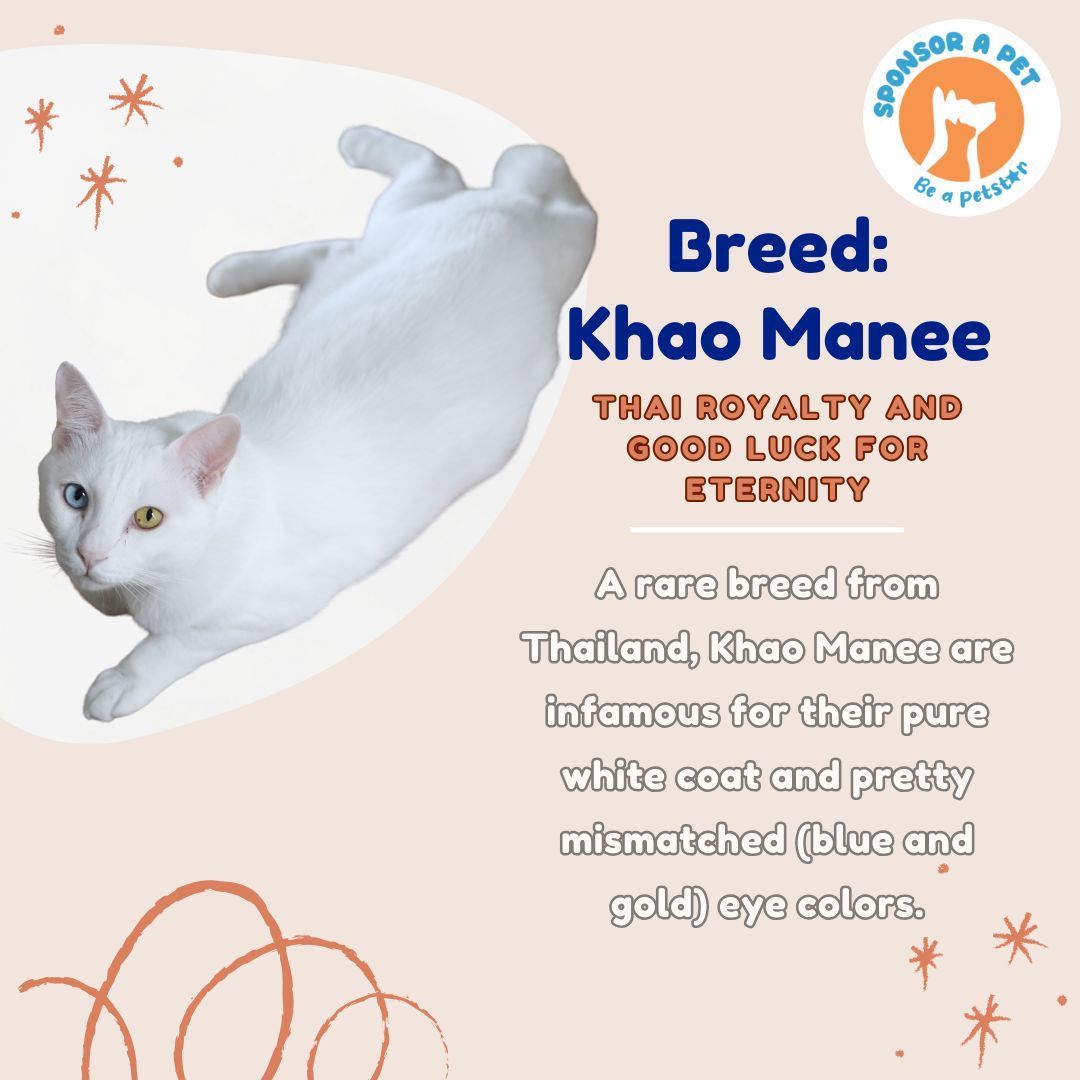
The Khao Manee is an ancient Thai cat breed whose name translates literally to "white gem." All-white, with eyes that may be blue, gold, or, most prized of all, one of each, the Khao Manee has been kept exclusively within Thailand's royal court for centuries, considered a powerful symbol of luck, longevity, and prosperity. Until the 1990s, it was essentially unknown outside Thailand, making it one of the most recently internationalised of all ancient pedigree breeds.
The Khao Manee occupies a place in Thai cat culture alongside the Siamese and Korat, all three are described in the Tamra Maew, the ancient Thai cat manuscript that is one of the earliest written sources on cat breeds anywhere in the world.
History and Royal Thai Tradition
The Khao Manee's documented history begins with the Tamra Maew (Treatise on Cats), written during the Ayutthaya Kingdom between 1350 and 1767 CE. This illustrated manuscript describes seventeen types of auspicious cats with specific physical characteristics, names, and the particular good fortune each type brings. The Khao Manee is described as a white cat whose eyes shine like diamonds, bringing luck, health, and wealth to those who keep it.
In Thai royal tradition, Khao Manee cats were kept exclusively in the palace. They were presented to foreign dignitaries as extraordinary diplomatic gifts, an honour reserved for only the most respected guests. The Thai king Rama V (King Chulalongkorn, reigned 1868-1910) is documented to have been a devoted keeper of Khao Manee cats.
For most of the 20th century, Khao Manee cats were essentially unavailable outside Thailand. The breed was first exported in the 1990s, primarily through the efforts of Colleen Freymuth, an American expatriate living in Bangkok who worked to introduce the breed to Western cat fanciers. TICA granted the Khao Manee preliminary status in 2009 and advanced new breed status in 2011.
Physical Characteristics
The Khao Manee is an all-white, short-haired, medium-sized cat of semi-foreign body type.
Coat. Short, dense, smooth, and pure white, no markings of any kind. The white coat is caused by the dominant white gene (W), which suppresses pigmentation throughout the body. This same gene is associated with deafness in white-coated animals (discussed in the health section).
Eyes. The eye colour is where the Khao Manee is most distinctive. Three eye types are possible:
- Blue eyes: Common in the breed; the same dominant white gene that suppresses coat pigmentation also reduces pigmentation in the iris
- Gold/yellow eyes: Less common; reflecting retained iris pigmentation
- Odd eyes (heterochromia): One blue eye and one gold or green eye, the most prized combination in Thai tradition and considered the luckiest and most beautiful
Body. The body is athletic and muscular rather than heavy, neither the extreme elongation of the Oriental type nor the cobby roundness of the Persian type. The head is a rounded wedge with a moderate muzzle and high cheekbones.
Physical Characteristics at a Glance
| Feature | Detail |
|---|---|
| Body type | Semi-foreign, medium, athletic |
| Male weight | 3.5-5.5 kg |
| Female weight | 2.5-4 kg |
| Coat | Short, smooth, pure white only |
| Eye colour | Blue, gold, or odd-eyed (most prized) |
| White gene | Dominant white (W), responsible for coat and eye colour |
| Lifespan | 10-15 years |
Odd Eyes: Heterochromia and Its Significance
Heterochromia, having two eyes of different colours, is particularly common in white cats carrying the dominant white gene, and particularly prized in the Khao Manee.
The dominant white gene (W) suppresses melanin production throughout the body. In the eyes, the degree of melanin suppression varies between individuals and sometimes between the two eyes of the same individual. When one eye has sufficient iris melanin and the other does not, the result is one gold/green eye and one blue eye.
In Thai tradition, odd-eyed Khao Manee cats were considered extraordinary lucky charms, more precious even than blue-eyed or gold-eyed individuals. The contrast of one blue and one gold eye in a pure white cat is visually striking, and the cultural significance amplified the aesthetic appeal.
Deafness in White Cats
White cats, particularly those with blue eyes, have an elevated risk of congenital deafness, and the Khao Manee is no exception. This is a well-documented genetic phenomenon across multiple species.
The dominant white gene (W) suppresses melanin production throughout the body. In the inner ear, melanocytes (melanin-producing cells) in the stria vascularis (a structure critical for cochlear function) are essential for normal hearing. When the W gene suppresses melanin production in the cochlea, the stria vascularis degenerates before birth, causing irreversible congenital deafness.
Risk by eye colour:
- Blue-eyed white cats: highest risk of deafness (affects one or both ears)
- Odd-eyed white cats: typically deaf on the blue-eye side
- Gold/orange-eyed white cats: lowest risk (more retained cochlear melanocytes)
Deafness can be tested in kittens using the BAER test (Brainstem Auditory Evoked Response), a non-invasive, accurate test appropriate for kittens as young as 5-6 weeks. Reputable Khao Manee breeders BAER-test all kittens before sale.
Deaf cats can live happy, safe lives as indoor-only cats with some specific management adaptations (vibration-based communication, visual cues for feeding and attention, no unsupervised outdoor access).
Temperament
The Khao Manee is a notably active, vocal, and social cat. Its personality reflects the Thai street cat heritage, adaptable, resourceful, and people-oriented.
Key characteristics:
Vocal and communicative. The Khao Manee is one of the more vocal breeds. It communicates actively with its owners through a range of vocalisations and is not shy about expressing opinions about food timing, attention, or access to preferred locations.
Curious and active. The breed explores its environment energetically and is not a calm lap cat by nature. It engages with its environment, investigates everything, and is not well-suited to small, unstimulating spaces.
Affectionate. The Khao Manee bonds strongly with its family and seeks contact and interaction. It does not do well with long periods alone.
Good with other animals. Generally adaptable to other cats and cat-friendly dogs.
Cross-Links and Related Articles
- Siamese Cat
- Korat
- Sphynx Cat
- Kitten Feeding Schedule by Age
- Senior Cat Nutrition Guide
References
Strain GM. "Deafness prevalence and pigmentation and gender associations in dog breeds at risk." The Veterinary Journal. 2004;167(1):23-32. doi:10.1016/S1090-0233(03)00104-7
Strain GM. "Hereditary deafness in dogs and cats: causes, prevalence, and current research." Tufts' Canine and Feline Breeding and Genetics Conference, 2004.
Lyons LA, et al. "Feline genetics: clinical applications and genetic diversity of cats." Veterinary Clinics of North America: Small Animal Practice. 2012;42(5):1111-1127. doi:10.1016/j.cvsm.2012.08.001
International Cat Association (TICA). "Khao Manee Breed Standard." TICA Official Publication, 2023. tica.org
Fogle B. The Encyclopedia of the Cat. New York: DK Publishing; 1997.
Lorimer HE. The Complete Illustrated Encyclopedia of Cat Breeds. New York: Lorenz Books; 2004.
Frequently Asked Questions
What is the Khao Manee?
The Khao Manee (Thai: ‘white gem’) is an ancient all-white Thai cat breed described in the Tamra Maew manuscript from the Ayutthaya Kingdom (1350-1767 CE). It was historically kept exclusively in Thai royal courts and presented to high officials and foreign dignitaries as a symbol of luck and prosperity. It was essentially unknown outside Thailand until the 1990s.
Are Khao Manee cats always deaf?
Not all Khao Manee cats are deaf, but blue-eyed individuals have a significantly elevated risk of congenital deafness. The dominant white gene (W) that produces the all-white coat also suppresses melanocytes in the cochlea, which are essential for hearing. Blue-eyed white cats are at highest risk; odd-eyed cats are typically deaf on the blue-eye side; gold-eyed individuals have the lowest risk.
BAER testing of kittens before sale is standard practice among reputable breeders.
Why are odd-eyed Khao Manee cats special?
Odd-eyed Khao Manee, with one blue and one gold eye, are considered the most auspicious and valuable in Thai tradition. The contrast of two different eye colours in a pure white cat is visually striking, and the Thai belief is that an odd-eyed Khao Manee brings exceptional luck. From a genetics perspective, odd eyes result when the dominant white gene suppresses pigmentation in one eye’s iris while the other retains melanin.
What is the Khao Manee's temperament?
The Khao Manee is active, vocal, and people-oriented. It communicates actively with a range of vocalisations, explores its environment energetically, and bonds closely with its family. It is not a lap cat by disposition but is affectionate and seeks interaction. The breed does not do well with long periods alone and is best suited to households where it receives regular attention.
Is the Khao Manee related to the Siamese?
The Khao Manee and Siamese are both ancient Thai breeds described in the Tamra Maew manuscript. They share Thai origin but are genetically distinct breeds. The Siamese is colour-pointed (dark points on pale body) and caused by a different temperature-sensitive enzyme gene. The Khao Manee is all-white due to the dominant W gene. The breeds have different body types, coat genetics, and visual appearances.
Can a deaf Khao Manee be a good pet?
Yes. Deaf cats can live happy, comfortable lives as indoor-only pets with some adaptations. Owners of deaf cats learn to communicate through vibrations (gentle floor taps, touching nearby surfaces), visual signals, and touch. Deaf cats should never have unsupervised outdoor access; they cannot hear approaching cars or predators. BAER-tested kittens confirmed deaf should always be placed as indoor-only pets with informed owners.