
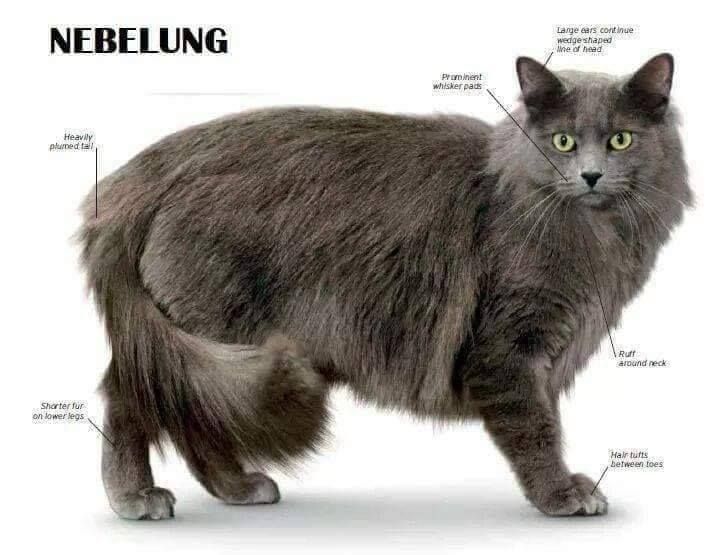
The Nebelung cat breed is a longhaired Russian Blue, a description that is simultaneously accurate and a little reductive, because the Nebelung is a recognised breed in its own right, not simply a longhaired variety of the Russian Blue. The two breeds share the same distinctive blue-silver coat colour, the same temperament of quiet loyalty and reserved intelligence, and closely related genetics.
The difference is the gene that determines coat length: the Nebelung carries a recessive long-hair gene that the standard Russian Blue does not express.
The Nebelung is a young breed by the standards of cat fancy, developed in the United States in the 1980s. Its name comes from the German word for mist or fog, a reference to its shimmering, ethereal coat.
History and Development
The Nebelung was created by Cora Cobb of Denver, Colorado, in the 1980s. Cobb's domestic cat, Elsa, was bred to a longhaired black male and produced a litter that included a longhaired blue male kitten that Cobb named Siegfried, after the hero of the German Nibelung saga. A subsequent litter from the same parents produced a longhaired blue female named Brunhilde, completing the Nibelung reference.
Cobb became committed to developing these cats into a formal breed. She worked with geneticist Dr. Solveig Pfleuger to establish that the cats carried the Russian Blue blue colour gene in combination with a recessive longhair gene and to develop a breed standard.
The International Cat Association (TICA) granted the Nebelung championship status in 1997. The breed is also recognised by several other international registries, though not currently by the CFA. Population numbers remain modest, the Nebelung is a rare breed even by the standards of less common pedigree cats.
Genetics: Russian Blue Plus Long Hair
The Nebelung's genetics are straightforward. The Russian Blue has a blue (dilute) coat that is caused by the interaction of two recessive dilution genes. The Nebelung has the same blue coat genetics, plus a recessive long-hair gene.
In the Russian Blue gene pool, the recessive long-hair gene has been present as an unexpressed recessive since at least the 1980s (when Cobb's cats revealed its presence) and probably longer. When two carriers are bred together, some offspring express the long-hair gene and have the Nebelung coat.
In current breeding practice, Nebelungs can be produced by breeding Nebelung to Nebelung (which consistently produces longhaired blue kittens) or by outcrossing with Russian Blues (which produces some shorthaired blue kittens alongside some longhaired blue kittens, with the shorthaired kittens carrying the longhair gene as unexpressed carriers).
This outcrossing with Russian Blues is permitted in TICA's Nebelung breed standard and serves the important function of maintaining genetic diversity in the small Nebelung population.
Physical Characteristics
The Nebelung is a medium-to-large cat of the Russian Blue body type: semi-foreign, meaning neither the extreme elongation of Oriental breeds nor the compact roundness of Persian-type breeds.
Coat. The defining feature. The coat is medium-long, with a silky outer coat and a dense, soft undercoat. The collar (ruff) around the neck is fuller than on the body. The tail is heavily furred. The overall effect, combined with the blue-silver colour, is of an exceptionally beautiful, light-catching coat that changes appearance with the cat's movement.
Colour. Blue only, with silver tipping on the guard hairs. The silver tipping gives the coat its characteristic luminous quality. Kittens are sometimes born with faint ghost markings (tabby pattern) that disappear as the adult coat develops.
Eyes. Vivid green is the adult eye colour, reached gradually from yellow-green in kittens. The transition to full green may take 1-2 years.
Physical Characteristics at a Glance
| Feature | Detail |
|---|---|
| Body type | Semi-foreign, medium-large, muscular |
| Male weight | 3.5-6 kg |
| Female weight | 2.5-4 kg |
| Coat | Medium-long, silky outer coat, dense undercoat |
| Colour | Blue (silver-tipped) only |
| Eye colour | Vivid green (adults) |
| Lifespan | 12-16 years |
Temperament
The Nebelung shares the Russian Blue's characteristic temperament to a remarkable degree, suggesting that the personality traits are strongly encoded in the shared genetics and are not significantly altered by the long-hair gene.
Key characteristics:
Quietly devoted. The Nebelung bonds deeply with its family and follows its chosen people with consistent, undemanding loyalty. It is not a lap cat in the demanding sense; it does not insist on physical contact, but it wants to be in the same room and to know where its people are.
Reserved with strangers. Nebelungs are typically cautious with unfamiliar people and may hide when visitors arrive. This is a consistent trait that prospective owners should understand and respect. A Nebelung that trusts you is affectionate and warm; one that does not know you yet will be invisible.
Gentle and quiet. The breed rarely vocalises except when necessary. Its voice, when used, is soft.
Sensitive to routine. Nebelungs are creatures of habit. They prefer consistent feeding times, consistent environments, and consistent handling. Changes in routine, moves, new animals, new people, schedule disruptions, can cause stress in this breed.
Intelligent. The breed is capable of learning household patterns, routines, and even simple games with minimal training.
Grooming
The Nebelung's semi-long coat requires regular brushing, approximately 2-3 times per week, to prevent tangles, particularly around the collar and hindquarters. The coat is naturally silky and has less tendency to mat than more densely coated longhaired breeds, but it does require attention.
Seasonal shedding, particularly in spring, produces heavier coat loss and requires more frequent brushing during that period.
Health
The Nebelung is a generally healthy breed. Given its close relationship to the Russian Blue, the health concerns that apply to that breed are relevant:
- No breed-specific heritable disease at high frequency is documented
- Urinary tract issues are occasionally reported but not significantly elevated compared to other breeds
- Obesity can be a concern given the breed's moderate activity level and love of routine feeding
Life expectancy is typically 12-16 years.
Cross-Links and Related Articles
- Russian Blue
- Korat
- Norwegian Forest Cat
- Senior Cat Nutrition Guide
- How Long Do Cats Live
References
Lyons LA, et al. "Feline genetics: clinical applications and genetic diversity of cats." Veterinary Clinics of North America: Small Animal Practice. 2012;42(5):1111-1127. doi:10.1016/j.cvsm.2012.08.001
International Cat Association (TICA). "Nebelung Breed Standard." TICA Official Publication, 2023. tica.org
Lipinski MJ, et al. "The ascent of cat breeds: genetic evaluations of breeds and worldwide random-bred populations." Genomics. 2008;91(1):12-21. doi:10.1016/j.ygeno.2007.10.009
Fogle B. The Encyclopedia of the Cat. New York: DK Publishing; 1997.
Lorimer HE. The Complete Illustrated Encyclopedia of Cat Breeds. New York: Lorenz Books; 2004.
Cat Fanciers' Association. "Russian Blue Breed Standard." CFA Official Publication, 2023. cfainc.org
Frequently Asked Questions
What is the difference between a Nebelung and a Russian Blue?
The Nebelung and Russian Blue share the same blue-silver coat colour and very similar temperament. The sole genetic difference is that the Nebelung carries a recessive long-hair gene that produces a medium-long, silky coat, while the Russian Blue has a short, dense coat. The Nebelung is a recognised breed in its own right, not simply a longhaired Russian Blue variant.
How was the Nebelung created?
Cora Cobb of Denver, Colorado created the Nebelung in the 1980s after her domestic cat produced unexpectedly longhaired blue kittens. Cobb named them Siegfried and Brunhilde (after the German Nibelung saga, giving the breed its name), and worked with geneticist Dr. Solveig Pfleuger to establish the genetics and develop a formal breed standard. TICA granted championship status in 1997.
Is the Nebelung rare?
Yes. The Nebelung is one of the rarer pedigree cat breeds. Population numbers remain modest even by the standards of less common breeds. It is recognised by TICA and several international registries but not currently by the CFA. Finding a reputable breeder typically requires some research and may involve a waiting list.
What is the Nebelung's personality?
The Nebelung is quietly devoted, intelligent, and reserved with strangers, closely mirroring the Russian Blue temperament. It bonds deeply with its family, follows its chosen people, and prefers consistent routines. It is typically shy with unfamiliar people but warm and affectionate with those it trusts. The breed is gentle and rarely vocalises. It is sensitive to change and stress.
How much grooming does a Nebelung need?
The Nebelung’s semi-long, silky coat requires brushing 2-3 times per week to prevent tangles, particularly around the neck ruff and hindquarters. The coat is less prone to matting than denser longhaired breeds. During spring shedding season, more frequent brushing is necessary. The Nebelung does not typically require professional grooming.
What are the Nebelung's health concerns?
The Nebelung is generally a healthy breed with no documented breed-specific heritable diseases at high frequency. Given its close relationship to the Russian Blue, relevant health awareness includes monitoring for urinary tract health, dental care, and weight management. Life expectancy is typically 12-16 years.