
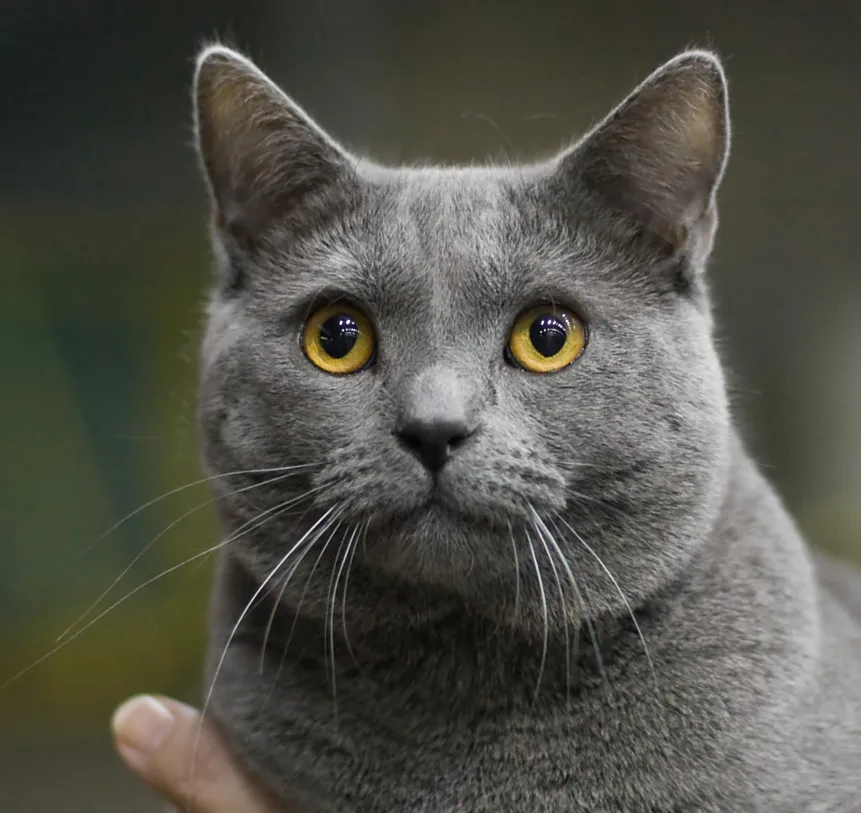
The Chartreux cat breed is one of France's most celebrated national treasures, a breed with documented history stretching back at least four centuries, associated with the Carthusian monastic order, painted by French masters, and owned by the French poet Joachim du Bellay and the writer Colette.
It is a cat of substantial physical presence: heavily boned, muscular, and compact, with a distinctive blue-grey woolly coat and an expression that appears permanently, gently amused, what French breeders call the "Chartreux smile."
Despite its ancient pedigree, the Chartreux came close to extinction during the Second World War, and its survival as a breed is owed to the dedication of a small number of French breeders who rebuilt the population from a remnant on the island of Belle-Île off the Brittany coast.
History: Monks, Wool, and War
The earliest written references to the Chartreux date to the 16th century. The naturalist and herbalist Jean-Baptiste Baudin wrote in 1558 about a particular type of French cat with a woolly blue coat. By the 18th century, the Chartreux had been formally described in natural history works and was associated with the Grande Chartreuse monastery of the Carthusian order near Grenoble, though documentary evidence linking the cats directly to the monastery's breeding is limited.
The poet Joachim du Bellay (1522-1560) wrote an elegy for his Chartreux, "Vers Funèbres d'un Petit Chat," one of the earliest documented instances of a cat as the subject of literary mourning. The writer Colette (1873-1954), who kept Chartreux cats throughout her life, described them in several works. Charles de Gaulle reportedly kept a Chartreux.
The breed's population was devastated by the Second World War, both through the general upheaval of wartime France and through indiscriminate crossbreeding. After the war, French breeders discovered a semi-feral colony of blue cats on Belle-Île-en-Mer and used this as a foundation to reconstruct the breed. The island cats were remarkably uniform in type, suggesting that the Chartreux had maintained consistent characteristics through geographic isolation.
The CFA recognised the Chartreux in 1987. TICA recognises the breed as well.
Physical Characteristics
The Chartreux's physical type is distinctive and different from any other blue cat breed.
Body. The Chartreux has a "primitive" body type, broad-chested, heavily muscled, and dense-boned. Adult males are notably larger and more substantial than females. The breed's French description is "a potato on toothpicks" a substantial body on relatively fine, medium-length legs. This silhouette is exaggerated but captures the characteristic broad chest and chest-heavy appearance.
Coat. The coat is short to medium in length with a distinctive woolly texture, denser and more textured than typical short-coated breeds, with a slight break in the coat caused by the thick undercoat beneath. The texture is unlike any other breed's coat and is one of the breed's defining characteristics.
Colour. Blue only, in all shades from ash grey to a warm, lighter grey. No markings, no white, no other colours. The coat may have silver tipping at the ends of the guard hairs, particularly in younger cats.
Head. The head is broad and rounded, with full cheeks and a slightly tapering muzzle that creates a permanent appearance of a small smile, the famous "Chartreux smile." The nose is medium short with a slight break. The ears are medium, set high.
Eyes. Round, large, and vividly coloured, the preferred and most prized eye colour is brilliant copper to gold, though all shades from gold to orange are accepted. Green is not preferred.
Physical Characteristics at a Glance
| Feature | Detail |
|---|---|
| Body type | Robust, heavily muscled, broad-chested |
| Male weight | 4.5-7 kg |
| Female weight | 3-4.5 kg |
| Coat | Short-medium, woolly texture, dense undercoat |
| Colour | Blue only (all shades from ash to warm grey) |
| Eye colour | Copper to gold (brilliant orange preferred) |
| Lifespan | 12-15 years |
The Chartreux Smile
The Chartreux's expression is one of its most remarked-upon characteristics. The combination of broad cheeks, a slightly tapering muzzle, and high-set, alert eyes creates a permanent expression that observers consistently describe as a gentle smile or a look of serene amusement.
This is purely structural, the cat is not smiling in any emotional sense, but it gives the Chartreux a characteristic expression that is unlike any other breed and contributes significantly to its appeal.
Temperament
The Chartreux is known for a calm, gentle, and observant temperament. The breed is described as intelligent but undemanding, present and interested without being intrusive.
Key characteristics:
Quiet. The Chartreux is one of the quietest cat breeds. Many individuals almost never vocalise, and when they do the voice is often surprisingly soft. The breed communicates through body language, presence, and occasional soft chirps rather than meowing.
Observant. The Chartreux watches household activity with focused attention. It notices everything but rarely reacts dramatically. This observant quality, combined with its stillness, gives the breed an air of wisdom that owners consistently remark upon.
Loyal but not clingy. The Chartreux bonds with its family and enjoys company, but it is not a demanding lap cat. It will be in the room, watching, present, but it does not insist on physical contact. On its own terms, it is affectionate.
Calm with children and other animals. The Chartreux's equanimity makes it a reliable family cat. It does not tend to startle, scratch unpredictably, or react aggressively. It may withdraw from a situation rather than fight.
Athletic despite appearance. Despite the stocky body, Chartreux cats are athletic, good hunters, and capable of surprising bursts of speed and agility. They enjoy play but are not frantic, their play style tends to be focused and deliberate.
Health
The Chartreux is generally a healthy breed. One condition warrants attention:
Patellar luxation, displacement of the kneecap from its normal position, has been reported in the breed at some frequency. This can range from mild (intermittent skip in gait) to severe (painful, limiting mobility). Reputable breeders should screen for this.
Struvite urolithiasis (bladder stones) is occasionally reported, consistent with general feline prevalence.
Life expectancy is typically 12-15 years.
Cross-Links and Related Articles
- Russian Blue
- Korat
- Nebelung
- British Shorthair
- Senior Cat Nutrition Guide
References
Lyons LA, et al. "Feline genetics: clinical applications and genetic diversity of cats." Veterinary Clinics of North America: Small Animal Practice. 2012;42(5):1111-1127. doi:10.1016/j.cvsm.2012.08.001
Fogle B. The Encyclopedia of the Cat. New York: DK Publishing; 1997.
Cat Fanciers' Association. "Chartreux Breed Profile." CFA Official Publication, 2023. cfainc.org
Lipinski MJ, et al. "The ascent of cat breeds: genetic evaluations of breeds and worldwide random-bred populations." Genomics. 2008;91(1):12-21. doi:10.1016/j.ygeno.2007.10.009
International Cat Association (TICA). "Chartreux Breed Standard." TICA Official Publication, 2023. tica.org
Lorimer HE. The Complete Illustrated Encyclopedia of Cat Breeds. New York: Lorenz Books; 2004.
Frequently Asked Questions
What is the Chartreux smile?
The Chartreux smile is the breed’s characteristic expression, a permanent appearance of gentle amusement created by the combination of broad, full cheeks, a slightly tapering muzzle, and high-set alert eyes. It is entirely structural and not an emotional state, but it gives the Chartreux an expression unlike any other breed that observers consistently describe as serene, wise, or gently amused.
Is the Chartreux related to the British Shorthair or Russian Blue?
The Chartreux, Russian Blue, and British Shorthair are three distinct blue-coated breeds. The Chartreux is the only one of French origin. All three have blue coats but differ significantly: the Chartreux has a woolly coat texture and copper-gold eyes (not green); the Russian Blue has a plush coat and vivid green eyes; the British Shorthair has a dense plush coat and copper or gold eyes with a rounder, cobby body.
The breeds were sometimes crossed in the post-WWII reconstruction period but are now strictly maintained separately.
Is the Chartreux associated with Carthusian monks?
The breed is traditionally associated with the Carthusian monks of La Grande Chartreuse monastery near Grenoble. However, documentary evidence directly linking the monks to cat breeding is limited. The name ‘Chartreux’ may derive from the monks’ association or may relate to a type of Spanish wool traded in France that resembled the coat texture. The association is historically credible but not definitively documented.
What is the Chartreux's temperament?
The Chartreux is calm, quiet, and observant. It is present and attentive without being demanding. The breed rarely vocalises (often nearly silent), watches household activity with focused intelligence, and bonds loyally with its family without being clingy. It adapts well to children and other pets, responding to stress by withdrawing rather than fighting. Despite its stocky appearance, it is athletic and a capable hunter.
What is the Chartreux coat texture?
The Chartreux coat has a distinctive woolly texture, denser and more textured than typical short-coated breeds. A thick undercoat creates a slight break in the outer coat, giving it an appearance somewhat like a water-repellent animal coat. This woolly quality is unique to the Chartreux and is one of the primary breed-defining features in the show standard.
Is the Chartreux a healthy breed?
Generally yes. The Chartreux is a healthy breed with a lifespan of 12-15 years. The primary breed-associated health concern is patellar luxation (kneecap displacement), which ranges from mild to severe. Reputable breeders screen for this. Bladder stones (struvite urolithiasis) are occasionally reported. Regular veterinary care, dental prophylaxis, and appropriate weight management support longevity.